“GET OUT OF MY JET!” the billionaire shouted as I stood on the burning wing of his $30 million F-15
I read the message three times before I moved.
“Stop digging, Major, or we finish it.”
The words were simple, but my hands knew what they meant before my mind was willing to admit it.
Someone wasn’t trying to scare me.
Someone was telling me they were close.
I slipped the phone into my pocket and looked across the dark parking lot toward the hangar.
The lights were still on inside.
Grady and the others had gone home hours ago, but I could see one light burning above the maintenance office.
For a moment, I wondered whether I should walk away.
I had already spent nine years losing things because I refused to let my father’s death become a convenient lie.
I had lost promotions.
Friends.
A career I had fought harder for than anyone knew.
I had lost the version of myself who believed doing the right thing automatically meant someone would protect you for doing it.
But I hadn’t lost my father’s voice.
Machines don’t lie.
People do.
I took my phone back out and photographed the threatening message.
Then I forwarded it to Becket Marsh.
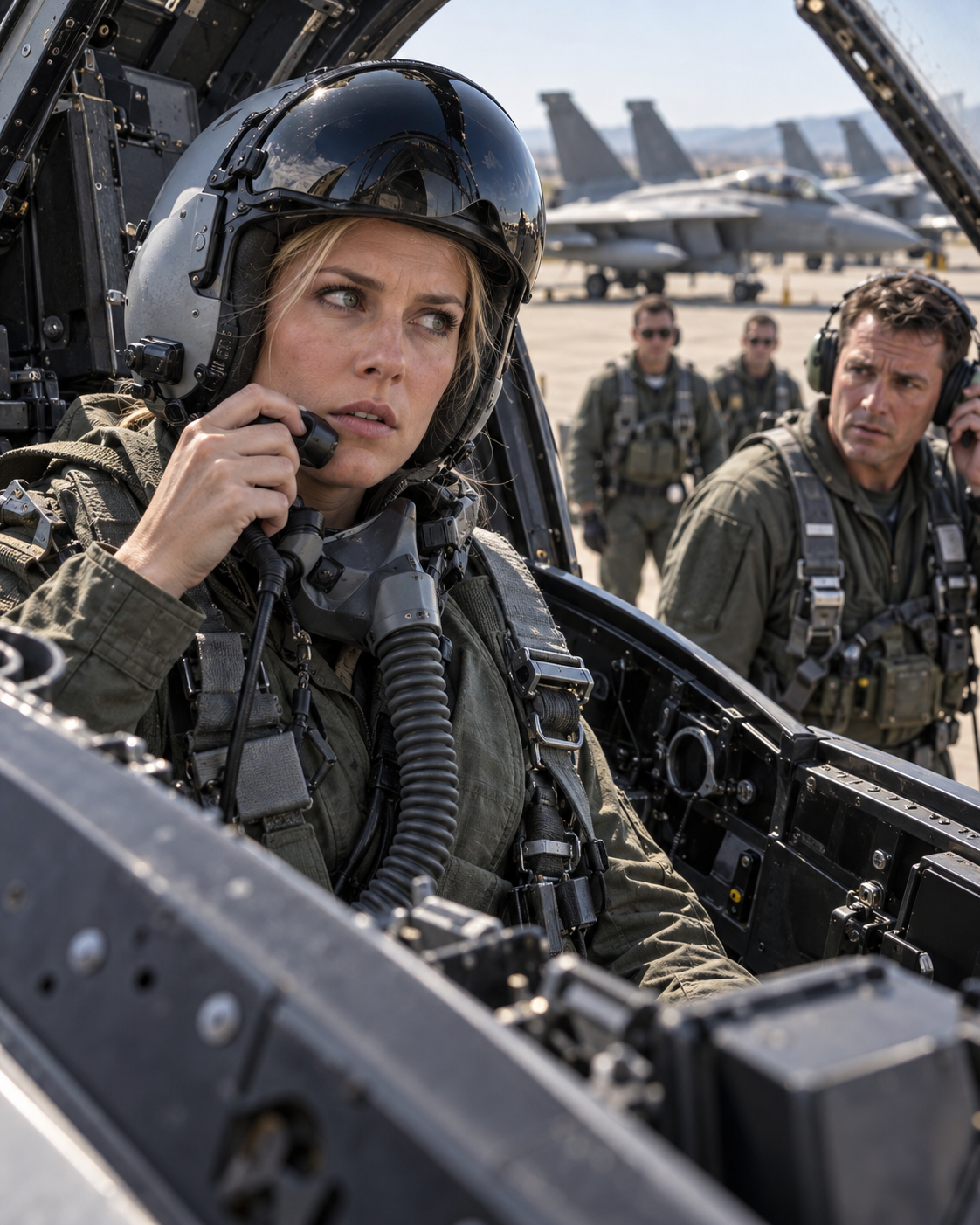
His response came less than a minute later.
“Do not delete anything.”
A second message followed.
“Lock your doors.”
I looked toward the highway.
A pair of headlights slowed near the fence.
Then they kept going.
I told myself it was nothing.
I didn’t believe myself.
The next morning, Marsh arrived before sunrise.
He didn’t bring coffee.
That was how I knew things were serious.
He walked into the maintenance office carrying a thin black case and closed the door behind him.
“Did you receive a threat?”
I nodded.
“Any idea who sent it?”
“No.”
“Any reason someone would want you frightened enough to stop?”
I almost laughed.
“Take your pick.”
He opened the case.
Inside were photographs, maintenance records, and a copy of my father’s original flight data.
“I spent four years trying to get this case reopened,” he said.
“Why didn’t you?”
“Because every time we got close to Meridian, something disappeared.”
“What disappeared?”
“Records.”
He looked at me.
“People.”
The room suddenly felt smaller.
Marsh slid a photograph across the table.
It showed a maintenance facility nine years earlier.
My father’s aircraft was visible in the background.
Standing beside it was a Meridian technician.
I recognized the face.
Not because I’d met him.
Because I’d seen his name in the margins of the investigation.
“Evan Rourke,” I whispered.
Marsh nodded.
“He was the engineer who signed off on the relay installation.”
“What happened to him?”
Marsh hesitated.
“He died six months after your father’s crash.”
I stared at him.
“How?”
“Officially, a heart attack.”
“And unofficially?”
“We don’t know.”
That answer bothered me more than anything else.
Marsh opened another file.
“There was one more thing.”
He placed a handwritten note on the table.
The handwriting was unfamiliar.
But the words weren’t.
“Relay failure occurred before throttle response.”
My father’s words.
The exact statement that had been removed from the official transcript.
I looked up.
“Where did you get this?”
“From Karen Whitfield.”
My father’s commander’s widow.
“She gave us everything.”
I thought about Karen’s tired face and the leather satchel she’d carried across the desert.
“She knew all this?”
“She knew enough.”
I closed my eyes.
Nine years.
Nine years of believing I had been crazy for seeing what nobody else wanted to see.
Now the evidence was sitting in front of me.
It should have felt like victory.
It didn’t.
It felt like grief finally finding a shape.
Marsh leaned back.
“We need to understand the money trail.”
“Why?”
“Because faulty components don’t accidentally get installed twice.”
He pointed to the documents.
“Someone approved the supplier.”
“Someone approved the substitution.”
“Someone suppressed the failure.”
“And someone made sure nobody asked why.”
I looked at him.
“You think my father was killed?”
“I think we have enough evidence to investigate whether negligence was deliberate.”
That distinction mattered.
Marsh wasn’t promising me revenge.
He wasn’t telling me what I wanted to hear.
He was telling me what the evidence could support.
And somehow, that made me trust him more.
That afternoon, I returned to the hangar.
Grady was waiting beside the F-15.
He looked older than he had the day before.
“I heard about the message,” he said.
I stopped.
“How?”
“Marsh called me.”
I studied his face.
“Are you scared?”
“Yes.”
He didn’t pretend otherwise.
That honesty surprised me.
“I should have listened to you,” he said.
“You should have.”
He nodded.
“I know.”
For the first time since I’d met him, Grady didn’t defend himself.
He simply stood there and accepted the weight of what he’d done.
Then he reached into his pocket.
“I found something.”
He handed me a small plastic evidence bag.
Inside was a burned relay connector.
My stomach tightened.
“Where did you get this?”
“From the trash.”
“Whose trash?”
“Kingston’s contractor.”
I looked at him sharply.
“When?”
“Last night.”
He lowered his voice.
“They weren’t finished working on the aircraft.”
“What do you mean?”
“The bypass they installed wasn’t the only modification.”
A cold feeling moved through me.
“What else?”
“I don’t know.”
He pointed toward the aircraft.
“But something was removed after the fire.”
I turned toward the jet.
“Who had access?”
“Three people.”
He counted on his fingers.
“Me.”
“Ferris.”
“And Blaine Holloway.”
Holloway.
The corporate pilot who had frozen inside the cockpit.
The man who had spent days pretending he understood the aircraft.
I remembered his expression when Cross revealed my identity.
It hadn’t been embarrassment.
It had been fear.
Not the fear of being exposed as an inexperienced fighter pilot.
Something deeper.
I found him in the hangar office ten minutes later.
He was packing a bag.
“Going somewhere?”
He froze.
“No.”
“You’re packing.”
“Personal stuff.”
“Why?”
He stared at me.
Then his eyes dropped to the floor.
“You shouldn’t have climbed into that cockpit.”
I felt every muscle in my body tighten.
“Why?”
“Because now they’re going to come after you.”
“Who?”
He didn’t answer.
“Holloway.”
His jaw clenched.
“You think I don’t know what happened?”
“What happened?”
He looked toward the closed door.
Then whispered, “Your father’s crash wasn’t the first.”
My blood went cold.
“What do you mean?”
“I flew for a private contractor before Kingston.”
He swallowed.
“Three years ago, one of our jets had the same relay issue.”
“Who supplied the parts?”
“Meridian.”
“What happened?”
“The pilot died.”
I stared at him.
“Why didn’t you report it?”
“Because I wasn’t flying that aircraft.”
“That isn’t an answer.”
His eyes filled with shame.
“No.”
He looked away.
“It isn’t.”
He sat down slowly.
“The company told us the pilot made a procedural error.”
I felt something inside me break open.
“How many?”
“What?”
“How many pilots?”
He didn’t answer.
I already knew the answer would hurt.
“Four,” he whispered.
Four.
My father’s crash had never been an isolated tragedy.
It was a pattern.
And somebody had been counting on everyone being too afraid to connect it.
That night, Marsh obtained a warrant.
By midnight, federal agents were inside Meridian’s headquarters.
Desmond Voss was waiting for them.
He didn’t run.
Men like Voss rarely ran.
They believed money could turn walls into shields.
But the agents carried boxes out of his office until dawn.
Contracts.
Emails.
Engineering reports.
Payment records.
And one encrypted drive.
The drive was the thing that changed everything.
It contained a folder labeled “HASTINGS.”
Inside were simulations of my father’s crash.
Not accident reconstructions.
Predictions.
Someone had modeled exactly what would happen if the relay lag occurred during throttle advancement.
The simulation ended with the aircraft losing engine control.
Beside it was a sentence dated eleven days before my father’s final flight.
“Failure is acceptable if attributed to pilot error.”
I read the sentence once.
Then again.
Then I couldn’t read anymore.
I walked outside.
The sun was rising over the desert.
The same desert that had swallowed my father’s name for nine years.
Marsh came outside and stood beside me.
Neither of us spoke for a while.
Finally, I asked, “Did he know?”
“Your father?”
“Yes.”
Marsh nodded slowly.
“The voice recorder suggests he knew something was wrong.”
I looked at him.
“Did he know they were doing it intentionally?”
“We don’t know.”
That uncertainty hurt.
But it was honest.
And I had spent too many years living inside dishonest certainty.
Three weeks later, the federal investigation became national news.
Meridian’s contracts were suspended.
Several executives were arrested.
The official report on my father’s death was reopened.
Then came the hearing.
I sat in the front row beside my mother.
She had aged nine years since I last saw her cry over my father’s uniform.
When the revised findings were read aloud, she reached for my hand.
“Relay failure caused by defective retrofit hardware.”
“Maintenance warnings were improperly suppressed.”
“Evidence indicates deliberate concealment of known failure risks.”
My mother squeezed my fingers.
Then came the sentence I had waited nine years to hear.
“Colonel Garrett Hastings was not responsible for the aircraft failure that caused his death.”
My mother closed her eyes.
I couldn’t breathe.
For years, I had imagined this moment would feel like triumph.
It didn’t.
It felt like someone had finally returned a piece of my childhood.
My father had not been careless.
He had not panicked.
He had not forgotten his training.
He had simply trusted a machine whose truth had been hidden from him.
After the hearing, Karen found me outside.
She hugged me without saying anything.
I cried against her shoulder.
Not because I was broken.
Because for the first time, I didn’t have to be strong.
“Your father would be proud,” she whispered.
“I hope so.”
“He would.”
That evening, I returned to the old farmhouse.
The dirt runway was almost gone.
Weeds had swallowed most of it.
But the fence was still there.
I stood where my father had once placed his hands over mine.
For a long time, I said nothing.
Then I smiled.
“You were right, Dad.”
The wind moved through the grass.
“Machines don’t lie.”
I looked toward the empty sky.
“People do.”
Behind me, gravel crunched.
I turned.
Becket stood beside his car holding two cups of coffee.
“I figured you might be here.”
I smiled.
“You’re getting predictable.”
“Occupational hazard.”
He handed me one of the cups.
We stood there quietly.
No federal files.
No interviews.
No cameras.
Just two people watching the sunset.
“I thought finding the truth would fix everything,” I said.
“It doesn’t?”
“No.”
I looked at the runway.
“But it lets you stop carrying the wrong thing.”
He nodded.
“That sounds like enough.”
Maybe it was.
I went back to Ironbridge the following Monday.
I didn’t become a celebrity.
I didn’t want to.
I went back to the hangar.
Back to the smell of oil and hot metal.
Back to the machines that had always made more sense to me than people.
But something had changed.
When young mechanics asked questions, I answered.
When someone spotted a strange fault, I listened.
And when Grady disagreed with me, he actually looked at the numbers before speaking.
He never called me sweetheart again.
I never asked him to.
Some apologies don’t need repeating once the behavior changes.
Months later, I was standing beneath another fighter jet when I heard a familiar voice behind me.
“Major?”
I turned.
Holloway.
He looked different.
Less polished.
More human.
“I wanted to say thank you.”
“You don’t owe me thanks.”
“Yes, I do.”
He looked at the aircraft.
“You saved my life.”
I nodded.
“And you told the truth.”
He looked down.
“I should have done it sooner.”
“Yes.”
He accepted that.
Then he walked away.
I watched him go.
People sometimes think courage means being fearless.
It doesn’t.
Courage is knowing exactly what something might cost you and deciding the truth is still worth paying for.
My father taught me how to fly.
The fire taught me how to stop hiding.
Karen taught me that grief doesn’t have an expiration date.
Marsh taught me that facts matter more than revenge.
And a burning aircraft taught me something I should have understood nine years earlier.
Silence can protect you.
But sometimes silence protects the people who hurt you.
That night, I stood beneath the hangar lights and ran my hand along the cold metal of the aircraft.
For the first time, I didn’t feel like I was standing inside my father’s shadow.
I felt like I had finally stepped out of it.
Then my phone buzzed.
Unknown number.
I almost ignored it.
Almost.
I opened the message.
There was no threat this time.
No warning.
Just a photograph.
My father standing beside an aircraft I had never seen before.
On the back of the photograph was a handwritten date.
Three months before his death.
And beneath the date were five words.
“Garrett knew about the second aircraft.”
I stared at the screen.
The hangar suddenly felt very quiet.
Nine years ago, I thought I was searching for the truth about one crash.
Now I understood.
My father’s death had been a door.
And someone had just shown me there was another room behind it.
I looked toward the dark runway outside.
Then I smiled, because this time I wasn’t alone.
I slipped the phone into my pocket and reached for my jacket.
Some secrets survive because nobody asks the next question.
I had spent nine years asking the first one.
Now it was time to ask the second.