“GET AWAY FROM THE CONTROLS!” the flight attendant screamed as Flight 622 plunged over the Pacific
The words stayed in my head long after the man left.
YOU WERE NEVER SUPPOSED TO SURVIVE.
I stared at the photograph until the edges blurred.
It showed an F-15E flying through a dark sky, its silhouette almost invisible against the clouds.
I knew that aircraft.
I knew the mission.
And I knew the date.
Six months earlier, I had been flying that exact sortie.
I turned the photograph over again.
There was no name.
No signature.
Only the four words.
I walked into the corridor and found Daniel Reyes still sitting with his coffee.
“Daniel.”
He looked up immediately.
“What happened?”
I handed him the photograph.
His expression changed before he even finished reading the back.
“Where did you get this?”
“Someone just brought it to me.”
“Who?”
“I don’t know.”
Daniel stood.
“Stay here.”
“No.”
He stopped.
“I’ve spent six months being told to stay here, stay quiet, don’t ask questions.”
I held the photograph between us.
“I’m done.”
He looked at me for a long moment.
Then he lowered his voice.
“You need to understand something.”
“What?”
“The mission in that photograph wasn’t supposed to exist.”
My stomach tightened.
“That’s impossible.”
“I know.”
He glanced down the corridor before continuing.
“Officially, your aircraft suffered a mechanical failure during a training operation.”
“That is what I was told.”
“That is not what happened.”
For six months, I had carried pieces of that night inside me.
A flash of light.
A warning tone.
A second aircraft appearing where no aircraft should have been.
Then darkness.
I had survived.
One pilot had not.
The investigation had ended quickly.
Too quickly.
I had been placed on leave, ordered not to discuss the incident, and eventually told to return to normal life.
But there had always been something wrong with the story.
Something my instincts refused to accept.
“What happened to the other pilot?” I asked.
Daniel didn’t answer immediately.
“His name was Marcus Hale.”
“I remember.”
“He wasn’t killed by the malfunction.”
I felt the corridor become strangely quiet.
“What are you saying?”
Daniel looked directly at me.
“Someone shot him down.”
My fingers tightened around the photograph.
“That wasn’t an accident.”
“No.”
“Then why was I told it was?”
“Because whoever did it wanted everyone to believe the same thing.”
I thought about the flight that night.
The darkness.
The sudden warning.
The moment my aircraft lost control.
And something else.
A radio transmission.
A voice I had never been able to identify.
At the time, I had assumed it was interference.
Now I wasn’t so sure.
“What does this have to do with Flight 622?”
Daniel shook his head.
“I don’t know yet.”
“That isn’t good enough.”
“I agree.”
He took the photograph from me and studied it again.
Then he noticed something I hadn’t.
A tiny marking beneath the aircraft.
Three numbers.
335.
My squadron designation.
Daniel’s face hardened.
“This wasn’t sent to scare you.”
“What was it sent for?”
“To tell you someone knows you’re still alive.”
The next morning, the safety investigators arrived before sunrise.
They wanted to talk about Flight 622.
They wanted to understand how I had flown a crippled 777 through a snowstorm after losing conventional controls.
They asked about the engines.
The hydraulics.
The landing.
I answered everything.
But nobody asked about the photograph.
Nobody asked about Marcus.
That frightened me more than anything.
When the interviews ended, I returned to the hangar where Flight 622 was being inspected.
The aircraft looked enormous and strangely vulnerable sitting beneath the lights.
Burn marks scarred the lower fuselage.
Panels had been removed.
Technicians moved around it like surgeons around an injured patient.
Diane found me there.
“You haven’t slept.”
“I’ll sleep later.”
She gave me a tired smile.
“You always say things like that?”
“Only when they’re true.”
She hesitated.
“There was something strange about one passenger.”
“Who?”
“Grant Whitfield.”
My attention sharpened.
“What about him?”
“He disappeared.”
I stared at her.
“Disappeared?”
“He left the terminal after we landed.”
“Maybe he went home.”
“Maybe.”
Her voice told me she didn’t believe that.
“Why does it matter?”
“Because he wasn’t on the passenger list under that name.”
For several seconds, neither of us spoke.
I remembered the man beside me.
His trembling hands.
His questions about turbulence.
The way he had watched me when he thought I wasn’t looking.
“Where is he now?”
Diane shook her head.
“No one knows.”
I went back to the operations center.
Daniel was already waiting.
He had found something.
A passenger manifest appeared on his screen.
Seat 12E.
The name Grant Whitfield.
But beside it was another identifier.
A federal travel clearance number.
“This isn’t a shipping executive,” Daniel said.
“Then who is he?”
“We’re still trying to find out.”
I thought about the moment he had grabbed my wrist.
The panic in his eyes.
The questions.
The way he had watched me walk toward the cockpit.
Then I remembered something tiny.
He had never once looked at the engine.
He had looked at me.
“He knew.”
Daniel looked up.
“Knew what?”
“Who I was.”
That was when the lights in the operations center flickered.
Every screen went black.
A technician swore.
Then one monitor came back.
A single message appeared.
FLIGHT 622 WAS NOT AN ACCIDENT.
Below it was another line.
NEITHER WAS YOUR LAST MISSION.
Then the screen died again.
Nobody moved.
Daniel reached for the phone.
“Lock down the building.”
Doors slammed shut throughout the facility.
Security teams moved through the corridors.
But whoever had sent the message was already gone.
That afternoon, I was taken to a secure room and shown a classified file.
The first page contained my name.
The second contained Marcus Hale’s.
The third contained a photograph of a foreign aircraft.
The fourth contained something that made me stop breathing.
A flight plan.
Flight 622.
My eyes moved across the document.
The aircraft’s original route had not been Seattle to Tokyo.
It had been altered hours before departure.
Someone had deliberately placed the Boeing 777 on a path that would bring it close to a restricted military corridor.
I looked at Daniel.
“They wanted the military to intercept it.”
“Yes.”
“And they knew the radios would fail.”
“Yes.”
“And they knew I would be on board.”
Daniel didn’t answer.
That silence was enough.
Someone had planned for me to be there.
The engine failure.
The electrical fire.
The dead radios.
The drifting aircraft.
The fighter intercept.
It wasn’t random.
It had been constructed.
But there was one question that made everything worse.
Why?
Daniel slid another photograph across the table.
It showed me six months earlier, standing beside Marcus before our mission.
On the back was a handwritten note.
SHE REMEMBERS THE VOICE.
I felt cold.
The voice.
That was the piece of the night I had never been able to explain.
I closed my eyes.
For six months, I had tried to remember it.
Now it came back.
Not the words.
The voice itself.
Calm.
Male.
Close.
Inside the radio.
And then I remembered what it had said.
“Ellison, abort.”
My eyes opened.
“That wasn’t an enemy transmission.”
Daniel waited.
“It was American.”
His face changed.
“Are you sure?”
“Yes.”
“How?”
“Because Marcus answered it.”
“What did he say?”
I swallowed.
“He said, ‘Who are you?’”
Daniel slowly sat back.
Neither of us spoke.
Then the door opened.
A senior general entered with two security officers.
His face was familiar.
Too familiar.
I had seen him six months earlier.
At Marcus Hale’s memorial.
He closed the door behind him.
“Major Ellison.”
I stood.
“Sir.”
He looked at Daniel.
“You need to leave.”
Daniel didn’t move.
“Sir, with respect—”
“Captain, leave.”
Daniel looked at me.
I nodded.
He walked out.
The general waited until the door closed.
Then he placed a small recorder on the table.
“I owe you an explanation.”
I didn’t sit.
“I’ve been waiting six months.”
“I know.”
“Marcus Hale was investigating an unauthorized weapons program.”
The room seemed to shrink.
“What weapons program?”
“One that wasn’t supposed to exist.”
He explained that Marcus had discovered aircraft being tested under false identities, equipment moving through military channels without proper authorization, and missions that never appeared in official records.
Marcus had reported it.
Then he had been killed.
The general looked at me.
“You were never the target that night.”
I felt something inside me collapse.
“Marcus was.”
“Why?”
“Because he knew too much.”
“Then why did they try to kill me?”
“They didn’t.”
I stared at him.
He continued quietly.
“They tried to make you disappear.”
The photograph.
The false accident.
The classified silence.
The forced leave.
Everything suddenly connected.
“They thought I was dead.”
“Yes.”
“Then Flight 622?”
“They discovered you were alive.”
I sat down.
For the first time since the landing, my hands started shaking.
“Who?”
“We don’t know.”
“That isn’t good enough.”
“No.”
He pushed another file toward me.
“This is why you were put on Flight 622.”
I opened it.
My name was listed beside a surveillance designation.
Someone had been monitoring me for months.
They knew my travel plans.
They knew the flight.
They knew my seat.
They knew I would recognize the engine problem.
They had expected me to try to take control.
The plan was never simply to destroy the aircraft.
It was to make the military believe I was responsible for the aircraft’s diversion.
A rogue pilot.
A hijacker.
A threat.
They wanted the fighters to shoot me down.
My throat tightened.
“If Reyes had believed I was hostile…”
“He would have followed his orders.”
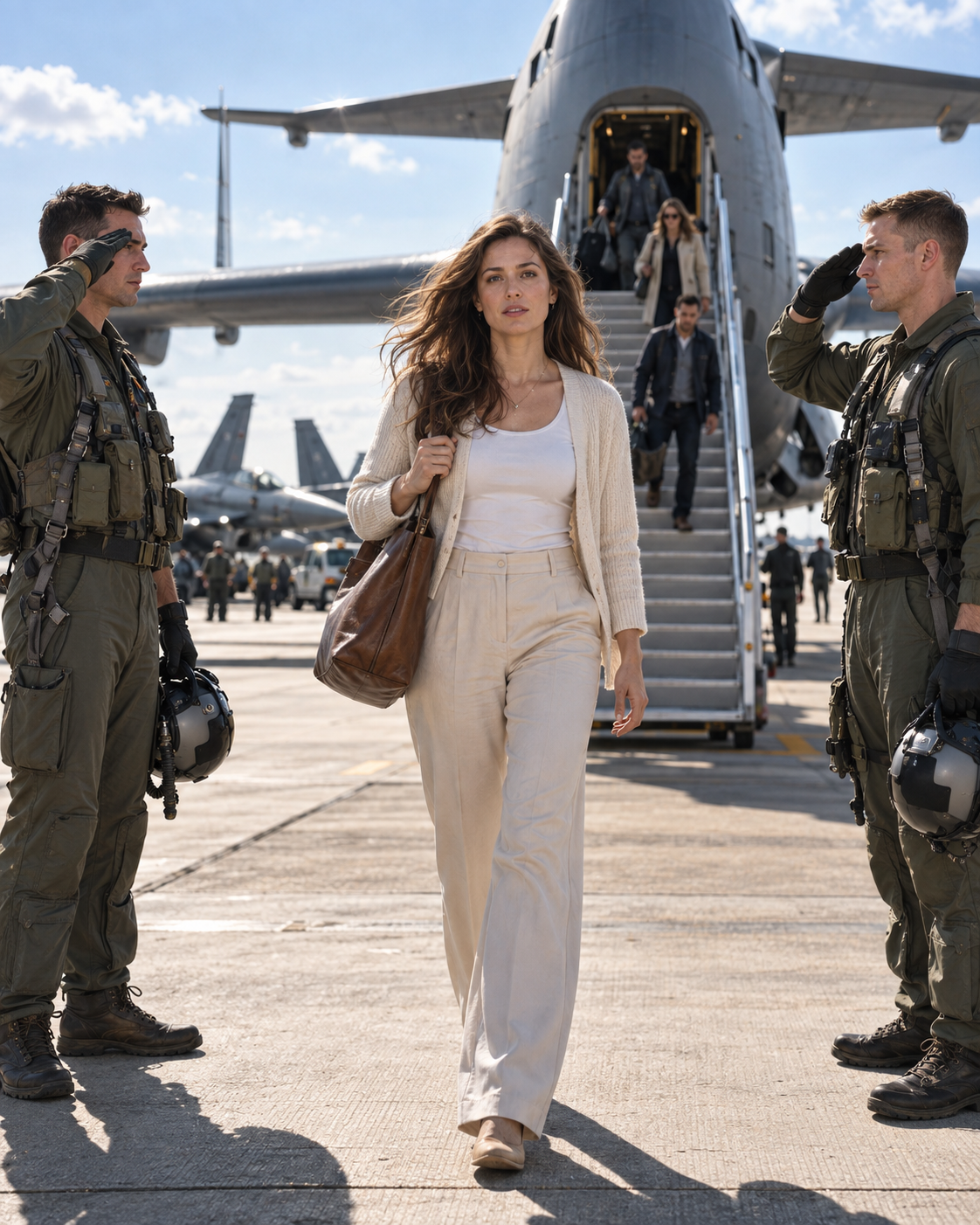
I thought about Daniel raising his hand in salute.
The man who had unknowingly stood between me and death.
“He saved me.”
“So did you save him.”
The general stood.
“There’s one more thing.”
I looked up.
“The person who arranged the operation is still alive.”
“Who?”
He didn’t answer.
Instead, he handed me a final photograph.
It showed a man walking through an airport.
Older.
Gray hair.
Dark coat.
I knew him immediately.
Not from the military.
From Flight 622.
He had been standing near the boarding gate in Seattle.
Watching passengers.
Watching me.
I turned the photograph over.
There were only three words.
SEAT 12E.
My blood went cold.
“Grant.”
The general nodded.
“We believe Grant Whitfield is an alias.”
“Where is he?”
“We don’t know.”
The room fell silent.
Then my phone vibrated.
An unknown number.
I answered.
Nobody spoke.
I could hear breathing.
Then a man’s voice whispered.
“You should have stayed dead, Major.”
The call ended.
I looked at the general.
He didn’t need to ask what I’d heard.
He had seen my face.
That night, I stood alone outside the hangar and watched snow drift across the runway.
For months, I had believed surviving meant the nightmare was over.
I finally understood the truth.
Sometimes survival is only the moment the real story begins.
Daniel joined me a few minutes later.
“Any idea what you’re going to do?”
I looked toward the dark runway.
“For the first time?”
“Yes.”
“I don’t know.”
He smiled faintly.
“That might be the smartest answer you’ve given me.”
I handed him the photograph.
“We need to find Grant.”
He studied it.
“And then?”
I looked at the aircraft resting under the hangar lights.
“Then we find out who thought they could decide whether I lived.”
The wind moved across the empty runway.
Somewhere beyond the fence, a car disappeared into the darkness.
Neither of us noticed the figure standing inside it.
The man watched us for several seconds.
Then he lifted a phone.
“She knows,” he said.
A pause.
“No.”
He looked back at the hangar.
“She remembers the voice.”
Another pause.
Then he smiled.
“Then we move to the next phase.”
Inside the hangar, I suddenly turned toward the darkness.
For one impossible second, I felt as though someone was watching me.
I couldn’t see anyone.
But I knew that feeling.
It was the same feeling I’d had six months earlier before Marcus disappeared.
The feeling that something was already behind me.
And this time, I wasn’t going to run from it.
Because I had finally learned the lesson that fear had been trying to teach me all along.
Courage was never the absence of fear.
It was refusing to let someone else use your fear to control the choices you made.
I looked at Daniel.
“Tomorrow, we start with Grant Whitfield.”
He nodded.
And somewhere beyond the frozen runway, a phone rang once in the darkness.
Then stopped.
We both looked toward the sound.
Neither of us spoke.
Because we already knew one thing.
Whoever had been hunting me for six months had just made the first mistake.
They had reminded me that I was still alive.
And now I remembered how to fight.