“Garrett will be taking a fifty-percent stake in the company,” my father announced over dinner. “He’ll handle the business side. You’ll keep doing the framing.”
Julian looked at my father for a long moment before speaking.
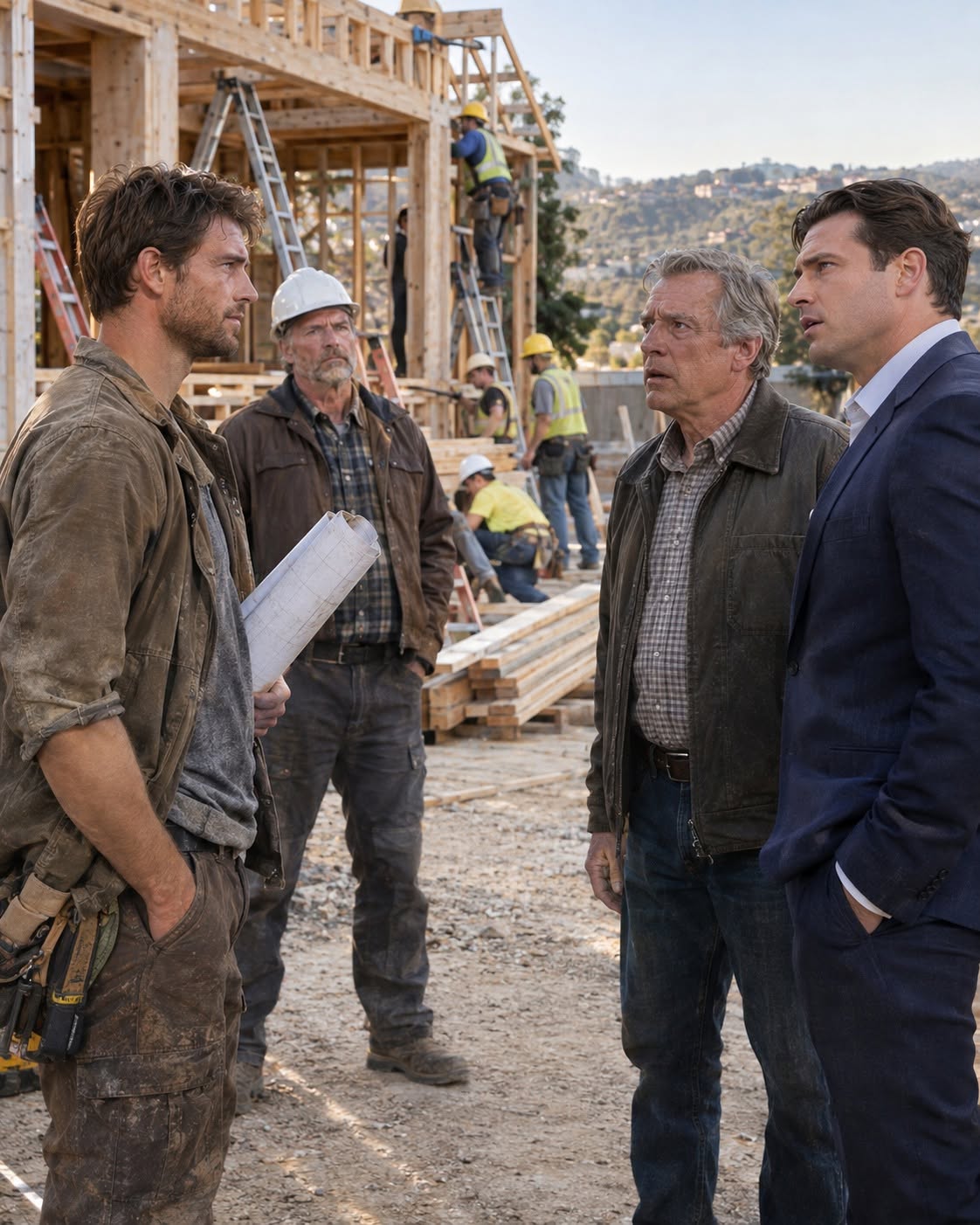
“Richard, I have one question. Do you know who actually owns the work standing behind you?”
Dad frowned. “What kind of question is that? Vance Framing has the contract.”
Julian shook his head.
“No. You had the contract. You lost it. Your company failed to meet its obligations, and I terminated the agreement. The crew standing here belongs to a different company now. One that has already corrected the damage your people left behind.”
He turned toward me.
“Vance Ridge Construction is doing this work. Every invoice, every inspection, and every responsibility is under their name. Not yours.”
Garrett stepped forward, his face tightening.
“Come on, Julian. We can work something out. We’re family. We know each other.”
Julian gave him a cold look.
“This is a construction project, not a family reunion.”
I watched my father absorb those words. For the first time in my life, he looked like a man who had no idea what to say next.
Dad finally turned toward me.
“Son, surely we can talk about this privately.”
I glanced at the unfinished section of the house.
“We can talk. But not about putting your name on my work.”
His jaw tightened.
“Your work? You wouldn’t have a business if I hadn’t given you a chance all those years ago.”
I almost laughed. Not because it was funny, but because I had spent so many years believing that sentence.
“You gave me a job, Dad. I built the company.”
Garrett scoffed.
“That’s a pretty convenient way to remember things.”
Julian raised a hand before I could answer.
“Enough. If you two have a dispute, take it somewhere else. I hired him because he knows what he’s doing. I won’t risk this house to rescue a business that couldn’t pay its own workers.”
Dad looked at the ground.
And that was when I noticed something strange.
He wasn’t looking at the house.
He was looking at the stack of lumber invoices on the hood of Julian’s truck.
One of them had my father’s signature.
I recognized it immediately.
It was the same signature he had used when he borrowed money from me years earlier.
“Where did you get those?” Dad asked.
Julian picked up the papers.
“From the supplier. Apparently, someone used this project’s credit to cover bills from another job.”
Garrett went pale.
“That’s not what happened.”
“Then explain it.”
Nobody spoke.
I took the invoices and looked through them. Several shipments had been billed to the ridge project but delivered elsewhere. The dates went back almost two months.
I knew exactly where some of that lumber had gone.
Dad’s unfinished development on the other side of town.
The same project Clara had mentioned.
The same project that had put him in debt to Garrett’s parents.
I looked up.
“You used the ridge house materials to pay for your other project?”
Dad rubbed his forehead.
“It was temporary. I was going to replace everything.”
“With what money?”
He didn’t answer.
Garrett suddenly stepped between us.
“Look, this is a private financial matter. My parents invested in the company. They have a right to recover their money.”
Julian folded his arms.
“Not with my materials.”
Then he turned to me.
“Can you finish the project?”
“Yes.”
“How soon?”
“Three weeks, provided the inspection schedule stays on track and the suppliers get paid directly.”
Julian nodded.
“Then that’s our agreement.”
He shook my hand.
My father watched us as if he had just witnessed something impossible.
For years, he had treated my skills like something he could summon whenever he needed them. He had assumed that no matter how badly he treated me, I would always come back.
This time, I climbed into my truck with my crew and drove away.
I didn’t look in the mirror.
But the story didn’t end at the ridge house.
Three days later, Clara called.
Her voice was shaking.
“Can you meet me? Please. I found something.”
I hesitated.
“Is Dad okay?”
“Physically, yes. But there’s something you need to know about Garrett.”
We met at a small coffee shop near the highway.
Clara arrived carrying a thick envelope. She looked as though she hadn’t slept in days.
She placed it between us.
“Garrett has been hiding this from me.”
Inside were bank statements, loan agreements, and copies of company documents.
I scanned the first few pages.
My stomach tightened.
The fifty-percent partnership wasn’t simply an investment.
Garrett’s parents had demanded collateral. Dad had signed over a portion of the company, but the agreement also included a personal guarantee.
If the business failed to repay the debt, they could pursue his personal assets.
There was something worse.
My name appeared on a separate document.
A personal guarantee.
I read it twice.
Then a third time.
It stated that I had agreed to guarantee a substantial portion of the company’s outstanding debt.
I had never signed it.
“Where did you get this?”
“From the office,” Clara whispered. “I was looking for my insurance papers. I found the folder hidden in Garrett’s desk.”
My hands went cold.
The signature looked like mine, but something was wrong with the final letter. It was copied from an old employment document.
Someone had forged my name.
“Does Dad know?”
Clara looked away.
“He said Garrett told him you had agreed verbally. Dad signed the papers anyway.”
I stared at her.
“And you believed him?”
“No.” Her eyes filled with tears. “I didn’t know what to believe. I was told you were being selfish, that you had abandoned the family when things got difficult.”
She pushed another page toward me.
It was an email printed from Garrett’s account.
The message was addressed to his father.
The subject line read: Vance Partnership.
The message was short.
Richard is desperate. He’ll sign whatever I put in front of him. Once we control the company, we’ll use the remaining contracts to recover our investment. His son is the real asset, but we don’t need him to know that until the paperwork is complete.
I read it again.
His son is the real asset.
I felt something inside me go quiet.
This wasn’t simply a disagreement about ownership.
They had been planning to use my experience, my reputation, and possibly my identity to keep their failing investment alive.
“Why are you showing me this?” I asked.
Clara swallowed.
“Because I found another email. Garrett was planning to make you responsible for the debt if the company collapsed. Dad knew about the loan documents, but I don’t think he knew about the forged signature.”
I leaned back.
“Why didn’t you tell me sooner?”
She wiped her eyes.
“Because I was afraid of losing my marriage. And because I kept telling myself Garrett couldn’t possibly be doing what those documents suggested.”
I didn’t comfort her.
Not yet.
I had spent too many years making excuses for people who knew exactly what they were doing.
“I’m taking copies of everything,” I said. “And you’re going to tell the truth when someone asks you about it.”
She nodded.
“I will.”
That afternoon, I contacted an attorney named Helen Brooks.
She had handled construction disputes for several contractors in the county. I gave her the documents and explained everything, including the money I had loaned my father.
She listened without interrupting.
When I finished, she closed the folder.
“First, don’t confront Garrett. Second, don’t sign anything. Third, preserve every original document and every message. We’ll have the signature examined and determine exactly what happened.”
“What about the money Dad owes me?”
“That depends on what we can prove. But you have more than a family argument here. You may have a fraudulent financial document.”
For the first time in months, I felt like I had a plan.
Meanwhile, the ridge house was moving forward.
My crew worked six days a week. Mateo supervised the structural repairs, and I personally checked every major connection.
We didn’t cut corners.
Not because Julian was watching.
Not because we wanted to prove my father wrong.
Because I remembered my grandfather standing beside me years ago, tapping a framing nail into a board and saying, “The things nobody sees are the things that keep everything standing.”
That sentence had followed me through every job.
And now, it was the foundation of my own company.
The first inspection passed.
The second passed.
On the eighteenth day, Julian walked through the property with the building inspector.
He checked the reinforced sections, reviewed the documentation, and spent nearly an hour examining the roof structure.
Finally, he turned to me.
“Your grandfather would be proud.”
I looked at him.
“You knew him?”
Julian smiled.
“Worked with him twice. He was one of the few men who would stop a job rather than cover up a mistake.”
I hadn’t expected that.
My grandfather had died when I was young, but his reputation had survived longer than the business he helped create.
Julian handed me a check for the final payment.
Then he offered something I hadn’t anticipated.
“I have two more projects coming up. One is a commercial building, and the other is a custom home. I’d like your company to bid on both.”
I looked at the check.
“Are you sure?”
“I’m sure. But I want one thing from you.”
“What?”
“Build a company where the people doing the work have a voice. I don’t want another contractor who treats his crew like disposable equipment.”
I thought about Mateo and the men who had left Dad’s company unpaid.
“You have my word.”
That evening, I took the crew out for dinner.
Nothing fancy. Just a family-style restaurant where the tables were crowded and the food came in large bowls.
I paid everyone a completion bonus.
Mateo raised his glass.
“To building something that doesn’t fall apart.”
Everyone laughed.
For the first time in years, I felt proud without needing my father’s approval.
But while my business was finally gaining momentum, the old company was collapsing.
Garrett’s parents had sent a formal demand for repayment.
The suppliers had stopped extending credit.
Two former employees had filed wage claims.
And the ridge house dispute had exposed enough questionable billing to bring the company’s finances under scrutiny.
Then came the phone call.
It was Dad.
“Can you come over?”
I was standing in my workshop, reviewing plans for Julian’s next project.
“Why?”
“Because things have gotten out of hand.”
“What things?”
He sighed.
“Garrett’s making decisions I don’t agree with. His parents are threatening legal action. The suppliers won’t release materials. I need someone who understands the business.”
I closed the plans.
“You need an accountant and a lawyer.”
“I need my son.”
The words hit harder than I wanted them to.
For a second, I was a teenager again, standing in the driveway waiting for Dad to tell me I’d done a good job.
Then I remembered the forged signature.
“I’ll come,” I said. “But I’m not coming to run your company.”
When I arrived, the old workshop looked smaller than I remembered.
The walls were stained. The tool racks were half-empty. A stack of unpaid invoices sat beside the coffee machine.
Dad was sitting at his desk.
Garrett stood near the window, talking on his phone.
He ended the call when I entered.
“Well, look who’s back.”
I ignored him.
Dad pushed a folder across the desk.
“This is everything. I want you to look at it and tell me what we can save.”
I opened the folder.
The numbers were worse than I expected.
The company had more debt than assets. Several customers had withheld payments because of incomplete work. The equipment was heavily financed, and the tax obligations were overdue.
But the biggest problem was the partnership agreement.
Garrett’s parents had the right to demand immediate repayment if certain conditions were breached.
They were preparing to do exactly that.
I closed the folder.
“This company can’t be saved the way it is.”
Dad’s face fell.
“What are you saying?”
“I’m saying you need to stop taking new jobs, account for every dollar, and deal with the debts honestly. You can’t borrow your way out of this.”
Garrett laughed bitterly.
“Easy for you to say. You walked away with the best workers and now you’re pretending to be some kind of hero.”
I turned toward him.
“I didn’t steal anyone. They left because you didn’t pay them.”
“They were supposed to stay loyal.”
“Loyalty doesn’t pay a mortgage.”
His face reddened.
Dad slammed his palm against the desk.
“Both of you, stop!”
The room fell silent.
He looked at me.
“I made mistakes. I know that. But I didn’t think it would come to this.”
I nodded slowly.
“You didn’t think it would come to this because you never thought there would be consequences.”
His eyes filled.
For the first time, I saw something that resembled genuine regret.
“I should have treated you differently.”
I wanted those words for years.
I had imagined hearing them after a successful job, at Christmas, or during one of the many nights I had worked until midnight to rescue his deadlines.
But now they sounded painfully late.
“Why didn’t you tell me about the debt?” I asked.
He looked at Garrett, then back at me.
“Because I was ashamed.”
“And the forged guarantee?”
His expression changed.
“What?”
I placed a copy of the document on his desk.
Dad stared at it.
“Where did you get this?”
“Clara found it.”
He picked it up with trembling fingers.
“I never saw this.”
“Your signature is on the partnership agreement. Mine is on this.”
He looked toward Garrett.
“Did you do this?”
Garrett’s expression hardened.
“Don’t start this. You signed everything. You knew the risks.”
“I didn’t sign his guarantee.”
“You said he would help us!”
“I said he might come back!”
Garrett stepped forward.
“You were desperate. I was trying to save the business.”
“By putting my son’s name on a loan he never agreed to?”
Garrett didn’t answer.
Instead, he looked at me.
“You think you’re better than everyone now? You think Julian is going to protect you? Once the construction market turns, you’ll be right back where you started.”
I stood.
“Maybe. But if my company fails, it will be because of decisions I made. Not because I stole someone else’s signature.”
I turned to Dad.
“I’m not here to save this company. Helen will contact you about the forged document and the money you owe me. You need to cooperate with her.”
Dad nodded slowly.
Then he said something I hadn’t expected.
“Can I see you again? Not for the business. Just as your father.”
I looked at him for a long moment.
“I don’t know yet.”
And I meant it.
The legal process took months.
The document examiner confirmed that my signature had been copied from an old company record. Emails recovered from Garrett’s business account showed that he had discussed using my identity without my permission.
His parents initially denied knowing anything about it.
But when their attorney reviewed the correspondence, they changed their position.
They agreed to cooperate with the investigation and pursue repayment through the lawful debt process rather than pretending I had guaranteed it.
Garrett was eventually charged in connection with the forged financial documents and related transactions. The matter was resolved through a court-supervised agreement that required restitution and prohibited him from participating in the management of the company.
He and Clara separated.
It wasn’t a clean or happy ending for her. She had to rebuild her life, find a place to live, and accept that the man she married had been hiding more than financial problems.
I helped her find an apartment.
I didn’t give her money without limits, and I didn’t pretend everything was forgiven.
But I did help her move.
Sometimes forgiveness begins with a small act, not a grand declaration.
Dad sold most of the remaining equipment to settle the company’s debts. Vance Framing eventually closed.
The old sign came down on a rainy Thursday.
I happened to be driving past when I saw him standing outside the building, holding one of the faded metal letters.
I stopped.
He looked older than I remembered.
“Didn’t think you’d come by,” he said.
“I was passing.”
He nodded toward the empty workshop.
“Your grandfather built that place with his own hands.”
“I remember.”
“He used to say the company wasn’t the building. It was the people who showed up every morning.”
I looked at the empty doorway.
“He was right.”
Dad held the metal letter in both hands.
“I thought giving Garrett half the business would solve everything. I thought if I made him a partner, his parents would stop calling. I thought you’d understand eventually.”
“You thought I’d always be here.”
He lowered his head.
“Yes.”
There was no argument left.
No excuses.
Just a tired old man finally looking at the damage he had caused.
“I can’t ask you to forgive me,” he said.
“Good.”
He looked up.
I continued.
“Because forgiveness isn’t something you get just because you’re sorry. It’s something I decide when I’m ready.”
He nodded.
“I understand.”
We stood there for a while, listening to the rain.
Then he asked if I wanted to get coffee sometime.
I told him I would think about it.
That was all I could offer.
And for once, he didn’t demand more.
Six months later, my company had grown to twelve employees.
We moved from Mrs. Whitaker’s workshop into a larger yard with a covered lumber storage area and a small office.
Mrs. Whitaker refused to let me pay her more than the agreed rent during our first year.
She said she was happy to see the old workshop used for something honest.
I insisted on repairing her roof and rebuilding her back steps at no charge.
She called it an even trade.
I knew it wasn’t.
Mateo became my operations manager.
We introduced paid training for young workers, transparent bonus agreements, and a rule that nobody would be asked to work unpaid overtime.
Every Friday, we reviewed the upcoming jobs together.
If a crew member spotted a problem, the job stopped until we understood it.
It sometimes cost us a day.
It probably saved us thousands.
More importantly, nobody had to be afraid of telling the truth.
One afternoon, Julian visited the new yard.
He walked through the shop, looked at the equipment, and nodded.
“Looks like you’re doing well.”
“We’re getting there.”
He pointed toward a framed photograph hanging above my desk.
It showed my grandfather standing beside a wooden frame he’d built decades earlier.
“What did he teach you?”
I smiled.
“Build everything twice as strong as necessary.”
Julian laughed.
“That’s expensive advice.”
“Cheaper than rebuilding something that should never have failed.”
He nodded.
Then he noticed a small plaque beside the photograph.
It read:
A GOOD NAME IS BUILT ONE HONEST JOB AT A TIME.
Julian read it twice.
“That’s a good rule.”
“It’s the only one that matters.”
That weekend, Clara came to visit.
She looked healthier. She had found a new job and was attending counseling. She and Garrett were working through their separation without pretending the marriage could return to what it had been.
She brought a box of old photographs from Dad’s house.
Inside was one of me and my grandfather standing beside the first workshop.
I was sixteen, wearing an oversized work shirt and holding a framing hammer.
On the back, my grandfather had written:
For my grandson. Never let anyone convince you that honest work makes you less important.
I sat with that photograph for a long time.
Clara stood beside me.
“Do you think Dad will ever understand what he did?”
“I don’t know.”
“Do you hate him?”
I looked at the picture.
“No. But I don’t trust him the way I used to.”
She nodded.
“That’s fair.”
A week later, Dad called.
He asked if I would meet him for lunch.
I agreed.
We met at a diner near the old highway, the kind of place where the coffee was always hot and the booths had cracked vinyl seats.
He arrived early.
For several minutes, we talked about ordinary things. The weather. The new road construction. The baseball team he followed.
Then he reached into his jacket and placed an envelope on the table.
“What’s this?” I asked.
“Your money.”
I opened it.
Inside was a bank check for the amount he had borrowed from me years earlier.
It wasn’t everything he had taken. The old crew bonus and the money used for Clara’s dental bill were different matters, and neither of us pretended those things could be undone.
But the loan was real, and he had finally repaid it.
“I sold my old truck,” he explained. “I didn’t want to leave that debt hanging.”
I looked at him.
“You didn’t have to sell your truck.”
“Yes, I did.”
He stared into his coffee.
“I used to think being the father meant I got to decide what was best for everyone. I thought you would always accept it because you were my son.”
He swallowed.
“I was wrong.”
I put the check back into the envelope.
“Thank you.”
He nodded.
“I don’t expect things to go back to how they were.”
“They won’t.”
“I know.”
We finished lunch without discussing the company.
When we stood outside, he hesitated.
“Your grandfather would be proud of you.”
I felt my throat tighten.
“I hope so.”
“He’d also tell me I was an idiot.”
That made me laugh.
For the first time in a long while, my father laughed too.
It wasn’t forgiveness.
Not completely.
But it was a beginning.
A year after that dinner, I stood on the porch of the ridge house.
The owners had moved in months earlier. Their children played in the yard while Julian showed a potential client around the property.
I looked at the roofline and remembered the damaged joists we had replaced, the late nights, and the first inspection.
Nobody looking at the finished house would ever know how close it had come to being built wrong.
That was the strange thing about good construction.
The strongest work was often invisible.
I thought about my father, Garrett, and the company that had once been my whole world.
For years, I believed loyalty meant staying no matter what someone did to me.
I had confused being dependable with being available for exploitation.
I had thought walking away meant I had failed.
I finally understood that sometimes walking away is the only way to protect what you know is right.
My phone buzzed.
A message from Mateo.
A young worker had just finished his first independent framing job. He had taken extra time to check every connection and had refused to cover a section he wasn’t satisfied with.
I smiled and typed back:
Tell him that’s exactly how we do things here.
Then I put the phone away and looked once more at the house.
My father had wanted Garrett to take half of a company I had spent my life building.
He had believed ownership was about signatures, titles, and control.
But a company was never just a name on a sign.
It was the people who showed up.
The promises they kept.
The work they were willing to stand behind when nobody was watching.
And the courage to admit when something wasn’t right.
I had lost the company I helped build.
But I had gained something far more valuable.
A business that belonged to me.
A crew that trusted me.
A sister who was finally learning to stand on her own.
And a father who, perhaps for the first time, understood that love without respect could destroy the very family it claimed to protect.
I didn’t need to rebuild the old Vance Framing.
I had built something better.
Something that could stand on its own.
And this time, I made sure its foundation was strong enough to last.