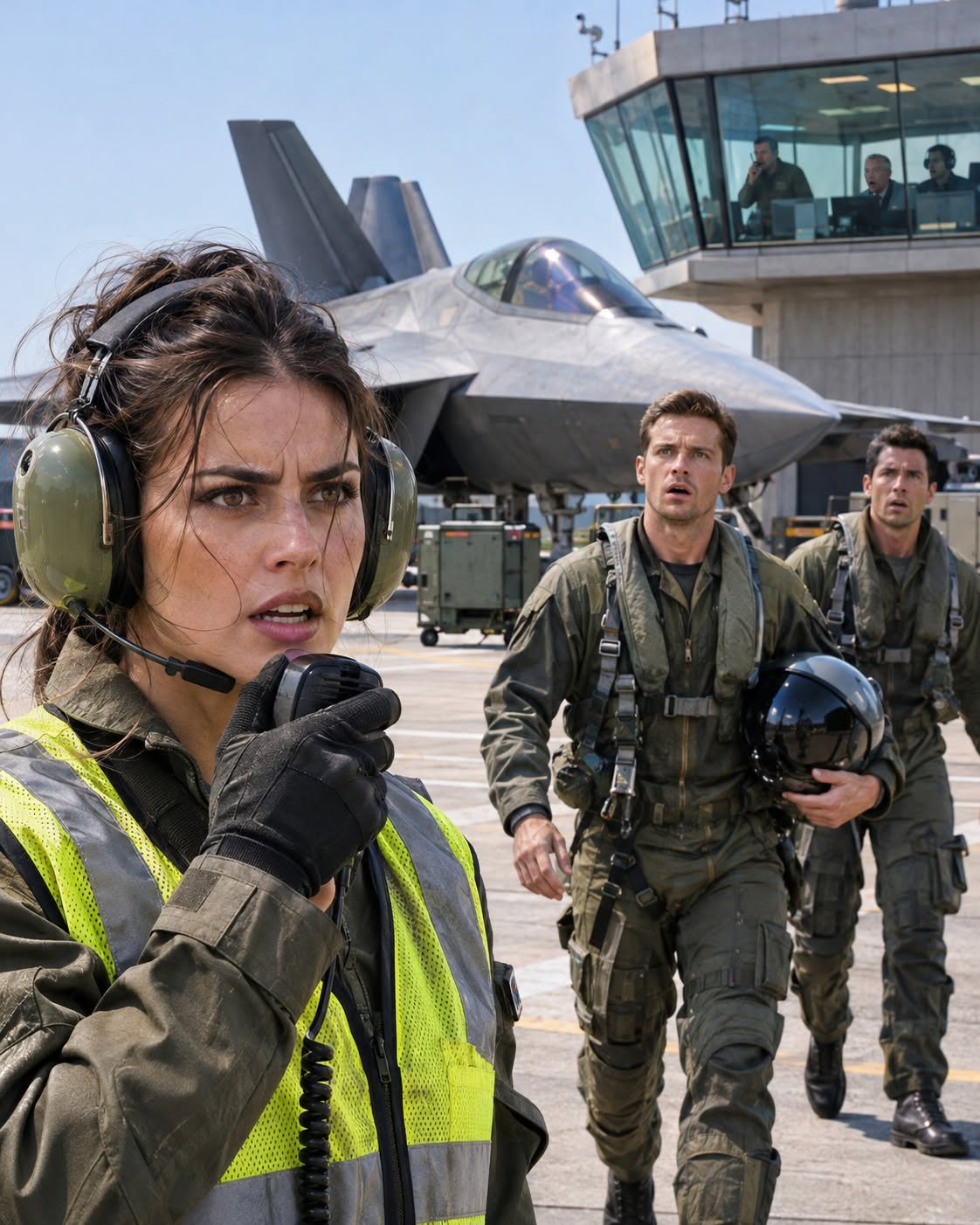
For months, I had been the most overlooked person on the flight line at Langley Air Force Base. I fixed aircraft, carried tools, followed orders, and kept my head down.
The commanding officer’s question stayed with me long after the hangar emptied.
“Would you consider returning to active flight operations?”
I didn’t answer immediately. I had spent months convincing myself that the life I left behind was no longer mine. The faded utility vest, the maintenance cart, the early mornings spent repairing aircraft while other people flew them—those things had become a kind of shelter.
And now, in a single afternoon, that shelter was gone.
Everyone knew about Falcon Actual.
But what nobody knew was why I had walked away from the cockpit in the first place.
The commanding officer, Colonel Hayes, waited patiently.
“I don’t need an answer today,” he said. “But I do need to know whether you were telling the truth about your qualifications. Because if you were, we have a serious situation developing.”
I looked at him.
“What situation?”
He glanced toward the command building.
“Those drones weren’t the only things we detected.”
I followed him inside.
The debriefing room was already crowded. Surveillance footage played across the main display, showing the drone formation approaching the restricted airspace. The footage was being replayed from several different angles.
But there was something else on the screen.
A map of the eastern coastline, marked with several locations where unidentified signals had appeared over the previous forty-eight hours.
I leaned forward.
“Those aren’t random locations.”
Hayes nodded.
“We think someone is mapping our response times.”
I studied the display carefully. Several of the locations were near military installations. Others were close to civilian airports, communication facilities, and shipping routes.
“What makes you think it’s connected?” I asked.
“Because every time we send aircraft to investigate, the signals disappear. And every time we don’t, they show up somewhere else.”
I stared at the map.
Then I noticed something that made my stomach tighten.
One of the locations was near an airfield I hadn’t visited in years.
An airfield connected to the last mission I ever flew.
“Where did you get this data?” I asked.
Hayes pointed to a folder on the table.
“Federal investigators. They believe whoever is operating these drones has access to restricted aviation information.”
I slowly sat down.
Because I knew what that meant.
Someone wasn’t merely testing our defenses.
Someone might be looking for me.
And if that was true, then the quiet life I’d spent months building hadn’t been as quiet as I thought.
The Name I Never Wanted to Hear Again
The next morning, I was called into a secure office.
Colonel Hayes was there, along with two intelligence officers and a woman in civilian clothes who introduced herself as Mara Collins.
She didn’t smile.
“Falcon Actual,” she said, “it’s been a while.”
I looked at her carefully.
I knew that voice.
“You’re supposed to be retired,” I said.
“So are you.”
Mara had been part of the intelligence team during my final deployment. She was one of the few people who knew why I had requested reassignment.
And she was the last person I wanted standing in front of me.
Hayes closed the door.
“We need to understand what you’re seeing,” he said.
Mara opened a folder and slid a photograph across the table.
It showed a man standing beside a hangar, his face partially turned away from the camera.
I didn’t need to see the entire picture.
I knew him.
His name was Daniel Mercer.
Years earlier, Mercer had been an operations analyst assigned to our unit. He was brilliant, impatient, and convinced that the fastest way to solve a problem was to remove every obstacle in his path.
He had once told me that rules were written for people who lacked imagination.
I had disagreed with him then.
I disagreed with him now.
“Mercer left the service years ago,” I said.
“Officially,” Mara replied. “But we’ve found evidence that someone with access to his old network has been involved in several unauthorized drone operations.”
Hayes folded his arms.
“Do you think he’s behind this?”
I looked at the photograph again.
“I think you’re asking the wrong question.”
Mara tilted her head.
“What question should we be asking?”
“Why now?”
The room went quiet.
The drone activity had increased in the past week. It had become more coordinated, more deliberate. The operators were no longer merely testing our response.
They were trying to make us react.
And reaction was exactly what Mercer had always wanted.
The Second Warning
Three days later, I was back on the flight line.
Not in a cockpit.
Not yet.
Colonel Hayes had asked me to help with a review of aircraft readiness and maintenance procedures. I agreed because I could still contribute without putting on a flight suit.
The younger mechanics treated me differently now.
Some were curious. Others seemed uncomfortable. A few had begun asking questions about my previous career, questions I didn’t particularly enjoy answering.
I kept my responses short.
“Did you really fly combat missions?”
“Yes.”
“Were you ever shot at?”
“More times than I liked.”
“Did you ever get scared?”
I stopped working and looked at the young mechanic asking me.
“Every time.”
He seemed surprised.
“Really?”
“Being afraid isn’t the problem,” I told him. “Pretending you aren’t afraid is.”
He nodded slowly and went back to work.
I was checking the maintenance records on one of the aircraft when a security officer approached.
“Sir, Colonel Hayes needs you in the operations room.”
I followed him.
The main display showed a live security feed from the base perimeter. A small unidentified object had appeared near the outer fence.
The camera zoomed in.
It was a drone.
But unlike the others, this one wasn’t moving.
It hovered almost perfectly still, facing the flight line.
“Has anyone tried to identify it?” I asked.
“Not yet,” Hayes replied. “We’re waiting on authorization.”
I stared at the image.
Then I noticed the small red light blinking beneath the drone.
It wasn’t a navigation light.
It was a camera indicator.
Someone was watching us.
“Don’t approach it,” I said.
Hayes looked at me.
“Why?”
“Because it wants us to.”
The drone remained motionless for another thirty seconds.
Then it turned.
And flew away.
The room erupted into activity.
Security teams were dispatched. Investigators began collecting footage. The communications staff started reviewing every signal that had been detected.
But I stayed in front of the screen.
Something about the drone had felt different.
It hadn’t been trying to get inside.
It had been trying to make sure we saw it.
That night, I couldn’t sleep.
I kept thinking about Mercer.
I kept thinking about the last mission.
And I kept thinking about a promise I’d made to myself when I left the cockpit.
Never again would I allow someone else’s ambition to turn my judgment into a weapon.
The Mission That Broke Me
Six years earlier, I had been flying with a team during a mission that had never been publicly acknowledged.
We had been sent to escort a transport through an unstable region. Intelligence indicated the route was clear. We were told to maintain our position and avoid unnecessary engagement.
Then the information changed.
A target had been identified near the transport route. We were told it posed an immediate threat.
The decision came down to us in seconds.
My wingman, Captain Elias Ward, was flying beside me. He was younger than I was, confident, and talented enough to make mistakes he didn’t yet understand.
We received the order to proceed.
But something didn’t feel right.
The intelligence was incomplete. The target location didn’t match the earlier briefing. There was a civilian structure near the coordinates.
I requested clarification.
The response came back: proceed.
Ward trusted the order.
I didn’t.
I asked for confirmation again.
That delay cost us time.
The transport was diverted. Our formation was disrupted. Ward’s aircraft took damage during the confusion, and he was forced to eject.
He survived.
But when I reached him on the ground, he was injured, furious, and convinced that I had hesitated too long.
Later, the investigation found that the intelligence had been compromised.
The target had been misidentified.
The mission had been rushed by someone who wanted results.
Mercer had been part of the analysis team.
He had argued that the threat was genuine.
I had questioned him.
And Ward had paid the price for all of us being caught between certainty and doubt.
Ward recovered physically, but he never returned to flying.
I did.
For a while.
Then one day, I realized I couldn’t keep climbing into a cockpit without hearing his voice in my head.
So I left.
I never blamed Ward.
I blamed the people who treated uncertainty like an inconvenience.
And I blamed myself for not finding a way to protect him from it.
The Truth Behind the Drones
The next morning, Mara Collins came to the maintenance hangar.
She found me beside the Raptor, examining a service record.
“Mercer wants you to know something,” she said.
I didn’t look up.
“I’m not interested in messages from him.”
“He claims the drones aren’t intended to attack the base.”
I finally turned.
“Then what are they doing?”
“Collecting information. Testing our response. Measuring how we react to unexpected situations.”
I stared at her.
“That’s not harmless.”
“No,” she said. “It isn’t.”
She handed me a tablet.
There was a video attached.
The footage showed the drone formation approaching the base. Then, just before the aircraft launched, the drones changed direction.
The camera zoomed in on the lead drone.
A small marking was visible along its side.
Three narrow white lines.
I recognized them immediately.
It was a symbol Mercer used years ago in a training program. A project designed to test decision-making under pressure.
The project had been canceled after the investigation into Ward’s accident.
Or so I thought.
“Someone restarted it,” I said.
Mara nodded.
“And they want you involved.”
“Why me?”
She looked directly at me.
“Because they believe you’re the only pilot who understands what they’re trying to prove.”
I shook my head.
“That’s not a reason to trust them.”
“It’s a reason to find out who’s behind it.”
I looked at the aircraft.
For months, I’d been hiding behind a vest and a toolbox. I had convinced myself that staying out of the cockpit meant staying out of the decisions that mattered.
But the truth was, I’d never stopped caring about the people who flew.
I simply didn’t know how to care without carrying the weight of every mistake.
A Choice I Couldn’t Avoid
Colonel Hayes called me into his office that afternoon.
He had two documents on his desk.
One was a temporary flight assignment.
The other was a formal request for an investigation.
“You don’t have to fly,” he said. “But we need someone who understands the history.”
I looked at the papers.
“I’m not going back because Mercer wants to provoke me.”
“Then don’t.”
Hayes leaned back.
“Go back because there are people here who need someone willing to say no when everyone else is saying yes.”
I thought about Ward.
I thought about the young mechanic who had asked whether I was afraid.
I thought about the drones hovering outside the fence, watching us react.
Finally, I picked up the investigation request.
“I’ll help,” I said. “But I’m not taking orders from Mercer.”
Hayes nodded.
“That’s exactly what I wanted to hear.”
I signed the document.
Not the flight assignment.
Not yet.
The Trap
The investigation uncovered a network of unauthorized communications linked to an old contractor. Several people had been using outdated military data to simulate drone incursions.
But the deeper we looked, the more complicated things became.
Mercer wasn’t operating alone.
A former contractor named Victor Sloan had been funding the project. He wanted to demonstrate that autonomous surveillance systems could outperform traditional security procedures.
His plan was to create increasingly realistic drone incidents, forcing military personnel to respond until they became predictable.
The drones weren’t armed.
But the danger was real.
A rushed response could cause a collision. A mistaken identification could lead to an unnecessary escalation. And the more people reacted emotionally, the easier it became for Sloan’s system to anticipate them.
The final test was scheduled for the following week.
Mara discovered the location through a recovered communication.
A remote airfield.
The same one where Ward’s accident had occurred.
I stared at the coordinates for a long time.
Then I closed the file.
“I’m going there,” I said.
Hayes looked up.
“You’re not flying.”
“I know.”
“Then why?”
“Because if Mercer is there, I want him to hear something from me before he starts another test.”
The Last Conversation
The airfield was quiet when we arrived.
Mara and I walked toward an old hangar. The building had been abandoned for years, but the lights were on.
Mercer stood inside.
He looked older than I remembered. His hair had turned gray, and his face was thinner. But his eyes were the same.
“Falcon Actual,” he said.
“Don’t call me that.”
He smiled faintly.
“You always hated the name.”
“I hated what people did with it.”
Mercer glanced toward the hangar door.
“You know what we’re trying to prove.”
“No,” I said. “I know what you’re trying to make people believe.”
He stepped closer.
“Human decision-making is inconsistent. Fear, hesitation, emotion. You lost time because you trusted your instincts instead of the data.”
I felt my jaw tighten.
“Ward lost his aircraft because you treated incomplete information like certainty.”
Mercer looked away.
“He survived.”
“That doesn’t make what happened acceptable.”
For a moment, neither of us spoke.
Then he said something I hadn’t expected.
“I was wrong about that mission.”
I stared at him.
“Then why are you doing this?”
“Because I thought if I could build a system that never hesitated, no one would have to suffer the way Ward did.”
I shook my head.
“You don’t fix a mistake by removing the people who are supposed to recognize mistakes.”
He looked at the floor.
“I thought you would understand.”
“I do understand,” I said. “That’s why I’m here.”
Outside, the drones began to appear.
Several small lights moved across the dark sky.
Mercer watched them with a strange expression.
“It’s too late,” he said.
I looked at him.
“What do you mean?”
He reached for a control panel, then stopped.
“The system isn’t responding.”
The drones continued moving.
Their formation shifted.
One of them descended toward the hangar.
Mara shouted for everyone to move back.
A security team rushed toward the entrance.
The drones were no longer following the planned test.
Something had gone wrong.
Mercer stared at the screen.
“Victor changed the software.”
The drone formation began moving toward the airfield’s fuel storage area.
I grabbed the radio.
“Everyone clear the hangar. Keep your distance from the drones. Do not approach the fuel area.”
The response came immediately.
The situation was deteriorating.
But for the first time in years, I wasn’t thinking about what I had lost.
I was thinking about what I could still prevent.
The Moment Everything Changed
The drones moved faster than the security team expected.
One clipped a light pole and spiraled toward the ground. Another veered dangerously close to the fuel storage perimeter.
Mara was coordinating evacuation when a sudden alarm sounded.
A ground vehicle had stopped near the access road.
The driver was trapped.
I ran toward the vehicle.
The man inside was a maintenance worker, unconscious after the vehicle struck a barrier. Smoke was rising from the engine compartment.
I pulled the door open and dragged him away.
Mara arrived moments later.
“Are you hurt?”
“No.”
“Then move.”
We carried the man to a safe area.
Behind us, the drone formation scattered.
The security team managed to isolate the perimeter, and emergency responders arrived before the situation could become worse.
Nobody died.
But the incident had made one thing painfully clear.
The system Mercer had designed to eliminate uncertainty had created an entirely new kind of danger.
And the people who had been supposed to control it had lost control.
The Consequences
The investigation lasted several weeks.
Victor Sloan was arrested after evidence connected him to the unauthorized operations. Mercer cooperated with investigators and admitted his role in the original program.
The project was shut down.
The drone incidents stopped.
But the consequences were not limited to arrests or reports.
Ward came to visit me one afternoon.
I hadn’t seen him in years.
He was walking with a slight limp, but he looked healthier than I remembered.
He stood beside the maintenance cart and looked at the vest I’d put back on.
“You really went back to fixing aircraft?” he asked.
“Someone has to.”
He laughed.
Then his expression became serious.
“I heard what happened at the airfield.”
I nodded.
“I’m glad you didn’t fly.”
I looked at him.
“I’m glad you survived.”
For a moment, neither of us said anything.
Then Ward placed a hand on my shoulder.
“You were right to question the order back then.”
I felt something inside me loosen.
Not disappear.
Not heal completely.
But loosen.
“I wish I’d found a better way to do it,” I said.
“You did the best you could with what you knew.”
He smiled.
“That’s all any of us can do.”
The Decision
Colonel Hayes offered me a permanent position in flight operations.
The offer included a return to the cockpit, training assignments, and the opportunity to help improve the procedures used to evaluate unidentified threats.
I read the paperwork twice.
Then I declined.
Not because I was afraid.
Not because I had lost my confidence.
But because I had finally understood that my life didn’t have to be defined by the job I had once done.
I could still contribute.
I could still teach.
I could still protect people.
And I could do all of that without returning to the cockpit.
Hayes accepted my decision.
“You’re sure?”
“Yes.”
“Then what do you want to do?”
I glanced toward the flight line.
“I want to stay here.”
He smiled.
“Then stay.”
The Quiet After
A few months later, the flight line returned to normal.
The pilots went back to joking over coffee. The mechanics returned to their routines. The hangars filled with the familiar sounds of tools, engines, and people arguing about paperwork.
I was back in my faded utility vest.
The young mechanic who had once asked whether I was afraid approached me again.
“Sir, can I ask you something?”
“Sure.”
“Do you ever miss flying?”
I looked up at the sky.
Every day.
But I didn’t say that.
Instead, I told him, “Sometimes the hardest thing you can do is choose where you belong.”
He frowned.
“Isn’t that the same as giving up?”
I shook my head.
“No. Giving up is walking away because you think you can’t do anything anymore. Choosing is knowing you can do something—and deciding what matters most.”
He thought about that for a moment.
Then he nodded.
I returned to my work.
The aircraft above me began to taxi.
The sound of its engines rolled across the flight line, and for the first time in a long while, I didn’t feel the need to chase it.
I had spent years believing that the only way to protect people was to be the one in the air.
Now I understood something different.
Sometimes the person who keeps others safe isn’t the one who takes off.
Sometimes it’s the one who stays behind, asks the uncomfortable questions, and refuses to let urgency become an excuse for recklessness.
And sometimes, the bravest call sign isn’t the one spoken over the radio.
It’s the name you choose when nobody is watching.
That day, I was just a technician again.
And that was enough.
THE END