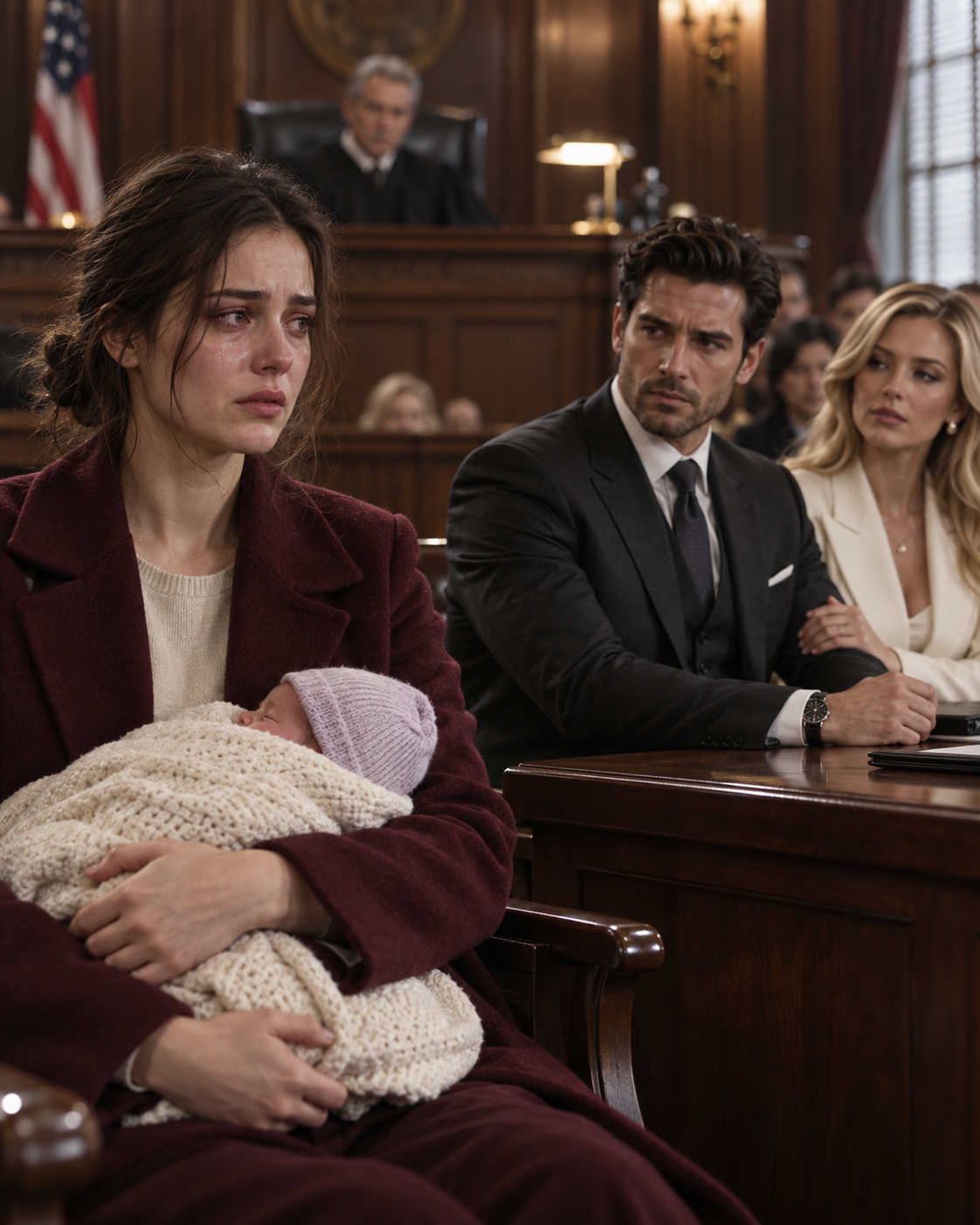
Eight days after my C-section, I stood in a courtroom clutching my surgical drain beneath my dress
For eighteen months, I had kept that envelope locked inside the bottom drawer of my desk at the Eleanor Center.
I told myself I was protecting my peace.
The truth was simpler.
I was afraid of what my grandmother had known.
Every time my fingers touched the envelope, I remembered the way Eleanor used to look at me when she knew something I didn’t.
She had never been dramatic.
She didn’t need to be.
She could sit across from you with a cup of tea and make you feel as though she had already read the last chapter of your life.
The envelope was thick, yellowed at the edges, and sealed with the same dark wax she had used on legal documents.
For eighteen months, I ignored it.
Then one Tuesday afternoon, a woman named Rachel walked into my office holding a newborn in a car seat.
She was twenty-three, exhausted, and shaking so badly she could barely sign her name.
“My husband says nobody will believe me,” she whispered.
I looked at the baby.
Then at Rachel.
Then at the shelves around me, filled with files from women who had heard the same sentence.
Nobody will believe you.
You’re emotional.
You’re confused.
You’re a bad mother.
You don’t understand the finances.
You don’t know what you’re talking about.
I had heard every version of it.
“Sit down,” I told her.
“You don’t have to convince me that you’re telling the truth.”
Her eyes filled with tears.
That moment reminded me why I had built the center in the first place.
Not because I had won.
Because I knew how close I had come to losing everything while people watched me bleed and called it weakness.
That night, after everyone left, I returned to my office.
I locked the door.
Then I opened Eleanor’s envelope.
The first page contained a letter.
My grandmother’s handwriting was immediately recognizable.
“Dear Claire, if you’re reading this, Jonathan has finally shown you who he is.”
I stopped breathing for a moment.
She had known.
Maybe not every detail.
But enough.
The next pages contained records of meetings, property purchases, corporate filings, and correspondence dating back nearly twenty years.
Jonathan’s father had once approached Eleanor asking to buy the land where the Vance Meridian would eventually stand.
She refused.
Years later, Jonathan approached her himself.
He never knew she was the person behind the holding company.
He believed the land belonged to an anonymous investment trust.
Eleanor had deliberately kept her name out of the transaction.
But there was more.
She had discovered that Jonathan’s father had been quietly using shell companies to move assets away from creditors.
Eleanor had documented everything.
She never exposed him.
Instead, she purchased the underlying properties and waited.
My grandmother hadn’t wanted revenge.
She wanted leverage.
And then I found the page that changed everything.
A handwritten note was clipped to a copy of a corporate agreement.
“Jonathan will eventually believe power comes from ownership.”
Below it, Eleanor had written:
“Teach him that power actually comes from what people are willing to trust you with.”
I sat there for a long time.
The room was silent except for the air conditioner humming above me.
Then my phone rang.
It was Mara.
“I need you to come to the office tomorrow.”
Her voice sounded different.
“Why?”
“I received a letter from Jonathan’s attorney.”
My stomach tightened.
“What does he want?”
“He wants to reopen the custody matter.”
I closed my eyes.
For eighteen months, Jonathan had stayed away.
He had sent birthday gifts through assistants, skipped scheduled visits, and occasionally appeared in business magazines beside photographs of the Vance Meridian.
I had assumed his silence meant surrender.
Mara knew better.
“He claims you violated the original custody arrangement,” she said.
“On what grounds?”
“He says the Eleanor Center proves you’re using Isla to build a public narrative against him.”
I laughed once.
It wasn’t funny.
“He abandoned his own daughter.”
“I know.”
“He called her a stranger.”
“I know.”
“And now he’s claiming I’m exploiting her?”
“I know.”
The next morning, Mara showed me the filing.
Jonathan’s lawyers had attached photographs of the Eleanor Center, excerpts from interviews I had given, and statements from people who claimed I had become obsessed with exposing him.
At the bottom was a request for expanded visitation.
Jonathan wanted access to Isla.
Not because he had suddenly become a father.
Because the Vance Meridian was in trouble.
The lease review had exposed financial weaknesses.
The property beneath the hotel was now being reassessed, and investors were asking questions.
Jonathan needed leverage.
His daughter was leverage.
I stared at the filing.
“He’s not trying to get custody.”
“No,” Mara said.
“He’s trying to get close enough to control the narrative.”
For the first time in eighteen months, I felt afraid again.
Not for myself.
For Isla.
I went home that evening and found her asleep on the living room rug, one hand wrapped around a stuffed rabbit.
I knelt beside her.
Her hair had grown into soft curls.
She had Eleanor’s stubborn chin.
I brushed a strand away from her forehead.
“I won’t let him use you,” I whispered.
The next hearing was scheduled three weeks later.
Jonathan arrived surrounded by attorneys.
He looked older.
Not ruined.
Not yet.
But there were cracks.
His smile had disappeared.
His shoulders were heavier.
When he saw Isla, something flickered across his face.
I couldn’t tell whether it was regret or calculation.
“Claire,” he said.
I kept walking.
“Please.”
I stopped.
“What?”
“I want to talk.”
“You had eighteen months.”
He swallowed.
“I made mistakes.”
“No.”
I looked directly at him.
“You made decisions.”
His expression hardened.
For a second, I saw the man from the courtroom again.
Then he softened his voice.
“She’s my daughter.”
I answered quietly.
“You should have remembered that before you denied her.”
The hearing began.
His attorney argued that I had created an environment hostile to Jonathan.
Mara responded with records showing his missed visits, unpaid obligations, and repeated attempts to communicate through third parties rather than directly with me.
Then she introduced the messages Lyra had surrendered.
Jonathan’s attorney objected.
The judge reviewed them anyway.
His strategy began collapsing piece by piece.
Then something unexpected happened.
Lyra Sterling entered the courtroom.
She wasn’t wearing the polished clothes I remembered.
She looked tired.
Human.
She asked to speak.
Jonathan stood immediately.
“Lyra, don’t.”
She ignored him.
“I thought he loved me,” she said.
Her voice cracked.
“I thought Claire was the problem.”
She looked at me.
“I was wrong.”
Then she handed the judge another folder.
This time, Jonathan’s face went completely white.
The folder contained internal company emails.
They showed that Jonathan had been diverting corporate funds into a private account controlled through an intermediary.
The money wasn’t connected to me.
It wasn’t connected to Isla.
It was his.
Millions of dollars.
Mara leaned toward me.
“Do you know about this?”
I shook my head.
Jonathan looked at Lyra with disbelief.
“Why?”
Lyra wiped her eyes.
“Because you told me Claire was dangerous.”
She took a breath.
“Then I realized the dangerous person was standing beside me.”
The judge ordered an investigation.
Jonathan’s visitation request was denied.
But the consequences didn’t end there.
Within months, investors demanded answers.
The lease review accelerated.
The Vance Meridian’s financial structure came under scrutiny.
Jonathan’s company survived, but the empire he had spent years building began changing hands.
He lost his position.
Then his board seat.
Then the house he had once called his.
The final blow came quietly.
The land beneath the Vance Meridian was never sold.
It remained under the ownership structure Eleanor had created.
The new lease terms were strict.
Fair.
Legally sound.
Impossible to manipulate.
Jonathan eventually asked to meet me one last time.
I agreed.
Not because I wanted closure.
Because I wanted to see whether the man who had humiliated me in court had finally learned what he had done.
We met at a small coffee shop across from the courthouse.
He looked at me for almost a minute before speaking.
“I was afraid.”
I said nothing.
“I thought if people knew Isla was mine, they’d question everything.”
“Everything?”
“My marriage.”
“Your company?”
He nodded.
“Your relationship with Lyra?”
Another nod.
I looked out the window.
“You weren’t protecting your life, Jonathan.”
He waited.
“You were protecting a lie.”
His eyes filled with tears.
“I know.”
For the first time, I believed him.
But believing someone’s regret does not obligate you to return what they destroyed.
“Isla deserves a father who doesn’t need a courtroom to remember she’s his daughter.”
“I want to become that person.”
“Then become him somewhere she doesn’t have to watch.”
He lowered his head.
We never met again.
The Eleanor Center grew faster than I ever expected.
Within two years, we had attorneys volunteering their time, financial counselors helping women understand marital assets, and advocates sitting beside mothers during hearings.
We helped women document abuse without turning their pain into spectacle.
We helped them find housing.
We helped them understand that being exhausted did not make them unreliable.
And every time someone whispered, “Maybe I’m overreacting,” I told them what I had once needed someone to tell me.
“You are allowed to take your own fear seriously.”
One afternoon, Isla and I stood outside the center.
She was four years old by then.
She held my hand and looked up at the building.
“Mommy, did you make this?”
I smiled.
“Lots of people made it.”
“But you started it.”
I knelt beside her.
“I started it because somebody helped me when I needed it.”
“Who?”
I looked toward the framed photograph of Eleanor inside the lobby.
“Her.”
Isla studied the picture.
“Was she brave?”
I smiled through the tears gathering in my eyes.
“Very.”
“Was she scared?”
I thought about that.
“Probably.”
“Then why was she brave?”
I kissed her forehead.
“Because being brave doesn’t mean you aren’t scared.”
She nodded as though she understood.
Maybe she did.
That evening, after Isla fell asleep, I returned to my desk.
The original envelope from Eleanor lay open beside me.
I thought I had read everything.
Then I noticed something I had missed.
A second piece of paper had been folded beneath the letter.
My hands trembled as I opened it.
There were only three lines.
“Claire, Jonathan was never the person I was preparing you to fight.”
I read the sentence twice.
Then the next.
“The person you should be watching is the person who helped him build the lie.”
My heart began pounding.
At the bottom was a name.
A name I recognized.
A name that had appeared on documents I had trusted for years.
I stared at it until the room seemed to tilt.
Then my phone buzzed.
Unknown number.
One message.
“Your grandmother knew what happened before Isla was born.”
I froze.
Another message appeared.
“And she wasn’t the only one.”
I looked down the hallway toward Isla’s bedroom.
She was asleep.
Safe.
For the moment.
I closed the phone in my hand and realized something Eleanor had understood long before I did.
Winning a battle is not the same as ending a war.
And somewhere beyond the walls of the life I had rebuilt, someone had been waiting eighteen months for me to finally open that letter.