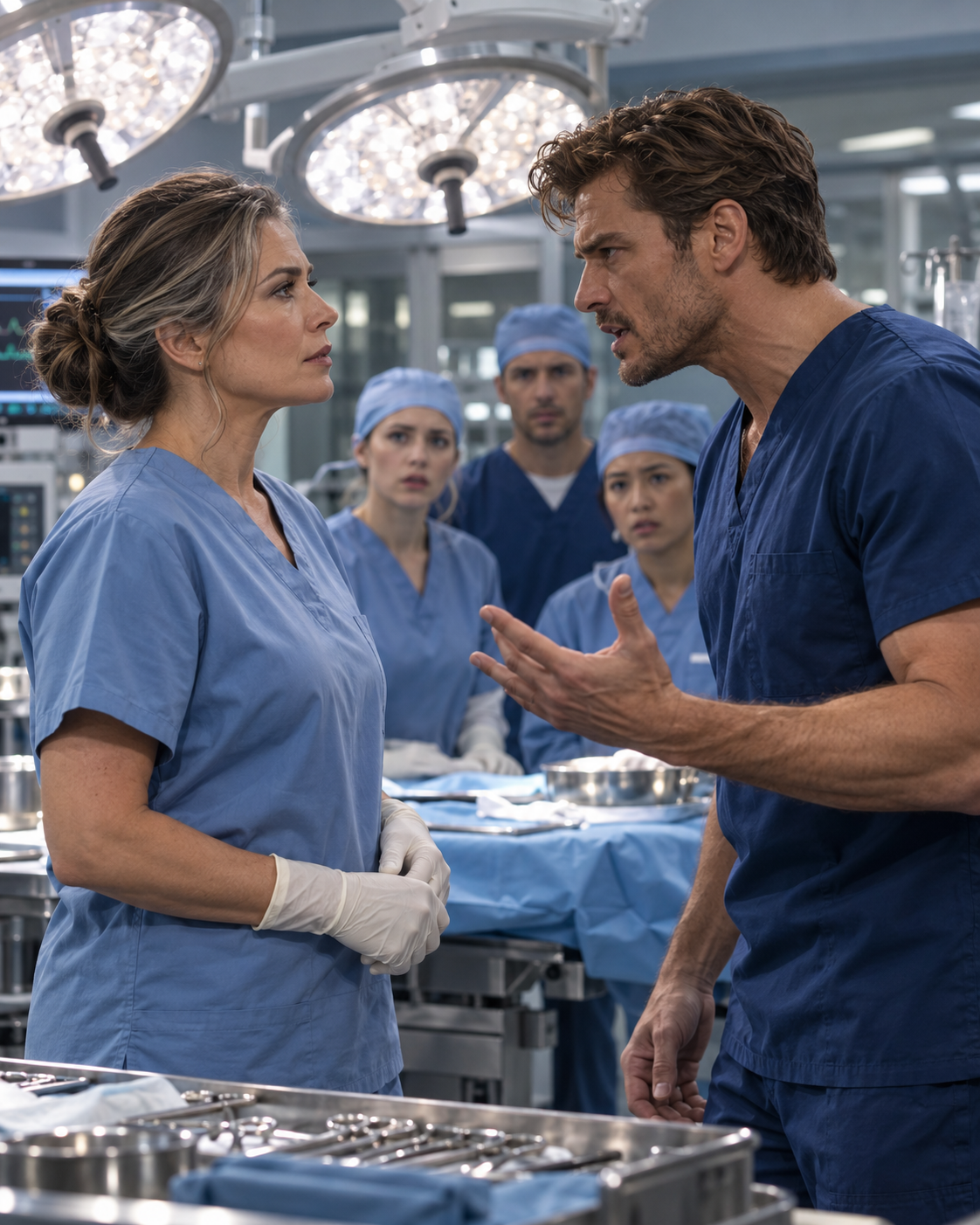
Dr. Vance pointed at my cardboard box and ordered me out of Operating Room 4 in front of the entire surgical team
The officer’s words followed me long after Julian disappeared behind the elevator doors.
“There is something in your old military file that General Edward wants you to see.”
I looked at the cardboard box in my arms.
For years, I had believed the hardest chapters of my life were behind me.
Apparently, I had been wrong.
General Edward asked me to follow him into a private conference room overlooking the city.
Gregory Vance remained outside.
He looked like a man who had just watched his carefully protected world collapse in less than ten minutes.
I almost felt sorry for him.
Almost.
Inside, General Edward closed the door.
His two officers stayed near the wall.
Then he removed his service jacket and placed it across the back of a chair.
“Sit down, Clara.”
I sat.
He remained standing.
“I owe you an explanation.”
“About my military file?”
“About that, and about why I recognized your name.”
He opened a leather folder.
The first document was an old military photograph.
I was younger in the picture.
Exhausted.
Dust-covered.
Standing beside a damaged Medevac helicopter.
Four soldiers stood behind me.
One of them was barely recognizable beneath bandages.
I knew him immediately.
“Michael?”
General Edward nodded.
“My nephew.”
I stared at the photograph.
I remembered that day with painful clarity.
The valley had been burning.
The aircraft had gone down after taking fire.
We were told there were no survivors.
I refused to believe it.
I had crawled through smoke and wreckage until I found four men alive.
Michael had a piece of metal buried in his side.
Another soldier couldn’t move his legs.
A third was unconscious.
The fourth kept asking whether anyone knew his name.
I had carried them one by one.
I had been shot.
My ribs were fractured.
I remember thinking I would collapse after the fourth man was out.
Instead, I stayed awake long enough to hear the evacuation helicopter lift away.
Then I passed out.
“You saved my nephew,” General Edward said.
“I was doing my job.”
“No.”
His voice was quiet.
“You did what most people would have been too afraid to do.”
I looked down.
“I’ve never considered myself brave.”
“That’s because brave people rarely do.”
He opened another folder.
This one was thinner.
Inside was a report I had never seen.
I read the first few lines.
Then my pulse changed.
It wasn’t about the rescue.
It was about what happened afterward.
My commanding officer had recommended me for the Medal of Honor.
But someone had attempted to block the recommendation.
“Who?”
General Edward didn’t answer.
I read further.
There were discrepancies in the casualty report.
The official record claimed our aircraft had been destroyed by indirect fire.
The classified assessment suggested something else.
The helicopter’s flight system had been tampered with before takeoff.
I looked up.
“You think it was sabotage?”
“We know it was.”
My mouth went dry.
“Why?”
“That’s what we never discovered.”
He turned another page.
There was a list of names.
One name had been blacked out.
But beneath the black ink, I could still see part of the handwriting.
My old commanding officer had written a note.
SUSPECTED INTERNAL ACCESS.
I remembered him.
Colonel Aaron Mercer.
He had been one of the most respected officers in our unit.
He had also been the man who recommended that I stop asking questions about the crash.
I had always assumed he was protecting me from painful memories.
Now I wasn’t so sure.
“Why are you showing me this now?”
“Because your file was reopened last month.”
“Why?”
General Edward sat across from me.
“Because someone requested it.”
“Who?”
“We don’t know.”
That answer frightened me more than anything else.
He slid another page across the table.
The request had been made through a military records system.
The access credentials belonged to a retired officer.
The name was Aaron Mercer.
My hands went cold.
“He’s dead.”
“His credentials were used after his death.”
I stared at the page.
“By whom?”
“We’re investigating.”
The door opened.
One of the officers stepped inside.
“General, we have a problem.”
Edward looked up.
“What kind?”
“Dr. Julian Vance.”
My stomach tightened.
“He escaped?”
“No.”
The officer hesitated.
“He’s refusing to speak to the hospital investigators, but he asked for Captain Vance.”
I almost laughed.
“Why?”
“He said he won’t talk unless you’re present.”
General Edward’s eyes narrowed.
“Absolutely not.”
I stood.
“I’ll go.”
He looked at me.
“Clara.”
“If he knows something about my file, I want to hear it.”
The general studied my face.
Then he nodded.
“But you won’t be alone.”
The hospital security office felt nothing like an operating room.
There were no sterile lights.
No controlled silence.
Only cameras, concrete walls, and the strange tension of people waiting for someone to make a mistake.
Julian sat behind a glass partition.
He looked smaller than I remembered.
Without his white coat, he didn’t look like the powerful chief surgeon who had terrorized an entire department.
He looked like a frightened man.
When he saw me, he smiled.
It wasn’t a kind smile.
It was the smile of someone who believed he still had a card to play.
“You came.”
I sat across from him.
“You asked for me.”
He leaned forward.
“You think today was about the patient.”
“It was.”
“No.”
His voice dropped.
“Today was about getting me out.”
“Who wants you out?”
He smiled again.
“You really don’t know.”
“Know what?”
Julian glanced toward the camera.
Then back at me.
“Your hospital director isn’t the person you should be afraid of.”
I felt a chill.
“What does Gregory have to do with this?”
“Nothing.”
“Then who?”
Julian hesitated.
“Your old military command.”
I stared at him.
He continued.
“Do you remember Colonel Mercer?”
My heart began pounding.
“How do you know that name?”
“Because he paid my father.”
I couldn’t breathe.
“For what?”
“Information.”
“What information?”
“About you.”
The room seemed to shrink.
“Why would he care about me?”
Julian looked almost amused.
“Because you survived.”
I stood so quickly the chair scraped the floor.
General Edward entered immediately.
“That’s enough.”
Julian’s expression changed when he saw him.
For the first time, he looked genuinely afraid.
General Edward leaned toward the glass.
“Tell me what you know.”
Julian swallowed.
“Mercer wasn’t working alone.”
“Who was he working for?”
“I don’t know.”
“Then start with what you do know.”
Julian looked at me.
“Your helicopter wasn’t supposed to crash.”
I closed my eyes.
I had spent fifteen years trying to bury that sentence.
Now it was alive again.
Julian continued.
“The mission was supposed to remove four specific soldiers from the unit.”
“Why?”
“Because they had discovered something.”
“What?”
“Financial transfers.”
General Edward went still.
“Military procurement?”
Julian nodded.
“Millions were being diverted through private contractors.”
I felt sick.
“And Michael?”
“He found the records.”
“That’s why they sabotaged the aircraft?”
Julian shook his head.
“They didn’t expect you to survive.”
Silence.
I stared at him.
“How did you become involved?”
“My father repaired HVAC systems for military facilities.”
That was something I hadn’t known.
“Mercer used him as a contractor.”
Julian’s eyes dropped.
“Years later, Mercer approached me.”
“For what?”
“To find women with access to money.”
I understood immediately.
“You were never a Sterling.”
“No.”
“You used the name because it opened doors.”
“Yes.”
“Why did you target me?”
Julian looked away.
“Because Mercer wanted to know whether your family still had connections to military funding.”
General Edward stepped closer.
“Why?”
“Because the veterans’ trauma program was going to expose some old financial records.”
My blood ran cold.
The new trauma wing.
The fifty-million-dollar military grant.
The same grant Julian had almost jeopardized.
This wasn’t simply about my job.
Someone had been watching the program before it even existed.
General Edward asked, “Who told you to infiltrate St. Jude?”
Julian shook his head.
“I never knew his real name.”
“Then how did you communicate?”
“Through messages.”
“From whom?”
Julian looked directly at me.
“Someone inside the hospital.”
The silence afterward was suffocating.
Gregory Vance?
Another surgeon?
An administrator?
A nurse?
Someone who had watched me work every day?
I suddenly understood how vulnerable we had been.
People don’t fear enemies they can see.
They fear the person standing beside them while pretending to help.
Julian’s lawyer arrived before we could continue.
The interview ended.
But the damage was already done.
The hospital began a full internal investigation.
Access logs were reviewed.
Financial records were audited.
Security footage was examined.
Within seventy-two hours, they found something.
A hospital administrator had accessed my military records nine times.
His name was Thomas Reed.
He had worked at St. Jude for eighteen years.
Nobody suspected him because he was polite, dependable, and almost invisible.
He had also processed the original paperwork for the military grant.
When investigators searched his office, they found encrypted drives.
One contained copies of my military file.
Another contained records from the trauma wing project.
The third contained payment instructions.
The money trail led to a private consulting company.
That company led to a defense contractor.
And that contractor led directly back to the same procurement scandal General Edward had described.
Thomas was arrested.
But before they took him away, he asked to speak to me.
I stood behind the glass.
“You don’t understand,” he said.
“Then explain.”
His face was pale.
“We weren’t trying to hurt you.”
“You sabotaged my military file.”
“No.”
“You gave Julian information about me.”
“Yes.”
“Then what were you trying to do?”
He lowered his voice.
“Keep you away from the trauma wing.”
“Why?”
“Because the wing would give General Edward access to records that certain people have spent years hiding.”
I stared at him.
“Who are these people?”
Thomas looked toward the security camera.
Then he whispered, “They’re not all outside this hospital.”
That sentence became the beginning of the largest investigation St. Jude had ever seen.
Gregory resigned within the week.
Julian lost his medical license pending prosecution.
Thomas cooperated with federal investigators.
The procurement scandal widened.
Names that had once appeared in newspapers as respected executives began appearing in court documents.
And somehow, through all of it, I kept thinking about Operating Room 4.
The father of three.
The damaged artery.
The clamp Julian wanted to use.
That one decision had seemed like a small professional disagreement.
It had actually been the moment the entire structure began to collapse.
If I had stayed silent, Julian would have remained chief surgeon.
If I had obeyed him, that patient might have died.
If I had been afraid of losing my job, I might never have discovered why someone wanted me removed from the hospital.
Sometimes the moment that humiliates you is secretly the moment that saves you.
Months later, the veteran trauma wing opened.
The first patient was an injured firefighter.
The second was a Marine.
The third was a young woman who had survived an explosion overseas.
I stood at the entrance while General Edward unveiled the plaque.
My name wasn’t written in gold.
There was no giant photograph of me.
The plaque simply read:
FOR THOSE WHO RAN TOWARD THE FIRE.
I touched the words.
General Edward stood beside me.
“You earned this.”
“We earned it,” I said, looking at the staff.
He smiled.
Then he handed me a small envelope.
“What now?”
I opened it.
Inside was a copy of the original Medal of Honor recommendation.
At the bottom was a handwritten note from Michael, the soldier I had rescued.
I read it twice.
“You carried me out of a burning helicopter,” it said. “I spent fifteen years wondering how to repay you.”
My eyes filled with tears.
The final line was simple.
“Now I know.”
I looked up.
General Edward was watching me.
“What does it mean?”
He smiled.
“It means the people you save don’t always disappear from your life.”
That evening, after everyone had gone home, I walked alone through the trauma wing.
The halls were quiet.
The lights were dim.
For once, silence didn’t feel threatening.
It felt earned.
I stopped outside Operating Room 4.
The door was closed.
I thought about Julian.
About the way he had shouted.
About the cardboard box.
About the medal.
About the strange path that had carried me from a hospital corridor back into a part of my past I thought I had buried forever.
I realized something then.
My medal had never been proof that I was fearless.
It was proof that I had been terrified and moved anyway.
That was the lesson I wanted every young nurse and doctor in that building to understand.
Courage isn’t the absence of fear.
It is choosing what matters more than your fear.
A few weeks later, I received a final letter from the federal investigators.
Most of the case had been resolved.
But one question remained unanswered.
Who had used Colonel Mercer’s credentials after his death?
The investigators believed it was someone who had known him personally.
Someone who had access to military records.
Someone who had known about the helicopter crash.
Someone who had known my name long before Julian Vance ever entered St. Jude Memorial.
I read the letter twice.
Then I noticed the final attachment.
It was a surveillance photograph.
The image showed a man entering a federal records facility three months before Julian was fired.
His face was partially hidden.
But I recognized the coat.
I recognized the way he walked.
And I recognized the scar beside his ear.
My hands began to shake.
Because I had seen that man before.
Not at St. Jude.
Not in Afghanistan.
But in the photograph from the day my Medal of Honor recommendation was signed.
He had been standing behind Colonel Mercer.
And according to the military records, he had been dead for fourteen years.
I stared at the photograph until the room seemed to tilt.
Then my phone rang.
Unknown number.
I answered without speaking.
For several seconds, there was only breathing.
Then a man’s voice whispered, “Captain Vance, you were never supposed to survive that helicopter.”
The line went dead.
I stood alone in the darkened hallway, listening to the silence return.
For fifteen years, I had believed I survived that day by courage, luck, and stubbornness.
Now I wondered whether someone had spent fifteen years making sure I remembered the wrong story.
I looked through the glass at the empty operating room.
Then I looked down at the medal around my neck.
It suddenly didn’t feel like a symbol of the past.
It felt like a warning.
And for the first time since Afghanistan, I understood that the fire I escaped all those years ago might never have gone out.
Maybe it had only been waiting for me to come back.