Dr. Vance called me a fraud in a VA rehab room while my boot lay unlaced on the floor, and his cold smile made everyone look away
Part 2
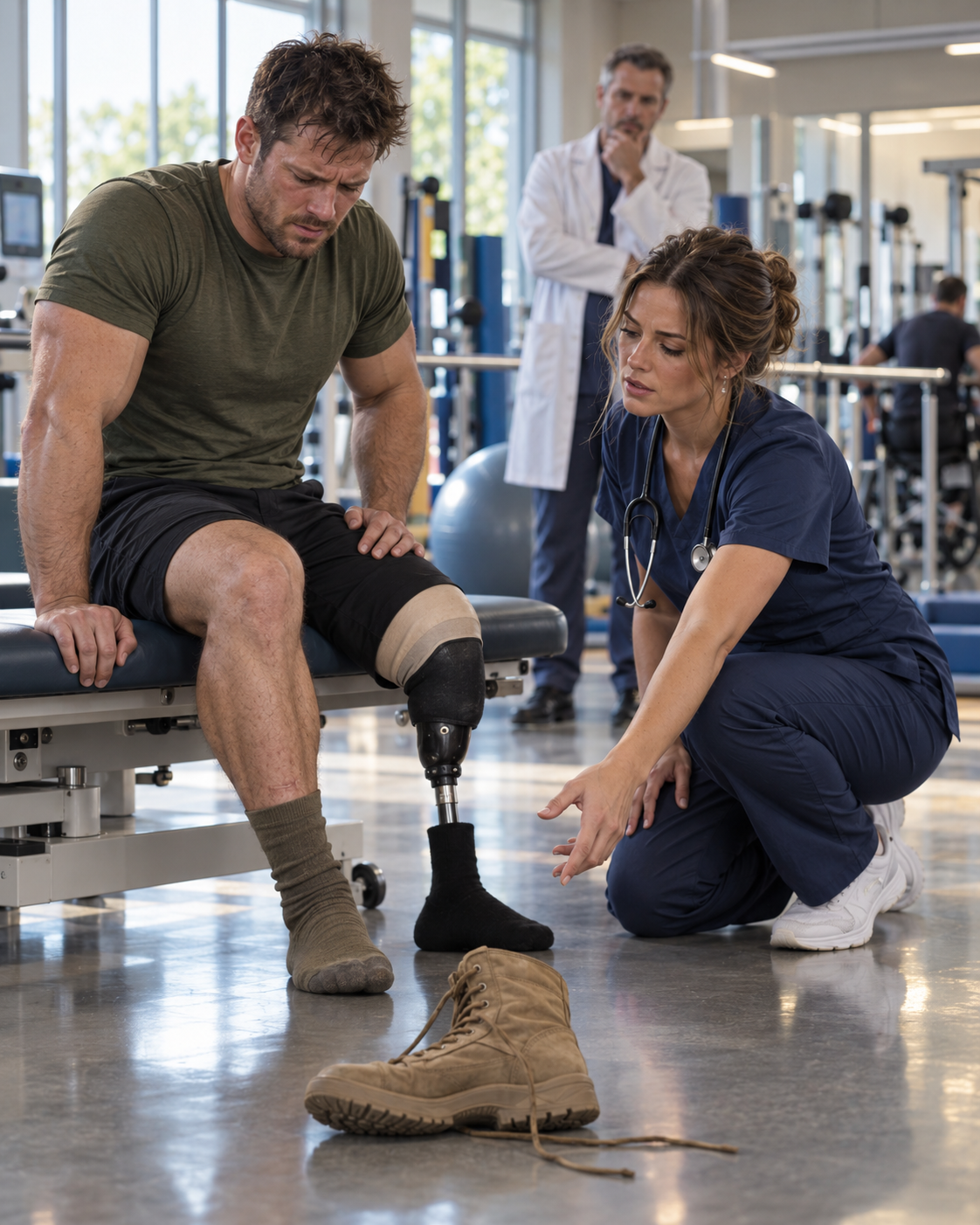
I sat there for another few seconds, staring at the boot as though it had become the most important object in the world.
Then Sarah said something I would remember for the rest of my life.
“You don’t have to win against your leg.”
I looked at her.
“You just have to work with the version of it that’s here.”
That sentence changed the way I saw the floor beneath my feet.
Until then, every failed movement had felt like evidence.
Evidence that I was getting weaker.
Evidence that I was becoming dependent.
Evidence that everyone who doubted me might eventually be right.
But maybe the problem wasn’t that my leg refused to behave.
Maybe the problem was that I kept demanding it behave like the leg I used to have.
I reached for the boot.
My foot drifted away.
This time, I didn’t fight it.
I watched where it went.
Then I moved the boot toward it.
The motion felt almost ridiculous.
After months of forcing my body to obey the old rules, I was finally changing the rules instead.
My foot drifted slightly outward.
I moved the boot outward.
It drifted forward.
I followed.
Then, somehow, the opening of the boot met the edge of my foot.
I stopped breathing.
I slid it over my heel.
It fit.
I looked up.
Nobody clapped.
Nobody congratulated me.
Nobody said, “See, you can do it.”
And somehow that made the moment more powerful.
I had done it without pretending my leg was normal.
I had done it by accepting that it wasn’t.
I pulled the laces toward me.
My fingers were clumsy, but they worked.
I tied them myself.
When I looked up again, Dr. Vance was staring at the floor.
He seemed quieter than before.
Finally, he said, “I was testing the wrong thing.”
I didn’t answer.
He opened the notes on his tablet.
I watched his thumb move across the screen.
Then he stopped.
He deleted the discharge recommendation that suggested staff or family should routinely assist me with dressing and daily tasks.
He replaced it with something different.
The patient is to direct his own care and determine when assistance is required, using compensatory strategies as needed.
He read it once.
Then he looked at me.
“Is that accurate?”
For the first time all day, I didn’t feel trapped by the question.
“Yes.”
He nodded.
“I should have asked that before I tested you.”
There was no dramatic apology.
No speech.
Just a doctor finally admitting that a measurement could be precise and still answer the wrong question.
Sarah stood.
“That’s enough for today.”
I put on my jacket.
When I reached the hallway, I expected to feel victorious.
Instead, I felt exhausted.
The truth was, nothing magical had happened.
My leg was still unpredictable.
My future was still uncertain.
The next morning, it might betray me again.
The day after that, it might cooperate.
But something inside me had changed.
I no longer saw assistance as the opposite of independence.
I saw choice as independence.
That night, when Emily asked how the appointment went, I sat beside her at the kitchen table.
She waited.
I told her everything.
When I finished, she stared at her hands.
“I thought I was helping.”
“You were.”
“Then why did it feel like I was hurting you?”
I took a breath.
“Because sometimes you helped before I had a chance to find out whether I needed it.”
Her eyes filled.
“I was scared.”
“I know.”
“I couldn’t stand watching you struggle.”
“I know.”
She wiped her cheek.
“I don’t want to take your life away.”
“You aren’t.”
I reached across the table.
“But I need you to let me decide when I need you.”
She nodded.
“Okay.”
That one word didn’t fix everything.
But it gave us somewhere to start.
Over the next three weeks, we practiced the strangest kind of patience.
Emily stopped grabbing the laundry basket from my hands unless I asked.
She stopped tying my shoes because she thought I was taking too long.
When I stumbled, she didn’t immediately catch me unless I was actually falling.
Sometimes that silence was harder than any physical therapy exercise.
Sometimes I would struggle with a button for two minutes while she stood six feet away, clearly fighting every instinct in her body.
Sometimes I would lose my balance and swear.
Sometimes I would laugh.
Sometimes I would ask for help.
And sometimes I would say, “Not yet.”
She learned to hear the difference.
So did I.
I learned that refusing help wasn’t independence.
Sometimes it was just fear wearing a proud face.
And accepting help wasn’t surrender.
Sometimes it was simply another way of choosing.
Three weeks later, I returned to the VA.
The same fluorescent lights greeted me.
The same narrow room.
The same rubber floor.
My left leg felt wrong before I even sat down.
I knew immediately that it was going to be a difficult morning.
Dr. Vance entered carrying his clipboard.
For one brief second, my shoulders tightened.
I expected the tests.
The questions.
The measurements.
The familiar feeling of being watched for evidence that I was either broken or pretending.
Instead, he placed the clipboard on the counter.
He said nothing.
I looked down.
My left boot was still on the floor.
For a strange moment, the room seemed to shrink around it.
I reached for my leg.
It drifted away.
I stopped.
Dr. Vance didn’t move.
I tried again.
My foot slid outward.
Still nothing from him.
I could hear the fluorescent light buzzing overhead.
I could hear my own breathing.
I dragged my calf toward me.
Missed.
Tried again.
Missed.
A month earlier, I would have panicked.
That morning, I watched where my foot wanted to go.
Then I moved the boot.
Not the foot.
The boot.
I brought it to the place my leg had chosen.
The opening caught my toes.
I adjusted.
Slid my heel inside.
Pulled the laces.
Tied them.
When I looked up, Dr. Vance was still standing where he had been.
He gave me a small nod.
Nothing more.
And somehow that silence told me everything.
Part 3
I used to think independence meant proving that I could do everything alone.
I thought every task I completed without assistance was a tiny victory over the body that had betrayed me.
So I turned ordinary things into tests.
Getting dressed was a test.
Taking the stairs was a test.
Walking across a parking lot was a test.
Tying my boots became the ultimate test because if I could do that, I could tell myself I was still the man I had been before.
But that wasn’t independence.
That was a courtroom.
And I was spending every day putting myself on trial.
My body was the defendant.
I was the prosecutor.
And I kept demanding a verdict that said I was normal.
The truth was much harder.
I wasn’t normal anymore.
I wasn’t broken, either.
I was living in the space between those two words.
A space where strength could exist beside unpredictability.
Where capability could exist beside fear.
Where needing help sometimes didn’t erase the fact that I was still capable of doing things myself.
A few months later, I still had bad days.
Some mornings my left leg worked almost normally.
Other mornings, it seemed to forget what walking was.
I still stumbled.
I still dropped things.
I still got angry.
There were days when I sat on the edge of the bed with my boot in my hands and wondered how something so small could make me feel so defeated.
But the difference was that I no longer treated those moments as proof that I had failed.
If my foot drifted somewhere unexpected, I adjusted.
If I could finish, I finished.
If I couldn’t, I asked.
And when I asked, I didn’t apologize.
Emily changed too.
She learned that loving me didn’t mean standing between me and every difficult thing.
Sometimes love meant standing nearby and doing absolutely nothing.
Sometimes it meant watching me struggle while trusting that I knew my own limits.
Sometimes it meant waiting until I said her name.
That kind of love was harder than rescuing me.
It required patience.
It required restraint.
It required faith.
One evening, months after that first appointment, we were getting ready to leave the house.
I sat on the bench near the front door.
My left boot was on the floor.
For a moment, the old anger returned.
I stared at it.
Emily stood behind me.
She didn’t move.
I bent down.
My foot drifted away.
I almost laughed.
“Still doing this,” I whispered.
Emily smiled.
“Apparently.”
I moved the boot toward my foot.
It drifted again.
So I followed it.
No panic.
No shame.
No battle.
Just adjustment.
I slipped the boot on.
Then I tied the laces.
When I stood, Emily handed me my jacket.
She didn’t put it on me.
She simply handed it over.
I smiled.
“Thank you.”
She smiled back.
“You’re welcome.”
We walked out into the evening together.
My gait wasn’t perfect.
My leg wasn’t predictable.
My life wasn’t the one I had planned.
But I was no longer measuring my worth by how closely my body could imitate the past.
I had spent months believing the greatest proof of independence was tying my own boot.
Now I understood something far more important.
Independence wasn’t having nobody reach for you.
It was having the freedom to decide when you wanted someone to reach.
And sometimes the most powerful person in the room wasn’t the one who lifted you up.
It was the person who cared enough to keep their hands still.
Because sometimes the greatest gift you can give someone who is fighting to reclaim their life isn’t strength, advice, or rescue.
Sometimes it is simply the patience to let them find their own way back to themselves.