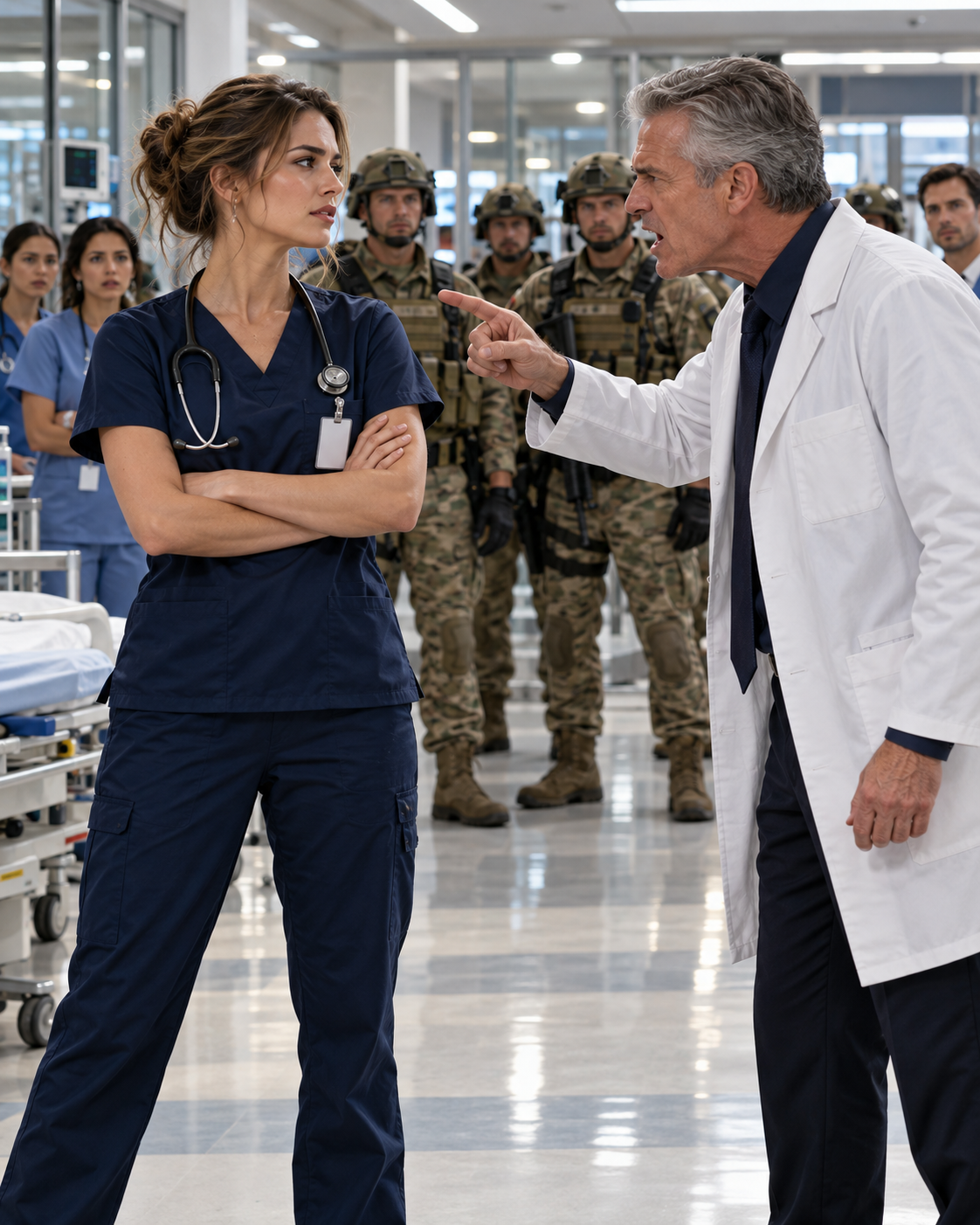
Dr. Sterling slammed his palm onto the nursing station and shouted that I had NO AUTHORITY to order an emergency surgery
I stopped with my hand on the curtain.
Richard’s voice was barely more than air.
“Don’t leave yet.”
I turned back toward his bed.
His eyes were open now, but there was something different in them.
Not fear.
Recognition.
The kind that comes when a person has finally decided he can no longer carry a secret alone.
I stepped closer.
“What is it?”
His fingers closed around the brass marker I had returned to him.
“The night in Kandahar wasn’t an accident.”
For a moment, I couldn’t hear anything except the soft rhythm of the ventilator beside him.
I had spent years telling myself that night belonged to the past.
The gunfire.
The dust.
The blood.
The nine wounded men.
The terrible decisions made in seconds.
I had buried all of it beneath years of hospital shifts and quiet routines.
“What do you mean?” I asked.
Richard swallowed.
“Someone knew where we were.”
Before I could answer, the curtain moved.
Lucas stood on the other side.
His face had gone pale.
He had heard every word.
“Richard,” he said quietly.
Richard looked at him.
“It’s time.”
Lucas entered the room and closed the curtain behind him.
For the first time since those twelve men had appeared in the waiting room, I noticed how frightened they actually looked.
These were men who had survived things most people could never imagine.
Yet none of them wanted to meet my eyes.
“What happened?” I asked.
Lucas pulled a chair beside the bed.
“The ambush wasn’t supposed to happen.”
My throat tightened.
“We were given a route,” he said.
“That route had been cleared.”
Richard lifted the brass marker.
“And this was how we found out someone had betrayed us.”
I stared at the small piece of metal in his hand.
It looked ordinary.
It was no larger than a quarter, scratched along one edge and darkened by age.
I had almost forgotten where it came from.
Almost.
Years ago, after the attack, Richard had pressed it into my hand while we waited for evacuation.
He had said it was a good-luck marker his team carried when things went bad.
I never understood why he gave it to me.
“What does this have to do with me?” I asked.
Lucas looked toward the hallway.
“Everything.”
Richard’s breathing became strained, and I immediately reached for the monitor.
“Save it,” he whispered.
I adjusted his oxygen and called the resident.
His blood pressure had dipped again.
The old nurse inside me took over before the woman inside me could panic.
“Stay with me,” I told Richard.
He gave me the faintest smile.
“Still giving orders.”
“Someone has to.”
A few minutes later, his numbers stabilized.
But the secret remained between us.
After my shift, I found Lucas waiting near the employee entrance.
The sun was barely rising over the naval base.
He handed me a sealed envelope.
“This was supposed to go to you if Richard didn’t make it.”
I stared at it.
“How long have you had this?”
“Fourteen years.”
My fingers went cold.
“Why now?”
“Because he almost died tonight.”
I looked at the envelope but didn’t open it.
“What does it say?”
Lucas shook his head.
“That’s for you to decide.”
Then he walked away.
I stood there beneath the gray morning sky with an envelope that had survived half my life.
I should have gone home.
Instead, I returned to the hospital.
I found an empty conference room and locked the door.
Inside the envelope was a single handwritten page.
The handwriting belonged to Richard.
I knew it immediately.
He had written the letter three days after the Kandahar attack.
The first sentence made my chest tighten.
“If you’re reading this, it means I couldn’t tell you in person.”
I kept going.
Richard explained that his team had discovered irregularities in the mission paperwork.
Their route had been changed hours before deployment.
The person who authorized the change had access to classified operational information.
Someone had deliberately placed them in the kill zone.
But there was something worse.
Richard believed the person responsible had been protected by someone inside the command structure.
He had tried to report it.
Then he had been warned to stop.
The warning had come from someone whose name I knew.
My hands began shaking.
It was the name of a senior officer who had been present in that trauma tent after the attack.
A man I remembered thanking for helping us evacuate the wounded.
A man who had later retired with honors.
I read the letter twice.
Then a third time.
There was one final sentence.
“He knew you were the one keeping us alive.”
I sat back.
For years, I had wondered why certain people had treated me strangely after Kandahar.
Why my recommendations had suddenly stopped being requested.
Why a promotion I had been told was nearly certain disappeared without explanation.
Why I had been quietly transferred stateside.
I had blamed bureaucracy.
I had blamed timing.
I had blamed myself.
Now another possibility stood in front of me.
Maybe someone had wanted me forgotten.
A knock sounded at the door.
I folded the letter quickly.
Dr. Sterling stood outside.
He looked different without the arrogance.
Older.
Human.
“I heard Richard’s pressure dropped again,” he said.
“He stabilized.”
He nodded.
Then he looked at the envelope in my hand.
“What is that?”
“Something from the past.”
He hesitated.
“I owe you an apology.”
I didn’t answer.
“I spent years believing authority meant being the person with the title.”
His voice cracked slightly.
“Last night taught me otherwise.”
I looked at him.
“Authority means knowing when you’re wrong.”
He nodded.
“And knowing when to listen.”
For a few seconds, neither of us spoke.
Then he said something I hadn’t expected.
“Your military records were never transferred completely into our hospital system.”
I frowned.
“What does that mean?”
“It means I spent two years working beside you without knowing what you’d done.”
I almost smiled.
“Most people don’t ask.”
“I should have.”
He left.
I looked down at the letter again.
By noon, Richard was awake enough to speak.
Lucas and the others gathered around his room.
There were no jokes.
No stories about old missions.
Just twelve men standing quietly around one hospital bed.
Richard looked at each of them.
“We waited too long.”
Lucas shook his head.
“We survived.”
“That’s not the same thing.”
Nobody argued.
Richard turned to me.
“You saved us once.”
I shook my head.
“We saved each other.”
He smiled.
“That’s what you always said.”
Then he looked toward Lucas.
“Tell her the rest.”
Lucas took a breath.
“The officer who changed our route died three years ago.”
I waited.
“But before he died, he left records.”
My pulse quickened.
“What records?”
“Names.”
He pulled out a folder.
“There were others.”
I opened it.
Several pages listed incidents from different units.
Different years.
Different locations.
The same pattern.
Information leaked.
Routes changed.
People warned.
Investigations buried.
And on one page, near the bottom, was my name.
Not as a victim.
As a witness.
I stared at it.
Lucas spoke softly.
“They were afraid you’d eventually connect everything.”
I remembered every strange transfer.
Every closed-door meeting.
Every time someone had told me not to worry.
Suddenly, my entire career looked different.
I wasn’t forgotten.
I had been contained.
I closed the folder.
“Who else knows?”
Lucas looked toward the door.
“Now?”
He gave a grim smile.
“Everyone who needs to.”
That afternoon, the hospital administrator came to Richard’s room.
He brought two security officers and a legal representative.
I knew immediately that something had changed.
The administrator looked uncomfortable.
“We received a request from federal investigators.”
“For what?”
His eyes moved toward me.
“For access to historical military medical records.”
My heart sank.
“Mine?”
He nodded.
Before I could respond, Dr. Sterling stepped forward.
“She isn’t going anywhere until Richard is stable.”
The administrator looked surprised.
Sterling didn’t move.
“She’s the reason he’s alive.”
The administrator finally nodded.
“Understood.”
After they left, I sat beside Richard.
He looked exhausted.
“You don’t have to do this,” I said.
He smiled.
“I’ve been carrying that letter for fourteen years.”
“I know.”
“I’m tired.”
I reached for his hand.
“So am I.”
He squeezed my fingers.
“But you’re still here.”
“So are you.”
He closed his eyes.
For a while, neither of us spoke.
Then he whispered, “The brass marker wasn’t good luck.”
I looked at him.
“What was it?”
He opened his eyes.
“It was a signal.”
My heart stopped.
“What kind of signal?”
“After the ambush, we started using it to identify people we trusted.”
He smiled faintly.
“I gave it to you because you were one of us.”
The words hurt more than I expected.
After all those years, I had thought of myself as the nurse who happened to be there.
They had never seen me that way.
They had seen me as one of them.
The next morning, Richard was strong enough to sit up.
Before I left, he called me back.
“There is one more thing.”
I turned.
“The person who ordered the route change wasn’t the highest person involved.”
The room seemed to shrink.
“Then who was?”
Richard looked at Lucas.
Lucas shook his head.
“Not yet.”
I stared at them.
Richard’s expression softened.
“You’ve spent your whole life saving people.”
“Yes.”
“Sometimes saving people means knowing when to stop carrying their secrets.”
I understood what he was trying to say.
He wasn’t asking me to become a soldier again.
He was asking me to decide whether I was willing to face the war I had left behind.
That evening, I went home for the first time in almost forty hours.
I showered.
I changed clothes.
I sat at my kitchen table and placed the brass marker beside my coffee cup.
For years, I had believed the hardest thing I had ever done was keep nine men alive under fire.
I was wrong.
The hardest thing was realizing that survival did not mean the war was over.
My phone rang.
Unknown number.
I almost ignored it.
Instead, I answered.
No one spoke.
Then a man’s voice said, “You should have stayed out of this.”
The call ended.
I sat perfectly still.
Outside, a storm was moving across the city.
I looked at the brass marker.
For the first time in fourteen years, I wasn’t afraid of what it meant.
I was afraid of what it might lead me to.
The next morning, I returned to the hospital.
Richard was sitting in a chair beside the window.
Lucas stood beside him.
Dr. Sterling was reviewing his chart.
When I entered, all three men looked at me.
I placed the brass marker on the table.
“I’m in.”
Lucas nodded.
Richard smiled.
Sterling looked confused.
“In what?”
I looked at him.
“The truth.”
He slowly closed the chart.
“Then I suppose I’m in too.”
For the first time, the room felt strangely peaceful.
Not because the danger was gone.
Because none of us were pretending anymore.
I picked up the marker and slipped it back onto my lanyard.
It was scratched.
Tarnished.
Almost worthless to anyone else.
To me, it was a reminder that some battles don’t end when the shooting stops.
Sometimes they wait quietly inside sealed files, forgotten names, and people who have convinced themselves that silence is the same thing as peace.
Richard watched me walk toward the door.
“Where are you going?”
I looked back.
“To my next patient.”
He smiled.
“Still saving people.”
I opened the door.
“One at a time.”
Behind me, the brass marker tapped softly against my badge as I walked down the corridor.
And for the first time in fourteen years, I wasn’t walking away from the past.
I was walking toward it.
Because courage isn’t always standing in the middle of gunfire.
Sometimes it’s finally asking who started the fire.
And sometimes the person who survives isn’t the one who escapes the battlefield.
It’s the one who refuses to let the truth die there.