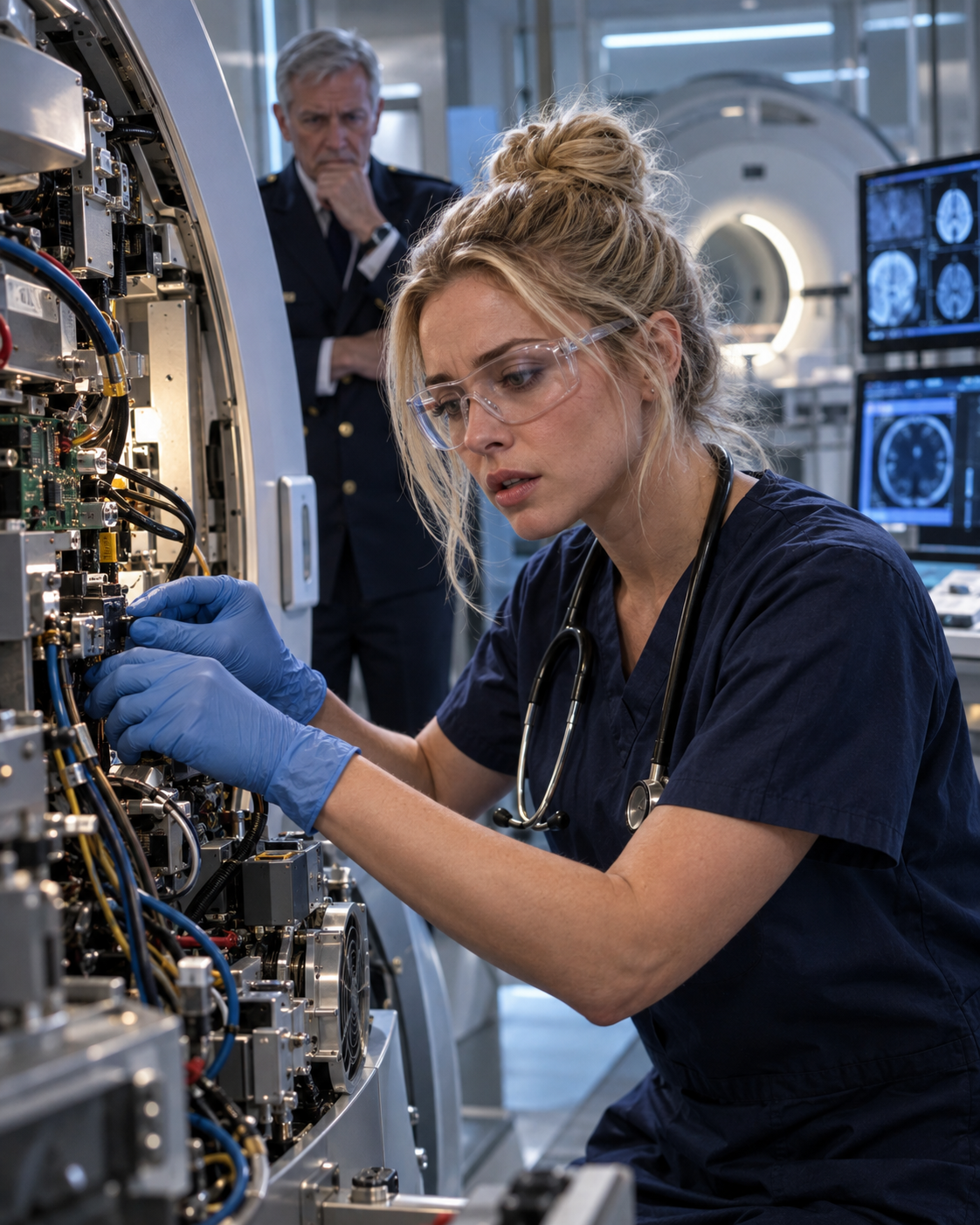
Dr. Mercier, if you cut Jeffrey open without this scan, you’re going to miss the bleed,” I said, while the CT scanner
For several seconds, nobody said anything.
The scanner continued its soft mechanical hum behind me, as if the machine had decided that whatever was happening in the room was none of its business.
I wanted to say something clever.
Something controlled.
Something that would put all of us back into the ordinary hierarchy of a hospital at three-thirty in the morning.
Instead, I said, “You have the wrong person.”
It was a terrible lie.
Commodore Sterling didn’t react.
He had aged since the last time I’d seen him, though I couldn’t have said exactly how. There were deeper lines around his eyes, more silver in his hair, and the tiredness of someone who had spent too many years signing papers that changed other people’s lives.
But I knew that face.
I’d known it before I became Cora.
Before the hospital.
Before the navy records disappeared into the administrative machinery of a career I had once believed would last until retirement.
“Do I?” he asked.
Dr. Mercier looked at me.
“Chief Warrant Officer?”
I couldn’t meet his eyes.
Sterling turned toward the door.
“Is the patient in surgery?”
“Yes,” Dr. Al-Mansoor answered from the hallway.
“How long?”
“They’re opening now.”
Sterling nodded once.
“Good.”
Then he looked back at me.
“We’ll talk when he’s stable.”
“No.”
The word came out before I could stop it.
Sterling’s expression changed slightly.
Not surprise.
Recognition.
He knew exactly what that no meant.
I had spent years saying it to people who wanted explanations.
“No inquiries,” I said.
His voice softened.
“This isn’t an inquiry.”
“They always say that.”
Mercier frowned.
“Can someone explain what is happening?”
Sterling looked at him.
“Doctor, you have a patient in surgery because this woman recognized a military imaging failure your team was treating as a hardware fault.”
Mercier’s face tightened.
“I was following the manufacturer’s protocol.”
“Yes,” Sterling said. “And that’s the problem.”
The sentence landed harder than an accusation.
Sean looked at me.
“How did you know the bypass?”
I stared at the scanner.
“I was trained on the field configuration.”
“What field configuration?”
I didn’t answer.
Sterling did.
“She helped develop deployment protocols for tactical imaging units.”
Meera’s mouth fell open.
Dr. Mercier stared at him.
“That isn’t in her file.”
“No,” Sterling said. “It isn’t.”
He looked at me again.
“That was the point, wasn’t it, Corinne?”
I folded my arms.
“Cora.”
He gave a tired nod.
“If that’s what you need right now.”
I hated him for saying it gently.
People were easier to fight when they were cruel.
Cruelty gave you something to push against.
Kindness made you remember that once, a long time ago, you had trusted them.
At 4:02 a.m., Dr. Al-Mansoor came back from the operating room.
She pulled off her cap and rubbed both hands over her face.
“He’s alive.”
The room exhaled.
She looked at me.
“We found the arterial injury exactly where the scan showed it.”
I nodded.
“Is he stable?”
“For now.”
She paused.
“Thank you.”
I didn’t know what to do with that.
So I said the only thing I could.
“Make sure he wakes up.”
“He has every chance.”
Then she left.
I watched the door close.
That should have been the moment I felt relief.
Instead, I felt exhausted.
Three years of exhaustion arriving all at once.
Sterling waited until the room had emptied.
Then he said, “Come with me.”
I laughed once.
It wasn’t funny.
“I’ve been avoiding that sentence since 2023.”
“I know.”
That stopped me.
“You know?”
“I know where you’ve been.”
He glanced at my badge.
“I know what name you’ve been using. I know you took a civilian nursing position. I know you refused every attempt to reopen your service file.”
My chest tightened.
“Then why didn’t you come?”
“Because you told me, through counsel, that if I contacted you again you’d consider it harassment.”
I closed my eyes.
I remembered that letter.
I remembered signing it at a kitchen table with my curtains drawn even though it was noon.
“I meant it.”
“I know.”
He sat in the chair beside the workstation.
For a moment he wasn’t a commodore.
He was just a tired man in a uniform, waiting for me to decide whether I could tolerate another conversation about the worst day of my life.
“Marc’s mother still lives in Saint John,” he said.
My eyes opened.
“Don’t.”
“I haven’t spoken to her in three years.”
“Don’t bring her into this.”
“I didn’t come here for Marc.”
I stared at him.
“Then why are you here?”
“Because a military hospital almost killed a sailor tonight because a procurement decision put a tactical scanner under civilian maintenance procedures.”
He let that sit.
“That’s why I’m here.”
The distinction mattered.
I could feel it.
He wasn’t asking me to forgive the past.
He was asking me to look at the present.
I looked toward the scanner.
“It’s been doing this for months.”
Sterling’s expression changed.
“What?”
I reached into the drawer beneath the console and pulled out a thin folder.
I’d kept it hidden beneath old quality-assurance forms.
Inside were copies of maintenance logs, temperature readings, error codes and three handwritten notes I’d made after previous incidents.
“Three undocumented lockouts,” I said. “Two aborted scans. One patient transferred because the scan couldn’t be completed.”
Mercier, who had remained near the doorway, stepped forward.
“You knew?”
I looked at him.
“Yes.”
“And you didn’t report it?”
“No.”
His face hardened.
“You allowed a known equipment defect to remain in service.”
The accusation hurt because it wasn’t entirely wrong.
“I identified the pattern,” I said. “I didn’t know whether the pattern was dangerous.”
“You knew enough to make notes.”
“Yes.”
“Then why didn’t you tell anyone?”
I could have blamed him.
It would have been easy.
He had dismissed me for months. He had corrected my pronunciation of technical terms in front of residents. He had once told me, in front of four people, that nurses who wanted to play engineer were dangerous.
But none of that was the real reason.
I looked down at the folder.
“Because the last time I said I saw something everyone else had missed, a man died.”
Nobody spoke.
The memory came back without permission.
A training range in northern New Brunswick.
Wet ground.
A demolition charge that had been inspected twice.
Marc Dupuis laughing because the coffee was terrible.
Me standing over a hydrological map that showed the ground should have been stable.
The explosion.
The sound wasn’t like movies.
It was pressure.
A wall of it.
Then silence.
Three years later, I still woke up with dirt in my mouth that wasn’t there.
The official inquiry had said I had failed to adequately account for shifting ground conditions.
I had read that sentence so many times it had become part of my identity.
Chief Warrant Officer Corinne Vance.
Failure of judgment.
One dead.
Inquiry closed.
Career finished.
So I became Cora.
I learned how to smile at nurses’ stations.
I learned how to ask where the coffee was.
I learned to keep my opinions inside my head.
Dr. Mercier’s voice was quieter when he spoke again.
“What exactly happened?”
Sterling answered before I could.
“Not tonight.”
Mercier looked at him.
“Commodore—”
“Not tonight.”
There was no argument.
At 6:11 a.m., the administrator, Danielle Cormier, arrived in the imaging suite wearing a wool coat over pajamas.
She had been called from home.
She took one look at the folder on the counter and understood that her morning had changed.
By seven, there were six people in the room.
By eight, there were twelve.
And by nine, I was sitting in a conference room staring at a projection of the hospital’s CT failure logs.
The pattern was obvious once the data were aligned.
The HVAC system had undergone an overnight energy-saving cycle.
The temperature dropped just enough to trigger a thermal compensation error.
The military scanner interpreted the incomplete compensation as a hardware cascade.
Civilian technicians, following the civilian manual, were instructed to isolate hardware components.
The more they tested, the longer the scanner remained locked out.
The machine wasn’t broken.
It was protecting itself from a condition it had been designed to survive.
Nobody had bothered to tell the hospital that.
Danielle sat at the end of the table.
“We need to understand how this got here.”
Sterling nodded.
“I’ve already requested the procurement records.”
I felt my stomach tighten.
“You shouldn’t.”
He looked at me.
“Why?”
“Because they’ll make it look like someone made a mistake.”
“They may have.”
“No.”
I pointed at the screen.
“This isn’t one person’s mistake.”
That was the first thing I’d said all morning with certainty.
“The manuals were changed. The firmware wasn’t. The maintenance contract was transferred. The environmental specifications weren’t carried over. Somebody copied a civilian support package onto a military platform.”
Sterling leaned back.
“How do you know?”
“Because the old configuration uses a different temperature envelope.”
Danielle frowned.
“You’re saying this has been misclassified?”
“Yes.”
“How long?”
I hesitated.
“Possibly since installation.”
The room went silent.
Mercier was sitting across from me.
He looked smaller than he had the night before.
Not weak.
Just human.
He finally said, “You should have told me.”
I met his eyes.
“I tried.”
He shook his head.
“No. You hinted.”
“I was afraid.”
“Of me?”
“Of being wrong.”
That answer seemed to land somewhere neither of us expected.
He looked down at his hands.
“I thought you were afraid of looking foolish.”
“I was afraid of killing someone.”
He swallowed.
Then he nodded.
“I understand now.”
It wasn’t an apology.
Not yet.
But it was the first honest thing between us.
Two hours later, the procurement records arrived.
And that’s when the story became worse.
The scanner’s original documentation had been complete.
The missing technical appendix had been removed during a contract transition.
Not misplaced.
Removed.
The person who signed the transfer wasn’t some faceless administrator.
It was a former defense contractor named Peter Rourke, who had since retired.
His signature appeared on three separate documents.
I stared at his name.
Something about it bothered me.
I knew it.
Not from the hospital.
From the range.
I pulled the file closer.
“Where have I seen him?”
Sterling watched me.
“That’s what we’re trying to determine.”
I shook my head.
“No.”
I tapped the document.
“Not here.”
Then I remembered.
A hydrological survey.
Three years earlier.
The map that had shown stable ground beneath the demolition site had been subcontracted through the same company Rourke had represented.
My mouth went dry.
“Commodore.”
He leaned forward.
I turned the page.
The room went quiet.
“His company supplied the ground survey for Marc’s range.”
Sterling’s expression changed.
Not shock.
Something heavier.
Recognition.
“I suspected that,” he said.
I stared at him.
“You knew?”
“I knew there were irregularities.”
“How long?”
“Three years.”
I pushed my chair back.
“You knew?”
“I knew there were discrepancies. I did not know they caused the collapse.”
“But you let me believe it was my fault.”
His face tightened.
“The inquiry concluded—”
“I didn’t ask what the inquiry concluded.”
My voice cracked.
“I asked what you knew.”
He didn’t answer immediately.
That was answer enough.
I stood.
“You let me carry it.”
“I thought reopening the case without evidence would destroy you further.”
“You don’t get to decide what destroys me.”
The room had become painfully quiet.
Sterling looked down.
“You’re right.”
I wasn’t prepared for that.
I wanted him to defend himself.
I wanted an argument.
Instead he said, “I was wrong.”
I sat back down.
For the first time in three years, someone in authority had said those words to me without adding a condition afterward.
Still, it wasn’t enough.
“Then show me,” I said.
He nodded.
“We will.”
The investigation took six days.
Six days of old maps, archived emails, contractor invoices and environmental readings.
I barely slept.
Jeffrey remained in recovery.
Every afternoon, Dr. Al-Mansoor sent me a text with the same update: stable, improving, annoyed at hospital food.
I liked that last part.
It meant he was alive enough to complain.
On the fourth day, Dr. Mercier came to find me in the imaging department.
He was holding a paper cup.
“I brought coffee.”
I stared at it.
“Why?”
“I didn’t know how to apologize.”
“That makes two of us.”
He gave me the cup.
Then he sat beside me.
“I was arrogant.”
“Yes.”
He winced.
“I deserved that.”
“Yes.”
He almost smiled.
“I kept thinking experience meant certainty.”
I looked at him.
“It doesn’t.”
“No.”
He paused.
“Sometimes it just means you’ve become very good at being wrong in familiar ways.”
That was the first time I laughed around him.
He looked relieved.
Then he said, “I checked the older scans.”
My smile faded.
“What did you find?”
“The previous lockouts weren’t random.”
He handed me a printout.
“The temperature drops happened before every failure.”
I stared at the graph.
Something inside me loosened.
For months, I had thought my fear was the problem.
It wasn’t.
The system had actually been telling us the truth.
We simply hadn’t listened.
That evening, Sterling called.
“Come to the records office.”
When I arrived, the original range file was open on his desk.
He didn’t speak.
He pushed a folder toward me.
Inside was the hydrological survey.
I read it once.
Then again.
There it was.
A revised water table estimate had been issued eleven days before the training exercise.
The revision showed the soil beneath the range was unstable after sustained rainfall.
My unit never received it.
The version I had been given was older.
Marc had died because information existed somewhere in the system that never reached the people standing on the ground.
My hands began to shake.
“Why wasn’t this in the inquiry?”
“We don’t know yet.”
I looked up.
“Then don’t tell me I’m cleared.”
Sterling frowned.
“Why?”
“Because I need to know why.”
That became the final investigation.
Not whether I had failed.
Why the information had failed to reach us.
And the answer was ugly in a way that felt more human than any conspiracy could have been.
Three offices had assumed another office had distributed the revision.
An automated mailing list had been retired.
A contractor had sent the update to an obsolete address.
A junior clerk had filed it under a different range designation.
No one person had decided to hide it.
Everyone had assumed someone else had handled it.
Marc died in the space between those assumptions.
And I had spent three years turning that administrative failure into a personal sentence.
When the formal review came back, Sterling asked me to read it alone.
I did.
The conclusion was blunt.
The hydrological discrepancy materially contributed to the range accident.
There was no evidence that my actions caused the ground shift.
There was no basis for the finding that I had acted negligently.
I read that paragraph until the words blurred.
Then I put the pages down.
I expected relief.
Instead, I cried.
Not dramatically.
Not loudly.
Just the kind of crying that happens when your body has been waiting years for permission.
Sterling stood near the window.
He didn’t touch me.
He knew better.
After a while, I said, “I don’t know who I am if it wasn’t my fault.”
He looked at me.
“You don’t have to know today.”
That sentence stayed with me.
Three weeks later, Jeffrey walked into the imaging suite.
He was thinner.
Paler.
He was holding a plastic bag of clothes and moving like every step had been negotiated with his abdomen beforehand.
Dr. Al-Mansoor followed behind him.
“Don’t get excited,” she said. “He’s still supposed to take it easy.”
Jeffrey grinned.
“Apparently almost dying doesn’t get you out of paperwork.”
I laughed.
He looked at me.
“You’re Cora, right?”
I hesitated.
Then I smiled.
“Sometimes.”
He shook his head.
“I remember you.”
“You were unconscious.”
“I remember your voice.”
That surprised me.
“What did I say?”
“You told someone to move.”
I laughed again.
“That sounds like me.”
He held out his hand.
“Thank you.”
I took it.
His grip was weak.
But steady.
“I didn’t save you,” I said.
He shook his head.
“You helped.”
That was enough.
A month later, I sat in Danielle Cormier’s office with a new contract in front of me.
Technical consultant.
Military imaging systems.
National audit.
My real name was printed across the top.
Corinne Vance.
Not Cora.
Not Chief Warrant Officer in secret.
Not Deepwater whispered by people who remembered the old days.
Just my name.
I looked at Sterling.
“You’re sure?”
“No.”
I smiled.
“Good answer.”
He smiled back.
“We need someone who knows what happens when paperwork and reality disagree.”
I signed.
Not because I wanted my old life back.
I didn’t.
That woman was gone.
I signed because I finally understood something I hadn’t been capable of understanding three years earlier.
A person can survive being wrong about themselves.
What destroys them is refusing to examine the story they’ve built around the mistake.
The next morning, I walked into radiology wearing my old hospital scrubs for the last time.
Dr. Mercier was at the workstation.
He glanced at my badge.
Then at me.
“Chief Warrant Officer.”
I raised an eyebrow.
“Doctor.”
He smiled.
“Still hate being called Cora?”
I thought about it.
“No.”
He nodded.
“Good.”
I looked through the glass at the CT scanner.
The machine was running a calibration sequence under the new protocol.
Thirty-eight seconds.
Exactly.
I watched the gantry turn.
For years, I had believed silence was the safest place I could live.
It had protected me from questions, from judgment, from the possibility of being wrong again.
But that night, standing beside a machine I had been too afraid to touch, I finally understood why my hands had remembered what my heart had tried so hard to forget.
I had never lost the person I was.
I had only buried her under a name that felt safer.
And when I finally signed the new service protocols as Corinne Vance, I didn’t feel like I was returning to the woman I used to be.
I felt like I was meeting her for the first time.