Don’t lift that beam yet,” I shouted, dropping beside the twisted grandstand as Professor Albright disappeared beneath
For one second, nobody moved.
Then Chief Morrison pointed toward the medical tent.
“Saline?”
Sierra’s event coordinator nodded frantically.
“Three cases.”
“Bring them.”
Sierra stepped forward.
“You can’t just take supplies from our tent.”
I turned toward her.
“Your tent is currently sitting twenty yards from sixty injured people.”
She opened her mouth.
Nothing came out.
Tessa was the one who answered.
“I’ll get them.”
She ran.
That was the first thing Sierra’s people did that actually helped.
I crawled farther under the twisted steel.
The space was barely large enough for my shoulders.
Professor Albright was conscious, but her breathing was shallow.
“Can you feel your legs?”
“Yes.”
“Any chest pain?”
“No.”
“Dizziness?”
“A little.”
“Stay with me.”
Her fingers found my wrist.
“You’re still carrying it.”
I glanced at the red backpack.
“Apparently.”
She smiled.
“Your grandfather would be proud.”
I didn’t answer.
I was concentrating on her pulse.
Fast.
Weak.
Her right leg was pinned beneath a section of truss.
There was no obvious arterial bleeding, but the tissue around the compression was already swelling.
I could hear firefighters preparing the hydraulic tools above us.
Chief Morrison’s voice came through the wreckage.
“We’re going to lift six inches.”
“Not yet.”
He crouched beside the opening.
“Lieutenant, we have to create space.”
“I know. Give me another minute.”
He nodded.
No argument.
No ego.
Just trust.
Tessa returned carrying saline.
Behind her came another medic with oxygen and supplies.
I started an IV.
Professor Albright winced.
“Still bossy?”
“Always.”
“Good.”
I smiled despite myself.
Then her monitor changed.
The rhythm became irregular.
The medic beside me frowned.
“What’s that?”
I watched the monitor.
The QRS complexes were widening.
My stomach tightened.
“Hyperkalemia.”
The crushed muscle was releasing potassium into her bloodstream.
The danger wasn’t theoretical anymore.
Her rhythm began developing a sine-wave pattern.
Chief Morrison leaned down.
“What does that mean?”
“It means we don’t have much time.”
The firefighter beside him cursed softly.
“Calcium.”
The medic handed it to me.
I administered calcium chloride while another medic prepared bicarbonate and fluids.
The rhythm didn’t immediately normalize.
Professor Albright’s eyes opened.
“Fiona.”
“I’m here.”
“Don’t let them carry me out until you’re ready.”
“I won’t.”
That was when I understood something I hadn’t wanted to admit.
She trusted me.
Not because of my rank.
Not because of the uniform.
Because five years earlier, when everyone else had been laughing at a battered backpack, she had seen a person.
I kept working.
Calcium.
Bicarbonate.
Fluids.
Monitoring.
Then the rhythm narrowed.
The monitor steadied.
I exhaled.
“Now.”
Chief Morrison shouted.
“Lift!”
Hydraulic tools screamed.
Steel rose inch by inch.
The firefighter beside me slid a board underneath Professor Albright.
“Careful!”
The beam moved another inch.
Her body shifted.
For a terrible second, her pulse vanished.
Then returned.
“Keep going.”
The beam cleared enough space.
We pulled her free.
The moment she emerged, the waiting medical team surrounded her.
Sierra stood nearby, pale and silent.
Professor Albright’s eyes found her.
Then mine.
“Don’t let her film this.”
I laughed despite everything.
“She stopped.”
Sierra looked down at the phone in her hand.
The screen was still recording.
She stared at it as if she’d forgotten it existed.
Then she turned it off.
The rest of the rescue blurred into movement.
Stretchers.
Bandages.
Airway checks.
Names written on forearms.
Parents screaming for information.
Firefighters cutting steel.
Medics arriving from three surrounding counties.
A helicopter landing on the athletic field.
By late afternoon, sixty-three injured people had been transported.
Miraculously, everyone survived.
Some had broken bones.
Some had severe crush injuries.
Several needed surgery.
One student lost part of his leg.
But no one died.
I didn’t let myself think about that number until much later.
At the time, there were simply people in front of me.
One after another.
One problem at a time.
When the last ambulance pulled away, I finally sat on the curb.
My uniform was torn at the knee.
There was dried blood on my sleeve.
The red backpack lay beside me.
Its zipper was still stuck.
I tried it once.
It opened.
I laughed.
Then I heard footsteps.
Sierra.
She stopped a few feet away.
Without the makeup and perfect posture, she looked strangely young.
“Fiona.”
I didn’t answer.
She swallowed.
“Lieutenant Gallagher.”
That sounded even stranger.
She stared at the backpack.
“That’s why.”
I looked at her.
“Why what?”
“You kept it.”
“Yes.”
“All these years.”
“Yes.”
She looked down.
“I remember that day.”
“So do I.”
“I thought you were going to yell at me.”
“I considered it.”
She almost smiled.
Then the smile disappeared.
“I was horrible.”
“You were twenty.”
“So were you.”
“That’s true.”
She sat on the curb several feet away.
For a while, neither of us spoke.
Then she said, “My video is still online.”
I nodded.
“I know.”
“It went viral.”
“I figured.”
She rubbed her palms together.
“People are watching it now.”
“What video?”
“The livestream.”
My expression changed.
“What livestream?”
“The collapse.”
She handed me her phone.
The screen showed thousands of comments moving too quickly to read.
Someone had clipped the moment Chief Morrison called me Lieutenant.
Another clip showed me crawling beneath the steel.
A third showed me treating the student with the chest injury.
Someone had identified my military unit.
Someone else had found old photographs from graduation.
And underneath it all was Sierra’s original five-year-old post.
Bag Girl.
The internet had connected everything.
But that wasn’t what bothered me.
I watched Sierra’s face on the screen as the grandstand collapsed.
For several seconds, she had stood frozen.
Then she had tried to raise her phone.
Then she had dropped it.
Then she had begun shouting for help.
It wasn’t flattering.
But it was human.
“You don’t have to apologize to the internet,” I said.
She looked at me.
“I know.”
“Then why are you here?”
She took a breath.
“Because I need to apologize to you.”
I waited.
She stared at the ground.
“I made you into a joke because I thought everybody needed to see that I was better than someone.”
Her voice cracked.
“I didn’t even know you.”
“No.”
“I knew your clothes. Your bag. Your job. Your grades.”
She wiped her cheek.
“I didn’t know you.”
That was the first apology she could have given me that mattered.
Not because it erased anything.
Because she finally understood what she had actually done.
Tessa approached quietly.
She had blood on her sleeves.
“You okay?”
I nodded.
She looked at Sierra.
Then back at me.
“I want to learn how to do this.”
“Do what?”
“This.”
She gestured toward the quad.
“I froze when the grandstand fell.”
“So did everyone.”
“But you didn’t.”
“I’ve frozen before.”
Tessa shook her head.
“Not today.”
I studied her face.
She wasn’t asking for admiration.
She was asking where to start.
“Paramedic school,” I said.
She smiled.
“That’s what I was thinking.”
Sierra stood.
“My clinic sponsors an EMT scholarship.”
Tessa looked at her.
Sierra hesitated.
“I’m not asking you to forgive me.”
Tessa nodded.
“Good.”
I almost laughed.
Then Chief Morrison walked over.
He had a helmet tucked beneath one arm.
“You Lieutenant Gallagher?”
“Yes, Chief.”
“You did good work.”
“Your crews did.”
He shook his head.
“We all did.”
He glanced at the backpack.
“That thing really belonged to your grandfather?”
“Yes.”
“Corpsman?”
“Twenty-two years.”
He nodded slowly.
“Sounds like he taught you well.”
“He did.”
Chief Morrison looked toward the helicopter where Professor Albright was being transferred to another aircraft.
“She’ll make it.”
I closed my eyes for a second.
“Thank God.”
The Chief walked away.
I expected relief.
Instead, something unexpected happened.
I started crying.
Quietly.
No collapse.
No sobbing.
Just tears.
Tessa sat beside me.
“You okay?”
“I think so.”
“Then why are you crying?”
I looked at the red backpack.
“Because my grandfather gave me this when I was seventeen.”
“What did he say?”
I smiled.
“He said, ‘You don’t carry supplies because you expect disaster. You carry them because someone else shouldn’t have to be unprepared.’”
Tessa was quiet.
“That sounds like him.”
“It was.”
She looked at the backpack.
“Would you ever let me see what’s inside?”
I unzipped it.
There wasn’t much left.
A few dressings.
A pen.
A pair of gloves.
A small sewing kit.
And tucked into the deepest pocket, wrapped in a cloth, was the object I had carried for years without showing anyone outside the military.
My gold trident.
I held it in my palm.
Tessa stared.
“You were really Navy?”
I smiled.
“I really am.”
She laughed.
Sierra looked at the insignia.
Her eyes filled again.
“I thought you were just some girl with an old bag.”
“I was.”
She looked confused.
“What?”
“I was just some girl.”
I closed my hand around the trident.
“That was enough.”
Three days later, Professor Albright woke up.
She called me before she’d even spoken to her doctors.
“You missed my retirement.”
“I had a scheduling conflict.”
She laughed.
Then she got quiet.
“You came back.”
“Yes.”
“I was hoping you would.”
I looked through the hospital window at the city below.
“I almost didn’t.”
“Why?”
I thought about the quad.
The laughter.
The old humiliation.
The backpack.
The grandstand.
Sierra’s face.
“My grandfather used to say that returning to a place isn’t the same as going backward.”
Professor Albright was silent for a moment.
“He was right.”
“I think so.”
When I returned to campus a week later, the grandstand was gone.
The university had fenced off the area.
Investigators were examining the failed connection.
There would be reports.
Lawsuits.
Hearings.
Questions about inspections and maintenance.
There should be.
A structure had failed.
People had been injured.
Someone had missed something important.
The university needed to understand why.
I didn’t want a medal for noticing it.
I wanted the answer.
That mattered to me more.
Sierra eventually shut down the social media campaign she had built around the disaster.
Her sponsors left.
Some publicly.
Some quietly.
I never celebrated it.
I had seen enough consequences to know they weren’t entertainment.
Months later, I heard she had begun volunteering with a local emergency preparedness organization.
Maybe it was genuine.
Maybe it was guilt.
Maybe it was both.
People rarely change for one clean reason.
Tessa entered paramedic training.
On her first day, she sent me a picture of herself outside the classroom.
She was holding a brand-new backpack.
Bright red.
I texted her:
“Too clean.”
She replied:
“Give me time.”
I laughed.
Before leaving campus, I stopped outside Professor Albright’s office.
The door was open.
Her old desk was still there.
A photograph of me sat beside her books.
I picked it up.
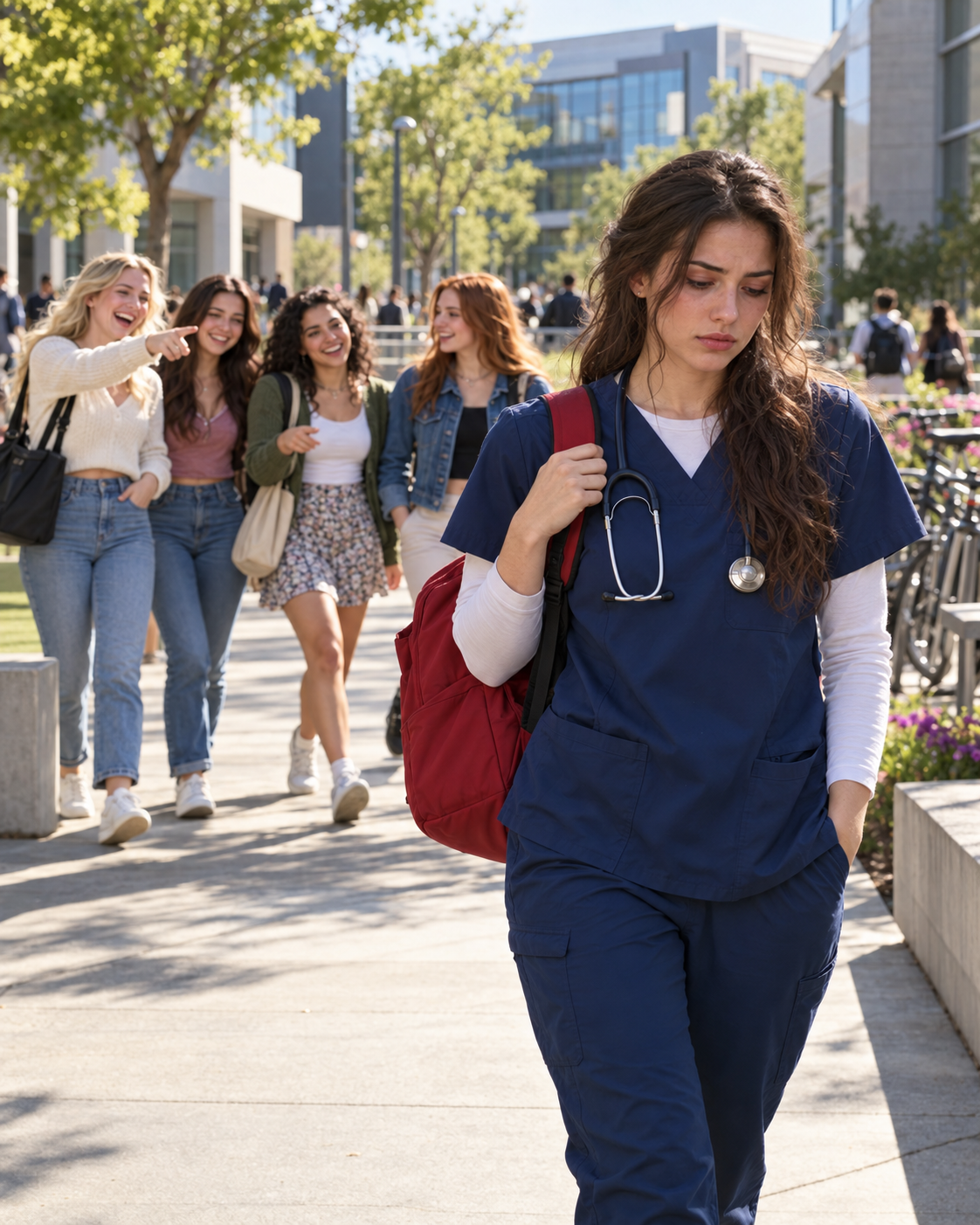
Five years earlier, I had walked across that same quad feeling ashamed of a backpack.
Now I stood there wearing a uniform that had nothing to prove.
I understood something then that I hadn’t understood when I was twenty.
Respect isn’t the opposite of humiliation.
It isn’t the number of followers you have.
It isn’t a title, a building, a family name, or a polished photograph.
It’s what remains when nobody is applauding and someone else’s life is suddenly in your hands.
I carried my grandfather’s red backpack out through the campus gates one last time.
Tessa was waiting by the sidewalk.
“You’re really giving it to me?”
I nodded.
She looked terrified.
“Are you sure?”
“My grandfather carried it for twenty-two years.”
She touched the faded canvas.
“How do I fill it?”
I smiled.
“You don’t.”
She frowned.
“You earn what’s inside.”
I handed it to her.
The old strap settled over her shoulder.
It looked too large.
Just as it had once looked on me.
I walked away before either of us could make the moment bigger than it needed to be.
My grandfather’s backpack had started as something I was ashamed to carry.
Then it became the thing that taught me who I was.
And as I headed back toward the life waiting beyond the campus gates, I didn’t feel like Bag Girl anymore.
I felt like the girl who had finally understood why her grandfather had never cared whether the canvas was worn.
He had only cared that when the ground gave way, she was ready to run toward the people who needed her.