Dad, why is that lady trying to take your car?” Nora whispered, gripping Barnaby so tightly his faded felt ear bent sideways
The name on Marian’s screen was Richard Hale.
I didn’t know who he was, but the moment she answered, the color drained from her face.
“Richard, I’m standing in front of it.”
She listened.
“No. The chassis plate is untouched.”
Another pause.
“I don’t care what your paperwork says. I’m looking at the metal.”
She turned away from the crowd.
I couldn’t hear the rest of the conversation, but I could see the muscles in her jaw tighten.
When she hung up, she didn’t immediately come back.
Instead, she stood beside the trailer staring at the ruined Cobra as though it had just spoken to her.
Victoria finally broke the silence.
“Marian, perhaps we should move this discussion somewhere private.”
Marian looked at her.
“No.”
That one word had more weight than Victoria’s entire afternoon of authority.
“This needs witnesses.”
The cameras were still rolling.
People who’d been drinking champagne under the exhibition tent were now packed around my trailer. A man in a navy suit kept whispering, “That’s impossible,” while another collector had his phone out, searching the chassis number.
Nora stood beside me.
I put a hand on her shoulder.
“You okay?”
She nodded.
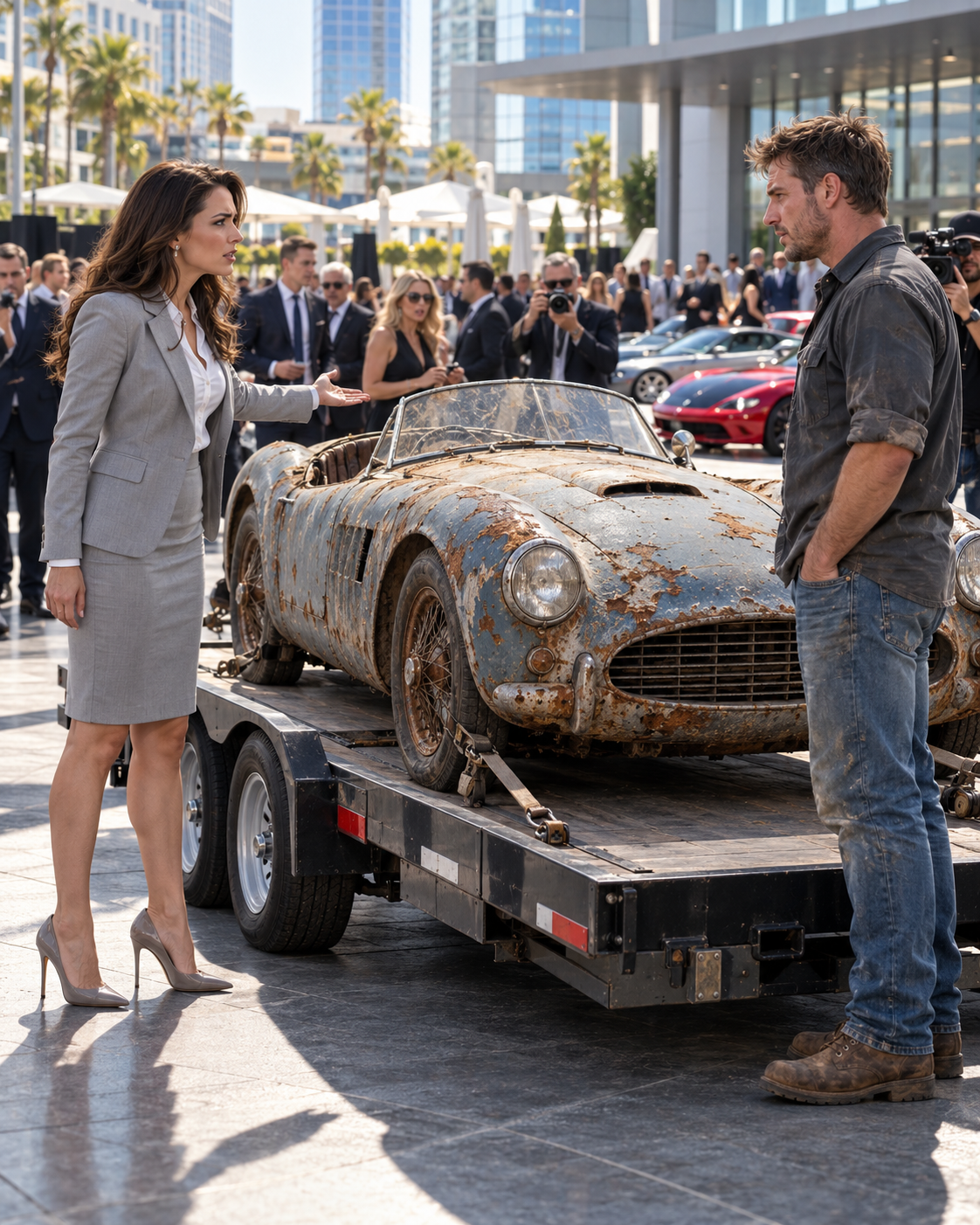
Then she looked up.
“Is the car a millionaire?”
I laughed before I could stop myself.
“No, honey.”
“What is it?”
“Apparently, very expensive.”
She considered that.
“Barnaby still likes it.”
“That’s good.”
“Can we keep it?”
I looked at the rusted shell.
Then at Marian.
“I don’t know yet.”
That answer seemed to satisfy her.
Adults, I’ve learned, are often the ones who make simple things complicated.
Marian asked me to take her somewhere quiet.
We went behind the service tent, where the noise from the crowd became muffled.
She took off her glasses.
“Listen carefully,” she said. “A valuation is not proof of ownership history. The chassis appears authentic, but we need to establish provenance before anyone puts a number on it that matters.”
“I understand.”
“No, you don’t.”
She looked toward Nora.
“You just became the custodian of something that may have a history people will fight over.”
That word stuck with me.
Custodian.
Not owner.
Not winner.
Custodian.
“Who was Richard Hale?”
Marian hesitated.
“A collector.”
“That doesn’t answer the question.”
“He’s the president of a private automotive trust. Twenty-eight years ago, he purchased what was believed to be the last known surviving chassis from a private estate.”
“And?”
“And that chassis was reported stolen during transport.”
I stared at her.
“Twenty-eight years ago?”
“Yes.”
“And you think this is it?”
“I think we need to find out.”
Before I could respond, a man in a charcoal suit approached us.
He was perhaps sixty, with silver hair and the calm expression of someone accustomed to entering rooms where everyone else already knew his name.
“Mr. Mercer?”
“Yes.”
“My name is Richard Hale.”
Marian stepped between us.
“You shouldn’t be here.”
“I had to see it.”
Richard’s eyes went to the trailer.
He didn’t touch the car.
For a moment, something almost like grief passed across his face.
Then he looked at me.
“I believe that’s my car.”
I expected anger.
I expected arrogance.
Instead, he looked exhausted.
I said, “You’d better have something stronger than belief.”
He nodded.
“I do.”
He reached into his coat and removed a folder.
Inside was a photocopy of an old transport manifest.
The chassis number matched mine.
So did the delivery date.
But the buyer’s name wasn’t Richard Hale.
It was his father, Thomas.
I looked at Marian.
“That’s bad.”
“Not necessarily,” she said.
Richard swallowed.
“My father died believing that car had been destroyed.”
“Then why was it reported stolen?”
His eyes lowered.
“Because it wasn’t stolen.”
Marian’s expression hardened.
“Richard.”
“My father was involved in an insurance dispute. He claimed the car disappeared during transport. The insurer paid him. Years later, he confessed to me that he’d hidden it.”
“Why?”
Richard looked toward the trailer.
“Because he was afraid of what he’d done to it.”
I felt a coldness move through me.
“What did he do?”
Richard didn’t answer immediately.
Instead, he looked at Nora.
Then at Barnaby.
Then back at me.
“He had it buried.”
I frowned.
“Why?”
“Because the car had been modified.”
“Modified how?”
Marian closed the folder.
“Richard.”
He shook his head.
“No. He deserves to know.”
Richard looked at me.
“My father had been racing it illegally. He destroyed parts of the original drivetrain. He believed that if the car ever resurfaced, collectors would discover the alterations and the insurance fraud.”
That explained the barn.
It explained the dirt.
It explained why somebody had deliberately hidden a million-dollar automobile under a collapsed structure.
But it didn’t explain the second number.
I told Marian.
Richard’s face changed.
“There’s a second number?”
“Yes.”
“Where?”
She pointed.
He stepped closer.
For the first time since we’d met, his composure cracked.
“That isn’t my father’s number.”
“What does it mean?”
“I don’t know.”
Marian crouched beside the chassis.
The number was partially obscured beneath corrosion.
She photographed it.
Then she went silent.
“What?”
She looked up.
“It’s a factory inspection code.”
Richard leaned down.
Marian continued.
“Not a replacement marking. Not a repair stamp. It was applied before the chassis left the Shelby American facility.”
“So?”
“So somebody altered the history afterward.”
Richard’s face tightened.
“You’re saying the records are wrong.”
“I’m saying the records are incomplete.”
The distinction mattered.
And it would matter even more the next morning.
By sunrise, the story had spread far beyond the gala.
A local news station had posted the footage of Nora crying beside the wrecker.
People online were arguing about everything from the car’s value to whether Victoria should be fired.
I didn’t read any of it.
I was more concerned with my daughter.
She woke at six and asked if the lady from the television was still angry.
“No.”
“Did she take the car?”
“No.”
“Is she going to?”
“I don’t know.”
Nora sat at the kitchen table with cereal going soft in front of her.
“Daddy?”
“Yeah?”
“Were you scared yesterday?”
I wanted to say no.
Instead, I told her the truth.
“Yes.”
She nodded.
“Me too.”
That was the first moment I understood that standing in front of the winch hadn’t been courage.
It had been panic wearing work boots.
I had been terrified that my daughter would see me surrender something simply because someone more powerful told me I wasn’t allowed to keep it.
But I also understood something else.
I didn’t want Nora growing up believing that every fight had to be won by standing in front of the machinery until somebody backed down.
Sometimes protecting something meant knowing when to step aside and let the truth do the fighting.
Two days later, Marian called.
“Come to the shop.”
Her tone told me not to ask questions.
I brought Nora.
Marian had arranged for the Cobra to be moved to a secured restoration facility.
When I arrived, she had three people waiting.
An archivist.
A metallurgist.
And an elderly man named Samuel Ortiz.
Samuel had worked at Shelby American in the sixties.
He walked around the car twice without touching it.
Then he stopped beside the driver’s door.
His eyes filled with tears.
“I remember this.”
Nobody spoke.
Samuel rested his fingers against the scarred aluminum.
“Not the car,” he said. “The driver.”
Marian looked at him.
Samuel nodded.
“Her name was Evelyn Mercer.”
My stomach tightened.
Mercer.
My name.
I stared at him.
“What?”
Samuel looked at me.
“She was your grandmother.”
I actually laughed.
Not because it was funny.
Because my brain didn’t know what else to do.
“My grandmother drove a Cobra?”
“Not just drove one.”
Samuel pointed toward the rear quarter panel.
“She raced it.”
I had never known.
My father never spoke about her.
I’d grown up hearing that she worked in a textile mill and hated cars.
Samuel told us the rest slowly.
Evelyn had been one of the few women in her racing circle to compete seriously against factory-backed drivers. She owned the Cobra briefly before selling it after a crash.
But according to Samuel, she never signed away the original competition history.
That meant the car wasn’t merely valuable because of its chassis.
Its history might be the reason collectors would pay extraordinary money for it.
I called my father.
He’d been gone nine years.
There was no one to ask.
Then I remembered something.
My mother had kept a cedar box after his death.
Inside were old photographs, military papers, Christmas cards, and things nobody knew what to do with.
I drove home and opened it.
Under a stack of letters, I found a photograph.
My grandmother stood beside the Cobra.
Young.
Dark-haired.
Smiling.
On the back, in faded blue ink, were four words.
“Don’t let them erase her.”
I read it three times.
Then I turned the photograph over again.
There was another line beneath the first.
“Thomas knows.”
Richard.
His father.
I called Marian.
She arrived forty minutes later.
Richard came with her.
I put the photograph on the table.
He stared at it.
“My father kept this?”
“No,” I said. “My grandmother did.”
Richard sat down.
For a long time, he didn’t speak.
Finally he said, “My father knew Evelyn.”
“How?”
“They raced in the same circuit.”
“Did he steal her car?”
Richard closed his eyes.
“No.”
That surprised me.
“He bought it from her.”
“Then why hide it?”
“Because Evelyn had discovered something.”
“What?”
Richard looked at Marian.
“An engine serial number didn’t match the factory record.”
Marian’s expression sharpened.
“What engine?”
Richard shook his head.
“I don’t know.”
That became the new problem.
The chassis was authentic.
The factory markings were authentic.
The provenance was real.
But the engine that should have been with it was missing.
And without the engine, the full history could never be certified.
Three weeks passed.
The story faded from television.
Victoria Sterling disappeared from public events.
I never heard from her.
Then, one rainy Thursday, her assistant called.
Victoria wanted to meet.
I almost refused.
Instead, I agreed.
We met in an empty conference room at the foundation.
She looked different without cameras around.
Not smaller.
Just tired.
She placed an envelope on the table.
“I owe your daughter an apology.”
“You do.”
“I’ve written one.”
“I don’t want a written apology.”
She nodded.
“I know.”
She pushed the envelope away.
“I was embarrassed.”
“I figured.”
“No.”
She looked directly at me.
“I was afraid.”
That I hadn’t expected.
“Of what?”
“Of looking foolish.”
I said nothing.
She continued.
“I had spent years building that event around the idea that I knew what belonged there. Your trailer made me feel like somebody had brought proof that I didn’t.”
“You could’ve asked.”
“Yes.”
Her voice cracked slightly.
“I should have.”
She stood.
“I don’t expect forgiveness.”
“Good.”
She almost smiled.
“I deserved that.”
Then she walked toward the door.
“Mr. Mercer?”
I looked up.
“Marian told me about Evelyn.”
I froze.
“She said your grandmother’s story may become part of the foundation’s permanent exhibit.”
“Maybe.”
Victoria nodded.
“I’d like to help.”
I shook my head.
“I don’t need your money.”
“I know.”
She opened the door.
“I wasn’t offering money.”
Then she left.
I sat there for a while.
When I got home, Nora was on the floor building a stable for Barnaby out of cardboard.
She looked up.
“Did the mean lady come back?”
“She did.”
“Was she mean?”
“No.”
Nora thought about it.
“Maybe she learned.”
“Maybe.”
The next morning, Marian called again.
“We found the engine.”
I sat down.
“Where?”
“You’re not going to like the answer.”
She told me.
It was in a private collection in California.
The collector had bought it fifteen years earlier as an unrelated Shelby engine.
But the serial number matched the original records.
There was only one problem.
The collector wouldn’t sell.
“He says it’s his.”
“Is it?”
“That’s what we’re trying to establish.”
“And if he refuses?”
Marian paused.
“Then we may have to go to court.”
The restoration became a legal fight before it became a mechanical one.
The collector produced receipts.
We produced factory documents.
Richard produced his father’s private correspondence.
And then Victoria did something none of us expected.
She released the gala footage publicly, including the moment Nora cried.
But she didn’t use it to defend herself.
She used it to explain why she had been wrong.
She announced that the foundation would fund independent research into overlooked American racing history, with no ownership interest in the cars being studied.
That wasn’t redemption.
It didn’t erase what happened.
But it was a choice.
A better one.
Six months after the gala, the California collector agreed to an independent examination.
The engine was genuine.
More importantly, the paperwork showed that Evelyn had sold it separately after the crash.
She hadn’t been trying to hide anything.
She had simply needed money to pay for her mother’s surgery.
That detail changed everything for me.
My grandmother hadn’t abandoned the car.
She had traded pieces of it to keep someone alive.
The collector eventually agreed to sell the engine at a fair market price.
Not cheap.
Not free.
Fair.
Richard contributed anonymously.
Victoria offered foundation funding.
I refused both at first.
Then Nora asked me a question.
“Does accepting help mean you didn’t do it yourself?”
I looked at her.
“No.”
“Then why don’t you?”
I laughed.
“You’re seven.”
She shrugged.
“Barnaby says you’re stubborn.”
“Barnaby doesn’t talk.”
“He talks to me.”
So I accepted the help.
Not because the money made the car more valuable.
Because the people involved finally understood that preserving something wasn’t the same as possessing it.
The restoration took eighteen months.
When the Cobra finally rolled out under its own power, I stood beside it with my hands in my pockets.
The engine sounded angry.
Alive.
Nora covered her ears and laughed.
Marian stood behind her, crying quietly.
The finished car was worth more than I could comfortably imagine.
But when I looked at the photograph of Evelyn on the workbench, the number didn’t mean much.
What mattered was that her name was now attached to the history.
Not erased.
Not buried.
Not reduced to a chassis number.
The foundation eventually built a small exhibit around her.
Victoria asked me to speak at the opening.
I almost said no.
Then Nora reminded me that Barnaby had an important opinion.
So I went.
Victoria introduced me without mentioning the money.
She simply said, “Three years ago, I lost sight of the difference between something being valuable and something being important.”
Then she stepped aside.
I spoke for five minutes.
I talked about my grandmother.
I talked about Claire.
I talked about Nora.
I talked about the strange habit I had of buying broken things because I couldn’t stand watching somebody decide they were finished.
Afterward, Victoria found Nora.
She crouched down in front of her.
“I owe you another apology.”
Nora studied her.
“For the car?”
“For being cruel to your dad.”
Nora glanced at me.
Then back at Victoria.
“Dad wasn’t scared of you.”
I opened my mouth.
Nora continued.
“He was scared for me.”
Victoria’s eyes filled.
“Yes,” she said softly. “I understand that now.”
Nora hugged Barnaby.
“Okay.”
That was all she gave her.
Not absolution.
Not a speech.
Just okay.
And somehow, it was enough.
Later that evening, I stood beside the restored Cobra while the crowd moved through the exhibit.
The blue paint gleamed under the lights.
The chassis was still the same old metal I’d pulled from under a collapsed barn.
The same scars remained beneath the restoration.
They had simply stopped being hidden.
Marian came to stand beside me.
“You know,” she said, “most people would have sold it.”
“Probably.”
“Are you going to?”
I looked across the room.
Nora was sitting on the floor beside a photograph of Evelyn, explaining to Barnaby why the woman in the picture had been brave.
I shook my head.
“No.”
Marian smiled.
“Why not?”
I thought about Claire.
About Evelyn.
About the $120 I’d spent without knowing what I was buying.
About Victoria’s face when she realized she’d judged something before taking the time to understand it.
And about my daughter crying behind me while a tow cable tightened.
“Because,” I said, “some things become yours long before you know what they’re worth.”
Marian didn’t answer.
She didn’t need to.
Outside, evening settled over the parking lot, warm and gold.
Nora came running toward me with Barnaby under her arm.
“Daddy!”
“What?”
“Can we take the old car home?”
I laughed.
“The old car?”
She nodded seriously.
“It’s tired.”
I looked back through the glass at the Cobra.
For the first time, I didn’t see a million-dollar machine.
I saw a survivor.
A woman’s forgotten story.
A daughter’s memory.
A little girl’s toy horse watching over something everyone else had mistaken for scrap.
“Yeah,” I told Nora.
“We can take it home.”
And when I turned off the exhibit lights, I caught my reflection in the glass beside Evelyn’s photograph and understood why that ruined old car had found me in the first place—not because I was lucky enough to discover something valuable, but because I had spent my whole life learning not to walk past things just because the world had already decided they were broken.