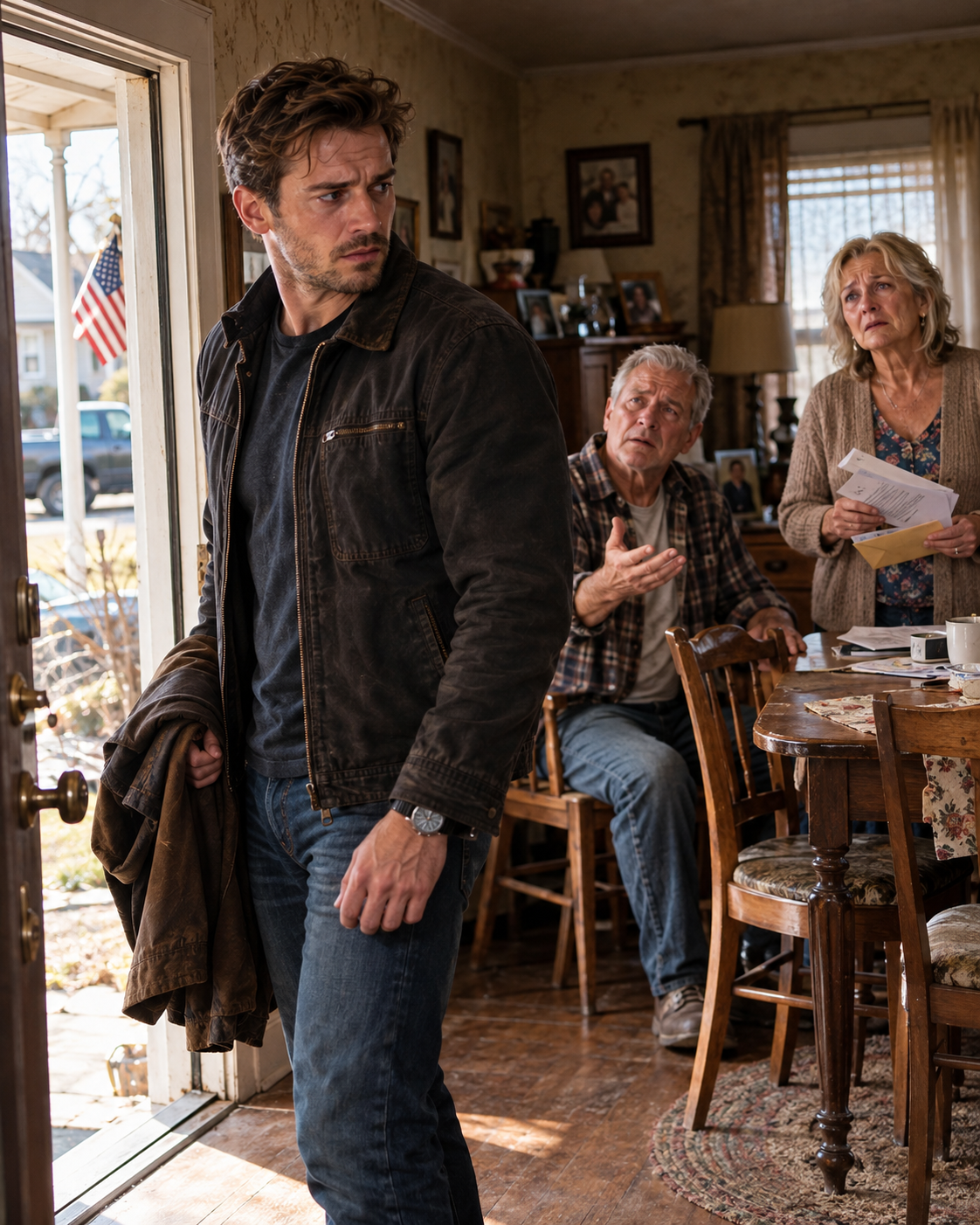
Dad had his hand on the front door when Mom said, ‘You have one hour to get out,’ and Kendra stood behind them
I hadn’t heard my father say my name in eight years.
For one absurd second, the sound made me want to run upstairs.
Not because I wanted to forgive him.
Not because I wanted to hug him.
Because some buried seventeen-year-old part of me still wanted to hear him say, “I was wrong.”
My mother stepped aside.
“He’s awake.”
I stood in the hallway, staring at the staircase.
“Did he know you called me?”
“Yes.”
“Did he ask you to?”
Her eyes filled again.
“No.”
That answer hurt in a way I hadn’t expected.
I went upstairs.
My father’s bedroom door was half open.
He looked smaller than I remembered. The man who had once filled doorways with his shoulders was now sunk beneath a blanket, his skin pale and his hair almost completely gray.
A plastic oxygen tube ran beneath his nose.
He turned his head.
For a moment, neither of us spoke.
Then he said, “You came.”
“I did.”
His eyes moved over me.
“You look like your uncle.”
It was such an ordinary thing to say that I almost laughed.
“I’ve heard that.”
He nodded.
Then his gaze dropped.
“I suppose your mother told you.”
“Some of it.”
He closed his eyes.
“I don’t know what to say.”
“That’s convenient.”
My voice came out colder than I’d intended.
He didn’t argue.
That surprised me.
“I deserve that,” he said.
I pulled the chair away from the wall but didn’t sit.
“Did you know?”
“Yes.”
“When?”
“Six years ago.”
I stared at him.
“How?”
He swallowed.
“Kendra was expelled from medical school.”
The room seemed to narrow around me.
My father explained slowly, stopping several times to catch his breath.
Kendra had been caught falsifying research data. During the investigation, administrators found other irregularities. She eventually admitted she’d manipulated records, lied about academic work, and fabricated messages before that.
Not just the messages about me.
Other things.
She had been jealous of me long before either of us understood what that jealousy was doing to her.
She had hated the attention I received from mechanics at Walter’s shop.
She hated that I could take something broken apart and put it back together.
She hated that Dad sometimes asked me for help with his truck.
Most of all, she hated that I seemed happy without needing the approval she had spent her life chasing.
The messages had been fabricated on a laptop.
She had copied my texting style.
She knew exactly which classmates I mentioned.
She knew about my locker.
She had built the lie carefully.
I listened without interrupting.
When he finished, I asked, “Did she admit it?”
“Yes.”
“Did she tell you why?”
My father stared at the ceiling.
“She said she wanted you gone.”
My chest tightened.
“Why?”
“She said she wanted to be the only child who made something of herself.”
I laughed once.
It sounded terrible.
“She got what she wanted.”
My father’s eyes closed.
“No.”
“Yes.”
He turned toward me.
“We were wrong.”
I stood there waiting for the sentence I had imagined for years.
It never came.
Instead, he said, “By the time we knew, you had built your business. You were doing well.”
I stared at him.
“And?”
“We thought you hated us.”
“I did.”
My voice broke slightly.
“I did hate you.”
He nodded.
“We were ashamed.”
“That doesn’t explain six years.”
“No.”
“Then explain it.”
He didn’t answer.
My mother came into the room behind me.
She stood with her hands clasped together.
I turned toward her.
“You knew too.”
“Yes.”
“Why didn’t you call?”
She cried harder.
“We didn’t know what to say.”
“You could have said, ‘We were wrong.’”
“I know.”
“You could have driven to my shop.”
“I know.”
“You could have found my address.”
“We had it.”
That stopped me.
“You had my address?”
She nodded.
“You knew where I lived?”
“Yes.”
“Then why?”
She looked at my father.
He answered for her.
“Pride.”
I felt something inside me go strangely quiet.
Not rage.
Not grief.
Something closer to exhaustion.
Eight years of wondering whether I had been forgotten.
They hadn’t forgotten me.
They had remembered me and chosen silence.
That distinction was devastating.
I sat down.
My father started crying.
I had never seen him cry before.
“I thought you would come back,” he said.
“Why?”
“Because you’re my son.”
I stared at him.
“You told me I wasn’t your son.”
He flinched.
“I know.”
“You gave me an hour.”
“I know.”
“You didn’t even let me explain.”
“I know.”
The room filled with the mechanical hiss of oxygen.
Finally, I asked the question that had been waiting since the kitchen eight years earlier.
“Why did you believe her so quickly?”
My father looked at me.
“Because we had already decided who you were.”
That answer hurt more than anything else.
They hadn’t needed evidence.
They had needed a version of me that fit the story they’d already chosen.
The boy who wasted his potential.
The boy who preferred greasy hands to textbooks.
The boy who was always going to disappoint them.
Kendra’s lie hadn’t created that judgment.
It had simply given it a reason.
My mother reached toward me.
I moved my hand away.
“I came because you said there was a medical problem.”
“There is,” she whispered.
“I’ll pay for one consultation.”
Her face changed.
“Only one?”
“Yes.”
“But—”
“I won’t become your bank account.”
My father looked at me.
“We don’t expect that.”
“You called me because you needed money.”
My mother couldn’t deny it.
“Your success was in the magazines,” she said quietly. “We saw the articles.”
I almost smiled.
“So you found me.”
She lowered her eyes.
“We were proud of you.”
“You didn’t call when I won the restoration award.”
“No.”
“You didn’t call when Ironclad opened the second bay.”
“No.”
“You didn’t call when Clara and I bought our house.”
“No.”
“But when the bills came?”
She cried.
I didn’t.
That surprised me.
I had expected some grand emotional collapse.
Instead, I felt strangely clear.
“I can help with one immediate medical expense,” I said. “After that, you’ll need to make other arrangements.”
My mother looked relieved.
Then I added, “And I’m not giving you the money directly.”
Her face fell.
“I’ll pay the hospital myself.”
My father nodded.
“That is fair.”
It was the first reasonable thing he’d said all afternoon.
I left soon afterward.
In the car, I sat with both hands on the steering wheel and stared at the house.
The curtains were the same.
The porch light was still crooked.
The maple tree in the front yard had grown enormous.
I had spent eight years imagining this moment.
I thought closure would feel like forgiveness.
It didn’t.
It felt like finally putting down a box I’d been carrying without realizing how heavy it was.
Clara was waiting at home.
She didn’t ask whether I had forgiven them.
She just wrapped her arms around me.
“How was it?”
“I found out they knew.”
Her arms tightened.
“For six years.”
She was quiet.
Then she said, “What do you need?”
I thought about it.
“Dinner.”
She laughed softly.
“That’s manageable.”
It took months before I stopped expecting another call.
Eventually, my parents’ financial situation stabilized enough that I no longer had to intervene.
My father underwent treatment.
I was told he was doing better.
I sent a card once.
Nothing more.
My mother wrote back.
I didn’t answer.
Not because I wanted to punish her.
Because I finally understood that silence could be a boundary instead of a weapon.
At Ironclad, things kept moving.
One afternoon, Walter came by with a box of old tools.
He was seventy-three by then and walked with a cane he’d pretend not to need.
“I found these in storage,” he said.
Inside were a set of battered wrenches, a torque wrench, and the first socket set I’d ever used under his supervision.
I laughed.
“You kept these?”
“Thought you might need reminding.”
“Of what?”
He shrugged.
“That you weren’t always the boss.”
I grinned.
“Get out of my shop.”
He laughed.
That was the thing about Walter.
He never needed me to call him Dad.
He had simply behaved like one when it mattered.
A few months later, a kid named Ethan started working for me.
Seventeen.
Quiet.
Skinny.
Always apologizing.
The first week, he dropped a tray of bolts.
He froze.
“I’ll replace them.”
“They’re bolts.”
“I know.”
“You’re acting like you broke the engine.”
He looked embarrassed.
I crouched and helped him gather them.
“Relax.”
He nodded.
Then, almost reluctantly, he asked, “Do you think I’m good at this?”
I paused.
The question reached somewhere old.
“You’re patient,” I said.
His shoulders loosened.
“Is that good?”
“It’s one of the best things you can have.”
Over the next year, Ethan improved quickly.
He could hear a misfire before most of us could diagnose it.
He asked questions.
He stayed late.
He kept a notebook in his back pocket.
One night, while we were closing the shop, he said, “My dad thinks this is a waste of time.”
I tightened the shop door.
“What do you think?”
“I don’t know.”
I looked at him.
“You don’t have to know yet.”
He nodded.
I understood then that the best thing I could give him wasn’t a speech about success.
It was time.
Nobody had given me much of that at seventeen.
Walter had.
So I did.
A year after my visit home, an envelope arrived at Ironclad.
No return address.
I recognized the handwriting before I opened it.
Kendra.
The letter was six pages.
I read it slowly.
She had been in psychiatric treatment for years, the letter said, and had finally begun confronting the jealousy, perfectionism, and fear that had shaped much of her behavior.
She didn’t ask me to forgive her.
That mattered.
She admitted exactly what she’d done.
She wrote that she’d watched my life from a distance.
She knew about Ironclad.
She knew about Clara.
She had seen the articles.
At one point she wrote that she used to believe my happiness was proof that she had failed.
Now she understood that my life had never been a competition with hers.
I read that sentence twice.
At the end, she wrote:
I don’t expect a place in your life. I only wanted you to know that the boy I betrayed was never the person I told myself he was.
I folded the letter.
Clara was sitting beside me on the porch.
“Who was it?”
“Kendra.”
She waited.
“Do you want to answer?”
I thought about that for a long time.
Finally, I took out a piece of paper.
I wrote only one sentence.
I received your letter. I hope your treatment helps you build a life you can live honestly.
Then I stopped.
I didn’t write I forgive you.
I didn’t write I miss you.
I didn’t write Maybe someday.
I sealed the envelope and sent it.
That was enough.
Years later, I still think about that first night above Walter’s shop.
I remember lying on the narrow bed with my eight hundred dollars hidden beneath the mattress because I was afraid someone might take it.
I remember listening to traffic through the thin window.
I remember believing that being thrown away meant I was worthless.
It took a long time to understand the difference between abandonment and freedom.
One is something someone does to you.
The other is what you build afterward.
Clara and I still live in the little house we bought together.
Walter still drops by without calling.
Ethan now works beside me and argues about transmission ratios as though he invented them.
Ironclad has more bays than Walter ever imagined.
There are old cars in the showroom that people drive three states to see.
Sometimes a magazine sends a photographer.
Sometimes a stranger recognizes me at a gas station.
I appreciate it.
But none of those things are what I’m proudest of.
I’m proud that when Ethan makes a mistake, he doesn’t have to wonder whether it makes him unworthy of love.
I’m proud that Clara can tell me when I’m wrong and I don’t hear rejection in her voice.
I’m proud that I can walk into my own shop, turn on the lights, and know exactly who built the life waiting for me inside.
Not my parents.
Not Kendra.
Not even Walter.
Me.
The family that raised me taught me that love could disappear when you failed someone’s expectations.
The family I built taught me something else.
Love can stay while you learn.
It can leave room for mistakes without turning them into verdicts.
And sometimes the most peaceful ending isn’t getting the apology you spent years imagining.
Sometimes it’s receiving it, reading every word, and discovering you no longer need anything from the person who wrote it.