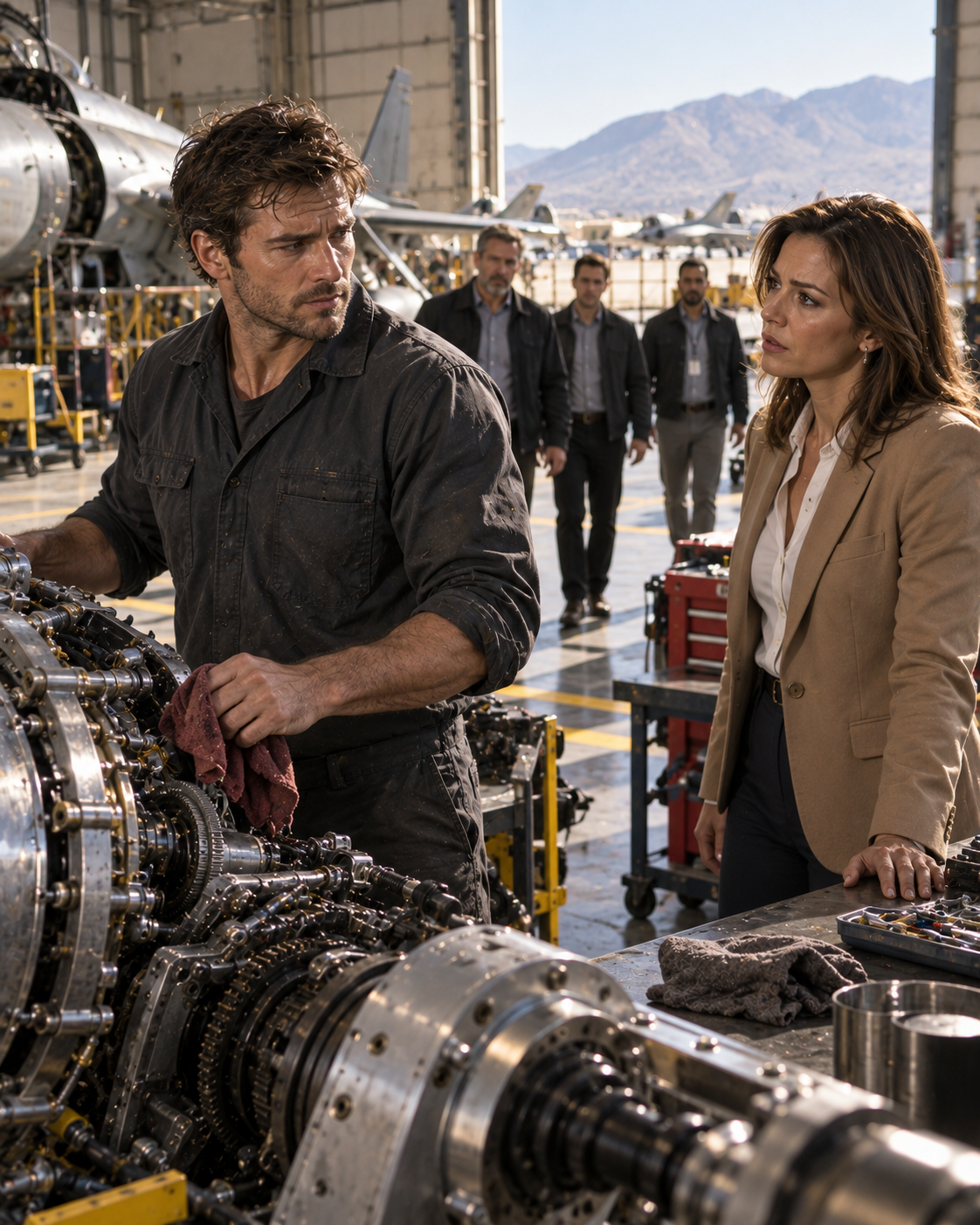
Clare Benton humiliated me in front of NASA engineers at my own shop, pointing at my grease-stained hands and calling my documentation a LIABILITY
I stared at the envelope beneath Noah’s project board while the noise of the school gym seemed to fade around me.
The showcase was crowded with parents, teachers, students, and folding tables covered with homemade robots, model bridges, solar panels, and small machines built from things that looked like they belonged in a garage.
But all I could see was my name.
“Where did you get this?” I asked.
Noah looked nervous.
“It was under my project when I came in.”
“Did you see who left it?”
He shook his head.
I picked it up carefully.
There was no return address.
No stamp.
Just four words written in black ink.
COLE, YOU WERE RIGHT.
My chest tightened.
For a moment, I thought about the vibration.
The coupling.
The missing photographs.
The substitute part.
The investigation.
Then I remembered the one thing I had deliberately refused to think about.
Someone had known the replacement component was wrong before we proved it.
I opened the envelope.
Inside was a single sheet of paper.
The handwriting was different from the outside.
There was only one sentence.
THE PART WAS NEVER THE WHOLE PROBLEM.
I looked at Noah.
He looked back at me.
“Dad?”
I folded the paper.
“Stay with your teacher.”
“But—”
“Please, Noah.”
Something in my voice made him stop.
I walked outside.
The desert afternoon had turned bright and warm, but I felt cold.
I called Luis.
He answered immediately.
“Everything okay?”
“Did you keep the original coupling?”
A pause.
“Yeah.”
“Where?”
“Locked cabinet, like you asked.”
“Don’t touch it.”
Another pause.
“Why?”
“Because I think someone wants me to.”
I drove back to the shop.
For the first time in years, I noticed how quiet Cole Auto felt after closing.
The lifts stood empty.
Tools hung in their places.
The office lights cast long rectangles across the floor.
I went directly to the evidence cabinet.
The lock was intact.
The seal was intact.
I opened it.
The original coupling was exactly where Luis had left it.
I stared at it for several seconds.
Then I noticed something.
There was a tiny blue mark near one of the mounting surfaces.
I called Luis back.
“Did you put that mark there?”
“No.”
“Did anyone else handle this?”
“Not after you sealed it.”
I photographed the mark.
Then I stopped.
I remembered the note.
THE PART WAS NEVER THE WHOLE PROBLEM.
Maybe the anonymous writer wasn’t accusing us of missing something.
Maybe they were warning me.
I called Marcus Bell.
He answered on the second ring.
“Cole.”
“I need you to look at something.”
His voice changed when he heard the details.
“Don’t send anything through normal email.”
“Why?”
“Because if you’re right, we may be dealing with something outside the original investigation.”
I sent him the photographs through the secure channel he’d previously given me.
He called back less than ten minutes later.
“That mark isn’t part of the manufacturing process.”
“What is it?”
“I don’t know yet.”
“Then what do you know?”
“I know it appears on another component.”
My stomach dropped.
“Which one?”
“The validated replacement.”
I sat down.
“The correct component?”
“Yes.”
That made no sense.
The failed substitute had the same geometry problem.
The correct component didn’t.
So why would both carry the same strange marking?
Marcus continued.
“There’s something else.”
“What?”
“The mark isn’t a defect.”
I waited.
“It’s an identification indicator.”
“For what?”
“I don’t know.”
The next morning, Marcus came to the shop.
He brought two engineers with him.
We placed both components on a clean inspection table.
Nobody touched them without gloves.
Nobody spoke for several minutes.
Marcus compared the marks under magnification.
“They’re nearly identical.”
Luis folded his arms.
“Could it be a factory tracking mark?”
“Possibly.”
I shook my head.
“Then why isn’t it in the documentation?”
Marcus looked at me.
“That’s what we’re going to find out.”
We contacted the manufacturer.
Their engineering representative joined a video call.
I placed the components beneath the camera.
He stared at the screen.
Then his expression changed.
“I don’t recognize that marking.”
Marcus leaned forward.
“You manufacture these.”
“I know.”
“Then who does?”
The representative hesitated.
“I need to check something.”
He disappeared from the call.
Five minutes passed.
Then ten.
When he returned, he looked uncomfortable.
“We found a reference.”
“Where?”
“In an internal quality archive.”
“What does it mean?”
He took a breath.
“Special handling.”
“For what?”
“Prototype-adjacent components.”
The room went silent.
Marcus asked, “Was the substitute part prototype-adjacent?”
“No.”
“Was the validated part?”
“No.”
“Then why are both marked?”
The representative looked directly at me.
“Because someone altered the traceability record.”
I felt a familiar heaviness settle into my chest.
This wasn’t about my shop anymore.
It wasn’t even about Aster Peak.
Someone had tampered with a chain of evidence that crossed multiple organizations.
And that meant someone had a reason.
Clare Benton arrived that afternoon.
She came alone.
No assistants.
No lawyers.
No polished presentation.
Just a woman in a dark jacket carrying a folder.
She placed it on my desk.
“I owe you an apology.”
I looked at her.
“For what?”
“For thinking you were the problem.”
She opened the folder.
Inside were procurement records.
“I approved the expedited sourcing path because we were under pressure.”
“I know.”
“I believed the component had been adequately screened.”
“You weren’t shown everything.”
She looked at me.
“No.”
Then she slid another document toward me.
“This came from our internal audit.”
The page contained a list of approvals.
One name appeared repeatedly.
Not Clare’s.
A procurement manager named Evan Rourke.
I recognized the name.
He had been copied on several emails during the original repair.
“Where is he now?”
“On administrative leave.”
“When did you discover this?”
“Yesterday.”
I looked up.
“Why didn’t you tell me?”
“Because I didn’t know if I could trust the information.”
That sentence stayed with me.
Months earlier, I had thought the hardest thing about the entire incident was admitting that I had failed to take photographs.
Now I understood something deeper.
Documentation wasn’t about proving you were perfect.
It was about making the truth visible when nobody was perfect.
I called Marcus.
We compared the procurement records against the component markings.
The pattern became clear.
Someone had inserted the substitute part into an expedited sourcing stream while making it appear fully interchangeable.
The physical geometry hadn’t been an accident.
The missing validation wasn’t an accident either.
But there was still one question.
Why?
The answer came three days later.
Marcus found a discrepancy in an engineering database.
The original application-specific specifications had been altered before the substitute component was approved.
Only slightly.
A tolerance value had been widened.
Not enough to trigger an obvious alarm.
Enough to make the wrong part appear acceptable on paper.
Luis stared at the screen.
“Someone changed the number.”
I nodded.
“Someone changed the truth.”
Then my phone rang.
Unknown number.
I answered.
“Hello?”
No response.
Only breathing.
Then a man’s voice.
“You should stop digging.”
I stood.
“Who is this?”
“You fixed the machine.”
“Yes.”
“You should have left it there.”
The line went dead.
Luis looked at me.
“What happened?”
I lowered the phone.
“Someone just made a mistake.”
“What kind?”
“They called me.”
Marcus arrived that evening.
We reviewed everything again.
The anonymous note.
The markings.
The altered tolerance.
The procurement trail.
The threat.
Nothing pointed directly to a single person.
That was the worst part.
We weren’t chasing a villain.
We were chasing a system of small decisions, shortcuts, omissions, and incentives that had created something dangerous.
Clare finally said what nobody else wanted to say.
“We were all rewarded for keeping the schedule alive.”
I looked at her.
“And punished by everyone when it stopped.”
She nodded.
That was the real pressure behind the entire mess.
Not evil.
Not some dramatic conspiracy.
Fear of missing a deadline.
Fear of losing a contract.
Fear of telling a boss that something wasn’t ready.
Fear of being the person who said no.
I knew that fear.
I had felt it the morning I wiped the coupling clean.
For one second, I had wanted the job to look easier than it really was.
That was enough to teach me something I would never forget.
The truth doesn’t become less dangerous because you hide the evidence.
It becomes harder to find.
The investigation continued for weeks.
Evan Rourke eventually admitted that he had changed the procurement records.
He claimed he believed the substitution was acceptable.
He denied knowing about the altered engineering tolerance.
Another employee admitted making that change after receiving pressure to keep the demonstration schedule intact.
The chain ended there.
There was no hidden mastermind.
No cinematic confession.
Just ordinary people making increasingly serious compromises because every shortcut seemed harmless when taken alone.
The substitute component was formally rejected.
The correct part was installed under full documentation.
And the unit passed every required test.
When the final acceptance report was signed, Marcus handed me a copy.
“Your name is on this.”
I looked at the page.
“Why?”
“Because you stopped the repair when everyone else wanted it finished.”
I shook my head.
“I also made the documentation mistake.”
“Exactly.”
He smiled slightly.
“You showed us both sides of the truth.”
I understood then.
Integrity wasn’t never making a mistake.
It was refusing to hide one.
Months passed.
Cole Auto grew.
Not dramatically.
Not overnight.
Just steadily.
Luis became more confident.
Our evidence procedures became routine.
Photographs before removal.
Photographs after removal.
Measurements witnessed.
Parts tagged.
Every stop-work decision documented.
And nobody was punished for saying, “I don’t know.”
I also learned to leave the shop.
That was harder than any mechanical repair.
When the phone rang late at night, I didn’t automatically answer.
When an emergency came in, I asked who on my team could handle it.
Sometimes the answer was Luis.
Sometimes it was another mechanic.
Sometimes the answer was no.
And “no” stopped feeling like failure.
It started feeling like responsibility.
One evening, Noah and I sat in the garage at home.
His engineering project was still on the workbench.
He was rebuilding it.
“I want to make something like your shop,” he said.
I laughed.
“You want to fix cars?”
“Not exactly.”
He pointed at his model.
“I want to build things people can trust.”
That sentence hit harder than anything Marcus had said.
I looked at my son.
“Then remember something.”
“What?”
“Build systems where people can tell the truth.”
He nodded.
“Even when it makes them look bad?”
“Especially then.”
He thought about it.
“Why?”
“Because one honest mistake can be repaired.”
I paused.
“But a hidden mistake can become somebody else’s disaster.”
Years later, I would still remember that conversation.
Not because Noah became an engineer.
Though he did.
Not because Cole Auto became larger.
Though it did.
I remembered it because that was the night I finally understood what the entire ordeal had been trying to teach me.
Machines fail.
People fail.
Schedules fail.
Companies fail.
The only thing that keeps a failure from becoming a catastrophe is whether someone is willing to stop, tell the truth, and let everyone see what actually happened.
The final surprise came almost a year later.
A package arrived at the shop with no return address.
Inside was a small metal coupling.
No paperwork.
No invoice.
No explanation.
Just a handwritten note.
I unfolded it slowly.
There were only six words.
GOOD THING YOU DIDN’T SIGN.
I stared at the component.
Luis came over.
“What is it?”
“I don’t know.”
My phone rang.
It was Marcus.
Before I could answer, another notification appeared.
An attachment had arrived from an unknown sender.
I opened it.
It contained a photograph of the original coupling from that first Saturday.
The one I had cleaned too early.
The one I had regretted failing to photograph properly.
But this photograph had been taken before I touched it.
Someone else had the image.
Someone had been watching that morning.
I looked at the timestamp.
My hands went cold.
The photograph had been captured eleven minutes before I even entered the shop.
I looked through the front window at the dark parking lot.
For a long moment, I couldn’t move.
Then Noah’s voice came back to me from years before.
Build things people can trust.
I locked the shop.
I called Marcus.
And this time, I didn’t try to carry the problem alone.
Because the greatest lesson Cole Auto ever taught me wasn’t how to repair a machine.
It was how to recognize the moment when something was wrong, admit what I had done, protect the people who depended on me, and refuse to let fear decide what happened next.
The truth had cost me money.
It had cost me a contract.
It had cost me sleep.
But it had also brought me home when my son needed me.
And standing alone beneath the fluorescent lights of my shop, staring at a photograph someone had secretly taken before the entire nightmare began, I realized there was one question I still couldn’t answer.
Who had been watching us that morning?
I turned off the lights.
The phone rang again.
This time, the caller ID displayed a name I hadn’t seen in years.
And before I answered, I already knew the past wasn’t finished with me.