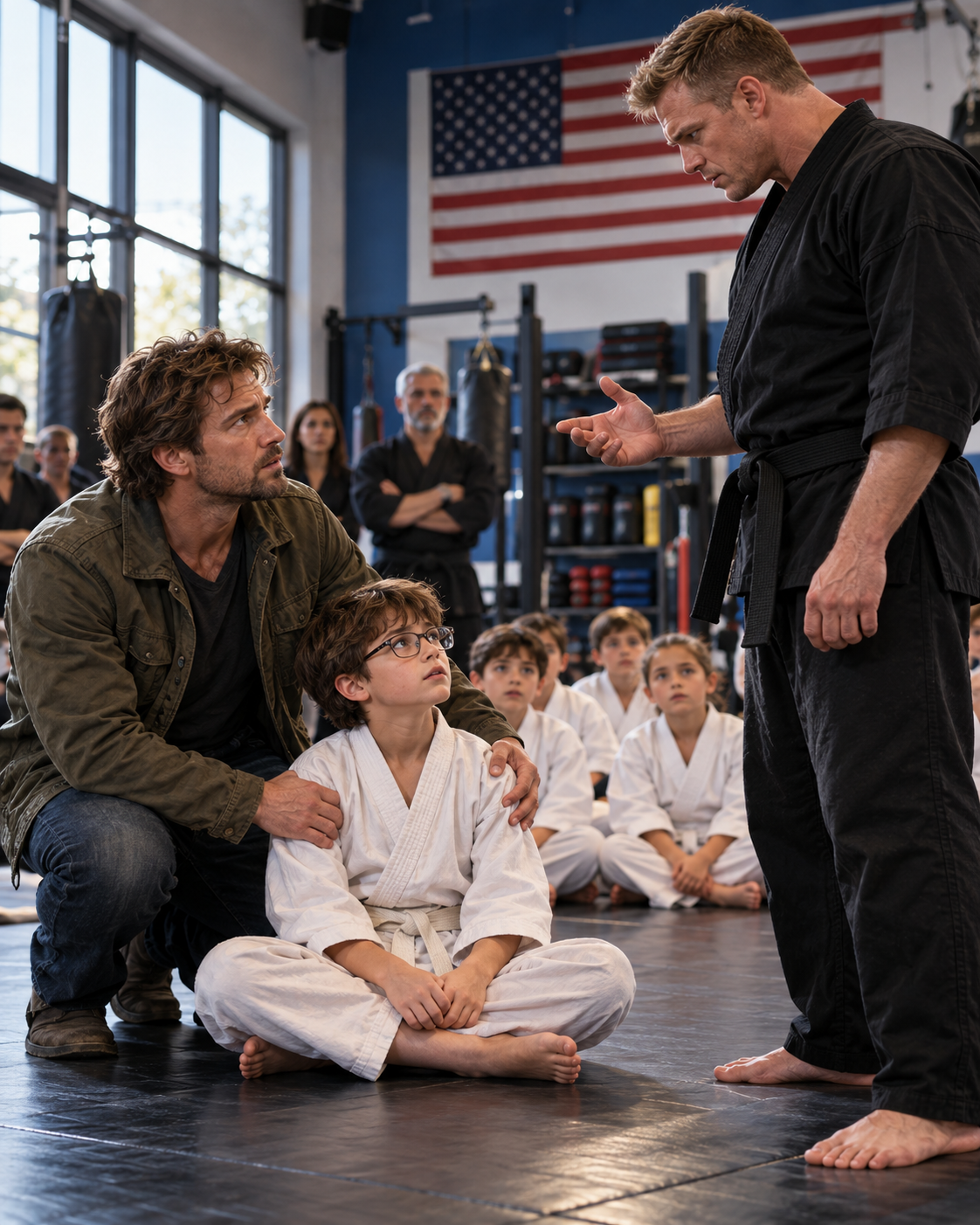
Brett slammed Leo onto the blue gym mat so hard that the room went silent, then smirked when my twelve-year-old
I did not answer him right away.
The frozen sidewalk stretched ahead of us, silver beneath the streetlights, and our footsteps sounded louder than they should have.
“What happened before I was born?” Toby asked again.
I looked at his face and realized that the question was not really about war.
It was about the man he had seen on that mat.
“I was an Army medic,” I said.
He nodded slowly.
“I knew you were in the Army.”
“You knew the safe version.”
That made him stop walking.
I stopped too.
Cars whispered over the wet road behind us.
“I spent sixteen years learning how to keep people alive,” I said.
Toby’s eyes stayed on mine.
“Then why did you look like that when you grabbed Brett?”
I swallowed.
“Because the same training that taught me to save a person also taught me exactly how to stop one.”
He stared at the pavement.
“Were you going to hurt him?”
“No.”
“But you could have.”
“Yes.”
The honesty seemed to hurt more than a lie would have.
I knelt on the icy sidewalk, even though my hip complained the moment I bent it.
“I need you to understand something, Toby.”
He waited.
“I am not proud because I could put a grown man on the floor.”
I touched the front of his coat.
“I am proud that I let him get back up.”
Toby’s mouth tightened.
“Then why didn’t you tell me?”
“Because I wanted you to know me as your dad before you ever had to know me as a soldier.”
He looked away.
“Maybe I needed to know both.”
That sentence stayed with me all night.
After we got home, I opened the bottom drawer of my dresser.
Under old tax papers and a spare flashlight was a flat green envelope I had not touched in years.
Inside were my service photographs, a faded unit patch, and a folded letter with a name written across the front in black ink.
Toby stood in the doorway.
“Whose letter is that?”
I almost closed the drawer.
Instead, I handed it to him.
“My brother’s.”
Toby blinked.
“You had a brother?”
“I did.”
His name was Daniel.
He had enlisted two years after me, convinced that following me was the only thing he had ever been good at.
I had spent sixteen years carrying the photograph of his smiling face without telling Toby that Daniel had never made it home.
“He died overseas,” I said.
Toby lowered the letter.
“What happened?”
I sat on the edge of the bed.
“We were in a convoy.”
Rain had turned the road into mud.
A vehicle ahead of us was struck, and everything became noise, smoke, and shouting.
I found Daniel trapped in the wreckage.
I had a choice to make.
I could pull him out and risk the secondary blast, or move the wounded soldiers first.
“I moved the others,” I said.
Toby’s eyes filled.
“And when I came back, Daniel was gone.”
He whispered, “You left him?”
“I left him for three minutes.”
My voice cracked.
“They were the longest three minutes of my life.”
Toby looked at the letter again.
“What does it say?”
“I never read it after they gave it to me.”
“Why?”
“Because it was written before his last deployment.”
He opened it carefully.
I watched his eyes move across the first few lines.
Then he handed it back.
“You should read it.”
I unfolded the paper.
Daniel had written about coming home, buying a house near water, and teaching his future kids how to fish.
At the bottom he had written one sentence that I had been too afraid to face for sixteen years.
“Don’t become a ghost just because I’m gone.”
I stared at the words until they blurred.
Toby sat beside me.
For a long time, neither of us spoke.
Then his shoulder leaned against mine.
It was a tiny movement.
It felt bigger than forgiveness.
The next morning, Toby asked whether we could invite Leo to breakfast.
We did.
Leo arrived with his mother, wearing a sweatshirt two sizes too big and keeping his injured arm close to his chest.
He looked embarrassed when he saw me.
“I’m sorry about everything,” he said.
“You have nothing to apologize for.”
He glanced at Toby.
“I thought you hated me that day.”
Toby looked confused.
“Why would I hate you?”
“Because Brett said I made everyone slower.”
Toby shook his head.
“You were the one trying not to cry.”
Leo’s eyes dropped.
“I was trying not to be scared.”
“So was I,” Toby said.
That was the first time I understood what Artie had been teaching them.
Falling was not the opposite of strength.
Pretending the fall never happened was.
Artie’s dojo occupied a narrow storefront behind a bakery on Maple Avenue.
There were no trophies covering the walls.
No mirrors meant for vanity.
No screaming.
There was only an old wooden floor, a tea kettle, and Artie himself, a seventy four year old man with silver hair and hands that looked permanently folded around an invisible prayer.
On the first day, Brett’s name came up.
Artie did not react.
He simply said, “A teacher who needs fear has already lost control.”
Leo looked relieved.
Toby looked thoughtful.
Then Artie pointed toward the mat.
“Learn to fall.”
The boys practiced backward rolls for nearly an hour.
Every time Leo hesitated, Artie waited.
He never shouted.
He never laughed.
He never hurried him.
One afternoon, I stayed after class to clean the entryway.
Artie watched me limp toward the supply closet.
“You are still carrying something,” he said.
I smiled without humor.
“That obvious?”
“To an old man, yes.”
He handed me a cup of tea.
“You have been trained to react.”
“Yes.”
“Now learn to notice.”
I looked at him.
“Notice what?”
“The moment before you become the man you do not want to be.”
His words followed me for days.
At work, I began seeing that moment everywhere.
A teenager shouting at his mother in the lobby.
A basketball player shoving another boy after losing a game.
A custodian snapping at a volunteer because he was tired.
Each time, I felt the old reflex rise.
Each time, I paused.
Not because I was weak.
Because I had finally started understanding what Daniel’s letter meant.
A few weeks later, Brett contacted the community center.
He asked for a meeting.
The director wanted me there.
So did Leo’s mother.
Brett entered the office without the swagger he used to wear like armor.
His black belt was gone.
His hair was shorter.
He looked smaller.
“I want to apologize,” he said.
Leo’s mother folded her arms.
“Then apologize to Leo.”
Brett nodded.
“I already did.”
He placed a letter on the table.
“He did not answer.”
“He doesn’t owe you an answer,” I said.
Brett looked at me.
“I know.”
For several seconds, no one spoke.
Then he said, “My father used to coach me the same way.”
I felt something in my chest tighten.
“He called it discipline.”
Brett rubbed his palms together.
“I thought if I could make children afraid of failing, they would become stronger than I was.”
“That is not what happened,” I said.
“No.”
He looked down.
“I became exactly what I hated.”
Leo’s mother did not forgive him.
Neither did the director.
The ban stayed.
But the letter remained on the desk.
Sometimes accountability begins with saying sorry and accepting that sorry does not erase what happened.
That evening, Brett stopped me in the parking lot.
“I still think you could have broken my arm,” he said.
“I could have.”
“Why didn’t you?”
I looked toward the road where families were leaving the center.
“Because you were already broken.”
He stared at me.
Then he looked away.
I never saw him again after that.
Spring arrived slowly.
The snow receded from the curbs.
The community center windows filled with afternoon light.
Toby became different in ways too small to announce.
He started speaking during dinner.
He started disagreeing with me.
He started telling me when I was wrong.
Every time he did, I thanked him.
One Friday, he came home with a bruise on his cheek.
My chair scraped backward before I could stop myself.
“Who did that?”
Toby raised a hand.
“Dad.”
His tone stopped me.
“It was Mason.”
Mason was the boy who had been bullying him for months.
“He cornered me behind the gym.”
My fists had already tightened.
Then I noticed Toby watching them.
I slowly opened my hands.
“What happened next?”
“I told him to stop.”
“And?”
“He laughed.”
Toby touched the bruise.
“So I asked him again.”
I waited.
“He shoved me.”
“And you hit him?”
“No.”
My chest loosened.
“I told him he was only brave when nobody told him no.”
I almost smiled.
“What did he do?”
“He pushed me again.”
“And then?”
“Tears came out.”
He looked ashamed.
I shook my head.
“That is not shameful.”
“I cried in front of him.”
“You are allowed to cry.”
“He stopped.”
“Why?”
Toby thought about it.
“Maybe because he saw I wasn’t scared of him anymore.”
I nodded.
He had finally found the lesson no belt could teach.
The following Monday, Mason waited by the lockers.
His friends stood around him.
Toby walked past.
Mason called his name.
Toby turned.
“I said we are not friends.”
Mason looked surprised.
Then one of his friends laughed.
Toby did not.
He stood there until the laughter died.
“You don’t have to like me,” he said.
“But you don’t get to hurt me.”
Then he walked away.
The story reached me through the school counselor.
She called it courage.
I called it something simpler.
My son had stopped asking permission to take up space.
That night, we ate pancakes for dinner because neither of us wanted to cook.
Toby poured too much syrup on his plate.
I pretended not to notice.
“Dad?”
“Yeah?”
“Do you still dream about Daniel?”
The fork in my hand stopped.
“Sometimes.”
“What happens?”
“I am back on that road.”
He was quiet.
“Can you change what happened?”
“No.”
“Can you change what happens next?”
I looked at him.
“Yes.”
He nodded.
“Then maybe that’s enough.”
Maybe it was.
For the first time, I understood that healing was not forgetting the worst thing that happened to you.
It was refusing to let the worst thing become the best description of who you were.
Months passed.
Artie asked Toby and Leo to help teach the younger students how to fall.
Leo was nervous.
Toby stood beside him.
“Show them,” Toby said.
Leo stepped onto the mat.
He knelt.
He rolled backward.
Then he stood.
The little kids clapped.
Leo smiled.
Not the nervous smile I had seen months earlier.
A real one.
Artie caught my eye from across the room.
He nodded once.
I nodded back.
Later, after class, I found an envelope tucked under the windshield wiper of my truck.
My name was written across it in handwriting I recognized immediately.
Brett.
Inside was a single page.
I read it twice.
He wrote that he had started counseling.
He wrote that he had visited his old coach.
He wrote that he finally understood the difference between discipline and domination.
At the bottom he wrote, “You were the first person who could have hurt me and chose not to.”
There was no request for forgiveness.
No excuse.
Just that sentence.
I folded the paper and put it in the glove compartment.
Toby had been watching me.
“Is it him?”
“Yes.”
“Are you going to answer?”
“I don’t know.”
Toby shrugged.
“You don’t have to.”
I smiled.
“Where did you learn that?”
“Artie.”
“Sounds like Artie.”
We drove home in silence.
At the next traffic light, Toby reached over and tapped my left hip.
“Still hurting?”
“A little.”
“Why don’t you get it checked?”
“I might.”
“You should.”
I looked at him.
He looked straight ahead.
There are moments when you realize your child is no longer asking you to protect him.
He is asking you to take care of yourself.
That may have been the strangest part of growing older.
For years, I thought being a father meant standing between danger and your child.
I was wrong.
Sometimes it meant teaching your child to stand without becoming dangerous himself.
The next winter, the community center held a charity tournament.
Artie brought his students.
Leo competed.
Toby volunteered.
I worked the front desk because my hip was bad that week.
Halfway through the afternoon, I noticed a familiar figure standing outside the glass doors.
Brett.
He did not come inside.
He simply watched.
Leo saw him too.
His shoulders stiffened.
Toby stepped closer to him.
“You okay?”
Leo nodded.
Then he looked at me.
I gave him a small nod.
He turned back toward the mat.
That was when Brett opened the door.
The room grew quiet.
He walked directly to Leo.
He stopped several feet away.
“I won’t come closer,” he said.
Leo said nothing.
Brett held out a small box.
“I found these in my old equipment bag.”
Leo did not take it.
“What are they?”
“Your first yellow belt test notes.”
Leo stared at him.
“Why do you have them?”
Brett looked embarrassed.
“I kept them because I thought you were the kid who would never make it.”
Leo’s face changed.
Brett swallowed.
“I was wrong.”
Artie stood quietly beside the mat.
Leo finally took the box.
He opened it.
Inside was an old notebook with his name written across the top.
The pages were filled with corrections.
Posture.
Balance.
Grip.
Fear.
At the bottom of the last page, Brett had written one sentence years earlier.
“Too weak to lead.”
Leo read it.
Then he looked up.
“I don’t want this.”
Brett nodded.
“I understand.”
Leo handed the notebook back.
“But I don’t hate you.”
Brett’s eyes filled.
“I hope someday I can say I don’t hate myself either.”
Leo did not answer.
He did not need to.
Brett left.
The tournament continued.
Leo won his match by points.
Toby lost his next one.
He laughed about it afterward.
“I forgot the sweep.”
Artie shook his head.
“No.”
Artie pointed to his chest.
“You remembered it there.”
Toby frowned.
“I don’t get it.”
“Then you will.”
On the drive home that night, Toby fell asleep against the window.
Streetlights slid across his face.
I drove slowly.
At a red light, I saw my reflection in the windshield.
Older.
Tired.
Still limping.
But no longer trying to disappear.
Daniel’s letter was in my wallet.
I touched it at the light.
“Don’t become a ghost,” I whispered.
The light turned green.
When we reached our block, Toby woke up.
He looked at me through heavy eyes.
“Dad?”
“Yeah?”
“I’m glad you didn’t hit Brett.”
I breathed out a laugh.
“So am I.”
He smiled.
“Would you have known how not to?”
I thought about the mat.
The punch.
The two seconds.
The years before Toby was born.
“Yes,” I said.
“I had to learn.”
He nodded as if that answer was enough.
Then he opened the truck door.
Before getting out, he paused.
“You know, Dad.”
“What?”
“You don’t have to be strong all the time.”
I looked at him.
Neither of us moved.
Then I nodded.
“I know.”
He shut the door.
I stayed behind the wheel after he went inside.
The house glowed warm through the curtains.
For sixteen years, I had believed strength meant carrying everything alone.
Daniel’s death.
The war.
The pain in my hip.
The memories.
The fear that one day my hands would betray the gentleness I wanted my son to see.
But strength had never been the absence of fear.
It was the choice made while fear was still standing beside you.
That night, I opened the old green envelope one more time.
Daniel’s photograph fell onto the table.
I turned it over.
There was something on the back I had never noticed before.
A date.
A location.
And six words written in Daniel’s handwriting.
“Ask him why he lied to us.”
My breath stopped.
For sixteen years, I had carried Daniel’s last letter.
For sixteen years, I had believed I knew how my brother died.
But suddenly there was a question inside that old photograph, waiting for me like a door I had been afraid to open.
And before sunrise, I knew I was going to find out who Daniel had been talking about.