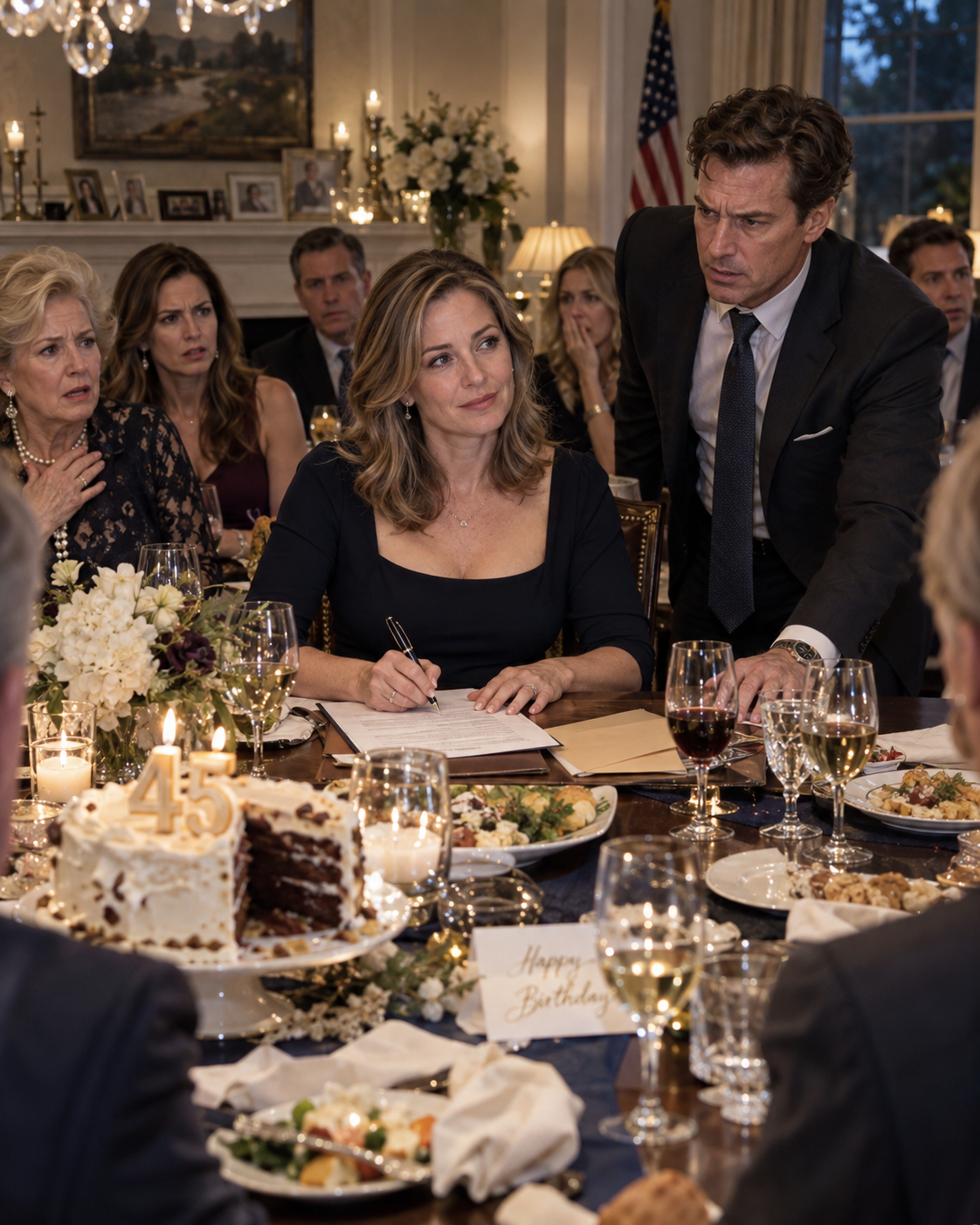
At Victor’s 45th birthday dinner, he pushed a thick envelope across the candlelit table and announced
At first, I thought Evelyn was exaggerating because fear had a way of making ordinary things sound dangerous.
Then she said three words that made me sit upright in bed.
“Your name is there.”
I drove to her suite before sunrise.
The house was silent when I let myself in, and for a moment, walking through the familiar hallway felt strange without Victor’s presence hanging over everything.
Evelyn was sitting at her kitchen table with an old cardboard box beside her.
Her hands were trembling.
“I found it behind the bottom drawer in Victor’s old office,” she said.
“Why were you in there?”
“Because he left some of his father’s things behind.”
She pushed the box toward me.
“I was looking for photographs.”
Inside were folders, receipts, handwritten notes, and copies of legal documents dating back years.
Nothing looked unusual until I saw my name.
Clara Vance.
My stomach tightened.
I opened the folder.
The first page was a copy of the original property deed.
The second was a renovation estimate.
The third was a handwritten calculation.
My name appeared beside a number.
So did Victor’s.
But the number beside mine was circled.
“What’s this?” I whispered.
Evelyn shook her head.
“I don’t know.”
I kept turning pages.
There were notes about the house, the renovation costs, Victor’s contributions, and conversations he had apparently recorded for his attorney.
Then I found a document that made my hands go cold.
It was a draft agreement attempting to establish that Victor had made substantial financial contributions toward the property’s improvement.
The document wasn’t signed.
But the numbers had been manipulated.
Several expenses he had never paid were listed as his.
I stared at Evelyn.
“He was trying to claim part of the house.”
She nodded slowly.
“I think so.”
Suddenly, the birthday dinner made sense in a different way.
The divorce papers had never been the whole performance.
Victor had wanted witnesses.
He wanted me embarrassed, angry, and emotional.
He wanted me to sign before I understood what he was trying to establish.
And if I had panicked that night, I might have said something he could later use against me.
My attorney confirmed what I had begun to suspect.
The papers Victor had presented at dinner were not the same as the final documents my attorney had prepared.
His version contained language that could have complicated the property dispute if I had signed additional agreements without legal review.
Thankfully, my signature had been limited to the documents in front of me.
Still, the discovery changed everything.
Victor hadn’t simply wanted to end our marriage.
He had wanted control of the story surrounding its ending.
When my attorney confronted his lawyer, Victor suddenly became much quieter.
The man who had announced our divorce over birthday cake now communicated through attorneys.
The man who had called himself the provider stopped talking about money in public.
And the man who had laughed when I questioned the house suddenly wanted to negotiate about it.
I refused to negotiate away what was already mine.
The legal process took time.
There were meetings, document exchanges, uncomfortable conversations, and long evenings when I sat at my kitchen table surrounded by folders that represented twelve years of a life I had thought was shared.
Some nights I wondered how I had missed so much.
Then I realized the answer.
I hadn’t missed it.
I had explained it away.
Every time Victor dismissed my work, I told myself he was stressed.
Every time he belittled me in front of friends, I called it a joke.
Every time he came home late, I believed his explanation because believing it was easier than accepting what my instincts were saying.
That was the hardest truth.
People don’t always break your trust in one dramatic moment.
Sometimes they teach you, slowly, not to trust your own eyes.
Evelyn became my unexpected anchor during those weeks.
She started coming over in the evenings.
We would sit on the back porch with coffee, watching the sunset over the trees Victor had once complained were too expensive to maintain.
One evening, she finally told me about her marriage.
“My husband used to do the same thing,” she said.
“Pay one bill, then act like everyone owed him obedience.”
I listened.
“He taught Victor that money was power.”
She looked down at her hands.
“I thought I could protect my children from becoming him.”
“You did what you could.”
“Apparently it wasn’t enough.”
“It was enough for Nora.”
She smiled sadly.
“You’re right.”
Nora was different.
She never defended Victor.
She never asked me to forgive him.
She never told me that family should stay together.
Instead, she showed up.
She helped Evelyn with paperwork.
She drove her to appointments.
She sat beside me during one of the attorney meetings when I couldn’t stand the idea of walking into the building alone.
One afternoon, Nora said something that stayed with me.
“You know what bothers me most?”
“What?”
“He actually believed humiliating you would make him look powerful.”
I looked at her.
“That’s because he doesn’t understand the difference between control and strength.”
Nora nodded.
“Neither did Dad.”
That was when I realized Victor had inherited more than his father’s arrogance.
He had inherited his father’s definition of love.
To Victor, love meant being needed.
Partnership meant being obeyed.
Providing meant having authority.
And when I stopped needing his permission, he didn’t know what to do with me.
The affair eventually became public among his friends.
Melissa stopped returning his calls after she learned that Victor was divorcing.
Apparently, she had been told a very different version of our marriage.
According to messages recovered during the legal process, Victor had described me as financially dependent, emotionally unstable, and desperate to keep the house.
None of it was true.
But I didn’t feel victorious when I read those words.
I felt tired.
There is a particular kind of sadness that comes from discovering someone has been telling stories about you while you were still trying to love them.
Then something unexpected happened.
One Saturday afternoon, Victor came to the house.
He stood on the front porch wearing the same expensive coat he had worn to his birthday dinner.
I almost didn’t recognize him.
Not because he looked different.
Because he looked smaller.
“I need to talk to you.”
“You can talk to my attorney.”
“Clara, please.”
I remained inside the doorway.
“What do you want?”
He looked past me into the house.
“Our house.”
I said nothing.
He swallowed.
“I made a mistake.”
“You made several.”
“I thought you would fight.”
“I didn’t want to fight.”
“Why didn’t you?”
The answer came easily.
“Because I was already done.”
His face changed.
For the first time, I saw something I hadn’t seen in years.
Fear.
Not fear of losing me.
Fear of losing control over me.
“I loved you,” he said.
“I believe you thought you did.”
He looked down.
“That’s not fair.”
“No.”
I shook my head.
“It isn’t.”
I closed the door gently.
That night, I cried.
Not because I wanted Victor back.
Because I finally understood how much of myself I had abandoned trying to make the marriage work.
A few weeks later, the property dispute was resolved.
The records confirmed what I had always known.
The house remained mine.
Victor had no ownership interest in the property.
The false calculations found in his office were never used successfully against me, and his attempt to portray himself as the sole financial provider collapsed under the weight of the actual records.
But the most painful part came afterward.
Evelyn asked me to meet her at a small café.
She looked exhausted.
“There is one more thing.”
I stared at her.
“What now?”
She slid her phone across the table.
It contained an old voicemail from Victor’s father.
Evelyn had discovered it while going through archived files.
In the recording, his father was talking to Victor when Victor was still a teenager.
The words were simple.
“Never let anyone believe they can leave you.”
I listened in silence.
Then came another sentence.
“If they know you need them, they’ll control you.”
The recording ended.
I looked at Evelyn.
“That’s where it started.”
She nodded.
“I think Victor has been trying to prove that lesson his whole life.”
I sat back.
Suddenly, the years of arrogance looked less like confidence and more like fear wearing expensive clothes.
That didn’t excuse him.
It simply explained why control had mattered more to him than love.
And explanations, I learned, were not the same thing as forgiveness.
Months passed.
My life became quieter.
I went back to work without constantly checking my phone.
I renovated the garden.
I changed the locks.
I bought a dining table that was smaller than the one Victor had insisted on because he liked entertaining people.
Then one evening, I hosted dinner.
Just Evelyn, Nora, and a few close friends.
No performance.
No speeches.
No one sitting at the head of the table because they believed the chair made them important.
Halfway through dinner, Evelyn lifted her glass.
“To Clara.”
Everyone smiled.
I shook my head.
“Don’t.”
“Why?”
“Because this isn’t a victory.”
I looked around the table.
“It’s a life.”
The room became quiet.
And that was when I understood what freedom actually felt like.
It wasn’t revenge.
It wasn’t watching Victor lose his apartment.
It wasn’t knowing his family had stopped believing him.
It wasn’t even keeping the house.
Freedom was waking up and realizing I no longer needed someone else to understand my worth.
Victor eventually disappeared from most of our lives.
Nora remained in contact with him occasionally, mostly because she wanted to know whether he was taking responsibility for his choices.
Evelyn forgave herself for things that had never been hers to carry.
And I learned to stop measuring my value by how much someone else acknowledged what I did.
A year after the birthday dinner, I found myself standing in the same dining room where Victor had once tried to destroy me.
Sunlight came through the windows.
The table was gone.
The candles were gone.
The envelope was gone.
But the memory remained.
I opened the window and let the morning air inside.
For twelve years, I had thought keeping a marriage together meant holding everything in place.
Now I knew better.
Sometimes the bravest thing you can do is stop holding.
You stop explaining.
You stop begging someone to see what they have chosen not to see.
You stop confusing endurance with love.
And you finally understand that leaving isn’t always the moment your life falls apart.
Sometimes, it is the exact moment your life begins returning to you.
I thought that was the end of Victor’s story.
Then, one rainy evening, almost eighteen months after the birthday dinner, a plain white envelope appeared beneath my front door.
There was no return address.
Inside was a single handwritten sentence.
“I found out why your name was in his father’s files.”
I read it twice.
Then I turned the page over.
There was nothing else.
My heart began pounding.
Because beneath that sentence was a name I hadn’t heard in years.
A name Victor had never mentioned.
And suddenly, the quiet life I had fought so hard to rebuild felt like it was standing at the edge of another secret.
I folded the letter slowly and looked toward the hallway.
For the first time since I walked away from Victor, I wondered whether leaving him had really been the end of the story…
or whether it had simply opened a door he had spent twelve years trying to keep locked.