At the Vantage garage in Parma, Evelyn Vance pointed at my grease-stained hands and sneered, ‘YOU’RE ONLY A MECHANIC,’
I stared at Dr. Torres, suddenly aware of the enormous glass walls around me and the silent machines moving behind them.
“What didn’t Arthur tell me?” I asked.
She glanced down the hallway, where Arthur sat across from Evelyn with two cups of coffee between them.
“Arthur asked us to keep something quiet until you were ready.”
My chest tightened.
“Why?”
“Because he was afraid you’d say no.”
That answer almost made me laugh.
“No to what?”
Dr. Torres handed me a slim folder.
Inside was a photograph of the wooden crate I had seen on that rainy highway three weeks before.
Under the photograph was a technical drawing marked with dozens of handwritten notes.
At the bottom, in Arthur’s handwriting, were six words.
“Find the mechanic who thinks with his hands.”
I looked up.
“He wrote that about me?”
“He wrote it before we ever knew your name.”
The bracket I built was part of a prototype lunar rover suspension assembly designed for extreme temperature swings, vibration, and unpredictable lunar terrain.
Their engineers had produced stronger versions on paper, but every design kept developing microscopic stress fractures after repeated thermal cycling.
Then Arthur saw what I did with a piece of scrap steel.
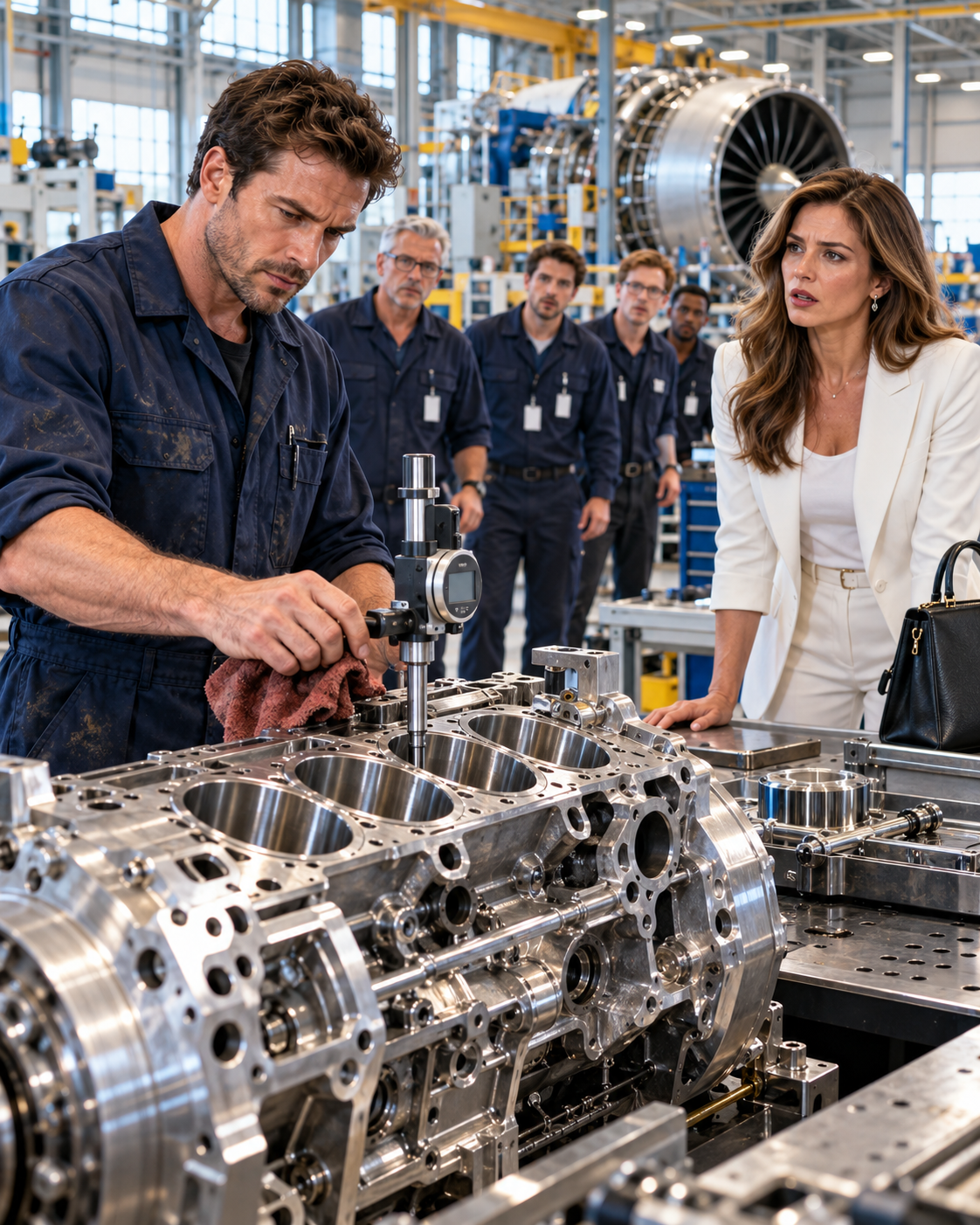
“You didn’t copy the original,” Dr. Torres said.
“You changed the way the load traveled through it.”
I shook my head.
“I just fixed a crack.”
She smiled.
“Sometimes that is where engineering starts.”
Before I could answer, a familiar voice came from behind us.
“You always did hate being surprised.”
I turned.
Arthur stood there with a cane in one hand and a cup of coffee in the other.
He looked older than I remembered, but his eyes were the same.
Tired.
Kind.
Unusually alert.
“You knew?” I asked.
“I suspected.”
“You knew what was in that crate.”
“I knew what I was carrying.”
“And you knew who you were?”
He smiled faintly.
“I knew who I was.”
I almost shouted.
“You let me tow you through a storm, then watched me build something for NASA out of trash.”
“I watched you help a stranger when you had every reason not to.”
His answer quieted me.
Then he looked toward Chloe, who was watching a rover wheel spin behind the glass.
“She’s the reason you stopped that night, isn’t she?”
I looked at my daughter.
“She’s the reason I try to be the kind of man she can be proud of.”
Arthur nodded.
“That is exactly what I was testing.”
I frowned.
“Testing me?”
“Not your honesty.”
He tapped his chest.
“Your character.”
For a moment, I was angry.
Then I remembered him shivering beside that truck.
I remembered the crate.
I remembered my own father, who had taught me to repair engines before I was old enough to drive.
Arthur sat beside me.
“I lost a daughter to pride,” he said softly.
I glanced at Evelyn.
“She?”
He nodded.
“She grew up believing that needing anyone was weakness.”
He looked toward the glass.
“She became successful.”
“She became powerful.”
“She became lonely.”
That sentence stayed with me.
The next morning, Evelyn asked to meet me privately.
She arrived at the small diner across from our old garage without security, makeup, or the polished armor she usually wore.
She looked exhausted.
“I owe you an apology,” she said.
“You do.”
She winced.
“I deserve that.”
She slid a folder across the table.
Inside were inspection records, maintenance orders, invoices, and internal emails.
Some vans had been overdue for brake-line replacements for months.
Managers had delayed repairs to avoid losing delivery contracts.
Someone had altered several inspection dates.
My stomach turned.
“You found all this?”
“I found out after the crash.”
“You’re going to report it?”
“I already did.”
She swallowed.
“I shut down the entire fleet before the regulators could.”
That decision would cost Vantage millions.
It could also destroy the company.
“You didn’t have to do that.”
“Yes, I did.”
She looked at my hands resting on the table.
“I spent my whole life believing mechanics were people who fixed problems after people like me created them.”
She took a shaky breath.
“I never realized how arrogant that sounded.”
“I can’t make it disappear,” I told her.
“I know.”
“But you can decide what happens next.”
She nodded.
“That is what I’m trying to do.”
She pushed another paper toward me.
It was the deed for our old garage.
I stared at it.
“I don’t understand.”
“The shop is yours if you want it.”
I nearly laughed.
“I can’t afford it.”
“You already paid for it,” she said.
“With four hours of your life and a replacement fuel pump.”
I shook my head.
“I didn’t do it for a business.”
“That is why I trust you with one.”
I did not know what to say.
So I told her the truth.
“I don’t want a garage because you feel guilty.”
Her eyes met mine.
“Then don’t take it because I feel guilty.”
She tapped the paperwork.
“Take it because you earned the right to decide what kind of place it becomes.”
I took the folder home.
I left it unopened on the kitchen counter.
Chloe found it before breakfast.
“Dad, what’s this?”
“A very complicated piece of paper.”
“Are we rich?”
I laughed.
“No.”
“Then what is it?”
“A chance.”
She studied me.
“Chance to do what?”
I thought about the shop.
About Arthur.
About the words, you’re only a mechanic.
“Build something better.”
She smiled.
“Like the rocket people?”
“Maybe.”
Three days later, I returned to Glenn Research Center.
Arthur was waiting beside a rover test platform.
Dr. Torres stood with two engineers and a series of thermal chamber reports.
“We have a problem,” she said.
The new bracket had failed.
A hairline fracture had appeared after a full thermal cycle.
My stomach dropped.
“You said mine passed.”
“It did,” Dr. Torres said.
“This is the redesigned version.”
I stared at the metal.
The failure was in a corner no computer model had predicted.
Arthur watched me carefully.
“What do you see?”
I walked around the platform.
“Too much.”
One engineer raised an eyebrow.
“Too much what?”
“Too much confidence.”
Nobody spoke.
I touched the bracket with one finger.
“The load is being shared the way the math says it should.”
I moved closer.
“But not the way the metal wants it to.”
The engineers looked at one another.
I asked for the original scrap bracket.
They brought it to me.
I placed both versions side by side.
The laboratory piece was flawless.
Mine was ugly.
Its edges were slightly asymmetrical, its surface marked by the hand grinder.
It looked like something nobody would display in a museum.
I pointed at a curved section.
“I relieved this corner because the steel kept fighting me here.”
Dr. Torres leaned closer.
“You felt that?”
“I heard it.”
She looked confused.
“When you cut metal for long enough, it tells you when it is angry.”
Arthur smiled.
“There.”
One word.
But it sounded like a verdict.
The engineering team spent the next twelve hours rebuilding the component based on my crude measurements.
I stayed beside them until midnight.
Not because I wanted the NASA job.
Because I could not walk away from a problem that had become personal.
At two in the morning, the new bracket went into the chamber.
The temperature dropped.
Sensors lit up.
The machine began to vibrate.
Ten minutes passed.
Twenty.
An hour.
Then two.
Nothing.
At sunrise, the chamber opened.
The bracket was intact.
Dr. Torres held the inspection report with both hands.
“Zero propagation,” she said.
I did not understand the phrase.
Arthur did.
He hugged me.
It was the first hug between us.
“Welcome to the team,” he whispered.
I laughed into his shoulder.
“I thought I was just a mechanic.”
He pulled back and looked me straight in the eyes.
“That was the problem.”
The offer from NASA became real that afternoon.
Precision machinist technician.
Training.
Benefits.
A salary I had once thought belonged only to people on television.
But I hesitated before signing.
Not because I was afraid of the work.
Because I was afraid of leaving Chloe.
Dr. Torres noticed.
“You don’t have to choose between being a father and building a career.”
They worked with me on a stable shift so I could still pick Chloe up most days.
I signed.
When I told Chloe, she screamed so loudly that our neighbor knocked on the wall.
“Are you going to space?”
“Not exactly.”
“Can you touch the moon?”
“Not exactly.”
“Can you build the thing that touches the moon?”
I smiled.
“Maybe.”
She hugged my waist.
“Then you have to make it strong.”
“I will.”
The months that followed were not easy.
Nothing in real life suddenly becomes simple because something good happens.
I still woke before sunrise.
I still packed lunches.
I still worried about money.
But the fear had changed.
Before, I was afraid of losing everything.
Now, I was afraid of wasting the chance I had been given.
Evelyn kept her promise.
She rebuilt Vantage’s maintenance system from the ground up.
She hired independent inspectors.
She created a rule that no executive could override a safety rejection from a mechanic.
She also started visiting the garage on Saturdays.
At first, everyone stared.
Then they got used to seeing the former CEO carrying coffee for people who once refused to look her in the eye.
One Saturday, I found her standing beside an open van hood.
“Can I ask you something?” she said.
“Sure.”
“Why did you help my father?”
I looked at the engine.
“Because he was cold.”
“That’s all?”
“That’s enough.”
She nodded slowly.
“My whole life, I thought powerful people were the ones who never needed help.”
I tightened a bolt.
“Power is being able to help and still choosing to.”
She smiled.
“I’m writing that down.”
“Don’t.”
“Why?”
“Because it sounds smarter than it is.”
She laughed.
It was the first time I heard her laugh without forcing it.
Arthur became part of our lives too.
He came to Chloe’s school science fair.
He taught her how to balance tiny wheels on a cardboard rover.
She called him Grandpa Arthur before anyone formally asked permission.
The first time she did it, he turned away because his eyes filled with tears.
Evelyn heard it.
So did I.
Nobody said anything.
Some moments were too sacred to explain.
Then came the day the rover prototype rolled across a simulated lunar surface.
Chloe and I stood behind the glass.
She wore a little badge with her name on it.
Arthur stood beside Evelyn on the other side of the room.
The rover moved.
Slowly.
Then faster.
Its wheels climbed over a field of artificial rocks.
A monitor showed the suspension flexing exactly as predicted.
Dr. Torres looked at me.
“You ready?”
“For what?”
She pointed to another screen.
It displayed the name of the mission.
I felt my throat tighten.
The component I had built was now part of the flight configuration.
I stared at the screen for a long time.
Then Chloe squeezed my hand.
“Dad?”
“Yeah?”
“Are you crying?”
“No.”
“You are.”
“A little.”
She smiled.
“I think Grandpa Arthur is too.”
I looked across the room.
She was right.
Arthur was crying.
Evelyn had one hand on his shoulder.
For the first time, they looked less like a CEO and an engineer and more like what they had always been.
A daughter and her father trying to find their way back to each other.
Later that evening, Arthur asked me to stay behind.
The others left.
The lab lights dimmed.
The rover wheels stopped turning.
He placed a small envelope on the workbench.
I recognized his handwriting.
“What is that?”
“Something I should have given you six months ago.”
I opened it.
Inside was a photograph of my old pickup beside the garage on the night of the storm.
On the back were three lines.
“You stopped because you saw someone who needed help.”
“You repaired what nobody else noticed.”
“Never let success convince you those instincts are no longer valuable.”
I turned the photograph over again.
There was one more sentence below the others.
“Because the next person who needs you may not be standing on the side of a road.”
I looked at Arthur.
“What does that mean?”
He took a long breath.
“There is another project.”
I laughed softly.
“Of course there is.”
He did not laugh.
“This one is dangerous.”
My smile disappeared.
“How dangerous?”
He looked toward the dark window, where the rover’s reflection hovered over us like a ghost.
“Dangerous enough that I didn’t want Evelyn involved.”
I felt the old tension return.
“What project?”
Arthur slid another photograph across the table.
It showed a compact machine unlike anything I had seen before.
The image was stamped with a classification warning.
At the center was a metal assembly that looked strangely familiar.
I leaned closer.
“That joint.”
“Yes.”
“I’ve seen it.”
“No,” Arthur said.
“You’ve seen the problem it creates.”
A chill ran through me.
“Why me?”
“Because the engineers know how to calculate failure.”
He looked directly into my eyes.
“You know how to recognize it before it happens.”
I looked at the photograph again.
For a moment, I was back on that highway in the Ohio rain.
A stranger.
A broken truck.
A wooden crate.
A choice I made because someone was cold.
Maybe that was why the night had never left me.
Maybe the road had never been about Arthur’s truck.
Maybe it had been about the person I was becoming.
I closed the envelope.
“I’m a mechanic.”
Arthur smiled.
“No.”
He placed his hand over mine.
“You’re the reason people survive the things they never see coming.”
I did not know whether that was a compliment or a warning.
Outside, rain began tapping against the glass.
The same sound.
The same dark rhythm.
For the first time, it did not make me think about bills or failure or the night I thought my life had hit bottom.
It made me think about choices.
One decision can feel invisible while you are making it.
You pull over.
You open a hood.
You spend four unpaid hours repairing a piece of metal no one will ever praise.
You refuse to sign a lie even when it costs you your job.
You choose your daughter over pride.
You choose conscience over comfort.
And sometimes, years later, you realize those tiny choices were quietly building the road beneath your feet.
I walked out of the research center with Chloe asleep against my shoulder.
Arthur and Evelyn followed behind us, arguing softly about whose turn it was to buy breakfast.
I looked back once at the glowing lab.
The rover was still there.
Waiting.
So was the new photograph in my pocket.
The next morning, I returned to the garage.
The old sign still hung above the door.
MECHANIC.
Nothing about those eight letters had changed.
But neither had I.
I unlocked the shop, switched on the lights, and heard the familiar hum of tools waking up.
For the first time, I understood something I wish someone had told me when Evelyn looked down at my dirty hands.
There is no “only” in honest work.
There is no “only” in being a father.
There is no “only” in stopping for a stranger.
And there is no small act of courage when someone’s life depends on it.
The world does not always announce the moments that will change your life.
Sometimes they look like inconvenience.
Sometimes they look like a stranger on a roadside.
Sometimes they look like humiliation.
And sometimes they look like a choice between keeping your head down and doing what you know is right.
You never know which one will become the turning point.
That night, I pulled Arthur’s photograph from my pocket one last time.
On the back, beneath everything he had written, I noticed a sentence I had missed.
It was only four words.
“Meet me before launch day.”
I stared at them until the coffee in my hand went cold.
Then my phone rang.
The screen showed a number I did not recognize.
I answered.
A woman’s voice said, “Please don’t tell Evelyn, but Arthur was wrong about one thing.”
I stood perfectly still.
“What?”
There was a pause.
Then she whispered, “The machine in that photograph was never supposed to leave Earth.”
The line went dead.
And suddenly, the rain outside sounded exactly like the night I first met Arthur.