At the Phoenix Motor Expo, Helena laughed beside my rust-streaked race car and called it a FARMER’S TOY
I didn’t move.
“Nathan wasn’t working alone.”
Helena’s voice was low enough that I barely heard it over the wind scratching at the metal walls.
“Who was he working with?”
She looked at the shop door before answering.
“Someone who has been sitting on Apex’s executive board for eleven years.”
Silas stopped moving behind me.
“What kind of someone?”
Helena swallowed.
“Someone who helped engineer the paperwork that erased your name from the thermal project.”
She slid a folder across the workbench.
I opened it slowly.
The first page carried a familiar signature.
Marcus Vale.
Apex’s chief financial officer.
He had been there the day I was escorted out of the building.
He had called me an embarrassment to the company.
He had told me that talented engineers sometimes became too emotionally attached to their ideas.
I remembered the way my wife’s photograph had slipped from my wallet while security searched my pockets.
Marcus had picked it up.
“Leave the sentimental things behind,” he had said.
My stomach tightened.
“Why would he care about my design?”
Helena looked at the machine beside us.
“Because your design was never just for racing.”
I stared at her.
She opened another folder.
Inside were contracts for military generators, industrial cooling units, and remote power systems.
My passive-convection network appeared in all of them.
My original equations had been altered just enough to make the documents look independent.
Nathan had not stolen one invention.
He had helped bury the ownership trail of an entire technology platform.
“The company made hundreds of millions from it,” Helena said.
“And Marcus made sure you disappeared before anyone could connect the patents to your lab notebooks.”
Silas cursed under his breath.
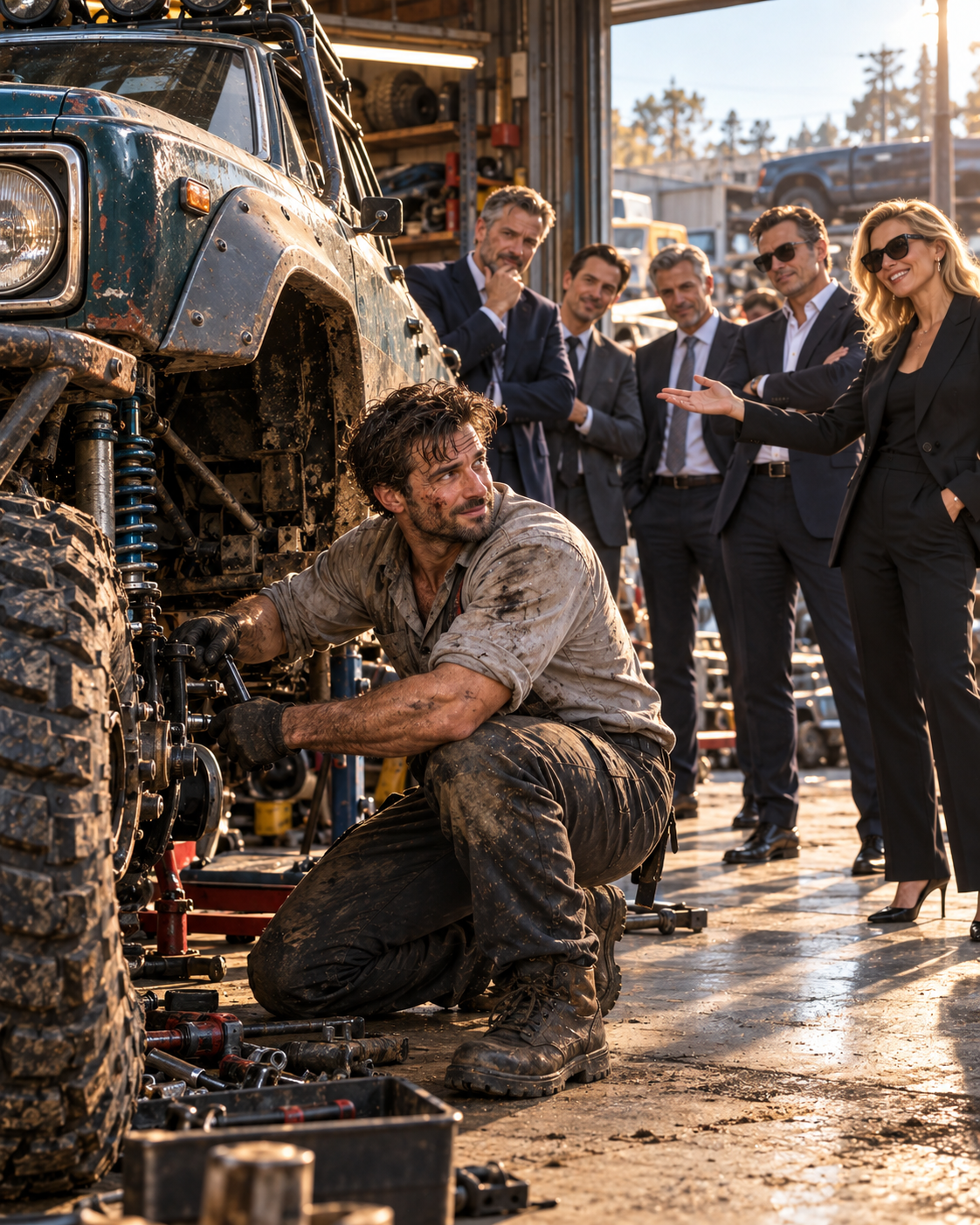
I felt strangely calm.
Three years of anger had taught me that rage was loud, but truth was patient.
“What do you want from me?”
Helena met my eyes.
“Help me expose all of it.”
I almost laughed.
“You want the man you publicly humiliated to save your company?”
“No.”
She looked toward my wife’s picture.
“I want to save what your company should have been.”
That sentence stayed with me.
I still didn’t trust her.
Trust was not something a signature could buy back.
But accountability had to begin somewhere.
I agreed to one condition.
“No lawyers controlling the story.”
Helena nodded.
“Agreed.”
The next morning, the journalist, Mara Ellis, returned to my shop.
She brought cameras, documents, and a question I wasn’t ready to answer.
“Why did you keep building after losing everything?”
I looked at Chloe.
She was on the floor, drawing a picture of Gravel with orange flames shooting from its side.
“My wife used to tell me that broken things deserved a second look.”
Mara lowered her camera.
“She sounds remarkable.”
“She was.”
Chloe held up the drawing.
“Mom said Daddy builds things because he misses people.”
I had to look away.
That afternoon, Helena called.
Marcus had learned about the documents.
He was trying to destroy the remaining records.
Silas opened an old steel cabinet in the corner of the shop.
“I knew this day would come.”
Inside were boxes wrapped in oilcloth.
For three years, he had kept copies of my laboratory journals, failed prototypes, and handwritten calculations in case I ever needed proof.
I touched the oldest notebook.
My wife’s handwriting was on the inside cover.
“Make it work.”
I had forgotten she wrote those words.
I sat down hard.
The first thermal model had been drawn during one of our last winter evenings together.
She had sat beside me in a blanket and challenged every assumption.
“What happens when the pump fails?”
I had told her the system would become unstable.
She had smiled.
“Then build one that doesn’t need the pump.”
I stared at the page.
The final breakthrough wasn’t entirely mine.
It was hers too.
For the first time, I understood why finishing Gravel had mattered so much.
I wasn’t rebuilding my career.
I was finishing a conversation that death had interrupted.
Three days later, the story broke nationally.
Mara published the documents, the original lab dates, the altered filings, and the internal messages between Nathan and Marcus.
Apex stock fell.
Federal investigators arrived.
Nathan disappeared before they could question him.
Marcus tried to resign.
Helena stopped him at the board meeting.
“You’re not leaving until every document is transferred to investigators.”
Marcus laughed.
“You think one race car makes you a hero?”
Helena stared at him.
“No.”
She pushed a file across the table.
“His evidence does.”
The board voted to remove Marcus from his position.
Nathan was later arrested at a private airstrip outside Tucson.
But the legal fight was only beginning.
Apex’s attorneys claimed the technology had been improved independently.
They argued that my old employment contract gave the company broad rights over anything I developed while on salary.
I had expected that.
What they didn’t expect was the notebook my wife had challenged me to finish.
The dates proved that the core system existed months before Apex filed anything related to it.
Mara called it the missing piece.
I called it her last gift.
Months passed.
The money from the rally sat untouched in a separate account while the legal case moved forward.
I kept working at the shop.
I repaired trucks.
I built cooling systems.
I taught Chloe how to hold a wrench without pinching her fingers.
Gravel sat beneath a tarp in the corner.
Sometimes I would uncover it just to hear the engine turn.
One evening, Chloe asked, “Are you going to race again?”
I looked at the old photograph of my wife on the workbench.
“I don’t know.”
She frowned.
“Mom would know.”
That made me smile.
“Your mother would probably tell me to stop being stubborn.”
Chloe giggled.
Then she became serious.
“She’d tell you to make it better.”
I looked at the little girl who had grown used to grief without ever truly understanding it.
“You’re probably right.”
That night, Helena came back to the shop.
She wasn’t carrying contracts this time.
She carried a toolbox.
“I was told engineers don’t trust CEOs who arrive with paperwork.”
I smiled despite myself.
“That’s because engineers have met CEOs.”
She laughed softly.
Then she set the toolbox down.
Inside were old parts from my original Apex prototype.
“I found these in storage.”
I recognized them instantly.
The first copper manifold I had designed.
The prototype chamber where my wife had written a tiny heart with a permanent marker.
I picked it up with both hands.
“I thought this was destroyed.”
“So did everyone else.”
Helena sat across from me.
“I should have listened.”
“You should have asked questions.”
“I should have done both.”
For a while, we said nothing.
Then she asked, “What would you build if nobody could take it from you?”
I looked toward Gravel.
“Something nobody needs to own alone.”
She nodded.
“That’s why I came.”
She slid one final document toward me.
It wasn’t an employment contract.
It was a joint venture agreement with equal ownership and a clause giving me final authority over the technology’s ethical licensing.
“No hidden patents.”
“No exclusive military sales.”
“No copying.”
“No pressure to bury failures.”
“And public records of the original research.”
I read every line.
Then I looked at Helena.
“You’ve been listening.”
“Late,” she said.
“But yes.”
I signed nothing that night.
I told her I needed time.
She said she understood.
Two weeks later, the workshop received its first official visitor from the federal investigation team.
They had recovered one more piece of evidence from Nathan’s accounts.
A payment ledger.
One name appeared beside several transfers.
My name.
I stared at it.
Silas stepped closer.
“That’s impossible.”
The investigator looked at me.
“We know.”
“Then why are you showing me?”
“Because the payments were made before you were removed from Apex.”
I felt the old floor tilt beneath my feet.
Someone had been funneling money into an account using my identity.
“Can you trace where it went?”
“We traced the first transfer.”
He placed a photograph on the table.
It was a bank envelope sitting on a desk.
Beside it was a handwritten note.
The handwriting looked like mine.
Except I had never written those words.
KEEP THE FAMILY SAFE.
My pulse slowed.
“Family?”
The investigator nodded.
“There was one more name attached to the account.”
He turned the photograph around.
My wife’s name was on the form.
I couldn’t breathe.
The investigator spoke carefully.
“We need to know whether your wife had knowledge of the Apex project.”
I stared at the signature.
For the first time since her funeral, grief felt less like an ache and more like a locked door someone had just opened.
I spent the next week searching every box she had left.
Receipts.
Old notebooks.
Recipes.
Photographs.
Movie tickets.
Nothing.
Then Chloe found a small wooden case beneath the bed.
“It has Mom’s star on it.”
I opened it.
Inside was a key and a folded note.
My hands shook before I unfolded the paper.
“If you’re reading this, you finally stopped looking at the wrong enemy.”
That was all.
No name.
No explanation.
Just an address.
A storage unit on the outskirts of Phoenix.
I went alone.
Silas wanted to come.
Helena offered security.
I refused both.
Some doors had to be opened by the person who had been waiting behind them.
The storage unit smelled of dust and old cardboard.
The key turned.
Inside were six boxes.
The first contained photographs.
The second contained technical drawings.
The third held copies of emails between my wife and Marcus Vale.
She had discovered the financial transfers months before I did.
She had begun documenting them secretly.
The fourth box contained audio recordings.
I played the first one.
Marcus’s voice filled the room.
“We can’t let him publish the independent cooling results.”
Nathan answered.
“He won’t.”
Marcus laughed.
“What if he does?”
Nathan said, “Then his wife becomes a problem.”
I stopped the recording.
My knees nearly gave out.
The final box contained medical records.
I called the investigator.
He arrived within an hour.
We compared hospital records with Apex payment logs.
There was a missing window.
One night at a private treatment clinic had never appeared in her official files.
The clinic had received money from a shell company tied to Marcus.
I could barely speak.
“What are you saying?”
The investigator looked at me.
“I’m saying we don’t know yet.”
For once, I appreciated those words.
He wasn’t giving me a dramatic answer.
He was giving me the truth.
We reopened the case.
Weeks became months.
The investigation uncovered fraud, intellectual property theft, bribery, and witness intimidation.
But there was still no proof that Apex had caused my wife’s death.
I had to live with that uncertainty.
It was harder than hatred.
Hatred gave me a target.
Uncertainty gave me a question I couldn’t force into an answer.
So I stopped building Gravel for revenge.
I started building again because creation was the one thing grief had never managed to take from me.
Helena kept her promise.
Our new venture began in a small warehouse outside Mesa.
The first prototype bore no Apex logo.
No Nathan name.
No corporate branding.
Only a small metal plate engraved with two words.
For Elise.
Chloe chose the plate.
“Because Mom helped build it.”
I nodded.
“Yes.”
The first test day arrived at sunrise.
The new thermal system ran without a pump.
No overheating.
No hidden failures.
Just clean, quiet circulation driven by the physics I had once been told was worthless.
Helena stood beside me wearing safety glasses.
Silas leaned against the tool chest.
Mara filmed from a distance.
Chloe pressed the ignition switch.
The engine came alive.
For a few seconds, nobody moved.
Then the temperature stabilized.
I closed my eyes.
I imagined my wife sitting beside me in the desert, asking the same impossible question she had asked years ago.
“What happens when the pump fails?”
I smiled.
“I built one that doesn’t need it.”
The test vehicle rolled forward.
Not because a corporation demanded it.
Not because a rival had challenged me.
Not because I needed to prove I was better than anyone.
It moved because something broken had been patiently rebuilt.
And somewhere behind that simple machine was a lesson I had almost forgotten.
The greatest thing we build is not the machine.
It is what the machine allows someone else to become.
A stolen idea can be copied.
A career can be erased.
A reputation can be damaged by people with money and power.
But integrity leaves records, memory, and witnesses.
You can bury the truth for years.
You cannot make every honest person forget it.
The investigator arrived the next morning with a sealed envelope.
“Before you open this, remember that a payment doesn’t tell you why it was made.”
Inside was a clinic ledger and a statement from my wife’s doctor.
The money had come from a shell company, but every dollar had funded emergency treatment for engineers who had become witnesses against Apex.
My wife had been paying those costs anonymously.
She had not been helping Vance.
She had been protecting the people he wanted silenced.
I sat down hard.
“She knew.”
“She knew enough to be afraid,” the investigator said.
There was one final document.
It was a letter addressed to me but never delivered.
I recognized her handwriting before I unfolded it.
“My love, if you are reading this, then I didn’t get the chance to tell you everything.”
She wrote that she never wanted me to become a man built entirely from anger.
“Build something that gives people a way forward.”
I swallowed against the pain.
“Don’t make them pay for what was done to us.”
The last line made my hands shake.
“Let our daughter inherit your courage, not your hatred.”
For three years, I had thought justice meant making someone hurt as much as I did.
My wife had understood something I hadn’t.
Justice could protect the future without poisoning it.
Months later, the investigations reached the people who believed money made them untouchable.
Some were charged.
Some testified.
Some names never became public.
I never learned every detail of my wife’s final days, and perhaps I never would.
Grief rarely gives complete answers.
But it can give direction.
The new company grew slowly.
We licensed the cooling technology to small manufacturers, hospitals, and remote communities that had never been able to afford systems like Apex’s.
I insisted on transparent contracts.
Helena agreed.
Silas kept working beside me even after retirement became an argument he lost repeatedly.
Chloe kept Gravel’s battered metal emblem on her bedroom shelf.
Years after the race, she and I returned to the desert.
The sun sank behind the mountains while she held her mother’s photograph and I carried the old notebook.
“Ready to go home, Dad?”
I looked across the empty course.
“Yes.”
Then my phone vibrated.
One new message.
No number.
Only three words.
WE FOUND HIM ALIVE.
I stared at the screen.
After everything, one secret was still buried beneath the dust.
But this time, whatever waited at the end of that road would not decide who I became.
I would.