At the marble table in our Tennessee dining room, my father laughed when I announced I would marry a farmhand
Part 2
The next morning, Lucas called the attorney whose name appeared on the documents.
I stayed beside him at the kitchen table while he listened.
He barely spoke.
Mostly, he said, “Yes,” or “I understand.”
When the call ended, he sat perfectly still.
“How much?”
He looked at me.
“Enough that I could buy my own farm ten times over.”
I waited.
He added quietly, “And apparently, enough that my father once owned a business that your father wanted very badly.”
My stomach tightened.
“What business?”
“Cattle.”
The word landed between us like a stone.
Lucas explained that his father, Daniel Vance, had once been Thomas Sterling’s business partner.
They had built a cattle operation together when they were young, before my father’s agricultural empire had become what it was.
Daniel had handled the ranch operations.
Thomas had handled financing and expansion.
Then, according to the records, Thomas had forced Daniel out of the partnership after a financial dispute.
Daniel lost control of the company.
His cattle were sold.
His property was taken.
And within a few years, he disappeared from the business world entirely.
My father had always told us that Daniel Vance had been reckless.
A man who couldn’t manage money.
A partner who had ruined his own future.
Lucas stared at the table.
“My father never told me your father did this.”
“Maybe he didn’t want you to hate him.”
Lucas shook his head.
“Maybe he didn’t want me to become like him.”
That afternoon, we learned something even stranger.
The trust Lucas had inherited was not simply money.
It included land rights and legal interests connected to the old cattle company.
And one of those interests had suddenly become important because my father was facing a legal claim over land that his company desperately needed.
The attorney representing Thomas discovered the heir’s identity while reviewing old partnership records.
Lucas Vance.
Daniel Vance’s son.
The missing heir everyone had assumed was either dead or had disappeared without assets.
My father found out before we did.
He drove to our farmhouse alone.
I saw his black SUV turn onto the gravel road just before sunset.
Lucas was repairing a gate.
I was carrying firewood.
My father stepped out of the vehicle wearing the same expensive coat he had worn to countless board meetings.
But he looked different.
Older.
Smaller.
His eyes moved from our farmhouse to the weathered barn, then to Lucas.
“You’re Daniel’s boy.”
Lucas straightened.
“Yes.”
My father stopped breathing for a second.
I had never seen him look frightened.
Not when markets crashed.
Not when storms destroyed crops.
Not when competitors threatened his company.
But now, standing in our muddy yard, he looked like a man who had just opened a door and found his own past waiting behind it.
“How much did your father leave you?”
Lucas said nothing.
My father stepped closer.
“I asked you a question.”
Lucas wiped dirt from his hands.
“You didn’t come here because you care how much I inherited.”
Thomas’s jaw tightened.
“Your father had legal interests in land connected to my company.”
“Then talk to your lawyers.”
“I am.”
My father looked at me.
“Clara, do you understand what this means?”
I felt the old instinct to obey him.
Then I remembered the dining room.
The laughter.
The word nobody.
“Yes,” I said.
“For the first time, I think I do.”
My father looked away.
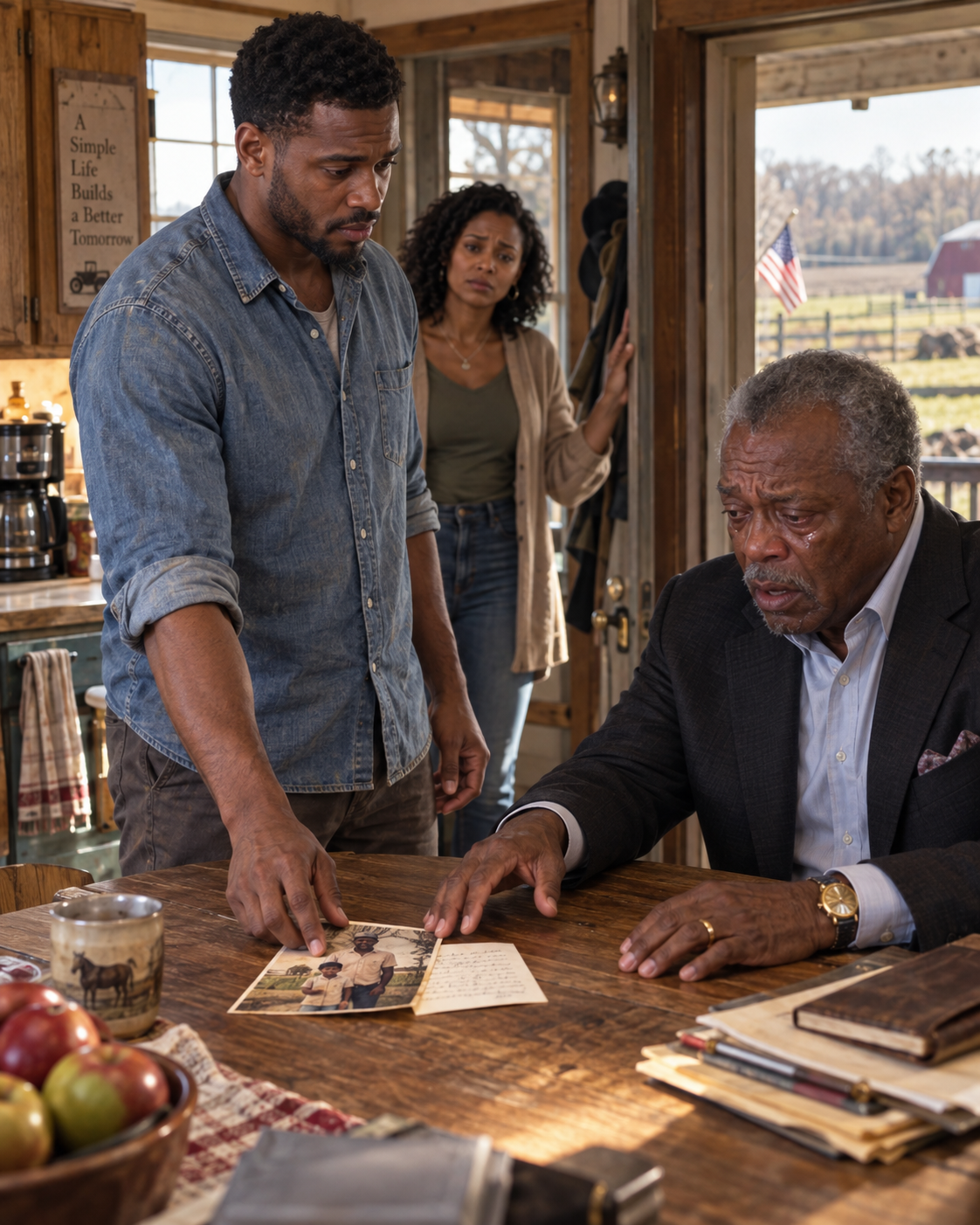
Lucas went inside and returned with the photograph.
He handed it to Thomas.
My father stared at the image.
His face changed.
I watched recognition spread across it.
“Daniel,” he whispered.
Then he turned the photograph over.
His fingers began to shake.
There was a message written in faded blue ink.
Lucas read it aloud.
“Thomas, if you ever forget what matters, remember this boy’s worth is not determined by what I leave him.”
My father closed his eyes.
The yard became silent except for the wind.
Lucas continued.
“Promise me you’ll remember that a child’s character is worth more than any inheritance.”
Thomas lowered the photograph.
“I remember.”
His voice cracked.
“No,” Lucas said quietly. “You forgot.”
My father looked at him.
For several seconds, neither man moved.
Then Thomas sat down on the wooden step outside our farmhouse.
He covered his face with both hands.
I had seen my father angry.
I had seen him ruthless.
I had seen him walk away from people without looking back.
I had never seen him cry.
But that evening, he did.
“I betrayed him,” he said.
I stood frozen.
Thomas looked at Lucas.
“I told myself Daniel was irresponsible. I told myself I was protecting the company. I told myself a hundred things because admitting the truth would have meant admitting what I had become.”
Lucas didn’t interrupt.
Thomas’s voice grew quieter.
“I wanted more land. More power. More control.”
He looked at me.
“And I taught my children that money was how you measured people.”
My throat tightened.
“I’m sorry, Clara.”
Then he turned to Lucas.
“I am ashamed of how I treated you.”
Lucas looked down at the photograph.
“My father spent his whole life refusing to hate you.”
Thomas wiped his face.
“Why?”
“Because he said hatred was another debt he didn’t want to leave his son.”
My father broke again.
That sentence seemed to reach somewhere in him that all the money in the world never had.
He stayed until dark.
Before leaving, he stood in front of Lucas.
“I can’t undo what I did to your father.”
“No.”
“But I can stop pretending it never happened.”
Lucas nodded.
“That’s a start.”
The next morning, my father called the entire family to the mansion.
For the first time in years, everyone sat around the same table.
My mother looked exhausted.
Julian looked confused.
Thomas placed the old photograph in the center of the table.
“I owe you all an apology.”
Julian shifted in his chair.
My father continued.
“I spent decades believing wealth proved a person’s worth.”
He looked at each of us.
“I was wrong.”
My mother began crying again, but this time she didn’t hide it.
Julian stared at the photograph.
“Lucas really inherited all that?”
Thomas nodded.
Julian looked uncomfortable.
I almost expected him to make a joke.
He didn’t.
Instead, he whispered, “I called him a nobody.”
Lucas sat quietly beside me.
“You did.”
Julian lowered his eyes.
“I’m sorry.”
The room remained silent.
And for once, nobody tried to fill the silence with money, excuses, or pride.
But the story wasn’t over.
Because Lucas had a fortune now.
And everyone wondered what a man who had spent his entire life rejecting wealth would do when wealth suddenly belonged to him.
Part 3
Lucas could have bought a mansion.
He could have bought cars, land, companies, and anything else my family once believed represented success.
Instead, he asked me one question.
“What did you see growing up that nobody in my father’s world seemed to notice?”
I thought about it.
“Farm workers.”
He nodded.
“Exactly.”
We began quietly.
No press conference.
No giant announcement.
No photographs of Lucas standing in front of oversized checks.
He created a foundation for agricultural workers who had spent their lives laboring on other people’s land without ever having enough money to feel secure.
The foundation helped families facing emergencies.
It funded training programs.
It provided equipment grants to small farmers.
It helped workers afford housing and education.
Lucas refused to put his name on the building.
When the board suggested naming the foundation after him, he shook his head.
“People don’t need my name.”
“They need help.”
That became the rule.
My father watched from a distance at first.
Then he asked Lucas if he could contribute.
Lucas said yes.
But he gave my father a condition.
“Don’t donate just to make yourself feel forgiven.”
Thomas nodded.
“Then what should I do?”
“Work.”
So he did.
For the first time in my life, I saw my father walk through a field without an entourage.
He met workers whose names he had never known.
He listened to stories he once would have dismissed.
He visited farms where roofs leaked and machinery was decades old.
He learned what fertilizer cost.
He learned what a missed paycheck meant.
He learned how quickly a medical bill could destroy a family.
And slowly, something changed.
Not the kind of change that happens in movies.
There was no single speech.
No miraculous transformation.
Just hundreds of small decisions.
A contract rewritten fairly.
A worker given another chance.
A family kept on its land.
A young farmer receiving the equipment he needed to stay in business.
Thomas and Lucas eventually became partners.
Not because Lucas needed Thomas.
Not because Thomas needed Lucas’s fortune.
But because they had discovered something neither of them had understood before.
Money could build an empire.
Character could build something worth leaving behind.
One evening, years after that first envelope arrived, Lucas and I stood on the porch of our farmhouse.
The house was still modest.
The porch still sagged.
The old truck still sat beside the barn.
I laughed when Lucas mentioned that we could easily afford to replace all of it.
“We probably should.”
He smiled.
“Maybe.”
“But we won’t.”
“Probably not.”
I leaned against his shoulder.
“Do you ever think about what would have happened if you hadn’t opened that envelope?”
He was quiet for a while.
Then he looked across the fields.
“I’d still be here.”
“Would you?”
“Yes.”
I smiled.
“So would I.”
Behind us, headlights appeared on the gravel road.
It was my father.
He stepped out carrying a small wooden box.
He walked toward us slowly.
Inside the box was the old photograph.
Thomas handed it to Lucas.
“I thought you should have this.”
Lucas took it.
“You kept it all these years.”
“I kept a lot of things.”
My father looked toward the fields.
“Most of them were useless.”
Then he looked at me.
“I spent my whole life trying to make sure my children would never have less than I had.”
He paused.
“I never realized I was teaching them to have less of what mattered.”
I reached for his hand.
It was the first time I had done that without remembering the mansion.
Without remembering the money.
Without remembering what he could give me.
Just my father’s hand.
He squeezed mine.
Lucas opened the photograph one last time.
On the back, Daniel’s handwriting was fading.
But the words remained.
A child’s worth is not measured by an inheritance.
I used to think that message was about Lucas.
Then I understood it was about all of us.
We inherit more than money.
We inherit beliefs.
Habits.
Fears.
Pride.
Sometimes, we spend half our lives carrying an inheritance that was never placed in a bank account.
And sometimes, the bravest thing we can do is refuse to pass it on.
My father never stopped being wealthy.
Lucas never stopped being wealthy either.
But neither of them spoke about wealth the way they once had.
The Sterling mansion still stood on its hill.
The fields still stretched beyond it.
The company still grew.
But now, some of its profits went toward people my family once barely noticed.
And on our little farm, Lucas and I still ate simple dinners at the same old kitchen table.
We still argued about broken fences.
We still laughed at stupid things.
We still counted our blessings differently than we once counted our money.
Years later, when someone asked Lucas what his greatest inheritance had been, he didn’t mention the trust.
He didn’t mention the land.
He didn’t mention the fortune that had once shocked my entire family.
He looked at me and smiled.
“My father’s final lesson.”
“What lesson?”
“That money can tell you what something costs.”
He squeezed my hand.
“But only character can tell you what it’s worth.”
I thought about the marble table where my family had once called him a nobody.
I thought about the envelope that changed everything.
And I realized the greatest twist in our story was never that Lucas had secretly been rich.
It was that he had been worthy before anyone knew.
The fortune only revealed what had already been there.
That night, the sun disappeared behind the Tennessee hills, turning the fields gold before the darkness settled over them.
Lucas and I sat quietly on the porch, listening to the wind move through the grass.
For the first time, I understood what home really meant.
It wasn’t the size of the house.
It wasn’t the land beneath your feet.
It wasn’t the name carved into a gate.
Home was the person beside you when everything that money can buy has been stripped away.
And if you are lucky, you discover that the people who truly matter were never the ones who could afford the most.
They were the ones who stayed when there was nothing to gain.