At the Lakeside warehouse, I watched ten supposedly worthless cars being dragged toward a scrap truck while a wealthy executive’s man laughed
The legal letter lay beside the Porsche 356 for three days before I finally stopped pretending it didn’t scare me.
I had spent my savings on ten cars that belonged, technically, to someone far richer and far more powerful than me.
Now her people were saying the transaction might never have been valid.
Lucas kept telling me not to panic.
I kept doing the math anyway.
Rent.
Parts.
Legal fees.
Food.
My son’s school expenses.
Every number seemed to end at the same place.
Zero.
One Monday morning, I found myself standing beside the Ferrari with my hand resting on its roof.
Marcus Webb had offered three hundred and eighty thousand dollars.
If I could sell it, I could breathe again.
But the legal freeze meant I couldn’t sell anything.
I could restore them.
I just couldn’t move them.
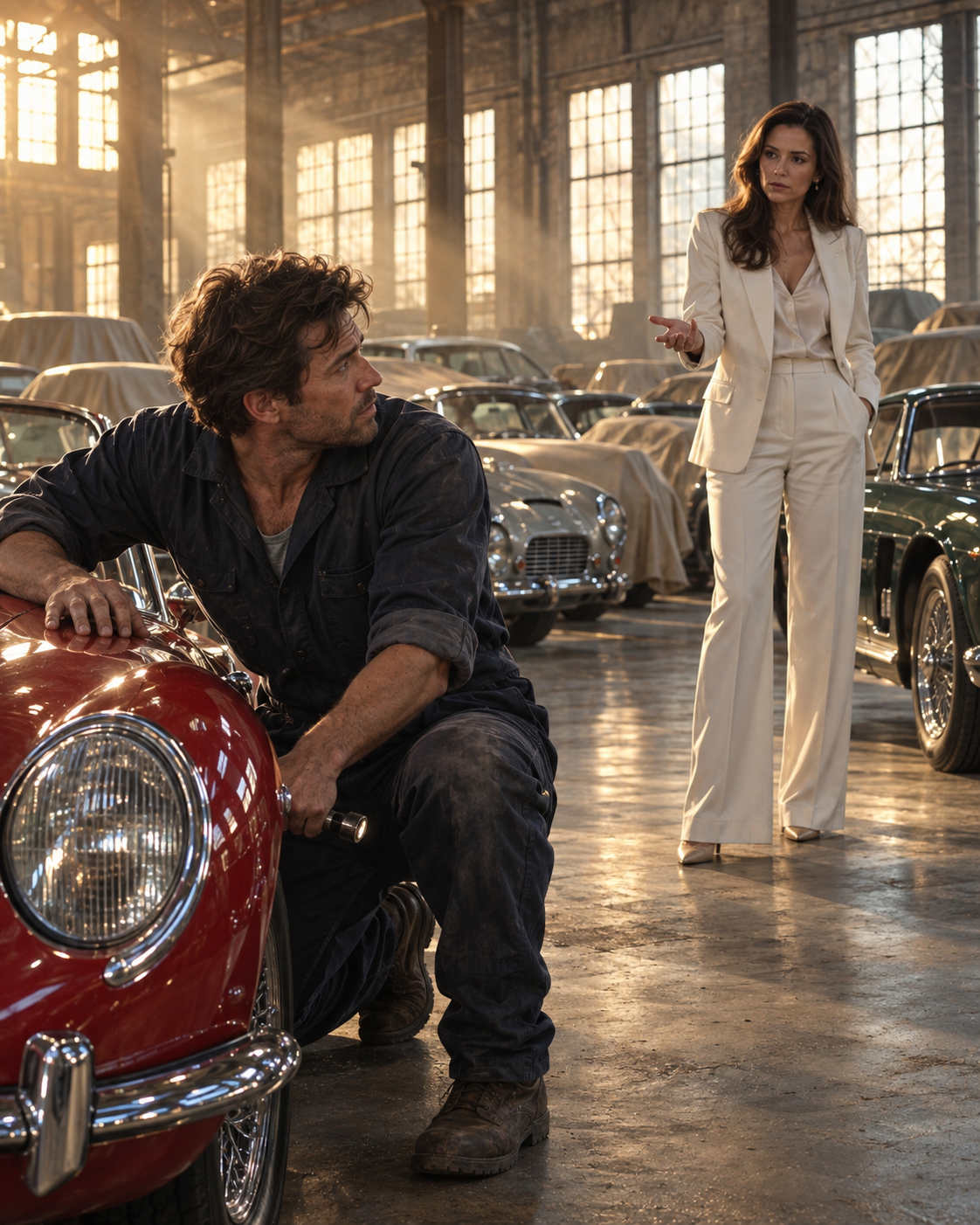
It was like rebuilding ten houses while somebody else held the deed.
That afternoon, a woman named Diana Sterling walked into my warehouse.
She was an investigative reporter, and Lucas had warned me that she asked questions people with expensive lawyers usually preferred not to answer.
She didn’t start with the cars.
She started with my notebook.
I had been keeping records of every problem I found, every part I replaced, every discrepancy between the official assessment and reality.
Diana flipped through the pages slowly.
Then she placed a finger beneath one sentence.
“Who wrote the original reports?”
“I don’t know,” I said.
“Who hired the inspectors?”
“I don’t know.”
“Who benefits if these cars are declared worthless?”
I looked at her.
She looked back at me.
Neither of us spoke.
Finally, she closed the notebook.
“That,” she said, “is the question.”
She left with copies of my records and promised nothing.
Three days later, she called.
“I found the contractor,” she said.
My hand tightened around the phone.
“What did you find?”
“The inspections were authorized through Carter Voss.”
The warehouse suddenly felt much smaller.
Diana explained that Carter had used the same external contractor on several Whitmore assets over the previous three years.
Every time, the pattern looked similar.
An asset was undervalued.
A report made it appear less useful than it really was.
A disposal was arranged.
Then, somewhere outside Eleanor Whitmore’s direct view, someone acquired the asset far below market value.
“This isn’t about ten cars,” Diana said.
“It’s about a system.”
I sat down on an overturned bucket.
“How much?”
She hesitated.
“Too much to guess yet.”
Meanwhile, my restorations continued.
The Aston Martin came back to life one circuit at a time.
The Porsche needed a rebuilt carburetor and fresh seals.
The Mercedes 300SL fought me for nearly a week because the driver-side door release had seized deep inside the mechanism.
I had never restored a Gullwing before.
So I studied every document I could find before touching it.
The night the door finally opened smoothly, Lucas just stood there smiling.
“You know,” he said, “there aren’t many people who would risk everything to fix cars that weren’t even supposed to exist anymore.”
I shrugged.
“They were always supposed to exist.”
The Lamborghini Miura nearly broke me.
Its fuel problem appeared randomly under load, which meant every successful test seemed to prove I had fixed it until the engine stumbled again.
For six days, I chased the fault.
On the seventh, I found it.
A diaphragm valve in the secondary circuit was failing intermittently.
The replacement wasn’t commercially available.
So I fabricated one.
When the engine finally ran clean, the sound filled the warehouse so completely that Lucas and I stopped talking.
Then we both laughed.
For five minutes, none of it mattered.
Not the legal freeze.
Not the debt.
Not Carter Voss.
Just the sound of something everyone had called finished coming back to life.
But outside the warehouse, the pressure was building.
The collector community had begun sharing photographs of my restorations.
Messages arrived from London, Tokyo, Geneva, Dallas, and Los Angeles.
People wanted the cars.
They wanted documentation.
They wanted to know who had brought them back.
I couldn’t legally sell them yet.
But Carter knew exactly what was happening.
One Wednesday afternoon, he called me personally.
His voice was polite.
Too polite.
He offered one hundred and fifty thousand dollars for all ten cars.
“You get out clean,” he said.
“You stop worrying about legal fees, and you walk away with more than three times what you invested.”
I looked across the warehouse.
Nine cars sat under work lights.
One Ferrari had already become the most talked-about restoration on the forum.
“One hundred and fifty thousand?” I asked.
“Yes.”
I almost laughed.
He wasn’t offering me money for broken cars.
He was offering me money because he knew what the cars were worth.
That realization told me more than the number did.
“I’ll pass,” I said.
He went quiet.
Then he said, “You should think carefully about what happens next.”
The line went dead.
I put the phone down.
Lucas looked at me.
“What did he want?”
“To buy everything.”
“For how much?”
“Enough to prove he’s scared.”
The next morning, Diana called me again.
“I’m meeting Eleanor Whitmore today.”
I felt something strange in my chest.
“Why?”
“Because I think she doesn’t know.”
Three hours later, Diana sat across from Eleanor in an office overlooking the Detroit River.
She placed two photographs on the desk.
The first showed the restored Ferrari.
The second showed the original inspection report.
Severe gearbox oil leak.
Restoration not cost effective.
Eleanor studied both.
Then she asked, “Where is this car now?”
Diana gave her my warehouse address.
Eleanor was forty-one, wealthy beyond anything I had ever experienced, and apparently had built her life by making decisions quickly.
But that afternoon, for once, she slowed down.
She asked for every document connected to Lakeside.
Every message.
Every authorization.
Every invoice.
Every communication Carter had touched.
Her assistant, Giselle Marsh, spent the evening assembling the file.
The next morning, Eleanor began reading.
And the deeper she went, the colder she became.
There were fourteen messages between Carter and the demolition company.
Eleven had been sent through a secondary contact address that did not belong to the Whitmore Group.
The inspection contractor listed Carter as its authorizing contact.
Several assessments had been submitted before Eleanor had even received the summary she eventually signed.
Carter had built a process designed to make Eleanor believe she was making the decision.
In reality, she had been approving a decision he had already made.
The biggest revelation came at 6:40 that evening.
Giselle found an old file from three years earlier.
A commercial property had been written down as nearly unsalvageable after a series of structural problems.
The asset was sold.
Six months later, it reopened under a different ownership structure.
Carter had never officially owned it.
But the buyers were tied to a company whose largest private investor was one of Carter’s relatives.
Eleanor closed the folder.
For the first time in twelve years, she called Carter and did not give him advance notice of why.
He arrived at her office the next morning.
She put the files on the table.
He looked at them.
His confidence shifted almost imperceptibly.
Eleanor asked only one question.
“How long?”
Carter tried to answer indirectly.
“How long have you been doing this?”
He said nothing.
“How long?”
Finally, he whispered, “It was never meant to hurt you.”
Eleanor stared at him.
“You stole from me.”
“I created opportunities.”
“You stole from me.”
“I made assets more efficient.”
“You stole from me.”
Her voice never rose.
That made it worse.
Carter left the building forty minutes later without his office keys, his company phone, or his access credentials.
But the battle wasn’t over.
He had already filed the challenge against my purchase.
The hearing remained.
My attorney, Rebecca Hart, had been working almost around the clock to defend the transaction.
The day before the hearing, I had less than twelve hundred dollars in my business account.
Parts invoices were overdue.
The warehouse owner was getting nervous.
Lucas had quietly started selling some of his own tools to help cover expenses.
I found out and nearly lost my temper.
“You don’t sell your tools for me.”
He looked at me.
“You sold everything for these cars.”
“That was my decision.”
“So is this.”
That ended the argument.
The next morning, Eleanor Whitmore filed a statement with the court.
She personally confirmed that the transaction was valid.
She withdrew the challenge.
The freeze was lifted.
Rebecca called me at 2:15.
I was underneath the Alfa Romeo.
When she told me, I didn’t understand the words at first.
Then I crawled out, sat on the concrete, and stared at the ceiling.
Lucas thought I was crying.
I was.
Not because the legal problem was over.
Because for the first time since I had entered Lakeside, someone with enormous power had chosen to tell the truth instead of protecting the person who had lied to her.
The Ferrari sold two weeks later for three hundred and ninety-five thousand dollars.
Marcus Webb drove up from Dallas himself.
He spent almost an hour going through the restoration records.
He looked at the photographs.
He examined every stamped number.
Then he shook my hand.
“I’ve bought a lot of expensive cars,” he said.
“This is the first one where I trust the paperwork more than the seller.”
That sentence meant more to me than the money.
The rest of the restorations accelerated.
The Aston Martin went to a private collector in Geneva.
The Jaguar went to a collector in California.
The Porsche found a buyer in New York.
The Mercedes 300SL went to a German-American family who had searched for one with matching history for years.
The Lamborghini Miura attracted offers from three countries.
Every buyer received the same thing.
The car.
The restoration log.
Every photograph.
Every replaced part documented.
Every flaw disclosed.
I refused to hide anything.
Because after watching Carter manipulate information, I knew exactly what kind of business I never wanted to build.
Eighteen months after I first touched the Ferrari’s cover, the last car left the warehouse.
It was the Talbot-Lago Grand Sport.
The final sale brought the collection’s total revenue to roughly ten million dollars.
After every expense, every loan, every legal fee, and every restoration cost, I was left with enough money to change my son’s life.
But the first thing I did was repay Lucas.
He protested.
I ignored him.
Then I offered him a partnership.
He stared at me like I had suggested we buy the moon.
“You’re serious?”
“You risked everything with me.”
“So did you.”
“I know.”
We shook hands.
The second thing I did was buy the warehouse.
The third was hiring three mechanics from the neighborhood.
One of them was a young man who had spent years repairing cars in his driveway because nobody would give him a real chance.
I knew exactly what that felt like.
The old garage on the dead-end road stayed open too.
We kept fixing ordinary cars there.
Brake jobs.
Transmission failures.
Engines that families depended on to get to work.
I never wanted money to become the only thing my business meant.
Diana published her investigation weeks later.
The article was not really about me.
It was about how easily wealth can become vulnerable when the owner stops asking questions.
It named Carter.
It documented the inspection scheme.
It showed how delegated authority could be manipulated until a person believed someone else was making honest decisions on their behalf.
My name appeared only briefly.
I preferred it that way.
One afternoon, months after everything was finished, a plain white envelope arrived at the warehouse.
There was no return address.
Inside was an original auction receipt for the Aston Martin DB5.
Tucked behind it was a handwritten note from Eleanor.
“I bought this car the year everything in my life finally started going right,” she had written.
“I forgot why it mattered until I saw what you did with it.”
There was one more line.
“I hope you understand that what you restored was more than a machine.”
I read it twice.
Then I put the note away.
I didn’t need Eleanor to apologize forever.
I only needed her to understand what had happened.
A few weeks later, she came to the garage.
Not with assistants.
Not with lawyers.
Just herself.
She walked past the service bays and stopped beside the workbench.
“Can I see the Ferrari?”
“It’s gone,” I said.
She smiled faintly.
“Of course it is.”
We stood there in silence.
Then she said, “I used to think discarded things were things that had lost their value.”
I waited.
She looked around the shop.
“Now I think sometimes they just haven’t met the right person yet.”
I didn’t know what to say.
So I handed her a cup of coffee.
She took it.
That was our conversation.
No dramatic reconciliation.
No perfect ending.
Just two people standing in a garage, both understanding that some mistakes could be repaired but never erased.
That evening, I went home to my son.
He was sitting at the kitchen table with a science book open beside him.
“Dad,” he said, “guess what?”
“What?”
“My teacher says the planets don’t really disappear when you can’t see them.”
I smiled.
“That’s right.”
“They’re still there.”
“Usually.”
He closed the book.
“Then maybe people are like that too.”
I looked at him.
“What do you mean?”
He shrugged.
“Maybe somebody can think you’re finished, but that doesn’t mean you are.”
I felt something tighten in my throat.
Because that was exactly what had happened to me.
The world had called those cars finished.
Carter had called my business too small.
The court had nearly called my purchase invalid.
My bank account had called my dream impossible.
And none of those things had been enough to decide what happened next.
That night, after my son went to bed, I walked through the new warehouse alone.
The restoration bays were quiet.
The polished floors reflected the overhead lights.
Ten empty spaces remained where the forgotten cars had once stood.
For a moment, I could almost hear the sounds of the old warehouse again.
The tools.
The engines.
Lucas laughing.
My own voice saying, “Nobody who knows cars writes a report this wrong by accident.”
I looked at the empty spaces.
Then at the locked cabinet containing every original report and every restoration photograph.
I realized the real fortune had never been the ten million dollars.
It was the lesson hidden underneath it.
When someone powerful tells you something is worthless, look closer.
When someone insists you should stop asking questions, ask one more.
And when the world decides something is finished, remember that value does not always disappear.
Sometimes it simply waits for someone stubborn enough to recognize it.
I switched off the lights and reached the warehouse door.
Just before I locked it, I noticed an envelope lying beneath the cabinet.
It had my name on it.
Not from Eleanor.
Not from Diana.
Not from Lucas.
The handwriting belonged to Carter Voss.
I opened it under the hallway light.
Inside was a single sentence.
And after reading it, I knew the story of the ten cars was only the beginning.