At the family dinner, my mother tore my $22,000 college scholarship letter in half and coldly told me to wait another year
The next morning, Nancy called me at 8:12.
I almost didn’t answer.
After everything that had happened, I had started to dread unexpected calls.
They usually meant another problem, another explanation, or another piece of my life that needed to be rebuilt.
But Nancy’s name on the screen made me sit up.
“Hello?”
“Claire, I need you to come to my office.”
Her voice was careful.
“What happened?”
“I found something else.”
I looked at Grandpa’s card sitting beside my bed.
“What kind of something?”
“A document your grandfather prepared before he died.”
My heart began beating faster.
“About the money?”
“About the money, and something else.”
I drove to Nancy’s office in silence.
The November sky over Madison was gray and heavy, and the streets were still wet from an overnight storm.
I kept thinking about the previous dinner.
Evan’s face.
Mom’s silence.
The way her spoon had slipped from her hand when Nancy’s message appeared on his phone.
Something about that moment had bothered me.
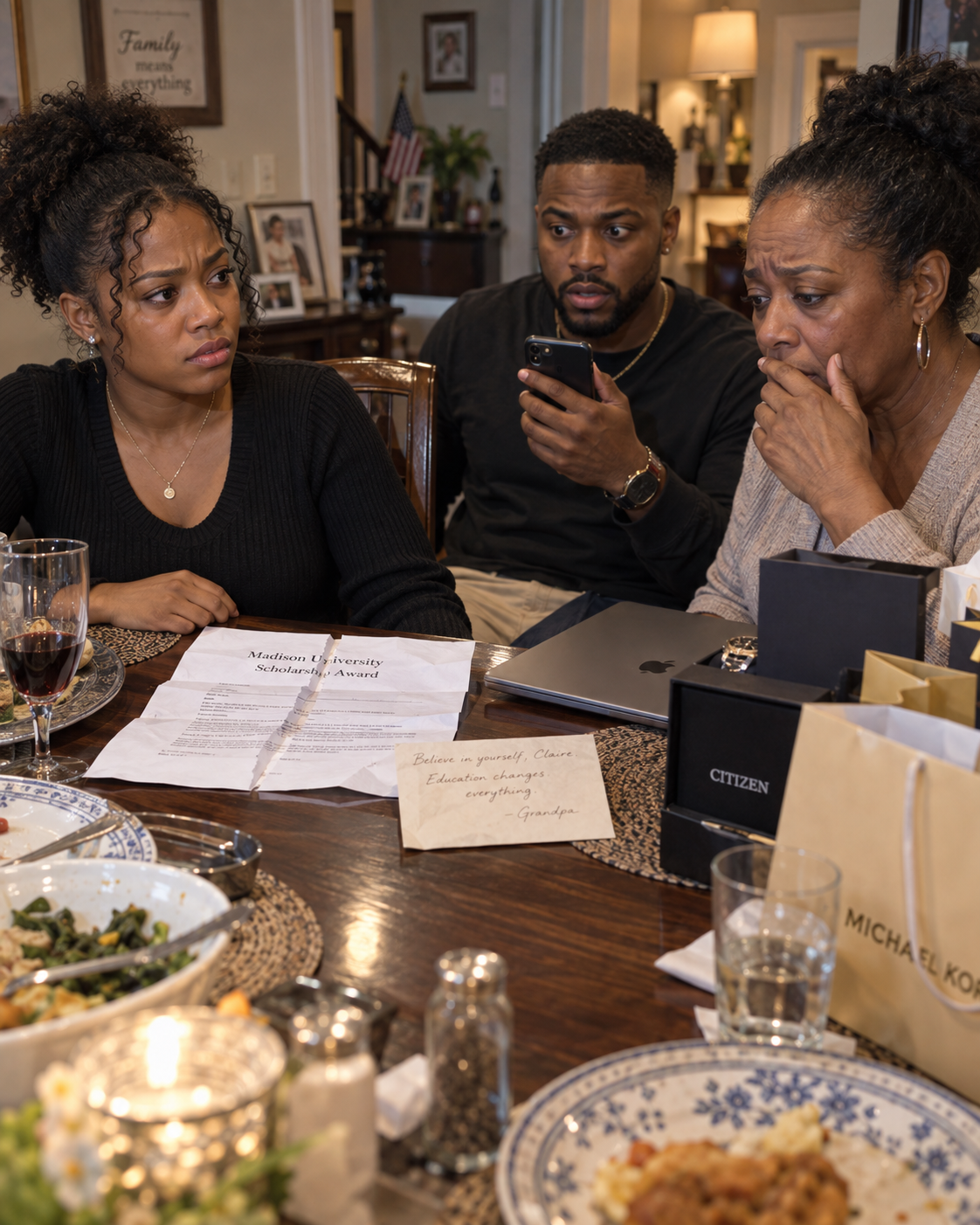
Mom hadn’t looked surprised.
She had looked terrified.
When I arrived, Nancy was waiting with a thick brown folder.
She didn’t immediately open it.
Instead, she looked at me and said, “Before I show you this, I want you to understand something.”
“What?”
“Your grandfather planned carefully.”
She placed the folder on the desk.
“He knew your mother loved both of you.”
I almost laughed.
“Loving someone doesn’t explain what she did.”
“No,” Nancy said quietly. “It doesn’t.”
She opened the folder.
Inside were copies of bank records, handwritten notes, and a letter dated nearly a year before Grandpa died.
I recognized his handwriting immediately.
My hands started shaking.
“Can I read it?”
Nancy nodded.
I unfolded the page.
It wasn’t long.
Grandpa wrote that he wanted the education fund preserved for me because he knew I had chosen a career that required clinical training and reduced work hours.
He wrote that he didn’t want me forced to abandon school because of financial pressure.
Then I reached the final paragraph.
He had added something I had never seen before.
“If Claire chooses another path, the money should remain invested until she decides how to use it, but it should not be given away without her consent.”
I looked up.
“He knew?”
Nancy nodded.
“He knew your mother might be tempted to help Evan.”
My throat tightened.
“Why?”
Nancy sighed.
“Because he had already seen it happening.”
She pulled another page from the folder.
It was a note from Grandpa to Nancy.
He had written about Evan’s repeated financial problems and his concern that your mother was solving every crisis for him instead of allowing him to become responsible for his own decisions.
I stared at the words.
For a moment, I couldn’t breathe.
Grandpa had seen it.
He had seen the pattern before I was old enough to understand it.
He had seen that Evan was always rescued.
And he had seen that I was praised for needing less.
I folded the letter carefully.
“Does this mean I can get the money back?”
Nancy didn’t answer immediately.
“It means you have evidence that your grandfather’s intention was very clear.”
“That’s not what I asked.”
“No,” she said. “It doesn’t guarantee an immediate recovery.”
I nodded.
I needed the truth more than I needed a comforting promise.
“What should I do?”
“Document everything.”
I already had.
“Don’t threaten anyone.”
I nodded.
“Don’t empty accounts you don’t own.”
“I won’t.”
“And don’t let guilt convince you that protecting your future makes you selfish.”
That last sentence stayed with me all the way home.
When I walked through the front door, Mom was waiting in the kitchen.
She looked exhausted.
Evan was sitting at the table.
Neither spoke at first.
I placed the folder on the counter.
Mom stared at it.
“What did Nancy give you?”
“Grandpa’s records.”
Her face changed.
Evan looked between us.
“What records?”
I opened the folder.
“Records showing the education fund was specifically intended for me.”
Evan leaned back.
Mom whispered, “Claire, please.”
“Please what?”
“Don’t make this worse.”
I looked at her.
“You already made it worse.”
She sat down.
“I was trying to help your brother.”
“You used my money.”
“He needed it.”
“So did I.”
“You had a scholarship.”
I felt the anger rising again, but this time it didn’t control me.
“Do you hear yourself?”
Mom looked away.
“You’ve said that three times.”
“Because it’s true.”
“No.”
I shook my head.
“It’s only part of the truth.”
Evan was silent.
I turned toward him.
“How much did you spend?”
He swallowed.
“Not all of it.”
“How much?”
He told me.
I closed my eyes.
It was enough to make my stomach turn, but not enough to destroy everything.
“What did you buy?”
He looked ashamed.
“Equipment for work.”
I waited.
“Clothes.”
I waited again.
“The laptop.”
“And?”
He looked at Mom.
She said nothing.
“I paid the deposit on an apartment.”
That surprised me.
“You were moving out?”
“I was going to.”
“When?”
“Next month.”
I stared at him.
“So Mom gave you my college money so you could move out?”
He rubbed his hands together.
“She told me it was family money.”
“What exactly did she tell you?”
He looked at Mom.
Then back at me.
“She said Grandpa wanted us both to have a better start.”
My mother’s eyes filled with tears.
“I didn’t know how else to help him.”
I finally understood.
She hadn’t only taken my money.
She had changed the story so Evan could accept it without feeling guilty.
And Evan had believed her.
That didn’t make him innocent.
But it made the situation more complicated than I had imagined.
“Did you know Grandpa left me a specific education fund?”
He shook his head.
“No.”
“Would you have taken it if you knew?”
He looked at the floor.
“No.”
Mom whispered, “Evan…”
He interrupted her.
“No, Mom.”
His voice cracked.
“You should have told me.”
She stared at him.
“I was trying to protect you.”
“From what?”
“From struggling.”
Evan laughed bitterly.
“I’ve been struggling because you keep protecting me.”
The room went silent.
I had never heard him say anything like that.
Not once.
He looked at me.
“I’m sorry, Claire.”
I didn’t answer.
“I’m serious.”
“I know.”
“I’ll pay it back.”
“You don’t have all of it.”
“I know.”
He stood.
“I’ll figure it out.”
Mom looked frightened.
“You don’t have to sell everything.”
Evan turned toward her.
“Maybe I do.”
That afternoon, Evan began returning what he could.
The laptop went back to the store.
Some of the clothes were returned.
The apartment deposit was lost, but he accepted it.
He sold a watch he had bought only weeks earlier.
He transferred the savings he had left into an account that Nancy helped document.
It still wasn’t enough.
Not close.
But it was a beginning.
Mom wanted to take out a loan.
I refused.
“This isn’t about finding another person to rescue someone.”
She looked hurt.
“I’m your mother.”
“I know.”
“And I want to fix this.”
I looked at her.
“Then stop fixing it for me.”
She didn’t understand.
I explained.
“I don’t need you to make everything disappear.”
I held up Grandpa’s letter.
“I need you to admit what happened.”
She started crying.
“I was scared.”
“Of what?”
“That Evan would fail.”
I waited.
“And you weren’t afraid I would?”
She couldn’t answer.
That question stayed between us.
A week later, I moved into a small apartment near campus.
It wasn’t beautiful.
The bedroom was barely large enough for my bed and desk.
The kitchen had two cabinets that wouldn’t close properly.
The heater made a strange clicking sound every time it started.
But when I locked the door that first night, I felt something I hadn’t felt in years.
Peace.
No one could walk into my room and decide what happened to my future.
No one could move money without me knowing.
No one could tell me that being responsible meant I deserved less.
My first clinical orientation was two weeks later.
I stood in front of the mirror wearing my new uniform.
The badge on my chest said:
Claire Dawson, Student Radiologic Technologist.
I touched the name with my fingertips.
Then I remembered Grandpa.
I remembered his hospital room.
The machines.
The cold hallway.
His hand in mine.
And the technologist who had made a frightening day feel slightly less frightening.
I whispered, “I’m doing it.”
The first clinical day was harder than I expected.
The equipment seemed enormous.
Everyone moved with confidence.
I felt like an impostor.
At one point, I stood in the hallway staring through the glass at the imaging room.
My supervisor noticed.
“You okay?”
I nodded.
“Just nervous.”
She smiled.
“That’s normal.”
I took a breath.
Then I walked inside.
Months passed.
My grades were good.
My clinical evaluations were better than I expected.
I learned how to position patients.
I learned how to explain procedures without making people feel stupid for being afraid.
I learned that some patients needed technical instructions.
Others needed someone to slow down.
Some needed a joke.
Some needed silence.
And sometimes, the most important thing you could do was remember their name.
I understood why Grandpa had remembered that technologist.
The work wasn’t only about machines.
It was about people.
Meanwhile, things at home changed.
Mom started therapy.
Not because I demanded it.
Because she finally admitted she had spent years confusing rescue with love.
Evan found another job.
It paid less than the sales position he had wanted to impress people with, but he stayed there.
He rented a small apartment.
He started paying Mom back for the amount she had contributed beyond what could be recovered from my education fund.
He also started handling his own problems.
Slowly.
Awkwardly.
For the first time, I saw him become an adult.
One evening, he called me.
“Can I ask you something?”
“Sure.”
“Do you hate me?”
I sat on my bed.
“No.”
“Why not?”
“Because I don’t think hating you would give me anything back.”
He was quiet.
“Do you forgive me?”
I thought about it.
“I think I’m getting there.”
“That’s fair.”
Then he said, “Grandpa would have been proud of you.”
I closed my eyes.
“Thank you.”
“I mean it.”
“I know.”
After we hung up, I cried.
Not because I was sad.
Because sometimes healing feels like grief leaving your body one piece at a time.
A few months later, Mom asked me to come over for dinner.
I almost said no.
Then I remembered how different she sounded on the phone.
So I went.
She had made lasagna.
The same recipe she used when I was a child.
We sat at the table.
For several minutes, neither of us spoke.
Then she placed something in front of me.
A small envelope.
I opened it.
Inside was a copy of Grandpa’s original handwritten instructions.
“I want you to keep this,” she said.
“I already have copies.”
“I know.”
She looked down.
“I just wanted you to have the one I kept.”
I looked at her.
“Why?”
“Because I finally understand that it was never mine.”
My eyes filled with tears.
She reached across the table.
I didn’t pull away.
“I failed you,” she whispered.
I shook my head.
“You made a terrible choice.”
She nodded.
“You’re right.”
“And I need you to understand something else.”
“What?”
“I’m not going to spend the rest of my life proving I’m strong.”
She cried.
“I know.”
“I want to be allowed to need people.”
“You are.”
I looked at her.
“Even if I need help?”
“Especially then.”
That was the first time I believed her.
Not because she said the perfect thing.
Because she finally understood what she had done.
My relationship with Mom didn’t become perfect after that.
Some wounds don’t disappear because someone says sorry.
Trust came back slowly.
Sometimes it didn’t come back at all.
But something else did.
Choice.
I could choose when to visit.
I could choose what to share.
I could choose how much access people had to my life.
And I could love my mother without surrendering my boundaries.
A year after the missing $22,000, I completed my clinical requirements.
On graduation morning, I woke before my alarm.
The apartment was quiet.
Sunlight was coming through the blinds.
My uniform was hanging on the closet door.
My graduation gown was folded on the chair.
I opened the drawer beside my bed.
Inside were two things.
Grandpa’s card.
And the scholarship letter Mom had torn in half.
I had kept it exactly as it was.
The tape had yellowed slightly along the center.
I ran my finger across the seam.
For a long time, I thought that torn letter represented what my mother had taken from me.
Now I saw it differently.
It represented the moment I stopped waiting for someone else to protect my future.
I put both pieces of paper into my bag.
Then I went to graduation.
When my name was called, I walked across the stage.
I heard Mom crying somewhere in the audience.
I heard Evan cheering louder than anyone.
And for one strange second, I wished Grandpa could have seen it.
Afterward, Mom hugged me.
“I’m proud of you.”
I held her.
“Thank you.”
She whispered, “He would be too.”
I knew exactly who she meant.
That evening, I returned to my apartment and placed Grandpa’s card on my desk.
I read the words again.
“For the day you finally get to help someone else through a scary day.”
The next morning, I began my first job as a radiologic technologist.
My first patient was an older man who looked nervous when he entered the imaging room.
He kept asking whether the procedure would hurt.
I pulled up a chair.
“My name is Claire,” I said.
He looked at my badge.
“Are you new?”
I smiled.
“I am.”
He laughed nervously.
“Well, that’s reassuring.”
I laughed too.
Then I explained every step before I touched the machine.
His shoulders slowly relaxed.
Before he left, he looked at me.
“Thank you for making this easier.”
I stood there for a moment after the door closed.
My eyes filled with tears.
Grandpa had been right.
People remember the person who makes a scary day easier.
That night, I called Mom.
She answered immediately.
“How was your first day?”
I smiled.
“Exactly what Grandpa wanted.”
She was quiet.
Then she said, “I know.”
We talked for a while.
Not about money.
Not about Evan.
Not about the past.
Just life.
Before we hung up, she said something I didn’t expect.
“Claire, I’m sorry I taught you that being strong meant you didn’t need anything.”
I closed my eyes.
“Thank you.”
After the call ended, I sat beside my window.
Madison was quiet outside.
Cars moved along the street.
Lights came on in apartment windows.
Life continued.
I thought about the $22,000.
For a long time, I believed that money was the thing my mother had taken from me.
But she hadn’t taken my future.
She had only delayed the moment when I realized that my future belonged to me.
The money mattered.
The betrayal mattered.
The apology mattered.
But the greatest thing I recovered was my voice.
I learned that being the responsible child doesn’t mean being the disposable child.
I learned that helping someone is different from enabling them.
I learned that forgiveness doesn’t require pretending nothing happened.
And I learned that sometimes love needs boundaries before it can become healthy.
Years later, I still keep the taped scholarship letter.
The tear is still visible.
So is the handwriting on Grandpa’s card.
Whenever a difficult patient enters the imaging room, I remember why I chose this career.
I don’t think Grandpa left me $22,000.
I think he left me something much larger.
He left me a reminder that a person’s future should never be sacrificed simply because someone else has learned to expect rescue.
And every time I help a frightened patient take one more breath, I feel like I am finally fulfilling the promise I made in that hospital room.
I never got my original future back.
I built a better one.
And sometimes, when I look at that torn letter, I realize the most important part was never the money.
It was the moment I finally understood that nobody else gets to decide how much my dream is worth.