At the country club banquet, my brother lifted a microphone and told four hundred guests that I had spent twenty years ‘pushing paper
I carried the black envelope out of the ballroom without opening it.
The applause continued behind me, but it already sounded far away, muffled by the rushing pulse in my ears.
I stepped through the side exit and into the cold night air, where the country club parking lot glittered beneath rows of white lights.
For ten minutes, I simply stood beside my car and breathed.
Then I heard footsteps.
“Joanna.”
I knew the voice before I turned.
Bradley.
He stopped several feet away, his tuxedo jacket still buttoned, his face drained of the confidence he had worn all evening.
“I didn’t know,” he said.
“I know.”
“That wasn’t what I meant.”
I looked at him.
“You meant exactly what you said.”
He flinched.
For once, he had no speech ready.
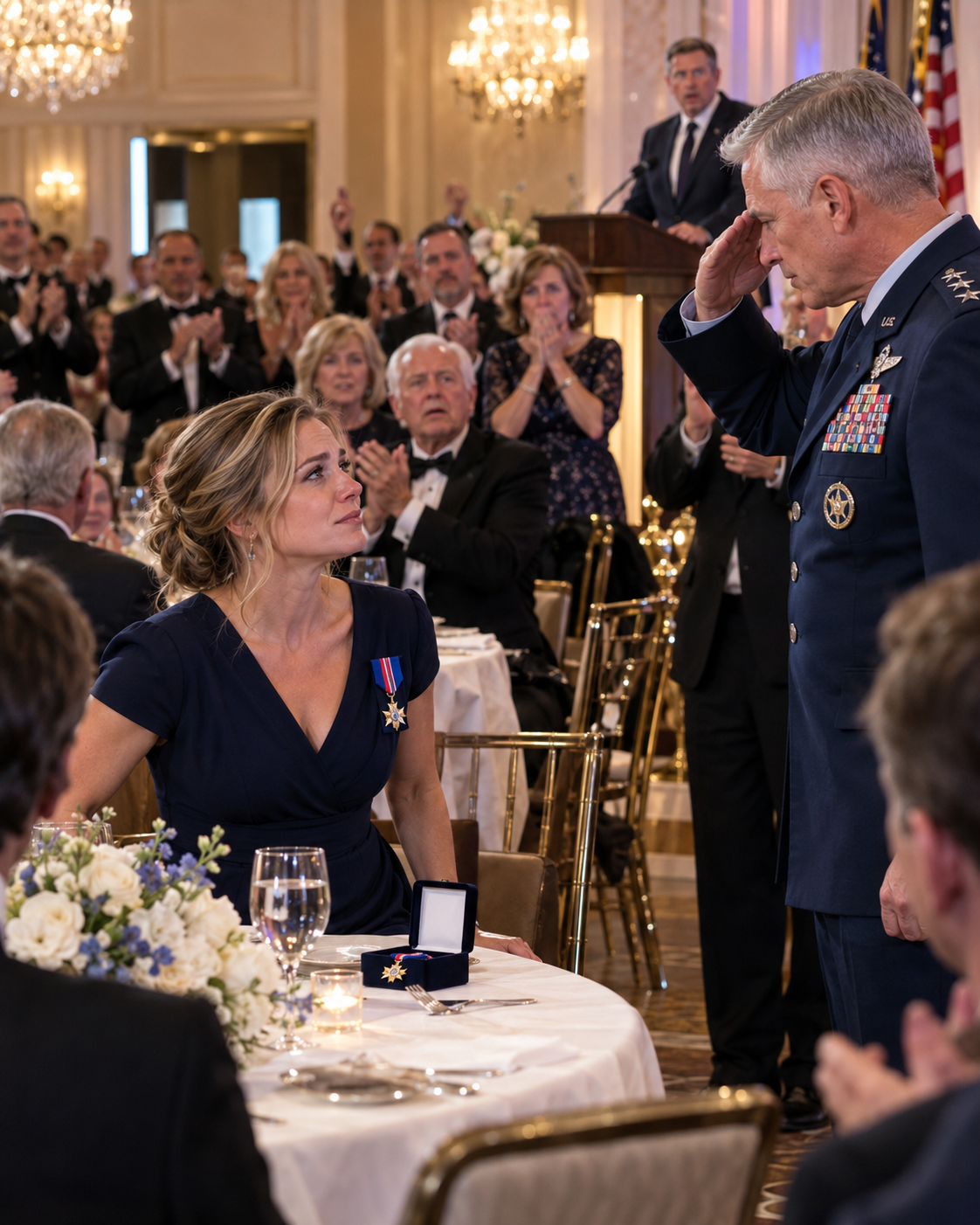
He looked at the medals pinned against my dress.
“Why didn’t you tell us?”
“Because I couldn’t.”
“But after all these years?”
“I wasn’t allowed.”
He stared at the black envelope in my hand.
“What is that?”
“Something I have to read alone.”
His expression tightened.
“Does it have anything to do with what happened that night?”
I felt the old ache return beneath my ribs.
“Maybe.”
He looked as though he wanted to ask more.
Instead, he said, “I am sorry.”
It was the first time Bradley had ever apologized to me without adding a joke afterward.
I drove home before he could say anything else.
My apartment was dark and silent.
I put the medals on the kitchen table.
Then I placed the envelope beside them.
For a long time, I could not make myself open it.
I had spent ten years refusing to remember that mission unless someone else needed the memory.
Now the military had given it back to me in black ink.
I finally broke the seal.
Inside were mission transcripts, weather reports, satellite photographs, and one handwritten statement signed by Lieutenant General Caldwell.
The first page made my stomach tighten.
“Mission Halo Six was not a standard extraction.”
I turned the page.
It became clear why.
The thirty-two soldiers had not simply been stranded by a storm.
Their convoy had been deliberately redirected into a known dead zone after enemy communications were compromised.
Someone had fed the wrong coordinates into the operation.
Someone inside our own system had made sure the men would be isolated.
I sat back in my chair.
My hands went cold.
The next page contained the line that changed everything.
“Captain Sterling assumed operational command after determining that ground extraction authority had been compromised.”
I read it twice.
Then I remembered that night.
The underground flight deck.
Red emergency lights.
Sand hammering the reinforced doors.
A radio operator shouting that our first aircraft had lost contact.
A commander telling me to stand down because weather conditions were beyond acceptable risk.
And me saying, “If we wait until it is safe, those men will be dead.”
What I remembered most clearly was the voice on the radio from the team leader.
“Whoever is out there, don’t leave us.”
I had answered with three words.
“Hold your position.”
I had flown two aircraft through the storm by redirecting fuel, timing, and altitude through a route that existed on no ordinary flight plan.
The men came home.
All thirty-two.
But I had never understood why the original route had failed so completely.
Now I knew.
It had not failed.
It had been sabotaged.
The final pages contained a name.
Colonel Victor Hale.
I knew him.
Everyone in special operations knew him.
He had retired three years after the mission and vanished into private defense contracting.
I stared at his name until the letters seemed to move.
At the bottom of the page, Caldwell had written another note.
“Captain Sterling, you were told at the time that the investigation was complete.”
Then came the sentence that made my skin crawl.
“It was not.”
I called Caldwell immediately.
He answered on the second ring.
“You opened it.”
“Yes.”
A pause.
“Then you know.”
“I know someone betrayed us.”
“Yes.”
“Who?”
“I can’t tell you over the phone.”
My throat tightened.
“Then tell me why you sent me the file tonight.”
“Because I am retiring.”
That surprised me.
“I need the truth out of government hands before I leave,” he said.
“And because there is something you deserve to know.”
“What?”
“You saved thirty-two people, Joanna.”
His voice softened.
“But you were not supposed to be the only one thanked.”
I frowned.
“What does that mean?”
“The person who helped you identify the compromised coordinates was never properly credited.”
My heartbeat changed.
“Who?”
Caldwell said one name.
“Daniel Mercer.”
I closed my eyes.
Daniel.
The tactical systems officer who had sat beside me that night.
Daniel, who had caught the corrupt routing data.
Daniel, who had stayed behind to keep the communication channel alive.
Daniel, who had died two years later during another operation.
“Why would you tell me this now?”
“Because he left evidence.”
“What evidence?”
“The part of the mission log that was erased.”
The line went silent.
Then Caldwell said, “Meet me tomorrow.”
We met at an unmarked federal building outside Washington.
There were no signs.
No ceremony.
No uniforms waiting to impress me.
Just a small conference room with gray walls and a stack of files.
Caldwell was already seated.
Beside him sat a woman I had never met.
“This is Special Agent Claire Donovan,” he said.
She slid a folder toward me.
“I have spent four years reviewing the Halo investigation.”
I opened it.
Inside were transaction records, old contractor communications, and redacted intelligence notes.
“Victor Hale was paid by a defense contractor after the extraction,” Donovan said.
“For what?”
“For access.”
I looked up.
“Access to what?”
“Flight systems.”
A chill went through me.
“He wanted proof that covert command structures could be manipulated from inside the network.”
“So the thirty-two soldiers were a test?”
“We believe so.”
My jaw tightened.
“Believe?”
“We don’t have a confession.”
I closed the folder.
“Then what do you have?”
Donovan opened another file.
“We have the communications intercept that was never entered into the original inquiry.”
She played an audio recording.
Static filled the room.
Then a man’s voice emerged.
“Wait until Halo takes control.”
Another voice replied.
“How do we know she will?”
“Because she won’t abandon them.”
My blood went cold.
I knew the speaker.
Victor Hale.
He had planned around my instincts.
He had counted on me refusing to let thirty-two men die.
The mission had been a trap designed to test whether a classified command structure could be bent without collapsing.
I looked at Caldwell.
“You knew.”
“I suspected.”
“You let me believe the failures were my fault.”
His eyes dropped.
“That is one of the things I regret most.”
Anger rose through me.
For twenty years, I had carried the memory of that mission like a stone inside my chest.
I had replayed every choice.
Every risk.
Every life.
I had wondered whether I had violated protocol by taking command.
Whether I had nearly killed everyone by acting too aggressively.
And all those years, someone else had designed the crisis.
“I was twenty-nine,” I whispered.
“I know.”
“I thought I had made the mistake.”
Caldwell leaned forward.
“You made the decision that saved them.”
The words should have comforted me.
Instead, they made me cry.
Not loudly.
Just a few tears slipping down before I could stop them.
Caldwell looked away.
Donovan quietly closed the folder.
“You’ve spent a long time believing you survived that mission.”
I wiped my face.
“Didn’t I?”
“You did more than survive it.”
She pushed another photograph toward me.
It showed the thirty-two soldiers years after the extraction.
Most were standing together at a reunion.
One man sat in front in a wheelchair.
At the center was a handwritten sign.
“We came home because Halo 6 refused to quit.”
I stared at the photograph.
“You found them.”
“We contacted twelve.”
“What did they say?”
Donovan smiled faintly.
“They remembered your voice.”
That destroyed whatever composure I had left.
I had forgotten their faces.
They had not forgotten mine.
That evening, I drove home and sat in my parked car for nearly an hour.
The medals were on the passenger seat.
The city moved around me.
People laughed outside restaurants.
A woman walked a dog.
Two teenagers argued over music.
Ordinary life.
The kind of life I had always wanted.
Yet suddenly the past had reached through the cracks and demanded to be acknowledged.
When I walked into my apartment, Bradley was sitting outside my door.
I froze.
He stood.
“I know I shouldn’t be here.”
I looked at him.
He held a paper bag.
“I brought dinner.”
“I am not hungry.”
He nodded.
“That’s fair.”
He started to leave.
Then I said, “Come inside.”
He looked surprised.
We sat at the kitchen table without speaking.
Finally he placed the bag down.
“I watched the video from the banquet.”
“What video?”
“The one someone posted online.”
I closed my eyes.
So much for privacy.
Bradley rubbed his hands together.
“People are saying things.”
“I don’t care.”
“I do.”
I looked at him.
“For the first time, I do.”
He swallowed.
“I spent my whole life trying to be the successful one.”
“I know.”
“I thought if I was impressive enough, Dad would finally see me.”
I almost laughed.
Instead, I said, “He saw both of us.”
“No.”
Bradley looked down.
“He saw me first.”
That sentence changed something.
Not because it excused him.
Because it explained him.
We had both spent years trying to earn love from the same people in completely different ways.
I had chosen silence.
He had chosen applause.
Neither of us had realized how much the other was hurting.
“I was cruel to you,” he said.
“Yes.”
“I was jealous.”
I stared at him.
“Of me?”
“Of the mystery.”
I frowned.
“You always had something you wouldn’t explain.”
He shook his head.
“It made me feel like there was a room in your life I could never enter.”
I looked at the medals.
“There was.”
He nodded.
“I know that now.”
We ate in silence.
It was awkward.
It was imperfect.
But it was honest.
A week later, Bradley invited our parents to dinner.
I almost refused.
Then I went.
My mother cried before we had finished the appetizers.
“I should have believed in you,” she said.
“You believed in what you could understand.”
“That isn’t an excuse.”
“No.”
My father stared at the table.
“I was proud of Bradley because his success was easy to explain.”
I looked at him.
“But your silence frightened me.”
“It wasn’t meant to.”
“I know.”
He looked older than I remembered.
For the first time, I saw not the father who had overlooked me, but a man realizing how much he had missed.
He reached across the table.
I let him take my hand.
It did not repair twenty years.
But it started something.
The next morning, Agent Donovan called.
“Victor Hale is alive.”
“I assumed he was.”
“He is being brought in.”
I sat down.
“On what charges?”
“We found the records.”
“What records?”
“Payments from the contractor, communications with his former aide, and a storage device containing the original mission routing.”
I closed my eyes.
“Does he know I know?”
“Yes.”
“What does he want?”
“We don’t know yet.”
Three days later, I sat across from Victor Hale in a secure interview room.
He looked older.
Smaller.
Nothing like the man I remembered from command briefings.
He studied the medals on my uniform.
“You actually got them.”
“Yes.”
He smiled faintly.
“I always knew you would.”
My stomach tightened.
“You planned the mission.”
“I designed the conditions.”
“You nearly killed thirty-two people.”
“No.”
His expression hardened.
“You nearly died because you chose to interfere.”
I leaned forward.
“You counted on me.”
“Yes.”
The admission landed like a stone.
“Why?”
“Because every system has a weakness.”
“What weakness?”
He looked directly at me.
“People.”
I said nothing.
“You were the variable I could not control,” he continued.
“You cared whether those men lived.”
“That is your defense?”
“No.”
He sighed.
“That is my failure.”
I did not expect that.
He looked down at his hands.
“I spent years believing strength meant controlling every variable.”
“And now?”
“Now I know some people cannot be controlled because they will choose others over themselves.”
For a second, I saw something almost human in his face.
Then Agent Donovan entered.
The interview was over.
Months later, the investigation became public.
The government released a carefully worded report confirming misconduct, manipulated operational data, and failures in oversight.
Victor Hale was prosecuted.
The thirty-two soldiers’ names were formally included in the record.
Daniel Mercer’s role was restored.
And Captain Joanna Sterling, once described by her own family as an administrative underachiever, was finally listed exactly where she belonged.
I did not attend the press conference.
I had no interest in microphones.
Instead, I stood at Daniel’s grave with my medals in my hand.
The grass was wet.
The morning was gray.
I placed his photograph beside the stone.
“You were right,” I whispered.
“Coming home didn’t mean the war was over.”
A voice behind me said, “But it means you’re still here.”
I turned.
It was Bradley.
He stood several feet away, holding two cups of coffee.
I smiled.
“Still bringing bad coffee?”
He laughed.
“Still refusing good coffee?”
“Always.”
We stood together.
No audience.
No applause.
No one knew where we were.
For the first time, I realized I did not need my family to rewrite my childhood.
I only needed them to stop pretending it had never hurt.
Bradley handed me one of the cups.
“You know what’s strange?”
“What?”
“People think medals are what make you a hero.”
I looked at Daniel’s grave.
“What makes you think that?”
“Because I used to.”
I smiled.
“Then you’ve learned something.”
He nodded.
“What?”
“That the loudest person in the room isn’t always the bravest.”
We stayed there until the rain began.
Before we left, I touched Daniel’s photograph one last time.
The years of silence had not disappeared.
The memories had not become gentle.
But they no longer owned me.
I finally understood that sacrifice was not the same as self-erasure.
Silence had protected my mission.
It had also hidden me from the people I loved.
There was a difference.
Walking toward the car, Bradley asked, “Are you going back to the Air Force?”
I stopped.
“I haven’t decided.”
He smiled.
“Whatever you do, don’t tell Mom you might move again.”
“Why?”
“She’ll start crying.”
I laughed.
A real laugh.
The kind I had forgotten how to make.
Then my phone rang.
The screen showed an unfamiliar federal number.
I answered.
A woman’s voice spoke softly.
“Captain Sterling, this is Agent Donovan.”
My smile disappeared.
“There is one final file we found in Victor Hale’s storage device.”
I looked at Bradley.
“What kind of file?”
A pause.
“One that contains the names of every person who helped him.”
I closed my eyes.
“Send it.”
“We did.”
My phone vibrated.
A file appeared on the screen.
The first name was Victor Hale.
The second was someone I had never expected to see.
My breath caught.
Because the third name was my brother’s.
I stared at Bradley as the world seemed to go completely still.
And suddenly, after twenty years of believing the hardest secrets of my life were finally behind me, I understood that the story I thought I had survived might have only been the first one.