At the candlelit engagement dinner, my father looked straight at me and ordered me to smile, say nothing
Part 2
Three days later, I walked into a small real estate office in Portland with a folder of bank statements and a level of certainty I had never felt in my family’s dining room.
The agent, a woman named Rachel, showed me listings on a wide screen.
Most were too polished, too expensive, or too far from the life I wanted.
Then she pulled up a three-bedroom cedar house on the edge of town.
The photographs showed a deep porch, dark wood beams, and a backyard large enough for the garden I had once joked about with Grandma Clara.
I stared at the last photograph for a long time.
There was a maple tree near the fence, its branches reaching over the grass like an open hand.
“That one,” I said.
Rachel smiled.
“Want to see it?”
“Today.”
When Julian and Nora saw the house, they stopped talking.
Nora walked straight into the kitchen and opened a cabinet.
“Imagine what we could hide in here,” she whispered.
Julian stepped onto the porch and looked toward the garden.
“This is it.”
I didn’t tell them it already felt like mine.
I could see birthday dinners there.
Rainy mornings with coffee.
A chair for Clara.
A table for people who knew what I had been through without needing a family tree to explain why I mattered.
I made the offer that afternoon.
No cosigner.
No family money.
No conditions.
Just my name on every page.
While the paperwork moved forward, my mother called again.
I ignored it.
Then my father called.
Then Leo.
Then an unknown number.
The voicemails became increasingly strange.
At first they sounded emotional.
Then offended.
Then threatening.
Finally, they became almost panicked.
One voicemail from Eleanor said, “You’re punishing innocent people because you’re angry with your parents.”
Another from Arthur said, “You’ll regret turning your back on your blood.”
Leo’s last message was different.
His voice was quiet.
“Just tell them you’re coming.”
I listened twice.
There was something underneath his words I couldn’t name.
Maybe guilt.
Maybe fear.
Maybe he had finally begun to understand what our parents had never allowed us to say aloud.
I still didn’t call back.
On Friday evening, my grandmother came over.
I showed her the house documents.
She read every page slowly, then looked at me over her glasses.
“They can’t take this from you.”
“No.”
“You aren’t buying a house to prove anything, are you?”
I thought about my father’s voice.
“No.”
“Good,” she said.
“Then you’re buying it because you deserve somewhere peaceful.”
I laughed softly.
“You’re skipping the engagement dinner, aren’t you?”
Clara closed the folder.
“I was never planning to sit through a room where everyone pretends nothing is wrong.”
I hugged her.
For years, I had thought loyalty meant standing beside people no matter how badly they treated you.
Clara taught me something different that night.
“Loyalty without respect,” she said, “is just another name for being used.”
The closing happened the following week.
I signed the final document with my hand trembling slightly.
Not because I was afraid.
Because for once, the signature meant something beautiful.
Rachel slid the keys across the table.
“Congratulations.”
I held them in my palm.
They were smaller than I expected.
Such a tiny object for something that represented an entire life.
That evening, I stood in the empty living room and listened to the house settle around me.
For the first time, nobody could threaten to take my room away.
Nobody could tell me when to arrive.
Nobody could decide whether I belonged.
My phone buzzed.
Arthur again.
I turned it facedown.
Then I changed my number.
I gave the new one only to Clara, Julian, and Nora.
The old number stayed active for exactly ten more minutes.
Long enough for one final voicemail to arrive.
I listened.
Arthur sounded exhausted.
“Come back,” he said.
Not angry.
Not commanding.
Almost pleading.
I sat on the floor beside a box of books.
He continued.
“Your mother is upset. Leo is under pressure. We just need you here.”
I closed my eyes.
There it was again.
Not “I miss you.”
Not “How are you?”
Not “Are you happy?”
Just what they needed.
I deleted the voicemail.
That night, I slept in my new house with the windows cracked open.
Rain moved through the trees.
Somewhere outside, a wind chime tapped softly against the porch.
I expected grief.
Instead, I felt something close to relief.
The engagement dinner happened without me.
Grandma Clara stayed home too.
Later, she told me about the photographs my mother had sent her.
In one, Arthur stood beside Leo, smiling too hard.
In another, Eleanor sat beside Megan’s parents, holding her wineglass like a shield.
My absence was obvious.
But the truth was more awkward than my family wanted anyone to know.
When Megan’s father asked where I was, Arthur apparently said, “He’s working out west.”
Megan’s mother raised an eyebrow and asked, “On what?”
Nobody had an answer.
Eleanor apparently stepped in quickly.
“Technology,” she said.
Leo looked down at his plate.
Then Megan asked the question that finally exposed the whole performance.
“If he’s so close to the family, why didn’t anyone know he moved?”
Silence.
A long one.
The kind of silence that makes every lie in the room suddenly visible.
Arthur changed the subject.
Dinner continued.
But from what Clara told me, the mood never recovered.
I pictured them beneath crystal lights, protecting an image they had spent years constructing.
For once, I wasn’t sitting there helping them maintain it.
And that mattered.
Not because I wanted them embarrassed.
Because I wanted to stop being part of the lie.
Part 3
The first spring in my new house arrived quietly.
Tiny green shoots appeared where I had planted tomatoes.
Julian built a raised garden bed.
Nora painted the old shed door a soft gray.
Clara brought seedlings wrapped in newspaper and complained that I had bought the wrong kind of shovel.
My house slowly filled with evidence that people had been there.
A coffee mug left on the counter.
A jacket tossed over a chair.
A half-finished puzzle on the dining table.
Shoes beside the door.
The things I once thought made a home look messy had become the things that made mine feel alive.
I also learned that freedom was not as loud as I had imagined.
Sometimes it was simply waking up and realizing nobody was angry with you.
Sometimes it was ordering takeout because you were tired without hearing that you were wasting money.
Sometimes it was planting flowers in a garden just because you liked their color.
And sometimes it was hearing laughter in your backyard and knowing nobody there had come because they were obligated to.
Months passed.
The calls stopped because the number had changed.
There were no more voicemails.
No more threats about the will.
No more lectures about family duty.
At first, I expected another explosion.
Instead, there was only silence.
It surprised me how different this silence felt from the one before.
The first silence had told me I didn’t matter.
This one told me I was finally free.
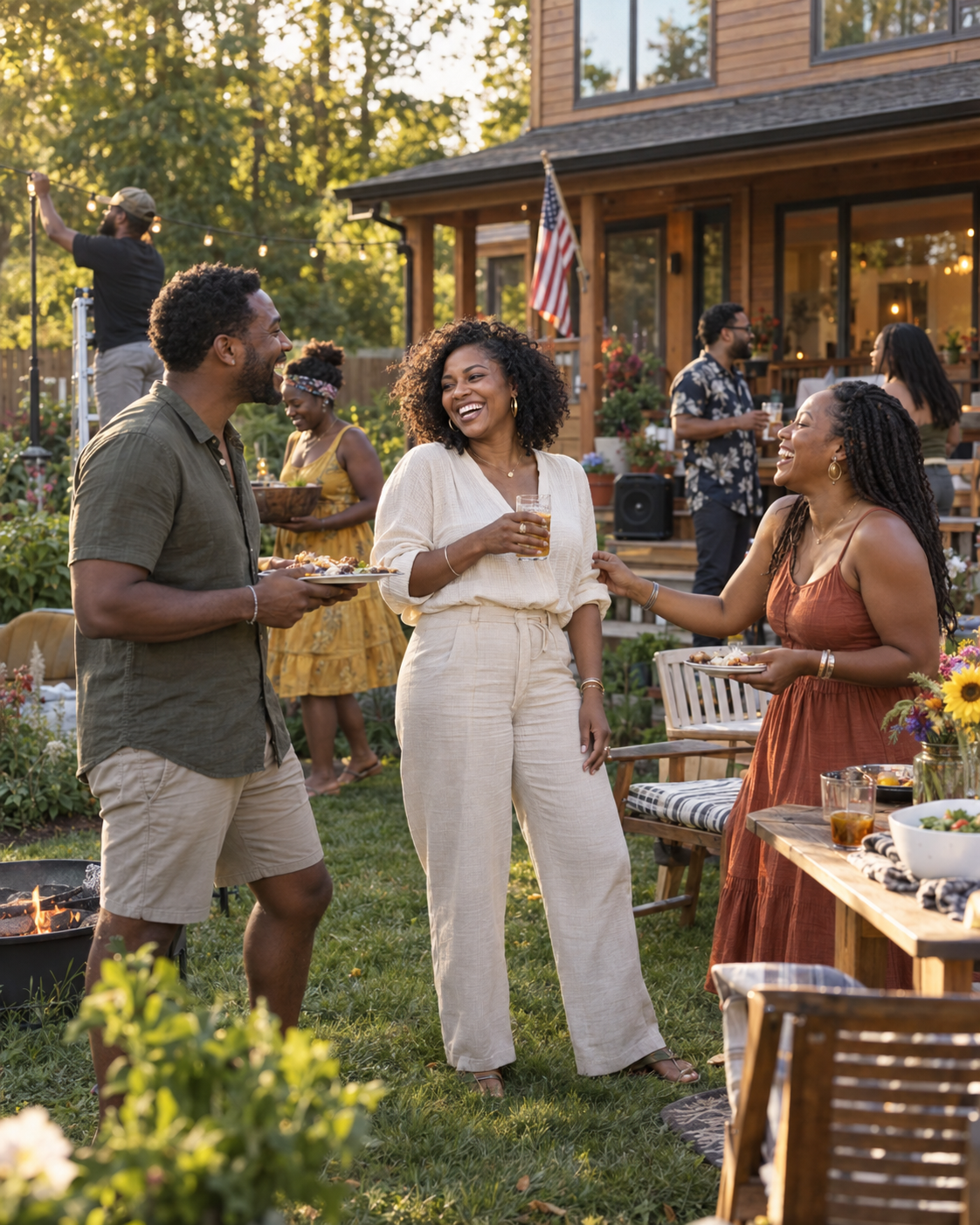
One Saturday evening, I hosted a backyard gathering.
Nothing fancy.
String lights hung between the trees.
Julian brought speakers.
Nora brought too much food.
Clara sat beneath the maple tree like she had been waiting years for that exact chair to exist.
Friends arrived carrying bread, flowers, bottles of sparkling water, and stories from their week.
Someone started dancing near the patio.
Someone else burned the first batch of burgers.
Everyone laughed about it.
I stood near the garden fence with a glass in my hand and watched the whole scene unfold.
There was music in the air.
Warm light across the cedar walls.
Tomato vines climbing their supports.
A dog I had never met chasing a tennis ball through the grass.
For a moment, I felt the strange sensation of seeing my own life from outside my body.
This was what I had spent years thinking I had to beg for.
Not perfection.
Not wealth.
Not a family that never fought.
Just a place where my existence wasn’t an inconvenience.
A guest I barely knew stepped beside me.
He looked toward the house and smiled.
“Beautiful place,” he said.
“Thank you.”
He nodded toward the crowd.
“You’ve got a lot of family here?”
I looked at Clara.
Then at Julian.
Then at Nora, who was laughing so hard she nearly dropped a plate.
I looked at the people gathered beneath the lights, the people who knew what I loved, what I feared, what I had survived, and what I was still becoming.
For years, I had thought the word family was something you were born into.
Standing there, I finally understood it could also be something you build.
“I used to,” I said.
The guest waited.
I smiled.
“But I built something better.”
I turned toward the house.
The cedar walls glowed gold beneath the lights.
My garden moved gently in the evening breeze.
Inside were keys that belonged only to me, photographs made from ordinary moments, and a table where nobody had to earn the right to sit.
I thought about my father threatening me with an inheritance I had never been allowed to depend on.
I thought about my mother asking me to smile for one hour so I could disappear again.
I thought about Leo, the brother who had been treated like the sun while I was expected to orbit quietly at the edge.
And I realized something that hurt less than I expected.
I didn’t need them to admit they had failed me.
I didn’t need an apology to validate the years.
I didn’t need their money, their approval, or their version of what family was supposed to look like.
What I needed was already standing around me.
Clara caught my eye and lifted her glass.
Julian shouted my name from across the yard.
Nora yelled that someone had stolen the last piece of pie.
I laughed.
A real laugh.
The kind that never had to be measured for volume, timing, or appearance.
The kind I had forgotten I knew how to make.
Later, when everyone had gone and the lights were still glowing over the empty chairs, I walked through the garden alone.
The night smelled like cedar and wet earth.
I touched the wooden gate and listened to the quiet.
Once, I had been terrified that leaving my family meant losing my place in the world.
Now I knew the opposite was true.
Sometimes the only way to find your place is to stop standing where you were never valued.
I went inside, locked the door, and set my keys on the table.
The house was quiet.
But it was not lonely.
It held every hard decision that had brought me there.
It held every person who had helped me rebuild.
And most of all, it held the version of me who no longer confused being tolerated with being loved.
I used to think home was the place where your family expected you to return.
Now I know home is the place where you can finally stay exactly as you are.