At the Ashford town fair, Henry Ravens knelt in the dirt when he saw the boy with his exact gray eyes
I stared at the sealed envelope for so long that Henry noticed the change in my face before he noticed the letter itself.
“What is it?”
I did not answer.
The handwriting was elegant and narrow, each letter pressed into the paper with deliberate force.
There was no return address.
No family crest.
No explanation.
Just my name.
Evelyn.
Arthur stood several feet away beneath the old staircase, studying a portrait of Henry’s grandfather.
He had no idea that the room around him suddenly felt dangerous.
Henry picked up the envelope.
“Should I open it?”
I put my hand over his.
“Not yet.”
He looked at me.
For seven years, I had feared secrets because one had already taken my home, my husband, and the future I thought I understood.
Now I had something I had never possessed back then.
Choice.
I slid the envelope into my coat pocket.
“We go together,” I said.
Henry nodded.
That was the first difference between us.
Seven years earlier, he had decided what I could handle.
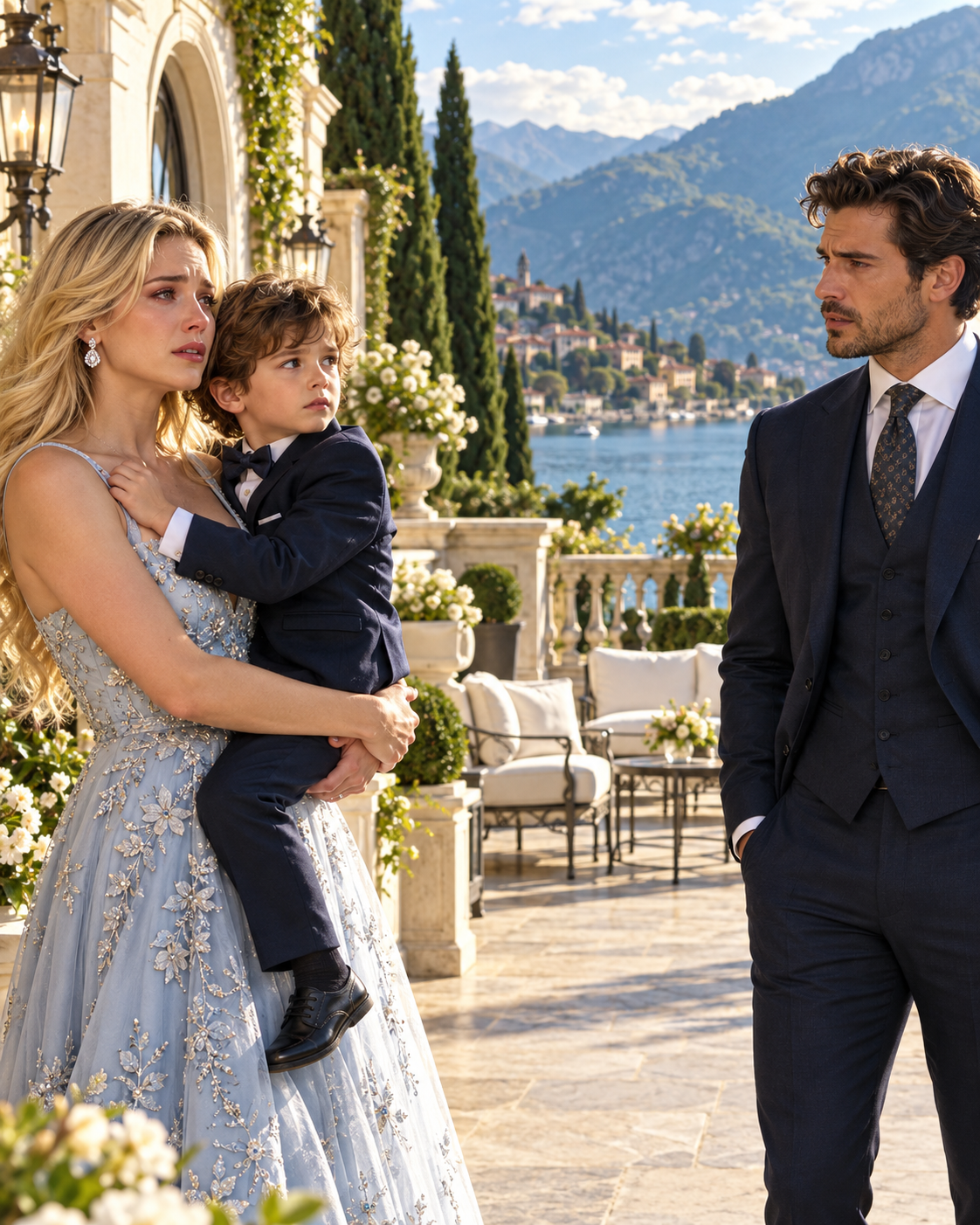
Now he waited for me to decide what came next.
That night, after Arthur fell asleep, we sat in the cottage kitchen with the letter between us.
Rain ticked against the windows.
The old farmhouse smelled like cedar and coffee.
Henry watched me with the same patience he had learned over the past year.
“Whatever is in there,” he said, “you don’t have to face it alone.”
I almost smiled.
There was a time when those words would have meant nothing.
Now they meant everything.
I opened the envelope.
Inside was a single sheet of paper.
The message contained only one sentence.
“You were right to leave, but you were wrong about why.”
My stomach tightened.
There was a second page.
A photograph.
It showed Henry outside the library door on the night I had left.
He was not alone.
A man stood in the shadows behind him.
The photograph had been taken from across the garden.
I recognized the man.
Thomas Bell.
Henry’s chief political adviser.
He had worked for the Ravens family for nearly twenty years.
He had also been one of the first people to tell the press that Clara’s scandal was nothing more than a misunderstanding.
Henry stared at the photograph.
“That’s impossible.”
“Why?”
“Because Bell told me he wasn’t at the estate that night.”
I looked at him.
“Did you ever verify that?”
He went silent.
That silence frightened me more than the photograph.
The next morning, Henry called his private investigators.
Within hours, they uncovered something stranger.
Thomas Bell had resigned from his post six months before the anonymous tip that brought Henry to Ashford.
He had disappeared from public life.
His properties had been sold.
His phone was gone.
And his last known financial transaction had been made to an offshore account connected to one of the same lawmakers Henry and Clara had spent years investigating.
I felt the old fear returning.
“What does he want?”
Henry leaned against the desk.
“I don’t know.”
Arthur came in carrying a wooden airplane he had built with Henry.
“Dad, are you coming?”
Henry looked at our son.
His entire expression changed.
“In a minute.”
Arthur nodded and ran outside.
I watched him through the window.
“He deserves a childhood untouched by this.”
Henry took my hand.
“Then that’s what we’ll give him.”
But the past had already found our doorstep.
Three days later, someone broke into the cottage.
Nothing valuable was taken.
The silver was untouched.
The computers remained.
Only one thing was missing.
The photograph of Thomas Bell.
I stared at the empty drawer.
Henry’s security team searched the property.
Nothing.
Then I saw something scratched into the wooden window frame.
One letter.
C.
I felt a strange chill.
“Clara?”
Henry shook his head.
“She hasn’t contacted me in years.”
I wanted to believe him.
Instead, we called her.
She answered from Washington.
“Henry?”
“We need to ask you something.”
There was a long pause.
Then Clara said, “I was wondering when Bell would come for you.”
The room went silent.
“How do you know about Bell?”
“Because I spent seven years trying to find him.”
She told us what she had never revealed publicly.
The parliamentary blackmail conspiracy had not simply been about stolen documents.
It had involved a network of political favors, shell companies, manipulated contracts, and blackmail material gathered over decades.
Henry’s family had nearly been destroyed by it.
Clara had helped expose the network from the inside.
But one man always seemed to disappear before arrests were made.
Thomas Bell.
“He wasn’t working for the conspiracy,” Clara said.
“He was feeding it information.”
Henry closed his eyes.
“From inside my office.”
“Yes.”
“And you knew?”
“I suspected.”
“Why didn’t you tell me?”
“Because I didn’t have proof.”
I looked at Henry.
He understood the irony immediately.
Once again, secrets were surrounding us.
But this time, nobody was hiding behind silence.
We documented everything.
We involved federal investigators.
We told Arthur’s school that unknown visitors were not permitted to approach him.
We doubled security around the estate.
And still, Bell remained invisible.
Weeks passed.
Then a letter arrived at our Boston office.
This one contained a newspaper clipping from seven years earlier.
It was from the day after I disappeared.
The article reported that Henry’s relationship with Clara had collapsed and that an unnamed source claimed Henry had “sacrificed his marriage to preserve a criminal alliance.”
I read the article twice.
“Why didn’t you tell me this existed?”
Henry’s face went pale.
“I never saw it.”
He reached for the clipping.
At the bottom was a handwritten note.
“He let you believe the worst.”
I looked at him.
“Who?”
The answer came from Clara.
“Bell.”
The next revelation was even worse.
The blackmail operation had learned about me before Henry ever realized he was being watched.
They had monitored our marriage.
They knew about my pregnancy.
They knew which doctor I visited.
They knew where I planned to travel.
Bell had access to private information that should have been impossible to obtain.
I finally understood why Henry had been so terrified the night I saw Clara in his arms.
He hadn’t merely been hiding a dangerous investigation.
He had believed someone could use me against him.
He had been wrong to keep me in the dark.
But he had not been imagining the danger.
The distinction mattered.
It didn’t erase the damage.
It simply allowed me to understand it without excusing it.
One evening, Arthur and I walked through the apple orchard behind the house.
He was carrying a wooden sword he had carved with Henry.
“Mom?”
“Yes?”
“Are you happy now?”
I stopped beneath one of the oldest trees.
“Most days.”
“Why only most?”
I smiled sadly.
“Because happiness isn’t something you hold still.”
Arthur thought about that.
“That’s okay.”
“Why?”
“Because Dad says things can be fixed if you don’t quit.”
I looked at my son.
“He says that?”
“All the time.”
Arthur grinned.
“I think he learned it from you.”
That night, Henry found me sitting on the porch.
He handed me a mug of tea and sat beside me.
“You heard what he said.”
“I did.”
“He thinks you’re the reason I learned how to stay.”
I looked at him.
“Maybe you are.”
He smiled.
Then his expression became serious.
“There is one more thing I need to tell you.”
My heart tightened.
The old instinct to run almost returned.
Instead, I stayed.
“I found something in my father’s records.”
“What?”
“A letter he wrote years before I met you.”
He handed it to me.
I unfolded the paper.
The handwriting was faded.
The first line made my hands tremble.
“If Henry ever marries a woman named Evelyn Carter, protect her.”
I looked up.
“How would he know my name?”
Henry had no answer.
The letter continued.
“She will become the key to understanding who betrayed us.”
I read the sentence again.
My skin prickled.
“Your father knew me?”
“Apparently not directly.”
“Then what does this mean?”
“I don’t know.”
A memory surfaced.
My mother had once told me that my father’s side of the family had received letters from the Ravens family when I was a child.
I had forgotten because I was too young to care.
Henry saw the realization in my eyes.
“What?”
“I think our families knew each other before we did.”
The next morning, my mother finally admitted it.
She had met Henry’s father twice.
They had discussed an old business dispute.
Nothing more, she claimed.
But she had kept a box of letters.
I found the box in her attic.
Inside were receipts, photographs, and a photograph of me as a little girl standing beside a man I didn’t recognize.
On the back was written:
“Ravens family summer gathering, 1998.”
I stared at the photograph.
Henry looked over my shoulder.
“That’s Bell.”
The man standing behind me was Thomas Bell.
My hands went cold.
I had met him as a child.
He had known me long before Henry had.
Suddenly, seven years of unanswered questions collided.
Bell hadn’t discovered me when I married Henry.
He had known exactly who I was.
He had known my family.
He had known Henry.
And perhaps he had been waiting for the right moment to use all three.
The investigators traced the old photograph to a private event connected to one of Bell’s companies.
They found archived guest records.
My father’s name was there.
So was Bell’s.
So was Henry’s.
The conspiracy was no longer just a political crime.
It had begun years earlier, in rooms filled with people our parents trusted.
The case eventually became national news.
Bell was located overseas and arrested after months of investigation.
The evidence against him was extensive.
He had manipulated records, directed illegal payments, leaked private information, and helped preserve the blackmail network from within.
He was eventually convicted on multiple charges.
But there was one thing investigators could never prove.
They could not prove Bell had intentionally caused the misunderstanding that destroyed my marriage.
He had certainly exploited it.
Whether he created it remained uncertain.
That uncertainty used to torment me.
Eventually, I stopped letting it.
Because there was something more important.
Henry could have chosen to keep defending his secrecy.
He didn’t.
I could have chosen to keep punishing him for the past.
I didn’t.
We both learned that love is not proven by how much pain someone can endure for you.
It is proven by whether they trust you enough to stand beside them when the truth is frightening.
A year after Bell’s conviction, we returned to the ancestral estate for good.
The great hall looked different now.
Maybe the building had changed.
Maybe I had.
Arthur ran ahead, his laughter echoing beneath the chandeliers.
Henry stood beside me.
“Are you nervous?”
“Terrified.”
He smiled.
“Me too.”
I looked at him.
“That’s reassuring.”
He laughed.
Then he reached into his pocket.
For a second, I thought it was another document.
It was my wedding ring.
The same ring I had left behind seven years earlier.
He had kept it all this time.
“I don’t want you to wear this because I’m asking.”
He placed it in my palm.
“I want you to wear it only if it’s yours again.”
I looked down at the ring.
Then at him.
“I think it is.”
He exhaled slowly.
I slipped it onto my finger.
Not because the past had disappeared.
Not because I had forgotten the night in the library.
Not because love erased fear.
I wore it because I had finally learned the difference between forgiveness and surrender.
Forgiveness did not mean pretending nothing happened.
It meant refusing to let what happened decide everything that came after.
That evening, Arthur asked Henry to read him a bedtime story.
I stood in the doorway and listened to my husband stumble through the voices of three different characters.
Arthur laughed so hard he nearly fell out of bed.
When Henry finally tucked him in, he kissed his forehead and whispered, “Good night, son.”
Then he turned off the lamp.
Arthur called after him.
“Dad?”
“Yes?”
“Don’t leave.”
Henry looked toward me.
His eyes were wet.
“I won’t.”
I realized then that this was the future I had once believed I had lost.
Not a perfect future.
Not a secret-free future.
A truthful one.
Later, Henry and I stood together on the balcony overlooking the estate gardens.
The apple trees moved in the night wind.
“You know what still frightens me?” I asked.
“What?”
“How easily one hidden truth can change an entire life.”
Henry took my hand.
“Then we tell each other everything.”
I smiled.
“Everything?”
“Everything.”
A quiet breeze passed between us.
For the first time, I believed him completely.
Then a servant approached from the corridor.
“Mrs. Ravens?”
“Yes?”
“There is one final envelope downstairs.”
My chest tightened.
“Who is it from?”
The servant shook his head.
“We don’t know.”
Henry and I looked at each other.
Seven years ago, a secret had destroyed our family.
This time, we walked toward it together.
And when I saw my name written across the envelope in the same handwriting that had once summoned me back from the darkness, I realized something I had spent years avoiding.
Some stories do not end when the truth is revealed.
Sometimes the truth is only the door.
And sometimes, the life you fight hardest to protect is standing on the other side of it, waiting for you to finally stop being afraid.