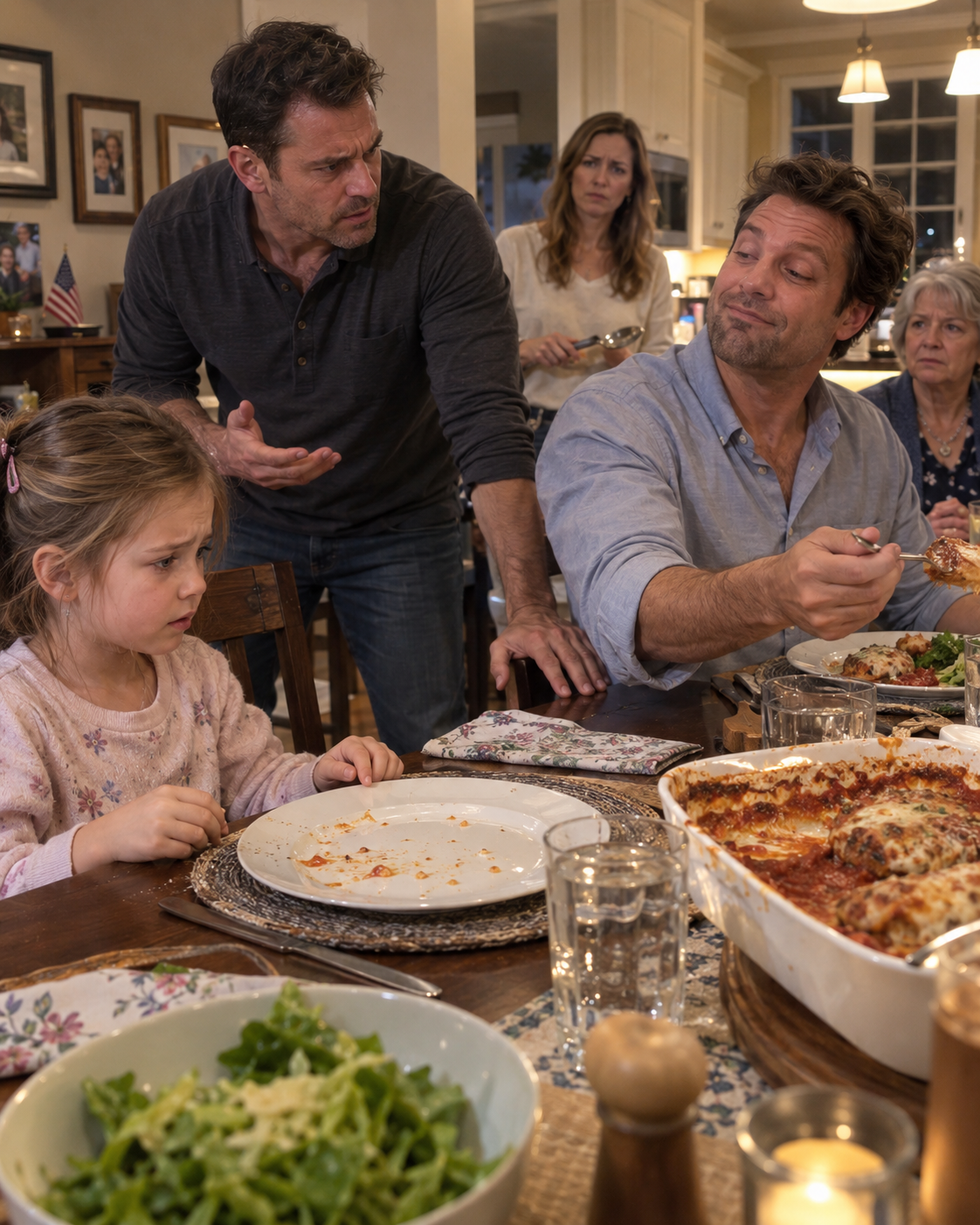
At our Sunday dinner table, my seven-year-old daughter watched her uncle steal the crispiest piece of chicken straight from her plate
The photograph showed a small wooden box sitting on a kitchen counter.
I recognized the counter immediately.
It was in Mom’s house.
But the box meant nothing to me.
There was a handwritten label taped across the top.
Dad’s name was written on it.
My father had been dead for nine years.
I stared at the photograph until my screen dimmed.
Then another message appeared.
“Don’t tell Mom yet.”
I called Brandon.
He didn’t answer.
I called again.
Nothing.
For eleven weeks, I had been angry enough to convince myself that silence was the only thing he deserved.
But that photograph changed the shape of my anger.
It didn’t erase what he had done.
It simply made me wonder whether I had been staring at the wrong piece of the puzzle.
I drove to Mom’s house.
She opened the door wearing the same worried expression she always wore whenever one of her sons came over separately.
“What’s wrong?”
I showed her the photograph.
Her face changed instantly.
“Where did you get that?”
“Brandon sent it.”
Mom stepped backward.
“Come inside.”
That was when I knew this wasn’t about chicken.
It wasn’t even about Brandon’s selfishness.
Something had been sitting inside our family for years, hidden beneath ordinary dinners and old arguments.
Mom closed the door behind me.
“Your father left that box for Brandon.”
I stared at her.
“Why?”
She shook her head.
“I don’t know.”
“You knew about it?”
“I knew there was a box.”
“What’s inside?”
Mom looked toward the hallway.
“I’ve never opened it.”
I almost laughed.
“Mom, you can’t tell me there’s a box from Dad that nobody opened for nine years.”
“I was afraid.”
“Of what?”
She didn’t answer.
My phone buzzed again.
This time it was Brandon.
“Come alone.”
I drove across town.
Brandon was waiting in his truck behind an abandoned strip mall, his hands gripping the steering wheel.
For the first time in months, he didn’t look angry.
He looked exhausted.
“You actually came.”
“Tell me what this is.”
He reached into the back seat and pulled out the wooden box.
I stared at it.
“You had it?”
“I took it from Mom’s attic.”
“Why?”
“Because I found out what Dad put inside.”
I sat across from him.
“Then tell me.”
Brandon looked down at his hands.
“I’ve been trying to figure out how to say this without making you hate me.”
I almost smiled.
“That ship sailed eleven Sundays ago.”
He nodded.
“I know.”
Then he opened the box.
Inside were envelopes.
Bank statements.
A hospital bracelet.
Several old photographs.
And a letter with my name on it.
My breath caught.
“That’s for me?”
“Yeah.”
I picked it up.
The handwriting was unmistakable.
Dad.
I hadn’t seen it in years.
My fingers trembled as I opened the envelope.
The letter was short.
He wrote that when I was a teenager, the family had been struggling financially.
He had taken a second job without telling us.
He wrote that Brandon knew about it because he had discovered the extra paychecks.
Then came the sentence that made me stop reading.
“Your brother asked me to keep something from you.”
I looked up.
“What did you do?”
Brandon swallowed.
“I asked Dad not to tell you about the money.”
“What money?”
“The money he was saving for you.”
I stared at him.
He continued.
“You were supposed to use it for college.”
My chest tightened.
“What happened?”
“I took some of it.”
The room went silent.
“How much?”
“Enough.”
“Brandon.”
He closed his eyes.
“I was seventeen.”
I didn’t speak.
“I thought I’d replace it before anyone noticed.”
“Did you?”
“No.”
The old memories suddenly rearranged themselves.
The summer I couldn’t afford the college program I wanted.
The conversation where Dad told me money was tight.
The way Brandon had suddenly bought a used car that fall.
I had always assumed Dad had helped him.
He hadn’t.
Brandon had taken the money.
But that still didn’t explain the chicken.
“Why show me this now?”
He looked at me.
“Because I realized I’ve been doing the same thing my entire life.”
I said nothing.
“Taking.”
His voice cracked.
“Whenever people gave me something, I convinced myself I deserved it.”
He looked down at the box.
“Money became something I could always ask for because someone had always rescued me.”
I thought about Mom.
About Dad.
About myself.
About all the times our family had called Brandon’s behavior a phase.
“When you took Chloe’s food,” he said, “she looked at you the way I used to look at Dad.”
My stomach tightened.
“Like you expected him to fix it.”
Brandon nodded.
“And I saw myself.”
For several seconds, neither of us spoke.
Then he said something I didn’t expect.
“I wasn’t stealing that piece because I wanted chicken.”
I looked at him.
“I wanted to see if you’d stop me.”
The words hit harder than they should have.
“What?”
“I know how that sounds.”
“It sounds terrible.”
“It was.”
He rubbed his face.
“Every time I’ve crossed a line, somebody has moved the line.”
That was the truth.
Not an excuse.
A truth.
“And when you finally stopped me, I hated you for it.”
I looked at him.
“Until you didn’t.”
He nodded.
“Until I realized you were the first person who loved me enough not to make another excuse for me.”
I didn’t know what to say.
There are moments when anger doesn’t disappear.
It simply becomes too complicated to carry in the same way.
I handed him the letter.
“You should have told me years ago.”
“I know.”
“You owe me more than an explanation.”
“I know.”
“You owe Mom.”
“I know.”
“And Chloe.”
His eyes dropped.
“Especially Chloe.”
That afternoon, Brandon came to Mom’s house with me.
He placed the wooden box on the table.
Mom stared at him.
“What did you do?”
Brandon sat down.
“I stole Dad’s money.”
Mom covered her mouth.
Then he told her everything.
Not just about the college money.
He admitted the loans he had never repaid.
The credit cards he had used when staying with relatives.
The times he had lied about losing jobs.
The favors he had manipulated people into giving him.
The room became painfully quiet.
Mom cried.
Not because Brandon had taken money.
Because she realized how often she had helped him avoid consequences.
“I thought I was helping you,” she whispered.
“I know.”
“I thought you needed me.”
“I did.”
She looked at him.
“But I also needed you to stop.”
Brandon nodded.
That was the first honest conversation our family had ever had about him.
Nobody yelled.
Nobody defended him.
Nobody called him misunderstood.
For once, we simply let the truth sit at the table.
A week later, Brandon came to my house.
He stood on the porch holding a paper bag.
Chloe opened the door before I could stop her.
“Uncle Brandon?”
He looked nervous.
“Hey, kiddo.”
She glanced at the bag.
“What’s that?”
He held it out.
“I brought you something.”
She opened it.
Inside was a box of chicken parmesan from a local restaurant.
Her eyes widened.
“Is this mine?”
Brandon smiled faintly.
“Yeah.”
She looked at him suspiciously.
“Did you ask Daddy?”
He laughed softly.
“Yes.”
She looked at me.
I nodded.
Then she smiled.
“Thank you.”
Brandon’s eyes became wet.
“You know something?”
“What?”
“I should have asked you before.”
She nodded.
“Yes.”
Children have a way of saying the simplest truth without dressing it up.
Brandon looked at me.
“I don’t expect you to trust me again right away.”
“I don’t.”
“I figured.”
“I’m glad you understand.”
“I want to earn it.”
I stepped aside.
“Then start there.”
He came inside.
That first visit lasted twenty minutes.
He didn’t ask for money.
He didn’t complain about anything.
He didn’t open the refrigerator.
He didn’t take food from anyone’s plate.
He sat on the floor and let Chloe explain every detail about her school project.
When he left, he said goodbye to her before he said goodbye to me.
It wasn’t a miracle.
It was one decent afternoon.
Sometimes that’s all change is at the beginning.
One decent choice made after years of bad ones.
The following Sunday, Brandon didn’t come.
Neither did he the Sunday after that.
I didn’t chase him.
I had learned that boundaries weren’t punishments.
They were doors with handles on both sides.
If someone wanted to come through, they had to choose to walk.
Three weeks later, he showed up carrying a folding chair.
“I figured I should bring my own.”
I smiled despite myself.
“Good idea.”
Mom laughed from the kitchen.
Sarah looked at me.
Chloe ran toward him.
“Uncle Brandon!”
He crouched down.
“Hey.”
She whispered something into his ear.
He looked embarrassed.
“What did she say?”
Sarah asked.
Chloe grinned.
“She told me to wait until everybody sits down before I pick my pizza.”
Brandon laughed.
“She’s right.”
We ate dinner together.
Nobody made a speech.
Nobody declared the family healed.
There was still damage.
There were still debts.
There were still conversations Brandon had to finish.
Trust wasn’t restored by one apology or one meal.
But that night, when the pizza arrived, Brandon waited.
He watched everyone take a slice.
Then he reached for one.
“The crispy one looks good,” he said.
Chloe looked at him.
“You can have it.”
He paused.
“Are you sure?”
She nodded.
“Because I asked.”
He smiled.
“Thank you.”
I watched them from across the table.
The same brother who once treated generosity like an endless resource was finally learning that receiving something freely given was different from taking something that wasn’t his.
After dinner, Brandon helped me clear the plates.
While we stood at the sink, he spoke quietly.
“I found another letter.”
I turned toward him.
“What letter?”
He dried his hands.
“The one Dad wrote to you wasn’t the only one.”
My heart sank.
“What does the other one say?”
He looked toward the living room, where Chloe was laughing with Sarah.
“I haven’t opened it.”
“Why not?”
“Because it’s addressed to both of us.”
He pulled a sealed envelope from his pocket.
My father’s handwriting was across the front.
Two names.
Mine.
Brandon’s.
I reached for it.
Then stopped.
For years, I had thought our family was held together by forgiveness.
I was beginning to understand it was something harder.
Truth.
The kind that hurts before it heals.
The kind that forces people to stop hiding behind love and finally learn what love requires.
I looked at my brother.
“Tomorrow?”
He nodded.
“Tomorrow.”
We put the envelope on the kitchen counter.
Neither of us opened it.
And that night, long after everyone had gone home, I found myself staring at my father’s handwriting in the darkness, wondering what he had known about his sons that neither of us had been ready to face.
Maybe the hardest lessons families teach us aren’t about who gets the biggest piece.
Maybe they’re about when to give, when to say no, and when loving someone means refusing to let them keep taking.
The envelope remained sealed until morning.
And when I finally turned it over, I saw three words written on the back that made my hands go cold.
“Don’t protect him.”