At our anniversary dinner beneath the crystal chandelier, Arthur raised his glass and smiled like the perfect husband
Part 2
The next morning, I called Helen.
Helen had been my attorney for years, but I had never called her with my voice shaking.
She listened without interrupting.
When I finished, she said, “Do not confront him again until we know what we’re dealing with.”
“I think I already know.”
“You know about the affair,” she said.
“You don’t yet know about the money.”
That sentence changed everything.
By noon, Helen had arranged for Rosa, a forensic accountant, to review our financial records.
I gave them access to every account I could find.
Checking.
Savings.
Investment accounts.
Retirement statements.
Credit cards.
Tax returns.
Property records.
I expected ugliness.
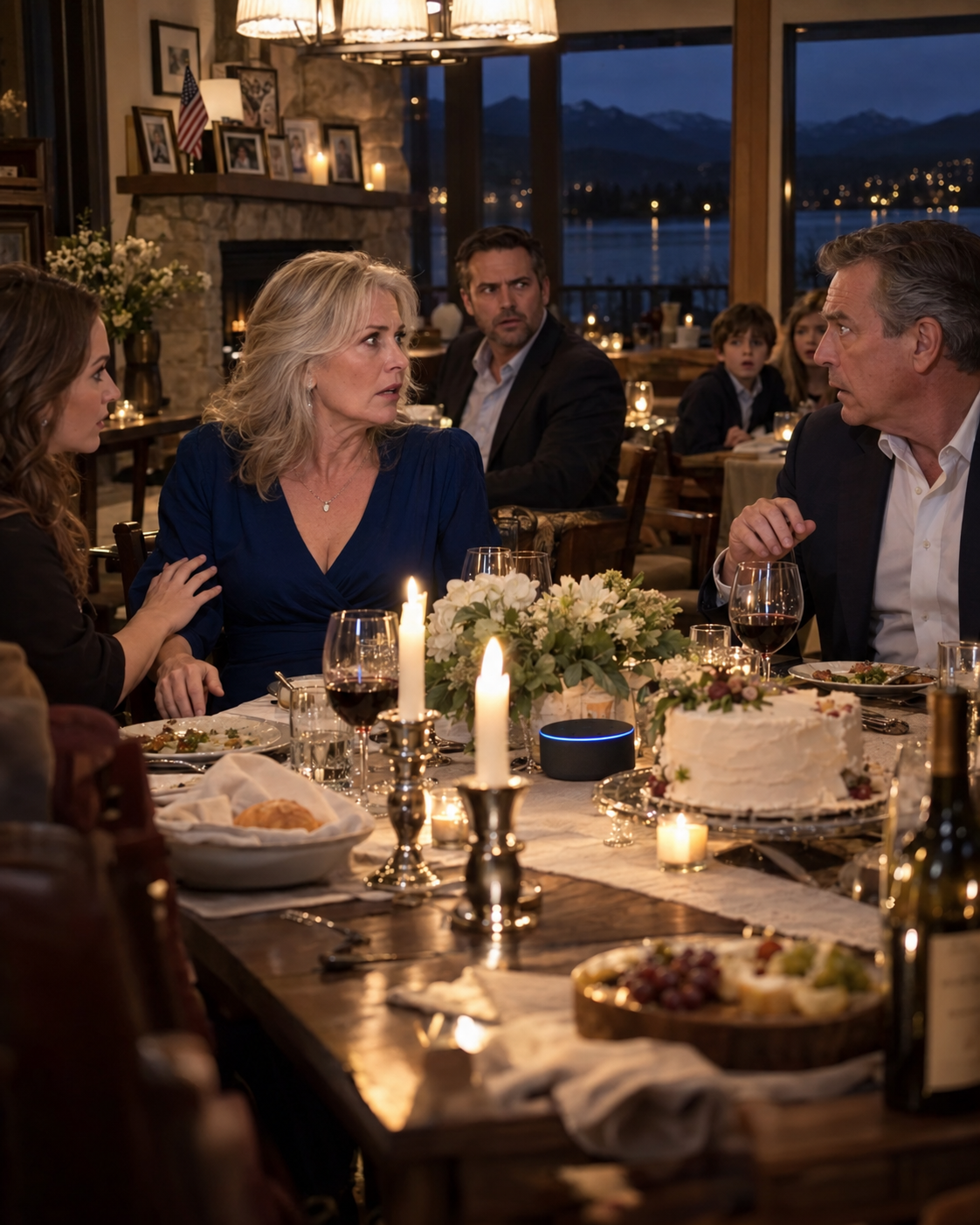
I did not expect a second financial life.
Rosa called me three days later.
“Mrs. Bennett, I need you to sit down.”
I was already sitting.
“What did you find?”
She paused.
“Over four hundred thousand dollars appears to have been diverted from accounts you shared with your husband.”
My hands went cold.
“Where did it go?”
“Mortgage payments.”
“Whose mortgage?”
She hesitated.
“Evelyn’s.”
I closed my eyes.
Rosa continued.
“Private school tuition.”
“For whom?”
“Toby and Julian.”
I felt a strange pressure behind my ribs.
Arthur had not simply been visiting another woman.
He had been financing a household.
Our household had been paying for his secret household.
There were restaurant bills.
Medical expenses.
Summer camps.
Utility payments.
Insurance.
Even holiday purchases.
Seventeen years of receipts.
Seventeen years of lies with numbers attached.
Helen told me to preserve everything.
So I did.
I created folders.
I printed statements.
I copied emails.
I photographed documents.
I saved every message.
I stopped thinking like a betrayed wife and started thinking like someone protecting a family inheritance.
Arthur noticed the change.
He came home one evening carrying flowers.
White roses.
My mother’s favorite.
I stared at them.
“Where did you get those?”
He looked embarrassed.
“I thought you’d like them.”
“You never remembered that before.”
“I remember now.”
I almost smiled.
“That’s convenient.”
He put the flowers down.
“Can we talk?”
“We’ve been talking for forty-three years.”
“I want to fix this.”
“You can’t fix seventeen years.”
“I love you.”
I looked at him for a long time.
“I believe you loved parts of our life.”
He looked hopeful.
“But you protected another life more carefully.”
His face fell.
“I made a terrible mistake.”
“No.”
I said it softly.
“You made thousands of decisions.”
He sat across from me.
“Evelyn never meant anything to me.”
I thought about the mortgage payments.
“The woman whose home you financed for seventeen years?”
He looked down.
“She needed help.”
“And your sons?”
Arthur flinched.
“Toby and Julian didn’t ask for any of this.”
“No,” I said.
“They didn’t.”
That was the first moment I felt something other than anger.
Pity.
Not for Arthur.
For two boys who had spent seventeen years believing their father was simply a man who had to remain hidden.
Helen advised me not to contact Evelyn yet.
But eventually, I needed to understand what those boys knew.
So I called her.
She answered on the fourth ring.
“Hello?”
“This is Margaret.”
Silence.
Then a small breath.
“I know who you are.”
“I thought you might.”
Arthur had apparently told her everything except the truth.
She said, “I never wanted to hurt you.”
I looked out the window at the backyard where our children had played decades earlier.
“You didn’t have to want it.”
There was another silence.
“Arthur said your marriage was over.”
I closed my eyes.
That sentence was almost predictable.
“He told you that for seventeen years?”
“He said you lived separate lives.”
“We shared a bedroom until three weeks ago.”
She began crying.
I did not feel victorious.
There was nothing victorious about any of it.
“I have two questions,” I said.
“Okay.”
“Did you know about the trust?”
Her breathing changed.
“No.”
“Did Arthur tell you the boys could not call him Dad in public?”
She was silent.
That silence told me enough.
A week later, I met Evelyn at a quiet café.
Toby and Julian came with her.
They were seventeen.
Tall.
Awkward.
Young enough to still look like boys and old enough to understand betrayal.
They stared at me with expressions that held fear, confusion, and shame that did not belong to them.
I sat across from them.
“I am not here to blame you.”
Neither boy spoke.
I looked at Toby.
“Your father owes you honesty.”
Then Julian.
“And he owes you support.”
I folded my hands.
“But my parents’ trust is not his to give away.”
Julian frowned.
“What trust?”
I explained.
Not every detail.
Not the accusations.
Just the truth.
My parents had created the fund for their grandchildren.
It was meant to protect the next generation.
It was never Arthur’s personal escape plan.
Toby looked at his mother.
“Did Dad really do all this?”
Evelyn started crying.
I answered gently.
“Your father made those choices.”
The boys looked down.
I could see the weight settling on their shoulders.
So I added, “None of this is your fault.”
That was the one thing I needed them to hear.
Arthur had created the secret.
The children should not have to carry it.
When I returned home, I went straight to his office.
I used the strange key I had found.
It opened a locked filing cabinet.
Inside were envelopes.
Dozens of them.
I pulled out the first.
Toby.
Age six.
Another.
Julian.
Age eight.
There were report cards.
School photographs.
Birthday cards.
Little handwritten notes.
Copies of medical records.
Pictures of Arthur standing beside two boys at baseball games.
Arthur had kept everything.
He had been there.
He had watched them grow.
He had attended parent meetings.
He had celebrated birthdays.
He had built memories.
Just not with me.
I sat on the floor surrounded by seventeen years of evidence.
That was when the deepest wound opened.
The affair was not the whole betrayal.
He had not merely stolen affection.
He had stolen reality.
He had taken years of my life and quietly edited the story while I was still living it.
I found a photograph of Arthur holding the twins when they were infants.
On the back, he had written, “My boys.”
My hands began shaking.
For years, I had believed my husband was devoted to our family.
He had been.
Just not exclusively.
And perhaps that was what hurt most.
People imagine betrayal as a single explosion.
Sometimes it is not.
Sometimes it is seventeen years of ordinary mornings.
Seventeen years of coffee.
Seventeen years of grocery lists.
Seventeen years of saying, “Drive safely.”
Seventeen years of sleeping beside someone who knew exactly how to hide the truth.
I called Helen.
“I found something.”
“Documents?”
“Photos.”
She was silent.
Then she said, “Keep them.”
“I will.”
That evening Arthur came home.
He saw the envelopes spread across the desk.
His face went white.
“You found those.”
“I did.”
He sat down.
“I never meant for you to see them.”
“That is the problem, Arthur.”
He looked at the photographs.
“I loved them.”
“I know.”
“I couldn’t abandon them.”
“I know.”
He looked at me with tears in his eyes.
“And I couldn’t leave you.”
I stared at him.
“So you decided I didn’t deserve the truth.”
He had no answer.
That night, he asked me to stay.
He promised therapy.
Counseling.
Separate finances.
A new beginning.
He said everything a desperate person says when consequences finally become real.
I listened.
Then I said, “I am not your second chance.”
His face crumpled.
“You don’t have to forgive me today.”
“I’m not asking myself to forgive you.”
“What are you asking?”
“For the first time in my life, I’m asking myself what I want.”
And the answer was becoming clear.
Part 3
I filed for divorce the following week.
There was no dramatic courtroom confrontation.
No screaming.
No revenge.
Just paperwork.
Signatures.
Bank statements.
Evidence.
And the slow, painful dismantling of a life I had once believed would end differently.
Helen fought to protect the trust.
Rosa documented every questionable transfer.
The financial records became impossible to explain away.
Some assets were recovered.
Some were accounted for through the divorce settlement.
The education trust remained protected for the grandchildren, exactly as my parents had intended.
That mattered to me more than winning against Arthur.
I didn’t want his humiliation.
I wanted my family’s future.
Arthur continued asking me to reconsider.
Sometimes he called late at night.
Sometimes he left messages.
“I miss you.”
“I’ve changed.”
“I know what I did now.”
One afternoon, he stood outside my new apartment holding the same kind of white roses he had brought before.
I opened the door but did not invite him inside.
He looked older.
So did I.
“Margaret,” he said, “forty-three years can’t just disappear.”
“They didn’t.”
He looked confused.
“I remember them.”
His eyes filled.
“Then don’t throw them away.”
I shook my head.
“I’m not throwing them away.”
I looked past him toward the street.
“Those years belong to me.”
He said nothing.
“I won’t let what you did rewrite everything that came before it.”
He wiped his eyes.
“Is there really no chance?”
I thought about the woman I had been at twenty-three.
The young bride who believed love meant trust.
The mother who worked through exhaustion.
The wife who forgave small things because she believed marriage was built by forgiveness.
The grandmother who wanted her family around one table.
That woman deserved better.
But she also deserved to know that her life had not been meaningless.
So I said, “There is a chance.”
Arthur looked hopeful.
“A chance for me to build a life where I don’t have to wonder what is true.”
His expression broke.
I closed the door gently.
Months passed.
The divorce became final.
The house was sold.
The photographs were divided.
Some went to Eleanor.
Some to Marcus.
Some stayed with me.
I kept one photograph from our first anniversary.
Arthur and I were young.
We were standing in front of a small restaurant with terrible lighting and enormous smiles.
I kept it because I refused to let the ending erase the beginning.
But I also kept the photograph of my parents holding me as a child.
That one went above my desk.
Under it, I placed a small wooden box containing the documents that proved the trust had survived.
My parents had left me more than money.
They had left me a responsibility.
To protect something they created for people they would never meet.
My grandchildren.
Months later, Claire came to visit.
She sat beside me on the porch.
“Grandma?”
“Yes?”
“Do you ever wish you hadn’t heard that recording?”
I thought about it.
“I wish I had never needed to hear it.”
She nodded.
“But I’m glad I did.”
“Why?”
I looked at the trees moving in the evening wind.
“Because the truth hurts once.”
I paused.
“Living inside a lie hurts every day.”
She leaned against my shoulder.
For a while, neither of us spoke.
Then she said, “You seem happier.”
I smiled.
“I am quieter.”
“Is that the same thing?”
“No.”
I looked toward the sunset.
“But sometimes peace begins as quiet.”
Eleanor eventually brought the grandchildren over for Sunday dinners.
Marcus fixed the loose railing on my porch.
The house filled with noise again.
Not the carefully staged noise of a perfect family.
Real noise.
Arguments over dessert.
Laughter from the kitchen.
Grandchildren running through the hallway.
People arriving late and apologizing.
People telling the truth.
That was what I wanted now.
Truth.
Not perfection.
One evening, I placed the blue smart speaker in a drawer.
I had considered throwing it away.
Instead, I kept it.
Not because I wanted to remember Arthur’s voice.
Because I wanted to remember the moment I finally listened to my own.
The little blue light had once felt like an accusation.
Now it felt like a strange monument to the day my life changed direction.
I thought about how easily we can mistake familiarity for safety.
How a person can know every detail of your life and still hide the most important one.
How love can survive disappointment but cannot survive endless deception without changing shape.
Arthur had spent seventeen years building a secret family.
I spent the first months after discovering it rebuilding myself.
There was a difference.
He had built his life through concealment.
I built mine through truth.
And eventually, truth became lighter to carry.
A year after the divorce, I stood at my parents’ graves with flowers in my hands.
The afternoon was cool.
Leaves moved across the stone like little pieces of gold.
I told them everything.
About Arthur.
About Evelyn.
About the twins.
About the trust.
About the divorce.
Then I told them the part that mattered most.
“I protected it.”
I smiled through my tears.
“I protected what you left for the children.”
For the first time, I did not feel like the woman whose marriage had ended.
I felt like the woman whose life had begun again.
I walked back to my car slowly.
The sun was dropping behind the trees.
My phone buzzed.
A message from Eleanor.
“Sunday dinner at six. Don’t be late.”
I laughed.
“Never,” I typed.
Then I looked at the road ahead.
For forty-three years, I had thought home was a person.
I was wrong.
Home was the place inside myself where I no longer had to question the truth.
And as I drove toward the life waiting for me, I finally understood something I wished I had known much earlier.
Sometimes the most devastating truth is not the end of your life.
Sometimes it is the door that finally opens it.