At my sister’s rehearsal dinner, my father slid my invitation back across the linen table and warned me not to embarrass the family
General Vance didn’t raise his voice.
He didn’t need to.
The silence around that table had already become heavier than shouting could have made it.
Mason looked from the challenge coin to me.
“You know her?”
General Vance gave him a flat stare.
“I know exactly who she is.”
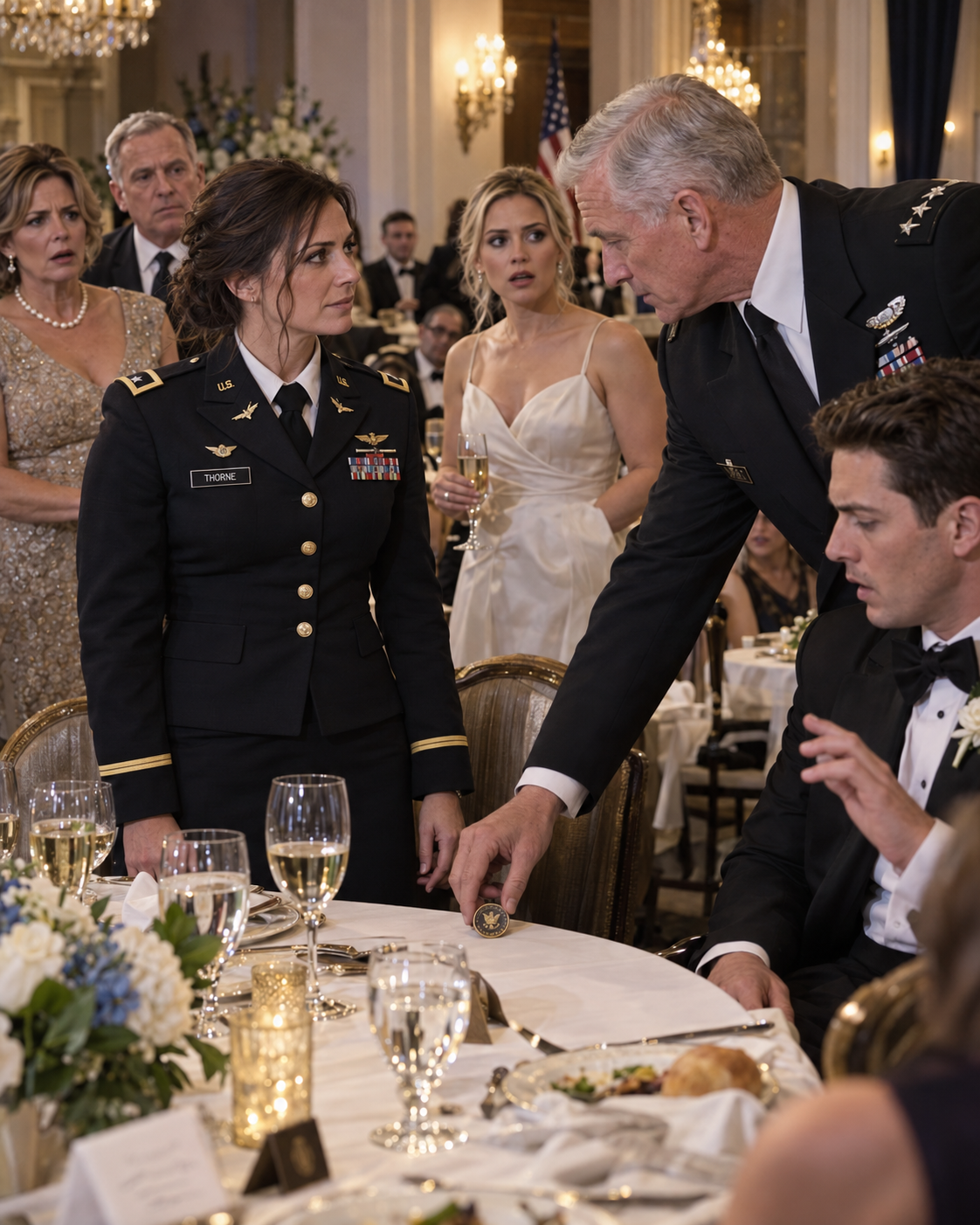
He turned toward the room.
“Captain Thorne led the engineering evaluation on an aircraft that was already showing abnormal stress under repeated flight loads.”
I felt every pair of eyes move toward me.
General Vance continued.
“She refused to certify it.”
Mason’s father leaned closer to the table.
“At first, the report was disputed.”
I remembered those weeks.
The arguments.
The pressure.
The meetings where executives wanted schedules protected and engineers wanted more testing.
General Vance looked at me.
“She volunteered to take the aircraft up herself.”
My mother’s face changed.
I didn’t look at her.
That flight had never been a story I enjoyed telling.
The aircraft had entered a test envelope that exposed the problem.
A vibration became a violent shudder.
The controls grew heavy.
Warning lights appeared.
I remember gripping the stick and thinking about the engineers waiting for data on the ground.
One wrong decision could have ended everything.
But if I aborted too early, people might decide the aircraft had simply experienced a bad flight.
So I stayed with it long enough to reproduce the fault.
Then I brought it home.
The footage and telemetry made the flaw impossible to dismiss.
The design was corrected.
The fleet was grounded long enough for inspections.
No headlines carried my name.
That was never the point.
General Vance tapped the challenge coin.
“This is what she received after that evaluation.”
Mason swallowed.
My father finally spoke.
“Maya, you never told us any of this.”
I met his eyes.
“You never really wanted to know.”
He flinched.
Chloe shifted in her chair.
“Maya, that’s not fair.”
I looked at my sister.
“Isn’t it?”
She opened her mouth.
Nothing came.
My mother found her voice first.
“You could have said something instead of letting us think you were just working on engines.”
I almost smiled.
“I tried.”
“No, you didn’t.”
“I told you I was an aviation engineer.”
Mom shook her head.
“You made it sound ordinary.”
“Because to me, doing my job is ordinary.”
Mason suddenly laughed.
“Okay, this is getting ridiculous.”
His father turned toward him.
“No, Mason.”
The room went still again.
General Vance’s expression hardened.
“You need to understand what you just did.”
Mason stared at him.
“You mocked an officer whose work I personally rely on.”
“I didn’t know.”
“That doesn’t excuse you.”
Mason looked down.
Chloe touched his arm.
“Can we please just get through tonight?”
General Vance looked at her.
“The problem isn’t tonight.”
He pointed toward me.
“The problem is that your family decided her value depended on whether they understood her job.”
My mother stiffened.
“We love our daughter.”
General Vance nodded once.
“Then act like it.”
That sentence landed harder than any insult.
My mother looked away.
The waiter came with the next course and stopped when he sensed the tension.
I told him to continue.
Food arrived.
Nobody ate much.
Mason eventually leaned toward me.
“I owe you an apology.”
I nodded.
“Yes, you do.”
He seemed surprised that I hadn’t softened it.
“I’m sorry for what I said.”
“Thank you.”
He waited.
I didn’t add anything.
He looked uncomfortable.
Maybe he expected forgiveness to be automatic.
It wasn’t.
My father stood and walked outside.
After several minutes, he returned with red eyes.
He sat beside me instead of at the other end of the table.
“I failed you.”
Those words were so quiet that I almost missed them.
I looked at him.
He rubbed his hands together.
“I spent years thinking you were tough enough not to care.”
I said nothing.
“I used that as an excuse.”
I finally whispered, “I did care.”
“I know.”
He looked down.
“I know now.”
Chloe began crying.
Mom stared at her plate.
I felt something inside me soften for my father, but only slightly.
An apology can open a door.
It cannot rebuild a house overnight.
Then Mom said something that changed everything.
“You enjoyed making us look stupid tonight.”
I looked at her.
“What?”
She was angry now.
“All these years, you kept this from us, and now your fiancé’s father walks in and makes everyone look foolish.”
I felt my chest tighten.
“I didn’t do anything.”
“You should have told us.”
“Why?”
“So we could have been proud of you.”
I stared at her.
“Why did you need me to become impressive before you could be proud?”
She didn’t answer.
I stood.
My chair scraped against the floor.
Chloe whispered, “Maya, don’t leave.”
I put on my jacket.
“I came here because you’re my sister.”
I looked at my mother.
“I stayed because I wanted to believe tonight could be different.”
Then I looked at my father.
“But I can’t keep walking into rooms where I have to earn the right to be respected.”
My father stood too.
“Maya.”
I stopped.
“I am sorry.”
This time, I believed him.
But believing an apology didn’t mean accepting the life that had required one.
I walked out.
The night air was cold.
For the first time, I didn’t feel embarrassed.
I felt empty.
Then my phone vibrated.
It was a message from Major Harris, the senior engineer who had stood beside me during my most dangerous evaluations.
“You handled that with more patience than I would have.”
I smiled despite myself.
Another message appeared.
“General wants to see you tomorrow.”
I stared at the screen.
I already knew which General.
The next morning, I entered the base before sunrise.
General Vance was waiting in a conference room.
A stack of reports sat on the table.
He didn’t waste time.
“I’ve been trying to reach you for six months.”
“For what?”
“An advanced flight safety evaluation unit.”
He slid a folder toward me.
“We’re building it from the ground up.”
I opened it.
The mission was larger than anything I had expected.
Flight testing.
Structural certification.
Failure analysis.
Human-factors integration.
Cross-service aviation safety.
I looked up.
“You want me to lead it?”
“I want someone who understands that an aircraft can be technically compliant and still be dangerously wrong.”
I closed the folder.
“Why me?”
“Because you were willing to risk your career to tell the truth.”
I didn’t answer.
He leaned back.
“Your family doesn’t need to know what you do.”
I smiled faintly.
“They never really did.”
He smiled too.
“Then let’s build something they can’t misunderstand.”
I accepted.
The first months were brutal.
We recruited pilots who had survived dangerous failures.
Engineers who had been ignored when they raised concerns.
Maintenance chiefs who knew exactly how expensive silence could become.
For the first time in my career, I wasn’t fighting alone.
There was a mechanic named Luis who could hear a bad engine vibration before the instruments caught it.
There was Major Harris, who could dismantle a flawed test plan with one sentence.
There was Dr. Naomi Reed, an aerospace physician who cared deeply about what stress did to decision-making.
And there was Lieutenant Cole, a young pilot who reminded me of myself at twenty-four.
They became my team.
Then came our first major evaluation.
A prototype aircraft had passed every conventional test.
The manufacturer wanted certification.
The schedule was already slipping.
Everyone was under pressure.
We found a strange vibration during one sequence.
Not enough to trigger an automatic failure.
Just enough to make me uneasy.
I requested another flight.
The manufacturer pushed back.
“We’ve already demonstrated compliance.”
I recognized those words.
They sounded exactly like the words I had heard years earlier.
General Vance looked at me.
“What do you want to do?”
I closed the report.
“Fly it again.”
Nobody argued.
I took the aircraft up with Cole beside me.
At first, everything looked normal.
Then, at altitude, the vibration returned.
Small.
Intermittent.
Almost invisible.
I felt it through the seat before the instruments registered it.
“Got it,” I said.
Cole looked over.
“What is it?”
“Something moving that shouldn’t be.”
I reduced speed.
The vibration changed.
I changed the load.
It changed again.
There it was.
A structural interaction nobody had modeled correctly.
I called it immediately.
The flight ended safely.
Back on the ground, the engineers opened the structure.
We found a component beginning to fatigue under a condition that standard testing had missed.
The aircraft would have passed certification.
Until it didn’t.
I stood beside the opened panel, staring at the damage.
Cole said quietly, “How do you keep finding these things?”
I thought about my family.
About being called a mechanic.
About sitting silently while people decided what my life was worth.
“Because I learned a long time ago that people don’t always listen when you speak politely.”
Word spread through the unit.
Not my family.
Not the people who had dismissed me.
The people who worked beside me.
Within a year, our unit became known for stopping problems before they became tragedies.
I never became famous.
I became trusted.
That was better.
Back home, things changed too.
My father called less often at first.
Then more often.
He wasn’t trying to defend himself anymore.
He simply wanted to talk.
One evening, he said, “Your mother still doesn’t understand.”
“Understand what?”
“That she hurt you.”
I looked out the window.
“I know.”
“She’s afraid you’ve replaced us.”
I closed my eyes.
“I didn’t replace anyone.”
“What did you do?”
“I stopped begging you to become the family I needed.”
He was silent.
Then he said, “I think I understand now.”
Months later, my father visited the base.
I had never invited him before.
He stood behind the observation glass while my team prepared for a test.
When I finished, he waited outside.
He looked at the aircraft.
Then at me.
“I used to think a pilot just flew.”
I smiled.
“Most people do.”
He shook his head.
“You’ve been carrying responsibility I couldn’t even see.”
I didn’t know what to say.
He handed me a small box.
Inside was an old photograph of me in college.
On the back, Dad had written something years earlier.
“I’m proud of you.”
I looked at the handwriting.
“When did you write this?”
He swallowed.
“Before you enlisted.”
I looked up.
“Then why did you never say it?”
His eyes filled.
“Because I thought your mother would be upset.”
I gave a sad laugh.
“That may be the most honest thing you’ve ever told me.”
He nodded.
We stood there for a while.
It wasn’t reconciliation.
Not completely.
But it was truth.
And truth was where everything good had to begin.
I still didn’t speak much with my mother.
Eventually, she mailed me a letter.
It was four pages long.
The first three were filled with explanations.
The fourth had only one sentence.
“I am sorry I taught you that being loved meant being easier to love.”
I read that sentence again and again.
I didn’t know whether I could forgive her.
But I knew I no longer needed her approval to breathe.
That was enough.
Years later, people sometimes asked why I chose flight safety.
I always gave the same answer.
“Because somebody has to be willing to say no before gravity gets the final vote.”
They usually laughed.
I never did.
I knew exactly what a quiet warning could cost.
I also knew what ignoring one could cost.
On the anniversary of the evaluation that changed my career, General Vance called me into his office.
He placed a familiar bronze coin on the desk.
“The first one was for surviving,” he said.
“What is this one for?”
He smiled.
“For building a team that doesn’t need to be saved.”
I picked it up.
It was heavier than I expected.
That night, I returned home and placed it beside the old coin I had hidden for years.
Two small pieces of metal.
Two reminders of who I had been when nobody was watching.
My phone rang.
It was Chloe.
I stared at her name for several seconds before answering.
Her voice was quiet.
“Maya, Mom found something.”
I frowned.
“What?”
“A letter from Grandpa.”
My grandfather had been dead for eleven years.
“What does it say?”
Chloe took a breath.
“It mentions your name.”
My stomach tightened.
“Why?”
“I don’t know.”
There was a pause.
“She said you should read it before she does.”
I stood in the darkened room, the two challenge coins beside me.
For years, I had thought my family’s greatest secret was why they never saw me clearly.
Now, for the first time, I wondered whether there had been another reason they were so determined to keep me small.
And suddenly, I wasn’t sure my childhood had been built on neglect alone.
It might have been built around a secret somebody had been protecting long before I ever wore a uniform.