At my parents’ Christmas Eve dinner, my mother pointed to the empty chair beside the tree and coldly
Part 2
No one responded for almost a minute.
Then Aunt Brenda wrote again.
“Eleanor, answer me.”
My mother called Chloe.
Chloe did not answer.
Another message appeared from my uncle.
“Are you saying Maya was deliberately excluded?”
I watched the typing bubbles appear and disappear.
Then Garrett’s mother wrote privately to my mother.
“What exactly have you been telling our family?”
The next call I received was from Aunt Brenda.
“You don’t owe me an explanation,” she said.
“I want to hear yours.”
So I told her everything.
Not dramatically.
Not selectively.
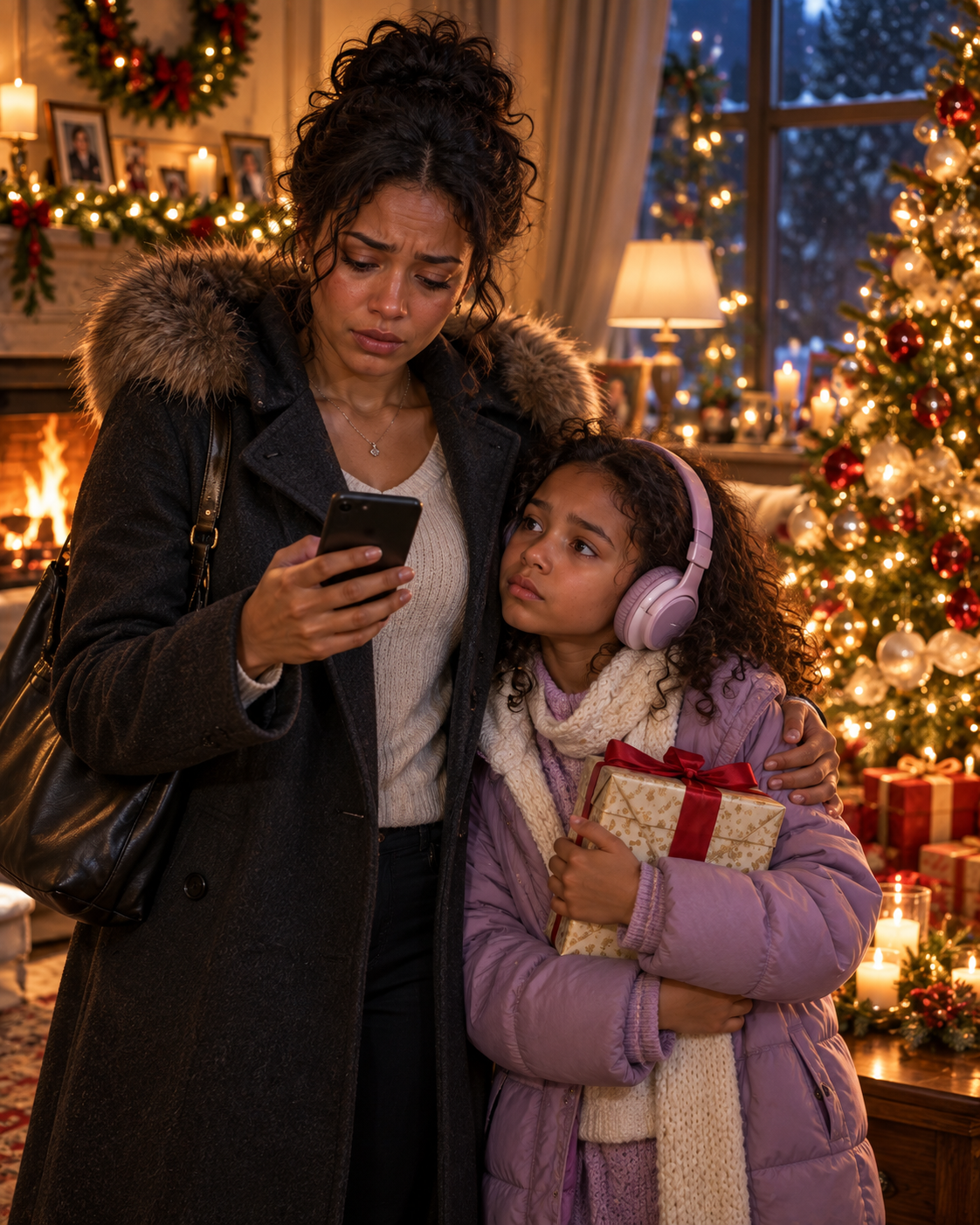
I read the original message.
Then I explained what happened at the house.
I told her about the grocery order.
The hospital.
The school counselor.
The pounding on my door.
Aunt Brenda was quiet for a long time.
Then she said, “I am so sorry.”
I realized I had expected anger.
Instead, I heard something more valuable.
Disbelief.
The kind that comes when someone finally sees the difference between a family story and the truth.
Within an hour, the extended family chat changed completely.
Relatives who had spent years praising my mother for keeping everyone together were now asking direct questions.
Why had Maya been excluded?
Why was I still expected to cook?
Why had they lied?
No one had good answers.
My mother tried to explain.
She said she was worried about sensory issues.
She said she thought she was protecting Maya.
She said she was trying to make everyone comfortable.
Aunt Brenda replied:
“Protecting Maya would have meant making room for her.”
That sentence ended the argument.
Then Garrett’s family found out.
The next morning, Chloe called me.
Her voice was shaking.
“Garrett broke the engagement.”
I sat down.
“Why?”
“His parents are furious.”
I did not feel satisfaction.
I felt tired.
Chloe started crying.
She said Garrett had asked her one question over and over.
“Why did you think my family needed to approve of excluding an eight-year-old child?”
She had no answer.
I had nothing to give her.
Not yet.
There are consequences that arrive like explosions.
Others arrive like quiet doors closing one by one.
This was the second kind.
By Christmas Eve, Chloe was alone in her apartment.
My mother was refusing to answer half the family.
My father had gone silent.
And I was packing a small suitcase for Maya.
She ran into the living room wearing her headphones.
“Are we really going to the ocean?”
“Yes.”
“Can we see jellyfish?”
“Yes.”
“Can we see sharks?”
“Probably.”
She gasped.
“I love sharks.”
“I know.”
She zipped her backpack.
“What about Christmas dinner?”
I stopped.
I wanted to tell her the truth.
Instead, I said, “We’re making our own.”
She thought for a second.
“Can there be pancakes?”
I smiled.
“There can always be pancakes.”
The coastal aquarium was almost empty when we arrived.
The staff had created a quiet entry window for families who preferred lower stimulation.
No loud music.
No crowded gift shop.
No flashing holiday displays.
Maya walked slowly through the first exhibit.
Blue light moved across her face.
She stared at the jellyfish.
They floated like tiny moons.
She whispered, “They look like they’re dreaming.”
I stood beside her.
“I think maybe they are.”
We stayed there for nearly twenty minutes.
No one asked her to make eye contact.
No one told her to take off her headphones.
No one sighed when she covered her ears.
No one stared when she rocked gently on her heels.
The world simply made room.
That was all she had ever wanted.
Not special treatment.
Not pity.
Room.
That night, our dinner came in a small room overlooking the water.
It was not glamorous.
The table was tiny.
The Christmas tree was barely taller than Maya.
But she had pancakes.
We watched the harbor lights flicker.
She drew a picture of two jellyfish holding hands.
Then she looked at me.
“Mommy?”
“Yes?”
“Are we okay?”
I knew she was asking more than whether we were having fun.
I reached across the table.
“We are.”
She smiled.
That night, she fell asleep with the aquarium brochure resting against her chest.
I sat beside the window and cried.
Not because I was broken.
Because I could finally feel how much I had been holding.
My phone rang at 2:11 a.m.
It was my mother.
I did not answer.
She called again.
Then again.
Then she sent a message.
“Your father is having a medical emergency.”
My body reacted before my mind did.
I stood up.
Then I stopped.
I called my father directly.
He answered.
He sounded tired.
But he was not in an ambulance.
He was sitting at home.
He had “chest discomfort,” he said.
I asked whether he had called his doctor.
“No.”
I asked whether he had called emergency services.
“No.”
I told him to do that immediately.
Then I ended the call.
My mother called again.
I did not answer.
The next message said:
“You have become very cold.”
I stared at it.
Then I wrote one sentence.
“I will respond to genuine emergencies, but I will not respond to guilt.”
I sent it.
Then I turned my phone off.
For years, I had been trained to confuse crisis with obligation.
That night, I learned the difference.
Over the next several weeks, the attacks changed shape.
My mother told relatives I had abandoned the family.
Chloe said I had humiliated her.
My father said everyone was suffering.
I kept my responses brief.
Facts.
Dates.
Screenshots.
Nothing more.
My boundaries became boring.
That was how I knew they were working.
Without drama, there was nothing for anyone to argue with.
At Maya’s school, the counselor documented the harassment and kept her environment stable.
At the hospital, Wendy told me to stop apologizing for taking time off when I needed it.
Dr. Davis checked in occasionally, not as my family, but as someone who had witnessed how exhausted I had become.
And Mrs. Gable became part of our daily rhythm.
She helped Maya after school.
She watered my plants when I worked late.
She taught Maya how to identify three kinds of sea grass in a library book.
One evening, Maya announced, “Mrs. Gable knows everything.”
I smiled.
“She knows a lot.”
“More than Grandma.”
I paused.
“That is possible.”
Maya laughed.
For the first time, I did not feel guilty for laughing with her.
Months passed.
Christmas became a strange memory.
One that still hurt, but no longer controlled the temperature of my life.
Then Chloe sent me a letter.
Not a text.
Not a voice message.
A letter.
She admitted she had joined the cruelty because she wanted Garrett’s family to approve of her.
She admitted she had laughed because she was afraid of losing the life she thought she was supposed to have.
She said she had begun therapy.
She said the therapist had asked her a question that stayed with her.
“What did you have to become to feel acceptable?”
Chloe wrote that she had never known how to answer.
At the bottom of the letter, she wrote:
“I hurt Maya because I was too afraid to stand beside her.”
I read it twice.
Then I put the letter away.
Accountability was different from apology.
I had learned that distinction the hard way.
Months later, Chloe asked whether she could see Maya.
I agreed to a short meeting in a quiet public place.
Maya sat across from her, eating apple slices.
Chloe looked nervous.
She did not ask Maya to hug her.
She did not force conversation.
She simply said, “I was wrong.”
Maya looked at her.
Then she asked, “Did you know jellyfish have no brains?”
Chloe blinked.
“No.”
“They still survive.”
Maya returned to her apple.
Something about that moment broke through all the adult language we had been using.
Chloe smiled through tears.
“I think you are very smart.”
Maya nodded.
“I know.”
For the first time, Chloe laughed without cruelty in it.
My father took longer.
He did not know how to apologize.
He began with smaller things.
He asked what Maya was learning.
He looked up marine biology documentaries.
He learned that her headphones were not a rejection of people.
They were a tool that helped her stay in the world.
He once called me just to tell me he had watched a documentary about coral reefs.
I smiled after we hung up.
It was not redemption.
It was a beginning.
That mattered.
Part 3
By the following December, our apartment looked nothing like my parents’ house.
There were no twelve matching place settings.
No expensive centerpiece.
No carefully arranged table designed to impress anyone.
There was a crooked paper star taped above the window.
There were two strands of lights that kept blinking at different speeds.
There were crayons on the table.
There was a small plastic shark in the fruit bowl.
And there were people I never expected to call family.
Mrs. Gable arrived first, carrying a pie.
Wendy brought rolls from the hospital.
Aunt Brenda brought a basket of oranges.
Two of my nursing coworkers squeezed around the table after their shifts.
My father came carrying a small gift bag.
Chloe came alone.
There was a moment at the door when she looked at me.
Then she said, “Merry Christmas.”
I stepped aside.
“Come in.”
Maya was sitting on the floor with a marine biology book open in front of her.
She looked up.
“Grandpa.”
My father froze.
He had not heard her say his name in months.
Then he smiled.
“Hi, Maya.”
She pointed to a page.
“Did you know manta rays can recognize themselves?”
He took off his coat.
“No.”
“I can show you.”
He sat beside her on the floor.
Nobody at the table said anything.
We just watched.
My father had once asked me to buy expensive headphones without asking why my daughter needed them.
Now he sat patiently while she explained a ray’s sensory system in extraordinary detail.
That was what change looked like.
Not grand speeches.
Not dramatic promises.
Attention.
Chloe eventually sat beside Maya too.
She listened.
She did not interrupt.
She did not tell her to speak more quietly.
She did not ask her to behave differently.
She simply listened.
Dinner was messy.
The turkey was slightly dry.
The potatoes were too salty.
Someone dropped a fork.
Mrs. Gable laughed so hard she nearly spilled her tea.
Maya talked about a tide pool for seven uninterrupted minutes.
No one stopped her.
No one exchanged embarrassed glances.
When she finished, Wendy said, “That is the coolest thing I heard all day.”
Maya smiled.
I looked around the table.
For years, I had believed family was the table I had inherited.
I thought belonging meant enduring whatever happened there because leaving was supposed to hurt more.
I was wrong.
Sometimes the table is not sacred.
Sometimes the table is simply a place where people reveal what they believe you deserve.
The first Christmas after I walked away, I thought I had lost my family.
By the second, I understood that I had lost an arrangement.
There was a difference.
The people around me now did not love Maya because she performed comfort for them.
They loved her because she was Maya.
A girl who loved whales.
A girl who wore headphones.
A girl who sometimes needed silence.
A girl who could spend twenty minutes watching jellyfish and then explain their movement to anyone willing to listen.
A girl who never needed to apologize for being exactly who she was.
Later that night, after everyone left, Maya and I sat by the window.
Snow began falling outside.
She leaned against my shoulder.
“Mommy?”
“Yes?”
“Are we going to Grandma’s next Christmas?”
I looked out at the lights.
I thought about the empty chair.
The cold words.
The slammed door.
The messages.
The lies.
The years I spent trying to earn a seat for myself at a table where I had been useful, but never fully welcomed.
Then I looked at my daughter.
“No,” I said.
She nodded.
“Okay.”
She rested her head against me.
After a moment, she asked, “Can we go back to the aquarium?”
I smiled.
“Absolutely.”
She smiled too.
And that was the moment I finally understood what walking away had given us.
It had not given me revenge.
It had not erased what happened.
It had not turned my mother into someone she was not.
It had done something quieter.
It had taught me that love should not require a child to become smaller so adults can feel comfortable.
It had taught me that boundaries are not punishments.
They are doors.
Sometimes you close them because you are angry.
Sometimes you close them because you are afraid.
And sometimes you close them because someone on the other side has spent years proving they will not stop hurting the people you love.
I used to think the strongest thing I could do for Maya was protect her from every cruel person in the world.
I know better now.
I cannot control who judges her.
I cannot control who misunderstands her.
I cannot control who walks away.
But I can make sure she always has at least one place where she never has to earn her right to belong.
Our apartment was small.
Our Christmas table was imperfect.
The people around it were still learning.
But when Maya started talking about sharks again, everyone leaned in.
No one asked her to lower her voice.
No one told her she was embarrassing them.
No one looked at the clock.
They listened.
And as her voice filled our little home, I realized something I wish I had known twelve years earlier.
A family is not the group of people who demand a place in your life because they share your blood.
A family is the place where your child can sit down without wondering whether she is too much.
That night, Maya reached for my hand.
I squeezed hers.
Outside, the snow kept falling.
Inside, every light was warm.
And for the first time, there was no empty chair at our table.
There was only room.