At my packed eighteenth-birthday party, my father slammed a green envelope onto the cake table and called me selfish
I read the sentence three times before I moved.
The garden was almost completely dark, but I could still picture Grandma’s hands pressing seedlings into the earth as if she were planting secrets meant to outlive her.
I took a flashlight from the kitchen and walked outside.
The October air smelled of wet leaves and cedar.
At the far edge of the garden stood an old stone bench I had never thought much about.
Grandpa used to sit there with a mug of coffee and a newspaper folded into precise quarters.
I remembered something else.
He had once told me, “The best hiding places are the ones everyone looks at every day.”
I lifted the bench cushion.
Nothing.
Then I noticed one stone beneath it was newer than the others.
My hands were shaking when I pried it loose.
Underneath was a rusted metal tin wrapped in plastic.
Inside the tin was a small brass key, three handwritten ledger pages, and another envelope addressed to me.
I carried everything into the study.
The letter began with Grandma’s handwriting.
“If you are reading this, something went wrong after we were gone.”
I stopped breathing for a moment.
She explained that Arthur had begun noticing unusual transfers at Vance Wealth Partners nearly a year before his death.
Clients were being charged for transactions they had never authorized, and money was moving through temporary accounts before disappearing into companies with no obvious connection to the firm.
He confronted Richard.
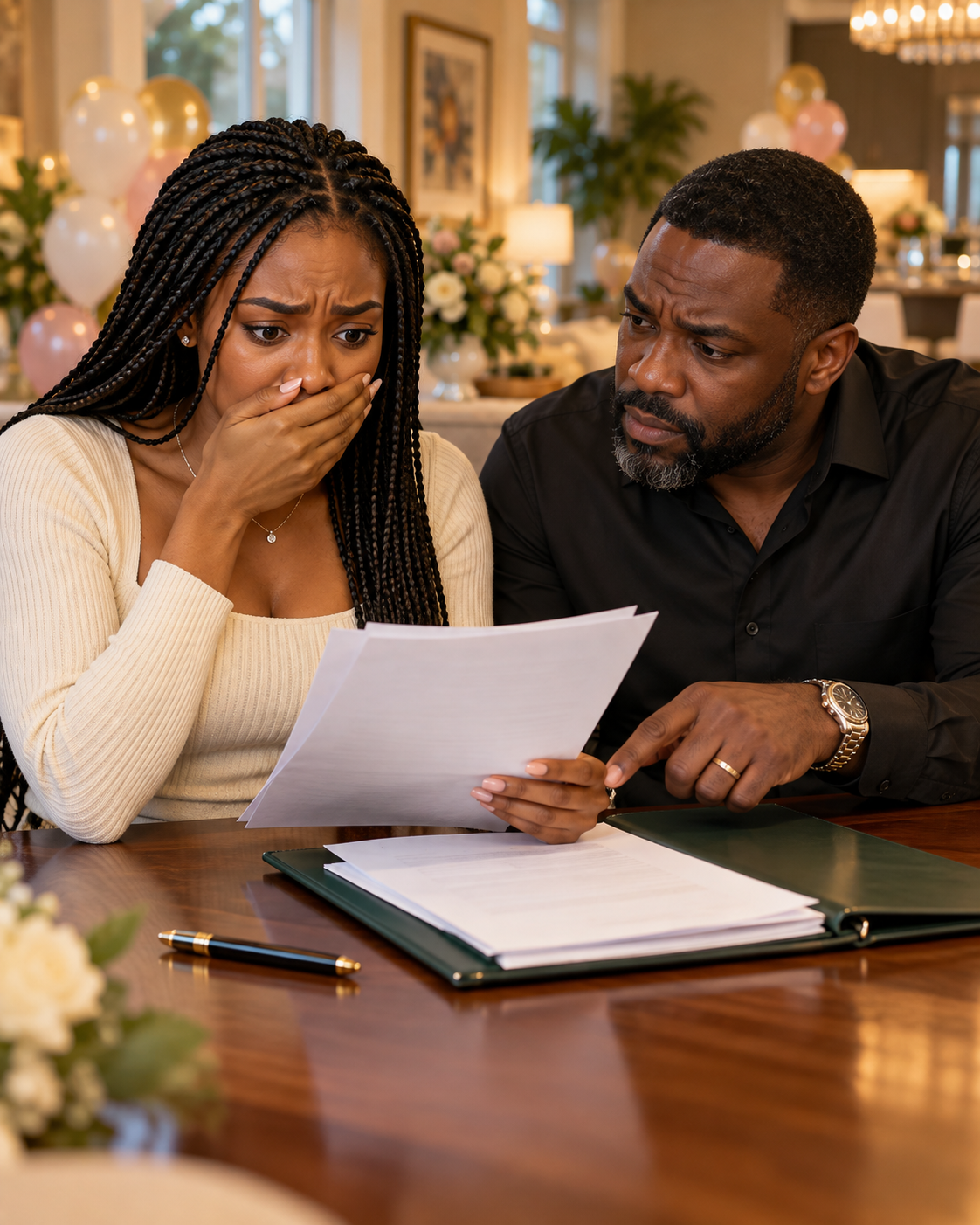
Richard denied everything.
Grandpa didn’t believe him.
The next page contained dates.
Amounts.
Account names.
One number was circled in red.
$760,000.
The discrepancy wasn’t new.
It had been growing for months.
My father hadn’t suddenly discovered a financial problem after my grandparents died.
He had already been trying to cover it.
I read faster.
Grandma wrote that they had moved my inheritance into an irrevocable trust specifically because they feared Richard might use family pressure to gain access.
She had hired Patricia Cole as an independent trustee and instructed her not to reveal the full size of the trust to me until I was legally able to understand and protect it.
Then came the sentence that made my chest tighten.
“Richard knows there is money, but he does not know how much.”
I leaned back in Grandpa’s chair.
The green envelope suddenly looked very different in my memory.
My parents had never been unusually affectionate because they were grieving.
They had been preparing.
I turned to the final page.
Grandma had written another warning.
“If Richard cannot control the trust, he may try to control the person who owns it.”
I closed my eyes.
The conservatorship petition suddenly made horrifying sense.
They had not needed to prove I was incapable because of grief.
They only needed to create enough doubt that someone else could make my decisions.
For the next several days, Lauren and Patricia worked with investigators to preserve every document.
The brass key opened a deposit box at a local bank.
Inside were copies of correspondence between Grandpa and a forensic accountant.
There were also recorded notes from meetings with Richard, including one where Grandpa said, “You will not use my granddaughter to solve your firm’s problem.”
My hands went cold when I read my father’s reply.
“She’ll do what family requires.”
Lauren looked up from the page.
“That sentence matters.”
“Why?”
“Because it shows this wasn’t simply about money.”
She tapped the document.
“It was about entitlement.”
The investigation expanded.
Regulators requested records from Vance Wealth Partners, and Patricia formally notified every institution connected to the trust that no request from Richard or Eleanor could override the trustee’s authority.
For the first time, I stopped wondering whether I had been unfair to my parents.
I began wondering how long they had been planning to make me doubt myself.
Then Megan called.
She sounded frightened.
“Dad wants me to sign something.”
My body went rigid.
“What kind of something?”
“He said it’s only for the business.”
“Don’t sign anything.”
There was silence.
“I knew you’d say that.”
“Where are you?”
“At home.”
“Go somewhere safe.”
Megan hesitated.
“He keeps saying you’re turning everyone against him.”
I closed my eyes.
“No, Megan.”
My voice softened.
“He did that himself.”
She came to the house that night with a backpack and tears on her face.
She was sixteen, still young enough to believe parents were supposed to be the safest people in the world.
I hugged her without asking for explanations.
After a while, she whispered, “Did you know Grandma was worried about Dad?”
“No.”
“She told me once that people can confuse being trusted with being entitled.”
I looked at her.
“Why didn’t you tell me?”
“I thought she was talking about business.”
Maybe Grandma had been talking about both.
The following morning, federal investigators interviewed us separately.
Megan told them about conversations she’d overheard between our parents, including a discussion about making sure I “looked unstable enough.”
She cried afterward.
I wanted to tell her none of this was her fault.
Instead, I said the simplest thing I knew was true.
“You never have to protect adults from the consequences of their choices.”
Weeks passed.
The case became increasingly difficult to keep private.
Our family name appeared in financial reports and court filings.
People who had once embraced my mother at church stopped returning her calls.
Some apologized.
Others insisted they had only been trying to help.
I learned not to spend energy deciding which was which.
My job was no longer to manage everybody’s opinion of me.
My job was to remain accurate.
That principle became the center of everything.
When investigators asked me what my father had said on a particular date, I gave them the exact message.
When they asked how my mother had behaved, I described what she did without guessing why.
I finally understood what Grandpa had meant about the fine print.
Truth did not need drama.
It needed detail.
One afternoon, Patricia asked me to accompany her to the bank because the trust required a new set of beneficiary confirmations.
As we waited, she said, “Your grandparents were very careful.”
I smiled sadly.
“They had reasons.”
“They did.”
She glanced at me.
“They were also proud of you.”
That broke something in me.
I looked down at my hands.
“I wish they could see me now.”
“They can.”
I almost smiled.
“You really believe that?”
“I think the things they taught you are still doing their work.”
The following morning, federal agents arrived on base.
They asked me to help explain the documents and timeline surrounding the trust and Vance Wealth Partners.
The deeper they looked, the clearer the pattern became.
Money had moved.
Stories had shifted.
And every time someone questioned Richard, the answer somehow became another version of the same thing.
I was too young.
I was too emotional.
I was confused.
I stared at the reports and realized how carefully my parents had built a world in which my objections could always be dismissed before they were heard.
Then Lauren found the missing piece.
A digital file from the firm’s internal records contained an email Richard had sent weeks before my grandparents died.
The subject line read, “Access at Majority.”
The body was only two sentences.
“She turns eighteen next fall.”
“We need the paperwork ready before then.”
I read it in silence.
There it was.
Not an accusation.
Not an interpretation.
A timestamp.
A sentence.
Evidence.
I finally understood why Grandpa had taught me to save dates.
Because memory can be challenged.
A document is harder to argue with.
The next court hearing concerned the regulatory action against my father’s firm.
Richard appeared with the same controlled expression he had worn at my birthday party.
For a second, I saw the father I remembered from childhood.
Then the feeling passed.
The proceedings were not about revenge.
They were about accountability.
The regulator presented transaction records, internal correspondence, and evidence that the firm had failed to properly account for client funds.
Richard’s attorneys challenged several findings.
Lauren responded with the paper trail.
The numbers aligned.
The dates aligned.
The messages aligned.
Eventually, Vance Wealth Partners was suspended while further disciplinary proceedings continued.
My father left the building without looking at me.
My mother followed him.
I watched them disappear through the courthouse doors and felt something unexpected.
Not triumph.
Grief.
Because there had been a version of my family I had loved.
I was grieving that version too.
Months later, I agreed to meet my parents again.
This time, the coffee shop was nearly empty.
My father looked smaller than I remembered.
His shoulders had curved forward, and the confidence he once wore like an expensive suit was gone.
My mother kept twisting her wedding ring.
Nobody spoke for several seconds.
Then Dad said, “I made mistakes.”
I looked at him.
“You did more than make mistakes.”
He swallowed.
“I know.”
“What did you think would happen?”
He stared at the table.
“I thought if I could fix the firm’s problem, everything else would settle down.”
“You were going to use my inheritance.”
“Yes.”
“And when I refused?”
He closed his eyes.
“We thought you weren’t thinking clearly.”
“No.”
I shook my head.
“You needed me not to think clearly.”
He looked at me then.
For the first time, I saw something in his face that wasn’t anger.
It was recognition.
Maybe he finally understood that the person he had dismissed as a grieving teenager had been paying attention the entire time.
My mother reached across the table.
I moved my hand away.
She stopped.
“I love you,” she whispered.
“I believe you.”
Her eyes filled.
“But love doesn’t give you ownership of me.”
She nodded slowly.
“And if we want to rebuild?”
“Then you start by respecting the boundaries you once tried to erase.”
There were no hugs.
No cinematic reconciliation.
Only a quiet agreement that contact would be limited and any future trust would have to be earned through consistency.
When I walked outside, Megan was waiting for me.
She had started college applications and was carrying a folder covered in sticky notes.
“How did it go?”
“Honestly?”
She nodded.
“It hurt.”
“Did you forgive them?”
I smiled faintly.
“That’s not the important question.”
“What is?”
“Did I protect myself?”
She thought about it.
“Yes.”
I squeezed her shoulder.
“Then it went well enough.”
The summer passed quietly.
I finished my first year of college with honors and started restoring the neglected vegetable beds behind the house.
Some plants survived.
Others didn’t.
Grandma had warned me that gardening was not about forcing everything to grow.
It was about learning what the soil could support and giving healthy things enough room.
One Saturday morning, I found myself standing beside the old stone bench again.
I had nearly forgotten about the brass key.
I kept it in the wooden box with Grandpa’s notes.
As I turned to leave, I noticed something scratched into the underside of the bench.
A date.
The same date as one of the ledger entries.
Below it were two initials.
A.C.
Arthur and Clara.
I ran my fingers over the letters.
Maybe they had left me one final lesson.
Not every warning arrives as a document.
Sometimes it is a habit.
A question.
A pause before signing.
A refusal to accept someone’s version of you simply because they say it with confidence.
That autumn, I planted a new garden.
No hidden tins.
No secret ledgers.
Just tomatoes, basil, lavender, and the old roses Grandma loved.
One afternoon, I received an email from Patricia.
The subject line read, “Final Trust Review.”
My heart skipped.
The attachment confirmed that the trust remained intact and that future distributions would occur according to the terms my grandparents had established.
At the bottom of the message was a personal note.
“Your grandparents wanted you to inherit more than money.”
I stared at the words.
Then I looked through the window at the garden.
They had left me a home.
An education.
A financial foundation.
But more than anything, they had left me the ability to question what looked obvious.
Years earlier, I had thought that lesson was about contracts.
Then I thought it was about money.
Now I knew it was about people.
The most dangerous forms of control rarely announce themselves as control.
They arrive wearing concern.
They sound like love.
They say, “Trust me.”
And sometimes, the bravest thing a person can do is answer, “I will, but I will also read the fine print.”
I kept my grandparents’ house.
I kept their garden.
I kept the little brass key.
But I did not keep the fear my parents had tried to plant inside me.
On the first cold evening of November, I sat on the porch with Grandma’s old blanket around my shoulders and watched the garden disappear into dusk.
Megan called from college.
Patricia emailed another routine update.
My classes waited upstairs.
My future was no longer something other people were negotiating over a kitchen table.
It belonged to me.
Before going inside, I walked to the garden and pressed my palm against the soil.
The roots were hidden.
The work beneath the surface was invisible.
But that was where everything important happened.
I finally understood why Arthur and Clara had spent so many years teaching me to look beneath appearances.
They weren’t teaching me to distrust everyone.
They were teaching me to trust myself enough to look closer.
The next morning, I waited until sunrise before touching the roses.
I brought a small shovel, Grandpa’s brass key tucked safely in my coat pocket, and Grandma’s gardening gloves folded beneath my arm.
The soil was cold enough to sting my fingers.
At first, I found nothing.
Then the shovel struck wood.
My heart began beating faster.
I cleared the dirt carefully until a narrow cedar box appeared beneath the roots.
There was no lock.
Inside were photographs, a worn fountain pen, and a final letter.
The handwriting was Arthur’s this time.
“If you have reached this point, you have already learned the lesson we hoped to give you.”
I sat down in the dirt.
He wrote that he and Clara had spent their lives building things that could outlast them, but they knew money could disappear and houses could be sold.
“What cannot be taken from you easily,” he wrote, “is the habit of thinking for yourself.”
I wiped my eyes.
Then came the line I had never known I needed.
“You are not difficult because you ask questions.”
I stopped reading.
For years, my parents had called my questions disrespectful.
My father had called my boundaries selfish.
My mother had called my grief instability.
But my grandparents had understood something none of them did.
A questioning mind was not a rebellious mind.
It was a living one.
Arthur’s final paragraph was about choice.
“If someone loves you, they may advise you, worry about you, even disagree with you, but they should never need you helpless in order to feel safe.”
I held the letter against my chest.
That was the inheritance.
Not the $3.15 million.
Not the brick house.
Not the trust that had survived every attempt to control it.
It was the permission to remain fully myself.
I called Megan and read the letter to her over the phone.
When I finished, she was quiet.
Then she said, “Grandpa would have liked you angry.”
I laughed through my tears.
“He probably would have.”
“No,” she said softly.
“He would have liked you free.”
That afternoon, I placed the letter in a frame beside the kitchen window.
The light fell across Arthur’s handwriting while the garden moved gently outside.
For the first time, the house did not feel like a monument to people I had lost.
It felt like a place that had successfully handed their values forward.
I understood then that rebuilding a life was not about pretending nothing had happened.
It was about refusing to let what happened decide who you became.
I still remembered the green envelope.
I still remembered my father’s voice demanding my signature.
I still remembered standing in that courtroom while strangers discussed whether I was capable of directing my own future.
Those memories would never become beautiful.
They didn’t need to.
They had already become useful.
Whenever I signed a contract now, I read every page.
Whenever someone told me something was “just routine,” I slowed down.
Whenever someone tried to define me by my worst day, I remembered that people who truly loved me had seen much farther than that.
And whenever fear told me that speaking up would make me difficult, I thought of a garden.
Roots were rarely visible.
But they were the reason anything survived.
Years later, people would probably remember the headlines about the firm, the court case, and the inheritance.
They might even remember the family that tried to turn grief into a legal argument.
I would remember something smaller.
A teenage girl sitting at her grandparents’ kitchen table while an old man pushed a contract toward her and said, “Read it twice.”
Back then, I thought he was teaching me how to protect my money.
Now I knew he had been teaching me how to protect my voice.
I closed the garden gate that evening and looked back at the house.
The windows glowed warmly.
My grandparents were gone.
My parents were no longer the center of my world.
My sister had found her own courage.
And I was standing in the life I had chosen, not the life someone else had drafted for me.
I carried the old brass key upstairs and placed it beside my college acceptance letter.
Two small pieces of metal and paper.
One opened a hidden box.
The other opened a future.
Both reminded me of the same thing.
The surface is never the whole story.
Sometimes the fine print is where the truth is waiting.
Sometimes the roots are where the strength is growing.
And sometimes, the most important signature you will ever make is the quiet decision to belong to yourself.