At my mother’s driveway, my nine-year-old son Julian stood waving as my sister shut the minivan door
I froze with the phone against my ear.
“What does that mean?”
Brenda inhaled sharply.
“It means you don’t know everything.”
Then she hung up.
I stood in my kitchen staring at the blank screen.
The house was quiet except for the refrigerator humming behind me.
Julian was at school.
My coffee had gone cold.
For nearly a year, I had believed I was helping my sister keep her family afloat.
Now I wondered whether I had been paying for something completely different.
I called back.
She didn’t answer.
I called Mom.
She answered immediately.
“You’ve made your point.”
“I want to know what Brenda meant.”
“She’s upset.”
“Mom, what was she talking about?”
There was a long pause.
Then she said, “You should talk to your sister.”
“I’ve been trying.”
“Give her time.”
I nearly laughed.
For years, “give her time” had meant “don’t make Brenda uncomfortable.”
It had meant I should be patient when Brenda forgot birthdays, patient when she borrowed money, patient when she expected favors, and patient when she made my son feel like an inconvenience.
I was done being patient at my own expense.
That afternoon, Brenda finally called.
Her voice sounded different.
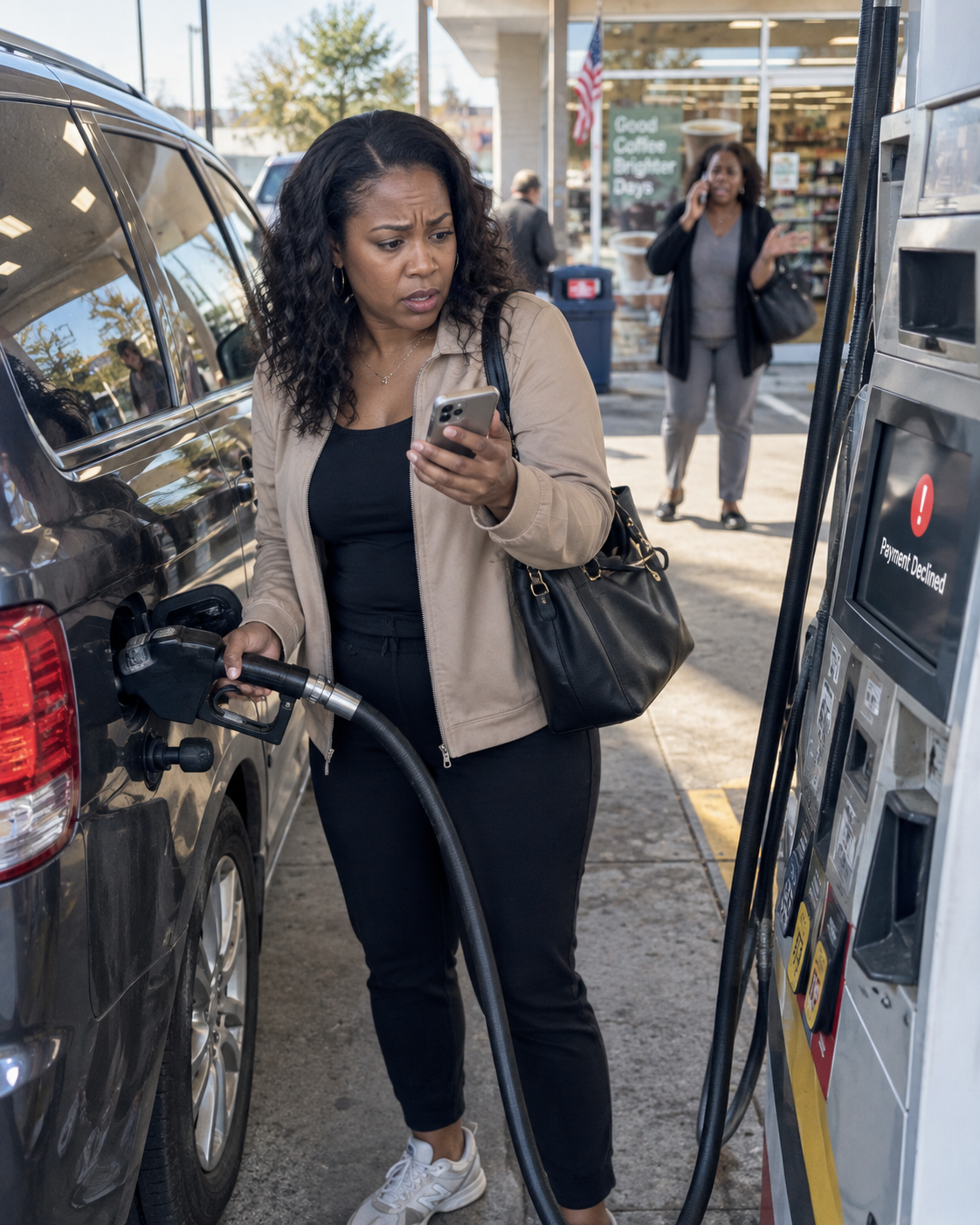
Not angry.
Cornered.
“I owe you an explanation.”
“Yes, you do.”
She hesitated.
“Some of those charges weren’t mine.”
I sat down.
“What?”
“My husband had access to the card.”
“Brenda, the card was issued under my name.”
“I know.”
“You told me only you used it.”
“I know.”
My stomach tightened.
She admitted that her husband, Mark, had occasionally taken the vehicle and used the card.
I asked how occasionally.
She didn’t answer.
“Brenda.”
“More than I said.”
“How much more?”
“I don’t know.”
I closed my eyes.
I had never liked Mark.
He was charming in public and evasive in private.
Whenever he saw me, he talked about how generous I was.
He had once slapped my shoulder at Christmas and said, “You always come through.”
At the time, I thought it was gratitude.
Now it sounded like entitlement.
I asked Brenda to send me the complete statements.
She did.
I spent two hours going through every transaction.
There were dozens of charges I couldn’t explain.
Premium car washes.
Restaurant purchases miles from their house.
Expensive snacks.
Two purchases from a sporting-goods store.
One late-night charge at a convenience store nearly an hour away.
Then I saw a charge that made me stop.
It was for a hotel.
The amount was $187.
I checked the date.
It was the same weekend Brenda had told me their minivan needed emergency repairs and she couldn’t afford a hotel for the kids.
I called her.
“Why was your card used at a hotel?”
Silence.
“Brenda?”
“I told you, Mark used it.”
“Why?”
“I don’t know.”
“You absolutely know.”
She began crying.
“I didn’t want to tell you.”
“Tell me now.”
She took a breath.
“Mark lost his job.”
I looked at the statement again.
“How long?”
“Almost eight months.”
Everything suddenly clicked.
The overdue utility conversations.
The requests for grocery money.
The constant complaints about gas prices.
The reason she had been driving so much.
The reason my card had become their invisible safety net.
But there was still something that didn’t fit.
“Why didn’t you tell me?”
“Because I knew you’d judge him.”
“I would have helped you.”
“I know.”
“Then why lie?”
She started crying harder.
“Because once you start helping someone, it never stops.”
Those words hurt more than I expected.
Because she wasn’t talking about me being generous.
She was talking about me being useful.
For a long time, I had mistaken being needed for being loved.
I asked about the water park.
Her voice became small.
“I was embarrassed.”
“About what?”
“We couldn’t afford the day.”
I said nothing.
She continued.
“I knew we couldn’t afford the tickets, food, parking, everything.”
“So you made room for the coolers instead.”
“I thought Julian would understand.”
“He did.”
There was a pause.
“He shouldn’t have had to.”
“No,” she whispered.
“He shouldn’t have.”
I could have ended the call there.
Instead, I asked the question I had been carrying since Saturday.
“Why did Mom say nothing?”
Brenda sighed.
“Because Mom thought you’d just pay for everything anyway.”
I stared at the wall.
For a moment, I couldn’t hear anything.
The hardest part wasn’t the six hundred dollars.
It wasn’t the hotel.
It wasn’t even the lie.
It was realizing my family had quietly built an expectation around my generosity.
They had turned my help into a permanent obligation.
And somewhere along the way, nobody noticed what that taught Julian.
That he could be excluded because his mother would always absorb the pain.
That he could be left behind because someone else would make it right later.
I refused to let him learn that lesson.
That evening, I picked him up from school.
He ran toward the car with a drawing in his hand.
“I made this for you.”
It was a picture of us at the water park.
Two stick figures beneath a giant blue slide.
Above us, he had drawn a bright yellow sun.
“What’s this?” I asked, pointing to a crooked square.
“Our special chair.”
He grinned.
“I put you in the shade because you always say the sun gives you headaches.”
I laughed.
“I never knew you remembered that.”
“I remember everything.”
Those four words stayed with me.
Children remember everything adults think they won’t.
They remember who showed up.
Who didn’t.
Who made excuses.
Who made space.
Who looked away.
A few days later, Brenda came to my house alone.
She looked exhausted.
Her hair was tied back carelessly.
She had no makeup on.
For the first time in years, she didn’t look like someone trying to convince everyone that she had everything under control.
She stood on the porch.
“Can I come in?”
I nodded.
She sat at the kitchen island.
The same island where we had spent years discussing money, groceries, family emergencies, and favors.
“I canceled my premium car wash,” she said.
I almost smiled.
“Good.”
“I’m selling some things.”
“Good.”
“I cut our streaming subscriptions.”
“Good.”
She looked at me.
“You really aren’t going to rescue me.”
“No.”
Her eyes filled with tears.
“I hate that you’re teaching me this.”
“I’m not teaching you how to struggle.”
“Then what are you teaching me?”
“That you can struggle without making someone else responsible for your life.”
She looked down.
“I deserved that.”
I shook my head.
“This isn’t about deserving punishment.”
“Then what is it about?”
“Boundaries.”
She nodded slowly.
“I don’t know how to have those with family.”
“Neither did I.”
We sat in silence.
Then she whispered, “I’m sorry about Julian.”
That was the first apology that mattered.
Not because it erased Saturday.
Because she finally understood why Saturday had hurt.
“He thought there wasn’t enough room for him,” I said.
“There was.”
“I know.”
Brenda cried.
“I was so focused on making the day work that I forgot he was a child.”
I looked at her.
“No, you remembered.”
She frowned.
“You just decided he could be the thing sacrificed.”
She covered her face.
“I know.”
It was the first time I had ever heard Brenda admit the truth without an excuse attached.
But there was still Mom.
I wasn’t ready to forgive her.
A week later, she called and asked to meet.
We sat at a small cafe near my work.
She looked older than I remembered.
“I owe you an apology too.”
I folded my hands.
“Okay.”
“I should have said something that morning.”
“Yes.”
“I should have told Brenda to move the cooler.”
“Yes.”
She nodded.
“I thought if I defended Julian, Brenda would explode.”
“So you let him be the one who felt unwanted.”
Her eyes lowered.
“Yes.”
I didn’t raise my voice.
I didn’t need to.
“Mom, he looked through that window and waved at you.”
“I know.”
“He was trying to be polite while you watched him get left behind.”
“I know.”
“That is the part I can’t forget.”
She wiped her cheek.
“I’ll never forget it either.”
For a long time, neither of us spoke.
Then Mom said something unexpected.
“I think I’ve spent too many years protecting Brenda from consequences.”
I looked at her.
“Why?”
“Because she always seemed more fragile.”
“And me?”
She swallowed.
“I thought you would be okay.”
There it was.
The sentence so many strong daughters hear without anyone realizing how cruel it is.
Because you’re responsible, you get less tenderness.
Because you cope, you get fewer chances to fall apart.
Because you can handle it, everyone assumes you should.
I reached across the table.
“Being okay doesn’t mean I don’t get hurt.”
Mom nodded.
“I know.”
For the first time, I believed she did.
That night, Brenda sent me a screenshot.
She had built a monthly budget.
Every expense was listed.
Gas.
Insurance.
Groceries.
School.
Debt.
Nothing was hidden.
At the bottom, she had written one sentence.
“We need to live on what we actually have.”
I saved the screenshot.
Not because I wanted proof.
Because I wanted to remember the moment the cycle finally cracked.
A month later, she told me Mark had found temporary work.
It wasn’t glamorous.
It wasn’t enough to restore their old lifestyle.
But it was honest.
She said they were learning to live without pretending they could afford things they couldn’t.
I told her I was proud of her.
And I meant it.
I didn’t give her money.
That mattered too.
Our relationship began changing slowly.
Not back to what it had been.
Something healthier.
Brenda stopped asking for emergency transfers.
She started paying her own fuel costs.
She began planning ahead.
And every few weeks, Julian and her children spent time together.
The first time they all met for lunch after the water park, Brenda arrived early.
She had brought extra food.
She looked at Julian and smiled.
“I saved you the good chips.”
Julian laughed.
“Thanks.”
He didn’t know the history behind that sentence.
He just knew she had made room.
That was enough.
Months passed.
The water park became a story we occasionally joked about.
But I never forgot it.
One Saturday, I found Julian sitting on the porch with his backpack packed again.
“Where are you going?”
He grinned.
“Brenda said we’re all going to the lake.”
I stared at him.
“She said she reserved a whole picnic shelter.”
I smiled.
“And did she make room?”
He nodded.
“She said there’s room for everybody.”
Something in my chest loosened.
Not because the past had disappeared.
Because I could finally see the future changing.
Then Julian handed me an envelope.
“What’s this?”
“It’s for you.”
Inside was a handwritten card.
The letters were uneven.
“Thank you for never making me feel like I’m too much.”
I had to look away.
He watched me carefully.
“Are you crying?”
“Maybe.”
“Happy crying?”
I nodded.
“The best kind.”
That night, after everyone left, I sat alone on the porch and thought about the four hundred and fifty dollars I had spent that first day.
For a while, I had thought it was too much.
Maybe it was.
But some purchases aren’t really about the price.
Sometimes you pay to give your child a memory that doesn’t include rejection.
Sometimes you spend money once so you can stop spending your dignity forever.
I still keep the old fuel card in the back of a drawer.
It doesn’t work.
I kept it because it reminds me of something I never want to forget.
Generosity without boundaries can quietly become self-abandonment.
Love doesn’t require you to finance people who refuse to respect you.
And family is not the person who simply shares your last name.
Family is the person who makes room when they see you coming.
A year after the water park, Brenda invited us on another family trip.
This time, she had planned everything herself.
She paid for her own tickets.
She packed her own cooler.
And when Julian walked toward her car, she opened the door before he could ask.
“Middle row is yours.”
He climbed in.
Then he turned around and called to me.
“Mom, there’s plenty of room.”
I smiled.
“I can see that.”
I watched them drive away and felt no fear.
Because this time, I wasn’t wondering whether someone would leave space for my son.
I already knew.
And just when I thought that old chapter had finally closed, my phone buzzed with a message from Mom.
It contained a photograph from that first water park morning.
The one I never knew she had taken.
Julian stood alone on the driveway, waving as the minivan pulled away.
Under the photo, Mom had written only six words.
“I wish I’d stopped her then.”
I stared at the picture for a long time.
Some wounds don’t disappear when people apologize.
They become reminders of what we will never permit again.
I saved the photograph.
Then I closed my phone and went inside.
Julian was laughing in the kitchen.
The sound filled the house.
And for the first time, I understood that the greatest thing I had given him wasn’t a VIP wristband, a shaded chair, or an expensive day at a water park.
It was the certainty that when the world told him he didn’t fit, his mother would never teach him to beg for a seat.
She would teach him to build a life where there was always room for him.