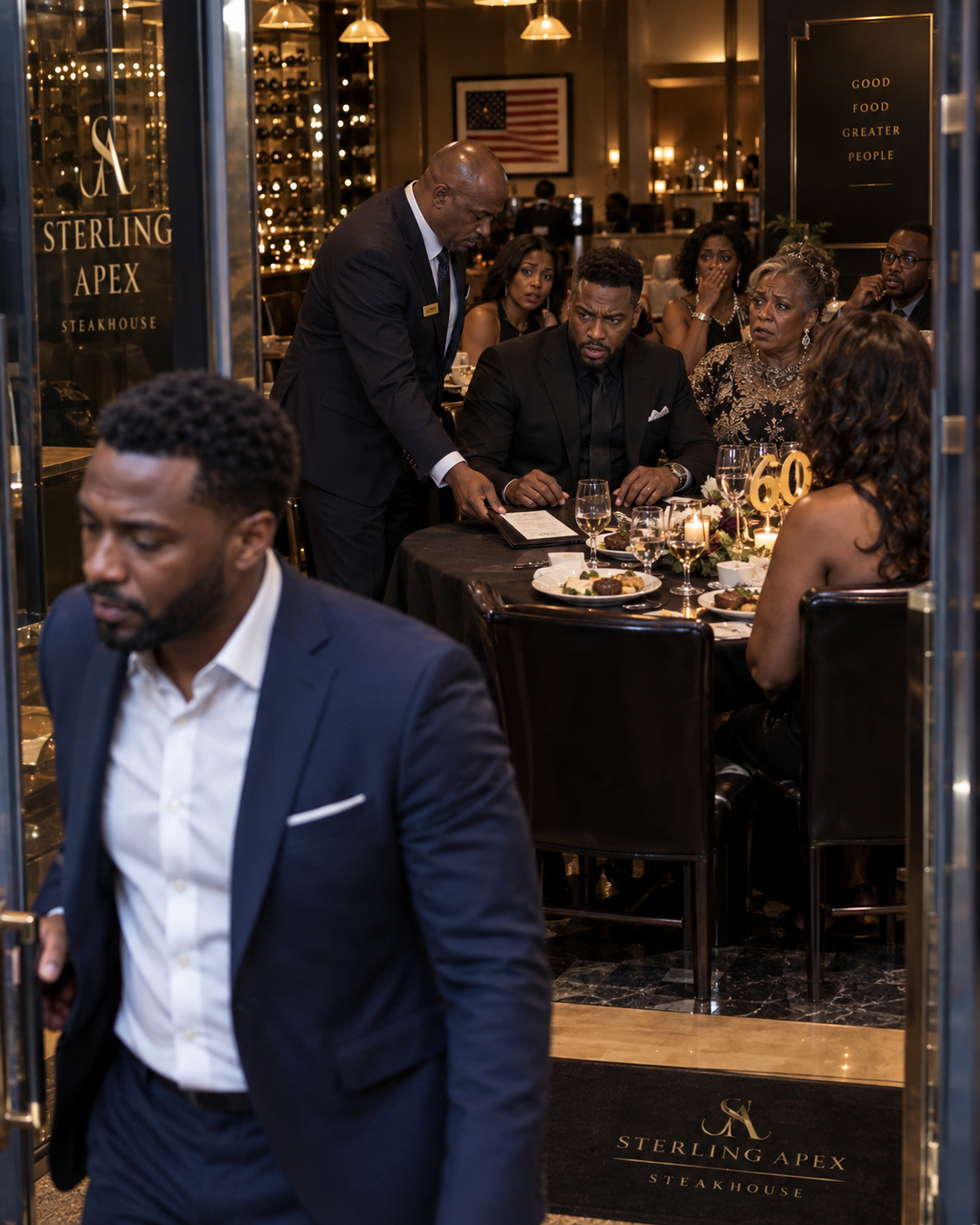
At my mother’s 60th birthday dinner at Sterling Apex, my brother shoved the premium beef menu away from me
Holden’s voice was low when I answered.
“Please don’t leave yet.”
I stopped beside my car.
“Why?”
“Because I think you should know what he left here.”
I went back inside.
Sterling Apex had become strangely quiet, as though the building itself had witnessed enough.
Holden led me toward a private office near the service corridor.
On the desk was a thick manila folder.
My name was written across it in black ink.
I looked at Holden.
“I didn’t put that there.”
“I know.”
He opened the folder.
The first thing I saw was a printed event proposal.
The second was a list of upgrades Bronson had requested.
The third was a handwritten note that made my stomach tighten.
“Use her card for the final settlement.”
Below it was my full name.
I looked closer.
There was another sentence.
“She won’t make a scene because Mom’s birthday matters more to her.”
For a few seconds, I couldn’t breathe.
Bronson had known.
He had known I was paying.
He had counted on my silence.
He had built the entire humiliation around the fact that I loved our mother enough to absorb it.
Holden handed me another page.
It was an email Bronson had sent to the restaurant weeks earlier.
He had written that he was organizing the event on a limited personal budget and that his sister would “handle the family contribution privately.”
I closed my eyes.
This wasn’t a misunderstanding.
It was planned.
The insult at the table wasn’t spontaneous cruelty.
It was the final step in a performance he had rehearsed long before he raised his glass.
I looked at Holden.
“Did he leave this here?”
“Apparently by mistake.”
“Thank you.”
He nodded.
As I walked back toward the lobby, I saw my family gathered near the elevators.
Bronson was arguing with the manager.
Mom stood beside him, pale and furious.
Aunt Denise was holding the bill like it was evidence from a crime scene.
Bronson spotted me.
“You did this?”
His voice echoed through the lobby.
I stopped.
“I canceled my card.”
“You can’t just do that.”
“I can.”
“You promised to cover tonight.”
I stared at him.
“I promised Mom a birthday gift.”
A strange silence followed.
Bronson looked at Holden.
“Tell her the payment has already been processed.”
Holden shook his head.
“Only the deposit was captured.”
“And the rest?”
“The remaining balance is your responsibility.”
Bronson looked at the bill.
The number seemed to swallow him whole.
The amount on the page was $13,200.
His face lost what little color remained.
Mom finally turned toward me.
“You were paying for this?”
I didn’t answer immediately.
I wanted to see whether she looked ashamed.
She did.
But shame couldn’t erase what had already happened.
“I authorized the card because I wanted you to have one perfect night.”
Her lips parted.
“Why didn’t you tell me?”
“Because I didn’t want money to be the center of it.”
Bronson laughed bitterly.
“You wanted to make me look bad.”
I looked at him.
“You managed that without my help.”
Nobody spoke.
Then Aunt Denise slowly lowered the bill.
“Bronson, what exactly did you tell us?”
He didn’t answer.
Mom did.
“He said he was paying.”
Bronson’s jaw tightened.
“I was going to.”
“With whose money?” I asked.
His eyes flashed.
“That’s none of your business.”
“It became my business when you used my card without telling me.”
He stepped toward me.
“You always do this.”
“Do what?”
“Make me feel small.”
I almost laughed.
“Tonight was your attempt to make me feel small.”
His expression hardened.
Then Mom spoke.
“Enough.”
We both turned toward her.
She looked older than she had an hour earlier.
Not sixty.
Much older.
She stared at the bill in her hands.
“How much of this did you create?”
Bronson looked away.
No answer.
The manager explained the charges.
The private room extension.
The wine upgrade.
The premium cuts.
The specialty dessert course.
The additional service package.
Every unnecessary expense had been approved by Bronson.
Mom looked at him.
“Why would you do this?”
“I wanted everything to be perfect.”
“You wanted everyone to think you paid.”
His silence answered her.
That night ended without the birthday toast anyone had planned.
People left in small groups.
Nobody hugged Bronson goodbye.
I went home alone.
I expected relief.
Instead, I sat on the edge of my bed and cried harder than I had cried in years.
Not because of the money.
Because I finally understood how deeply I had been erased.
Bronson hadn’t simply stolen credit.
He had convinced himself that my generosity was something he could use against me.
The next morning, Mom called.
I almost didn’t answer.
“Can I come over?”
I hesitated.
“Yes.”
She arrived carrying a small paper bag.
Inside was the blue dress she had worn the night before.
She had folded it carefully.
“I thought you might want this.”
I frowned.
“Why?”
“Because I don’t deserve to keep wearing the dress you bought me for a night I helped ruin.”
I sat down.
Mom lowered herself into the chair across from me.
“I need to tell you something.”
There was a tremor in her voice.
“I knew Bronson was in trouble.”
I said nothing.
“He has been borrowing against properties.”
That explained the strange calls.
The late-night whispers.
The constant talk about refinancing.
“He has three investment properties,” Mom continued.
“Two are underwater.”
I stared at her.
“How long have you known?”
“Almost a year.”
“And you still let him present himself as the provider?”
She looked down.
“I kept thinking he would fix it.”
“Like Dad?”
Her eyes filled.
That question landed where neither of us wanted it to.
Dad had always favored Bronson.
When Bronson broke something, Dad called it a mistake.
When I succeeded, Dad called it luck.
When Bronson needed money, Dad called it family.
When I needed recognition, Dad called it competition.
After Dad died, Mom inherited more than the house.
She inherited the habit of protecting Bronson from consequences.
“I thought I was keeping the family together,” she whispered.
“You were keeping Bronson comfortable.”
She began to cry.
I didn’t hug her immediately.
That was new for me.
For most of my life, I had rushed to comfort everyone else before they had earned the comfort.
This time, I let the silence exist.
Finally, I said, “I love you, Mom.”
She looked up.
“But I won’t keep paying the price for someone else’s choices.”
She nodded through her tears.
“You’re right.”
A week later, Bronson sent me a message.
“We need to talk.”
I ignored it.
Another arrived.
“You can’t abandon family over one bad night.”
That one I answered.
“You didn’t abandon family over one bad night.”
I stared at the screen.
“You built the night.”
He didn’t reply.
Three days passed.
Then I received a formal letter from an attorney.
Bronson claimed the birthday expense had been agreed upon as a family contribution.
He demanded reimbursement for the deposit and alleged that my withdrawal had embarrassed him professionally.
I handed the letter to my attorney.
A few hours later, we responded with the documents Holden had given me.
The restaurant records.
The emails.
The authorization history.
The handwritten note.
Everything.
Bronson’s legal argument collapsed almost immediately.
But he still wasn’t finished.
Two weeks later, he appeared at Mom’s house.
I was already there.
He came through the front door and looked at both of us.
“You have no idea what you’ve done.”
Mom stood.
“No, Bronson.”
“I was trying to save the family.”
“No.”
Her voice was quiet.
“You were trying to save yourself.”
He looked at me.
“You’ve always wanted everyone to choose you.”
I felt something settle inside me.
“I don’t need anyone to choose me.”
“That’s a lie.”
“No.”
I shook my head.
“For the first time, I don’t.”
That seemed to frighten him more than anger would have.
He started pacing.
“I lost a contract because of this.”
I frowned.
“What contract?”
He stopped.
Then I understood.
The birthday dinner wasn’t only about family.
He had invited two business associates who had been considering investing in one of his properties.
The extravagant evening was supposed to make him look successful.
When the payment collapsed at the table, one of them left before dessert.
The other sent him a message that simply said, “We need to reconsider.”
His financial problems weren’t mine.
But the consequences had finally become visible.
Mom sat down.
“You lied to everyone.”
Bronson’s voice cracked.
“I was scared.”
That was the first honest thing he had said.
He admitted the properties were in danger.
He admitted he had borrowed money to keep one investment afloat.
He admitted he thought if he looked successful long enough, eventually he would become successful again.
And then he looked at me.
“I knew you would cover it.”
I stared at him.
“That’s the part you need to understand.”
He waited.
“I covered things because I loved you.”
His eyes lowered.
“You treated that love like a resource.”
He didn’t deny it.
Mom began to cry.
Bronson looked toward her.
“I didn’t know how to stop.”
Mom whispered, “You stop by telling the truth.”
For once, nobody rescued him.
No one offered money.
No one called a lender.
No one suggested selling someone else’s property.
He had to face his own numbers.
His own decisions.
His own life.
It took months.
He sold one property.
Then another.
He moved into a smaller house.
He stopped attending family gatherings unless Mom personally invited him.
He began repaying people slowly.
Not because someone threatened him.
Because there was finally nobody left to blame.
Our relationship didn’t return to what it had been.
Maybe that was the healthiest thing that could have happened.
There were apologies.
There were uncomfortable conversations.
There were long stretches of silence.
But there were no more performances.
One Sunday afternoon, almost a year after Mom’s birthday, I found her sitting on the back porch.
She handed me an envelope.
Inside was a photograph from the dinner.
Not the family photograph Bronson had posted.
A different one.
It showed Mom sitting beneath the candlelight, smiling before anything went wrong.
I stared at it.
“You were happy there,” I said.
“I was.”
She smiled sadly.
“Until I realized you were the one who had made that moment possible.”
I looked at the photo again.
“I wanted that smile for you.”
“I know.”
She reached for my hand.
“I should have protected it.”
We sat there quietly.
For once, silence didn’t mean someone was being ignored.
It meant nobody had anything left to prove.
Later that evening, Bronson arrived at the gate.
He stayed outside.
He didn’t come in until Mom invited him.
He carried a small box.
“I brought something for you.”
Mom opened it.
Inside was the watch Dad had given him when he graduated.
He set it on the table.
“I sold the last property.”
Mom looked at him.
“And this?”
“I kept it because I thought it proved I was Dad’s son.”
His voice shook.
“Now I think I just need to stop trying to be him.”
No one knew what to say.
Mom reached for his hand.
I watched them.
I didn’t feel forgiveness.
Not yet.
But I felt something I hadn’t expected.
Possibility.
Not the possibility that we would become the family we once pretended to be.
The possibility that we could become something more honest.
That night, after everyone had gone, I stood alone in my kitchen.
I remembered the restaurant.
The silverware.
The laughter.
The way Bronson had looked at me when he said I hadn’t paid a dime.
For years, I had believed being generous meant staying quiet.
I had believed love meant absorbing disrespect so someone else could remain comfortable.
I had believed family meant enduring anything as long as nobody walked away.
I was wrong.
Love without boundaries becomes permission.
Generosity without respect becomes expectation.
And family without accountability becomes a place where the loudest person can keep rewriting the truth.
I didn’t regret the $2,000 deposit.
It had bought me something worth more than the money.
Clarity.
I had spent years trying to prove that I belonged at our family table.
That night, I finally realized I never needed permission to sit there.
I only needed the courage to leave when the table became cruel.
Months later, Mom turned sixty-one.
There was no exclusive restaurant.
No twelve-course menu.
No dramatic toast.
She asked for pizza, homemade cake, and the people who made her feel safe.
Bronson showed up early.
He carried the cake.
I carried the plates.
Mom looked around the small backyard and smiled.
This time, she knew exactly who had given her the gift.
But as we sat beneath the string lights that evening, she reached into her purse and pulled out one final envelope.
She handed it to me.
“I found this in your father’s desk,” she said.
I opened it slowly.
It contained a note dated years before Bronson’s debts, years before the birthday dinner, years before I understood how deeply our family had been shaped by silence.
I read the first line.
Then I looked up at Mom.
She was already crying.
Because the note explained something neither of us had ever understood about why Dad chose Bronson over me.
And suddenly, I knew our family’s oldest secret had not started with my brother at all.
It had started long before him.
And for the first time, I was ready to read every word.