At my mother-in-law’s Saturday dinner, Chloe held up the fifteen pounds of snow crab legs I had bought and laughed
Part 2
The next morning, Justin and I sat at our kitchen table with two untouched cups of coffee between us.
Sunlight came through the blinds in narrow stripes.
Neither of us wanted to have another conversation about his family.
But we both knew we needed to.
“I don’t want you to stop loving them,” I said.
“I don’t want that either.”
“I just don’t want loving them to require me to disappear.”
Justin nodded.
“So what happens next?”
“We decide what we will and won’t accept.”
He took a breath.
“If my mom criticizes something you bring, I’ll address it.”
“If Chloe makes another joke at my expense, I won’t laugh along.”
“And if they push?”
“We leave.”
He looked at me.
“Together.”
That word mattered.
Together.
Not me alone in a kitchen trying to defend myself.
Not him standing between us and telling me to ignore it.
Together.
Three days later, Martha called.
Justin answered.
I was sitting across from him and could hear only his side of the conversation.
“No, Mom.”
A pause.
“No, she didn’t embarrass you.”
Another pause.
“She brought food.”
He rubbed his forehead.
“Food that she paid for herself.”
Another pause.
Then his voice became quieter.
“Mom, this isn’t about crab.”
I watched his expression change.
He was finally saying out loud what I had been afraid to say for years.
“It’s about how you talk to her.”
When he hung up, he sat there for a while.
“She wants to talk.”
I felt my stomach tighten.
“With both of us?”
“Yes.”
I wasn’t sure I was ready.
But I said yes.
We met at Martha’s house the following Sunday afternoon.
Chloe wasn’t there.
That surprised me.
Martha sat across from us at the dining table.
There was no elaborate meal.
No polished centerpiece.
Just three glasses of iced tea.
For some reason, that made the conversation feel more serious.
Martha folded her hands.
“I’ve been thinking about what happened.”
I said nothing.
She looked at me.
“I owe you an apology.”
My chest tightened.
I had imagined hearing those words so many times that I had forgotten what they might actually feel like.
Martha continued.
“I’ve been calling everything standards.”
She swallowed.
“But I think sometimes I’ve been using standards as an excuse to criticize people.”
Justin leaned back.
“Mom…”
She shook her head.
“No, let me finish.”
She looked at me.
“My mother was like that.”
Her voice changed.
“Nothing I did was ever enough.”
She told us about growing up in a house where compliments were rare and mistakes were remembered.
A crooked hem.
A burned dinner.
A bad grade.
A cheap dress.
A party that wasn’t elegant enough.
“She taught me that if you criticize first, people can’t criticize you.”
Martha gave a small, embarrassed laugh.
“It took me a long time to realize that wasn’t perfection.”
She looked down.
“That was fear.”
I didn’t excuse what she had done.
Understanding someone doesn’t erase the damage they caused.
But for the first time, I could see the person beneath the behavior.
I could see how pain had traveled through a family without anyone stopping to name it.
“Why did you do it to me?” I asked.
She looked directly at me.
“Because you were close.”
That answer stunned me.
She continued.
“And because I thought you were strong enough to take it.”
My eyes burned.
“That doesn’t make it okay.”
“I know.”
She nodded.
“It doesn’t.”
Justin reached for my hand under the table.
Martha noticed.
“I’m not asking you to forget seven years,” she said.
“I’m asking if I can start doing better.”
I took a slow breath.
“You can.”
She nodded.
“But if you want this to change, it has to be different when nobody is watching.”
“I understand.”
We left without hugging.
There was no dramatic reconciliation.
No instant forgiveness.
Just a door that had been locked for years, opened a few inches.
For the next several weeks, I watched.
Not suspiciously.
Carefully.
Martha didn’t suddenly become a different person.
She still corrected things sometimes.
She still had opinions.
But when she caught herself, she stopped.
Once, she tasted a dish I brought and began to say, “It could use…”
Then she paused.
She smiled.
“Actually, it’s good.”
I laughed.
She laughed too.
It was awkward.
But it was real.
Chloe took longer.
She didn’t apologize right away.
She became quieter around me.
I didn’t chase her.
I had spent enough years chasing approval.
Instead, I let time do what arguments never could.
Then, six weeks after the crab incident, my mother called me on a Saturday morning.
“Someone is outside.”
“Who?”
She laughed.
“You’d better come see.”
I stepped onto the porch.
Martha was standing beside her car.
There was a cooler in her hands.
She looked almost nervous.
“Hi,” she said.
“Hi.”
She lifted the cooler slightly.
“I brought something.”
I already knew.
Still, I stared.
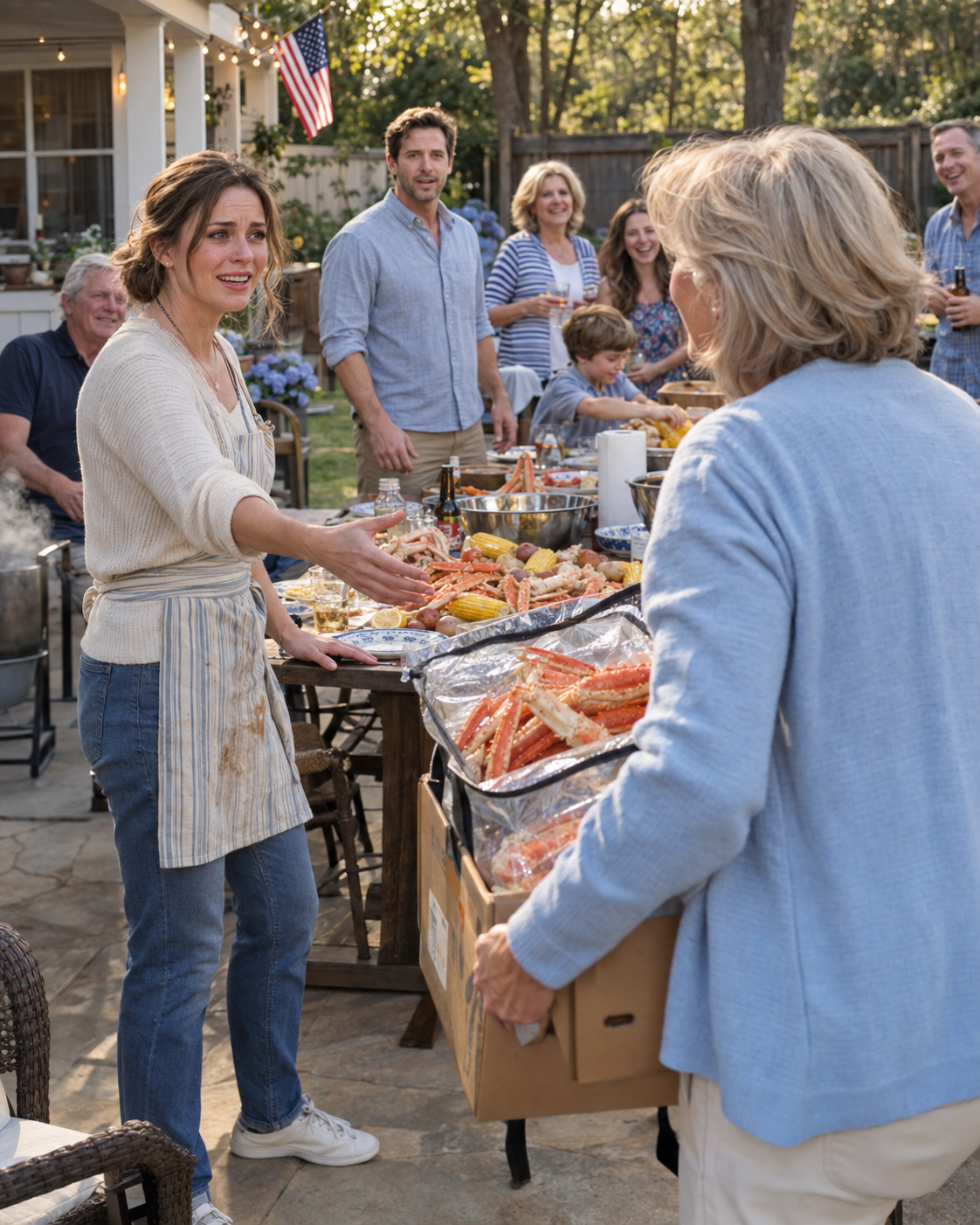
Martha opened it.
Fifteen pounds of fresh snow crab legs.
For a moment, nobody spoke.
Then Martha smiled.
“I asked the seafood guy for the good ones.”
My mother laughed from behind me.
“These look pretty good.”
Martha looked at me.
“I thought maybe we could have dinner here.”
I stared at the cooler.
Then at her.
Then at my mother.
Something warm moved through my chest.
Not because of the crab.
Because she had come to my mother’s house.
She had crossed the distance herself.
She had brought the thing that had once become a symbol of everything wrong between us.
And this time, she wasn’t asking me to prove anything.
She was offering something.
So I stepped aside.
“Come in.”
Part 3
That evening, we dragged folding tables into my mother’s backyard.
There were no crystal glasses.
No expensive decorations.
No perfect table settings.
Just paper plates, cold drinks, steaming potatoes, corn, sausage, and fifteen pounds of snow crab piled in the center.
My uncle brought a radio.
My cousin brought a ridiculous amount of dessert.
My mother kept insisting everyone needed another serving.
And Martha sat at the end of the table with her sleeves rolled up, cracking crab legs with everyone else.
At one point, Chloe arrived.
She stood near the fence, uncertain.
I waved her over.
She came slowly.
“Those are good,” she said, looking at the crab.
I smiled.
“They are.”
She looked at me.
“I’m sorry about what I said that day.”
The backyard seemed to grow quieter.
I nodded.
“Thank you.”
She sat down beside me.
For a while, we just ate.
Then she whispered, “I really was being mean.”
“I know.”
“I don’t know why I thought it was funny.”
“Sometimes people laugh at things because they don’t know what else to do with their own insecurity.”
She looked at me.
“Did Mom tell you that?”
“She told me some things.”
Chloe looked toward Martha.
For the first time, I noticed the resemblance between them.
Not in their faces.
In the way both of them held themselves when they were afraid.
Later, Justin came into the backyard carrying another pitcher of lemonade.
He looked around at the table and smiled.
“This is nice.”
My mother handed him a plate.
“Sit down before someone gives your seat away.”
Everyone laughed.
Even Martha.
The sun began to disappear behind the trees.
The sky turned pale gold, then lavender.
Butter dripped onto paper plates.
Someone told an old family story that I had never heard before.
Martha laughed so hard she had to put down her crab cracker.
And I realized something strange.
For seven years, I had thought the choice was either endure them or lose them.
I had never considered a third possibility.
Tell the truth.
Set a boundary.
Leave when necessary.
And then give people the chance to meet you on the other side of that boundary.
Standing up for myself hadn’t destroyed the family.
It had exposed the version of the family that existed only when I kept swallowing everything.
The old dynamic didn’t disappear in one afternoon.
It didn’t disappear because Martha bought crab.
It changed because, finally, everyone understood that my kindness was not an unlimited resource.
My generosity was not an obligation.
And my silence was not consent.
After dinner, Martha helped me gather the empty shells.
We stood together beside the kitchen sink.
For a few seconds, neither of us spoke.
Then she said, “I never thanked you for the first crab.”
I looked at her.
“You didn’t have to.”
“Yes, I did.”
She dried her hands.
“You spent your money because you wanted everyone to have something good.”
She looked embarrassed.
“And I made you feel like it wasn’t enough.”
I nodded.
“It hurt.”
“I know.”
She took a breath.
“I’m sorry.”
This time, I believed her.
Not because the words were perfect.
They weren’t.
Not because the past had vanished.
It hadn’t.
I believed her because she had finally stopped defending herself.
She had simply acknowledged the wound.
I reached for the dish towel.
“Next time, you can just tell me you want crab.”
She smiled.
“Next time, I’ll bring it myself.”
We both laughed.
Outside, the others were still talking.
Justin was telling some ridiculous story about our first apartment.
My mother was arguing with my uncle about whether the potatoes needed more seasoning.
Chloe was laughing with my cousin.
The sound came through the open window like something I had almost forgotten existed.
Peace.
Not the fake kind that requires one person to stay quiet.
The real kind.
The kind that can survive honesty.
I stood there for a moment and looked at the empty cooler.
Six weeks earlier, that same kind of cooler had carried fifteen pounds of crab into a house where I felt unwanted.
Now another cooler sat empty in my mother’s kitchen because everyone had eaten together.
The crab had never been the real story.
It was only the thing that finally made the invisible visible.
Sometimes, the moment that changes your life doesn’t look important from the outside.
Sometimes it’s a cooler.
A dinner table.
A careless joke.
A sentence you finally refuse to swallow.
Sometimes you don’t know you’re standing at the edge of an old life until you take one small step away from it.
That Saturday, I thought I was walking away from a dinner.
Instead, I walked away from seven years of believing that being loved meant constantly proving I was worthy of a seat at the table.
And when I came back, the table was still there.
But this time, I didn’t have to earn my place.
I simply sat down.
And for the first time, everyone made room.