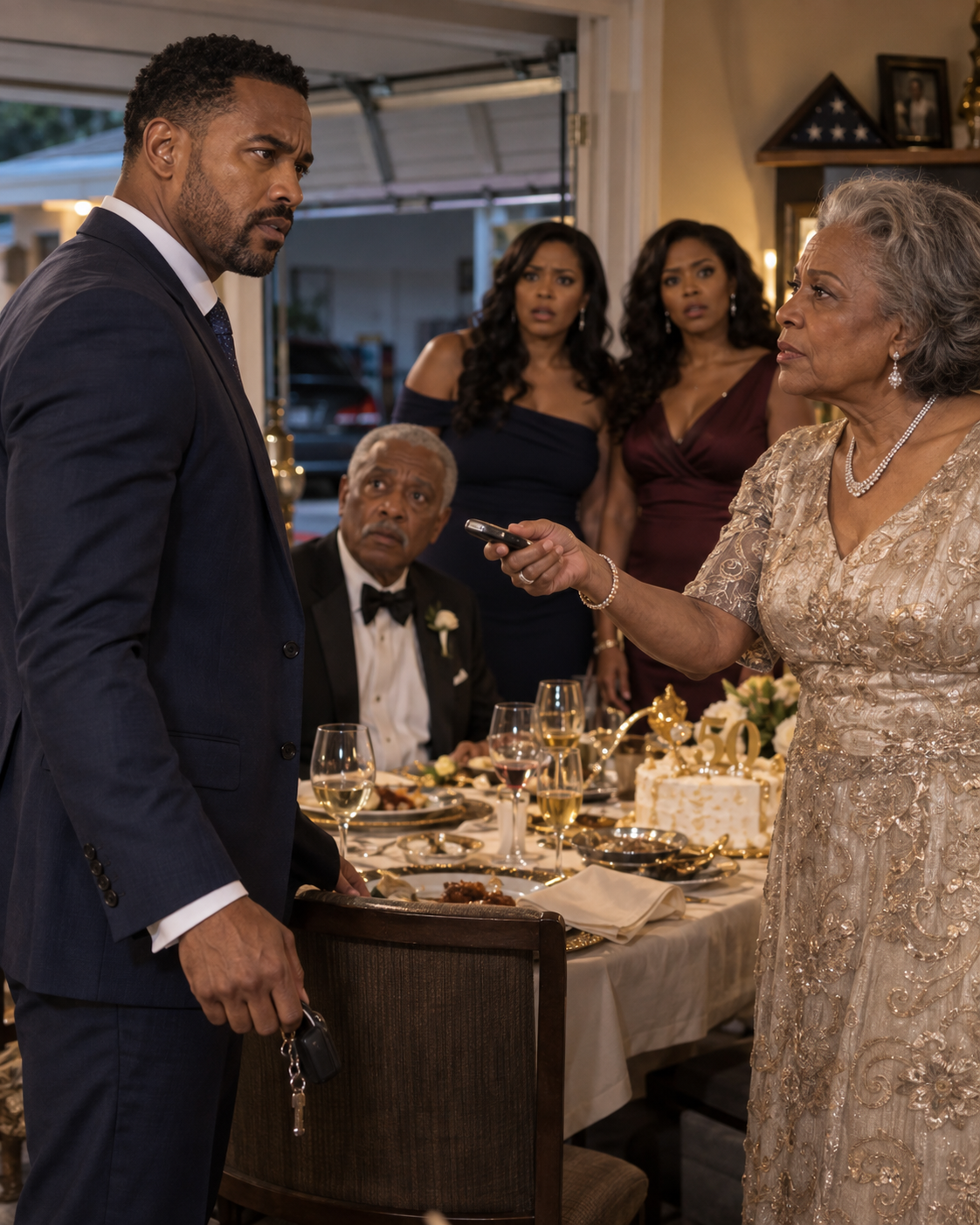
At my in-laws’ 50th anniversary dinner, Eleanor calmly announced that her $5 million estate would go entirely
Eleanor’s words stayed in my head long after the call ended.
“There’s something about the estate you need to know.”
I had heard fear in her voice.
Not guilt.
Not anger.
Fear.
David sat across from me at our kitchen table in Denver, staring at the coffee he had forgotten to drink.
“Do you want to call her back?” I asked.
He shook his head.
“Not yet.”
For the first time since we had moved, he looked uncertain.
Not about leaving.
About what leaving had uncovered.
Two days later, Eleanor called again.
This time, she asked to speak with both of us.
We put her on speaker.
Arthur was there too.
Eleanor took a long breath.
“I owe you an explanation.”
David leaned back in his chair.
“Okay.”
“The estate isn’t five million anymore.”
I frowned.
“What happened?”
“There are expenses,” Arthur said quietly.
Eleanor corrected him.
“That’s not the whole story.”
A pause followed.
Then she admitted that the number she had announced at the anniversary dinner had been an estimate based on several properties and investments.
Some assets had debts attached to them.
Some investments had lost value.
And one property was tied up in a complicated ownership arrangement.
David looked at me.
“So the five million wasn’t actually five million?”
“No,” Eleanor said.
“Then why announce it like it was?”
She didn’t answer immediately.
Finally, she whispered, “Because I wanted your sisters to know they were secure.”
David closed his eyes.
That sentence hurt him more than the inheritance itself.
Not because he wanted the money.
Because it revealed how carefully his mother had planned to make him feel unnecessary while still expecting him to remain available.
But then Eleanor said something none of us expected.
“There’s another reason.”
Arthur shifted in his chair.
“Your grandfather left something to you, David.”
David opened his eyes.
“My grandfather?”
“Our father,” Eleanor said.
I watched the confusion spread across his face.
David’s grandfather had died when he was twenty.
He had never mentioned receiving anything.
“What did he leave me?”
“Not money,” Eleanor said.
“Something else.”
She explained that several years before his death, David’s grandfather had created a small education and investment account in David’s name.
It had been modest at the time.
Over the years, it had grown.
The account was now worth enough to make a meaningful difference in David’s life.
But Eleanor and Arthur had never touched it.
“Then why didn’t you tell him?” I asked.
Eleanor became quiet.
“Because we thought he didn’t need it.”
I felt something cold settle in my chest.
David laughed once, but there was no humor in it.
“Of course.”
His mother started crying.
“David, that’s not what I meant.”
“I know.”
But his voice had changed.
“That’s exactly what you meant.”
He ended the call.
For several minutes, neither of us spoke.
Then he looked at me.
“Do you ever wonder if they actually saw me?”
I knew what he meant.
Not as the dependable son.
Not as the person who answered every call.
Not as the man who could fix anything.
Just David.
His parents had always praised his reliability.
They had rarely asked what that reliability cost him.
The next week, Sarah called.
She wanted to meet us privately.
We agreed to dinner.
When Sarah arrived, she looked exhausted.
Laura came ten minutes later.
Neither of them touched the menus.
Sarah looked at David.
“We need to tell you something.”
He waited.
“We’ve been going through Mom and Dad’s paperwork.”
Laura placed a folder on the table.
“There are years of records.”
David frowned.
“What kind of records?”
“Everything they asked you to do.”
She opened the folder.
There were old emails.
Text messages.
Repair invoices.
Medical schedules.
Travel records.
Lists of appointments.
Handwritten notes with David’s name beside almost every task.
For a moment, nobody spoke.
Then Sarah said, “We didn’t realize how bad it was.”
David looked through the pages.
There was a note from eleven years earlier.
“David will handle roof estimate.”
Another.
“David can take Dad to specialist.”
Another.
“David will deal with insurance.”
Then another.
“David can pick up keys.”
He turned the page.
More.
And more.
His entire adult life was scattered across those sheets of paper like a ledger nobody had ever balanced.
Laura’s eyes filled with tears.
“We thought you just liked helping.”
David swallowed.
“I did.”
He looked at both sisters.
“I loved helping.”
“Then why didn’t you say anything?”
He gave a tired smile.
“Because I thought family was supposed to help each other.”
Sarah looked down.
“It is.”
“But help isn’t the same as being assigned.”
That sentence silenced the table.
Laura reached across and touched his arm.
“We’re sorry.”
David nodded.
“I know.”
There was no bitterness in his voice.
That was what made it hurt.
He didn’t need them to apologize anymore.
He needed them to understand.
The family began changing slowly.
Sarah took responsibility for medical appointments.
Laura handled the finances.
Arthur hired a local handyman.
Eleanor hired a home-care coordinator to organize the appointments she had once expected David to manage.
The first few weeks were messy.
There were missed calls.
Forgotten paperwork.
Arguments.
People complained.
But eventually, something surprising happened.
Arthur learned to use online scheduling.
Eleanor started making friends at a community center.
Sarah discovered she actually enjoyed helping with certain things.
Laura became closer to her parents than she had been in years.
And David stopped waking up with his phone beside his pillow.
That small change affected him more than he expected.
He began sleeping through the night.
He started running again.
He accepted projects at work without wondering whether someone would call him halfway through.
He and I explored Colorado on weekends.
We bought hiking boots.
We learned which coffee shop had the best cinnamon rolls.
We began building a life that wasn’t organized around emergencies.
But the biggest change happened between David and Arthur.
One Saturday afternoon, Arthur called.
David stared at the phone for a long time before answering.
“Hey, Dad.”
There was silence.
Then Arthur said, “I need to apologize.”
David sat down.
“For what?”
“For making you believe that being a good son meant always being available.”
David looked out the window.
“Who told you that?”
“I did.”
Another silence.
Arthur continued.
“I grew up believing men prove their love by providing.”
David smiled sadly.
“That’s what you taught me.”
“I know.”
His father’s voice cracked.
“And I didn’t realize I was teaching you that your worth came from how much you could carry.”
David closed his eyes.
That was the apology he had been waiting for.
Not an apology for the inheritance.
Not an apology for the garage door.
An apology for the lesson.
“I don’t want you to stop being my son,” Arthur said.
“I just don’t want to be the reason you stop being yourself.”
David wiped his eyes.
“I’m still your son.”
“I know.”
“But I can’t be your whole support system.”
“I understand.”
And for the first time, they ended a conversation without David being given a task.
Months passed.
The estate dispute faded into the background.
The five million dollars became irrelevant.
The mysterious account from David’s grandfather was eventually transferred properly into his name, but he didn’t rush to spend it.
He invested most of it.
He used a portion to help us buy a home.
And he made one decision that surprised everyone.
He created a separate fund for his parents’ long-term care.
Not because they demanded it.
Not because he owed them.
Because he wanted to.
There was a difference.
A year after the anniversary dinner, the whole family gathered again.
This time, nobody talked about inheritance.
Nobody discussed who deserved what.
Eleanor brought a casserole.
Arthur brought a terrible bottle of wine.
Sarah arrived late.
Laura forgot dessert.
It was ordinary.
And somehow, ordinary felt miraculous.
Halfway through dinner, Eleanor looked at David.
“I have something for you.”
He froze.
She reached into a drawer and pulled out an old toolbox.
It was scratched and faded.
David recognized it immediately.
His grandfather had owned it.
“I found it in the garage,” Eleanor said.
“You used to use it every time you fixed something here.”
David took it carefully.
Inside were old screwdrivers, a measuring tape, a small wrench, and a handwritten note taped beneath the lid.
He unfolded it.
It was from his grandfather.
The message was only a few lines.
“A man can spend his whole life repairing other people’s houses and forget to build one of his own.”
David stared at it.
His eyes filled instantly.
Nobody spoke.
He looked at his mother.
“Did you know this was here?”
She shook her head.
“I didn’t.”
He laughed softly through his tears.
“Maybe Grandpa knew me better than any of us.”
Eleanor reached across the table.
“I think he did.”
David held the toolbox against his chest.
For years, he had believed his value came from being useful.
If something broke, he fixed it.
If someone needed help, he came.
If his parents called, he answered.
He thought love meant proving, over and over, that he would never leave.
But love without boundaries can quietly become obligation.
And obligation can disguise itself as devotion until you can no longer tell the difference.
That night, as we drove home, David kept the toolbox on the seat beside him.
“Are you okay?” I asked.
He smiled.
“Yeah.”
“Really?”
He looked out at the highway lights.
“I think I finally understand.”
“Understand what?”
“That leaving wasn’t abandoning them.”
He paused.
“It was the first time I trusted them to stand without me.”
I reached for his hand.
“And they did.”
He squeezed my fingers.
“Because I finally gave them the chance.”
Years later, I would remember that dinner as the night our family stopped measuring love in sacrifices.
Not because anyone suddenly became perfect.
They didn’t.
Eleanor still worried.
Arthur still called too often.
Sarah and Laura still argued.
David still sometimes felt guilty when he said no.
But now, when that guilt appeared, he knew it wasn’t proof that he had done something wrong.
It was simply the old habit trying to survive.
And habits can be changed.
Sometimes the hardest boundary is not telling someone else they can’t have something.
Sometimes it is telling yourself that you are allowed to stop giving it.
David never received the inheritance his mother had once promised his sisters.
And eventually, none of us cared.
Because the real inheritance was something no will could divide.
He inherited his grandfather’s toolbox.
He inherited his father’s apology.
He inherited his sisters’ respect.
And, finally, he inherited something he had been giving away for twelve years without realizing its value.
His own time.
That night, before we went to bed, David placed the old toolbox on a shelf in our garage.
He didn’t use it.
He simply left it there.
A reminder that he could repair things when he wanted to.
Not because someone expected him to.
Not because guilt demanded it.
But because the choice belonged to him.
And sometimes, I think that is what freedom really looks like.
Not having everything.
Not being promised everything.
Just finally understanding that your life belongs to you.