At my husband’s forty-eighth birthday dinner in downtown Cincinnati, his mother raised a glass and praised me
Nathan’s father did not look surprised by the word townhouse.
He looked afraid.
That difference mattered.
I turned toward him.
“Robert?”
He stared at Nathan.
Nathan had gone completely still.
Brooke looked from one face to another.
“I thought everybody knew.”
Robert pushed his chair away from the table.
“What address?”
Brooke told him.
I will never forget what happened next.
Elaine dropped her fork.
Robert whispered, “Jesus Christ.”
Nathan stood.
“Dad.”
But Robert was already looking at me.
“Claire, how much money is missing?”
The entire table disappeared around me.
Not literally.
But emotionally.
There are moments when the world narrows until only one question exists.
“How do you know money is missing?”
Nathan stepped between us.
“This is not the place.”
Robert ignored him.
“How much?”
“Almost forty-four thousand.”
Robert closed his eyes.
Elaine stared at her husband.
“You knew?”
“No.”
But he didn’t sound convincing.
Nathan reached for my arm.
“Claire, we’re leaving.”
I pulled away.
“No.”
People at nearby tables had begun pretending not to watch us.
Nathan’s sister stared into her lap.
Brooke had started crying silently.
Eric stood near the doorway with both hands in his pockets.
I looked at Robert again.
“What is at that address?”
Robert sat down slowly.
Then he said, “A property I used to own.”
Nathan’s face changed.
That was all I needed.
“Used to?”
Robert nodded.
“I sold it three years ago.”
“To whom?”
Nobody answered.
Nathan picked up his coat.
“I’m done with this.”
Robert slammed his palm against the table.
“Sit down.”
I had never heard him raise his voice.
Neither had Nathan, judging by his expression.
“Sit down and tell your wife what you did.”
Nathan laughed once.
Not because anything was funny.
Because cornered people sometimes make strange sounds.
“You don’t know what you’re talking about.”
Robert looked sick.
“I know exactly what I’m talking about.”
Elaine whispered, “Robert.”
He turned to her.
“That townhouse belonged to my company.”
Elaine blinked.
“What?”
“Years ago.”
Nathan’s mother looked genuinely lost.
Robert rubbed both hands over his face.
“When I sold the business, several small properties were transferred separately. Nathan helped organize the paperwork.”
My heartbeat slowed in the strange way it does when fear becomes too large for panic.
I looked at Nathan.
“Helped how?”
Nathan said, “Claire, don’t.”
Robert answered for him.
“He handled some of the accounts.”
Brooke wiped her face.
“Nathan told me he bought the townhouse last spring.”
Nobody moved.
Last spring.
I had been six months pregnant.
I remembered last spring.
Nathan had painted Noah’s nursery.
He complained about the smell of primer.
He assembled a dresser while Lucy handed him screws and called herself his assistant.
One evening, we ate pizza on the nursery floor and argued about middle names.
Apparently, sometime around then, my husband had also been acquiring property for the life he intended to have after us.
“Whose name is it in?” I asked.
Brooke looked at Nathan.
His eyes told her not to answer.
That was enough.
“Brooke.”
She swallowed.
“A company.”
“What company?”
“North Line Consulting.”
I had never heard of it.
Robert had.
His face drained again.
Nathan finally snapped.
“Can everyone stop acting like I’ve committed some crime?”
The word hung in the air.
Crime.
Nobody else had used it.
Eric slowly looked at me.
I felt cold.
Robert stood.
“Where did North Line get its money?”
Nathan’s jaw flexed.
“Business.”
“What business?”
“Consulting.”
“For whom?”
Nathan laughed again.
“Are you interrogating me now?”
“No.”
Robert’s voice broke.
“I am praying you are not stupid enough to have done what I think you did.”
That was when Nathan walked out.
Not dramatically.
No overturned table.
No screaming.
He simply grabbed his coat and left his own birthday dinner.
I watched him disappear through the restaurant doors.
Three weeks earlier, I had watched him leave our house the same way.
Back then, I had wanted to run after him.
This time, I didn’t move.
Brooke sank into Nathan’s empty chair.
“I didn’t know.”
I believed her.
That surprised me.
Maybe because betrayal recognizes betrayal even when it arrives wearing a different face.
“You knew he was married.”
She flinched.
“Yes.”
“Then you knew enough.”
Her eyes dropped.
“I thought you were separated.”
Eric made a bitter sound.
Brooke looked at him.
“And I told myself your marriage was dead.”
Eric said nothing.
She closed her eyes.
“I suppose that’s what people say when they need someone else’s pain to feel theoretical.”
I didn’t forgive her.
But I understood the sentence.
Robert asked me to call my attorney immediately.
I called Marissa from my car.
She listened without interrupting.
When I finished, she said, “Do not go home alone if Nathan is there.”
My hand tightened around the phone.
“Do you think he’s dangerous?”
“I think a person who discovers his secrets are unraveling can become unpredictable.”
That frightened me more than if she had simply said yes.
Mom had the children.
I drove there instead.
I barely slept.
At 6:20 the next morning, Nathan started calling.
I let it ring.
Then came the messages.
“We need to talk.”
“Last night got out of control.”
“My dad is confused.”
“Brooke misunderstood.”
Then finally:
“Do not involve lawyers in the townhouse.”
I screenshot that one.
Marissa called at eight.
“Send me everything.”
By noon, Nathan had changed strategies.
His messages became softer.
“I love you.”
“I know I’ve hurt you.”
“I panicked.”
“I was trying to protect our future.”
That final sentence almost made me laugh.
Protect our future.
By moving money.
Buying property.
Planning an apartment with another woman.
Leaving me with a feverish toddler and a newborn.
Language is extraordinary.
You can drag almost any behavior through enough words until it emerges wearing a suit.
Marissa began asking questions through proper legal channels.
Then things became slow.
Painfully slow.
Nothing happened like television.
No police rushed through Nathan’s office carrying cardboard boxes.
No judge slammed a gavel.
There were records.
Requests.
Account statements.
Company documents.
Emails between lawyers.
And through it all, I still had children.
Noah needed vaccinations.
Lucy developed an obsession with sleeping in sparkly rain boots.
The washing machine stopped draining.
My mother burned garlic bread because she was helping me sort financial statements while cooking dinner.
Life refused to become a thriller just because my marriage had become one.
Then, eleven days after the birthday dinner, Robert called me.
“Can we meet?”
I almost said no.
He was Nathan’s father.
A piece of me suspected he was calling to protect his son.
But there was something in his voice.
We met at a diner near the river.
Robert arrived carrying a folder.
I was beginning to hate folders.
He didn’t order food.
He pushed the folder toward me.
“Before you look at that, I need to tell you something.”
I waited.
“Years ago, Nathan worked for me.”
“I know.”
“He was good.”
Robert looked out the window.
“Maybe too good.”
I said nothing.
“When I sold my company, he helped close several dormant entities and transfer properties. One of them was North Line.”
I felt my stomach tighten.
“I thought Brooke said Nathan created it.”
“He revived it.”
“What does that mean?”
“It was supposed to be dissolved.”
Robert looked ashamed.
“I signed documents trusting him to finish the process.”
I opened the folder.
There were corporate records.
Old transfer documents.
A sale agreement.
And one page with Nathan’s signature.
“What am I looking at?”
“A company that should not exist.”
Robert tapped the page.
“And a property that should have been sold to an unrelated buyer.”
“But it wasn’t.”
“No.”
“Who owns it?”
“North Line.”
“Meaning Nathan.”
“Functionally, yes.”
I stared at him.
“Did he steal it?”
Robert’s eyes lifted.
“I don’t know what legal word will eventually apply.”
It was the careful answer of a man whose son might have committed more than adultery.
“But he concealed the transfer from me.”
I felt suddenly nauseated.
“The forty-four thousand?”
“I don’t know.”
He leaned forward.
“But if he used marital funds to maintain or renovate that property, your lawyer needs to know.”
She did.
Within weeks, the financial picture became clearer.
Nathan had not simply transferred our money into a secret savings account.
Some of it had gone toward taxes, repairs, furniture, and deposits connected to the townhouse.
Some had funded travel with Brooke.
Some had passed through North Line.
And some remained unexplained long enough to become the kind of question attorneys ask repeatedly and accountants answer very carefully.
Nathan blamed everybody.
Robert was vindictive.
Brooke was confused.
Eric was obsessed.
I was unstable.
Marissa was “turning a family problem into warfare.”
Only Nathan, apparently, had no role in Nathan’s circumstances.
Then came custody.
That hurt in a different way.
Nathan wanted equal parenting time.
Part of me was angry.
He had disappeared when Noah was four months old.
He had ignored my calls when Lucy was sick.
Now he wanted to tell a court he was an involved father.
Marissa reminded me of something difficult.
“Being a terrible husband and being an unsafe father are not automatically the same thing.”
I hated hearing it.
Because it was true.
So I stopped trying to make divorce feel morally satisfying.
There would be no arrangement that perfectly translated betrayal into justice.
Nathan was their father.
Lucy loved him.
Noah would grow up needing his own understanding of him, not mine.
We created a schedule.
The first weekend Nathan took both children alone, he called me six times.
“Where are Noah’s pajamas?”
“In the bag.”
“He won’t take the bottle.”
“Try warming it.”
“Lucy says her stomach hurts.”
“Did she eat?”
“She had macaroni.”
“How much?”
Silence.
“Nathan?”
“A lot.”
At 1:18 a.m., he texted.
“Noah won’t sleep.”
I stared at my phone.
For one second, my body moved before my mind did.
I sat up.
I nearly reached for my clothes.
Then memory stopped me.
A bathroom floor.
Lucy’s feverish body against mine.
Noah crying.
Nathan’s message.
“I can’t do this tonight.”
I typed:
“Check his diaper, feed him, walk with him, take his temperature. If you’re worried, call the pediatrician.”
His reply came immediately.
“Can you come?”
My fingers hovered.
Then I wrote:
“You can handle it.”
I turned my phone face down.
I did not sleep easily.
But I slept.
The next morning, Nathan sent one message.
“We survived.”
I cried when I read it.
Not because I was proud of him.
Because I realized how low the bar had been in our marriage.
He had performed basic parenting for one night and described it as survival.
I had done it for months while believing my exhaustion represented some personal weakness.
The divorce stretched across almost a year.
Nathan and Brooke fell apart before it was finalized.
I learned that accidentally from Eric.
Brooke had discovered that Nathan had lied to her about the townhouse, too.
He had told her it was fully paid for.
It wasn’t.
He told her North Line was a successful consulting company.
It wasn’t.
He told her he had enough savings for them to start over comfortably.
Most of the money she had seen had been ours.
The fantasy collapsed when confronted by invoices.
There is something almost poetic about affairs ending over spreadsheets.
But I didn’t celebrate.
By then, Brooke looked less like the villain of my story and more like another person who had agreed to believe a convenient lie.
She had hurt me.
That remained true.
Nathan had lied to her.
That was also true.
Pain does not always assign clean roles.
Eric and I stopped talking eventually.
Our connection belonged to the disaster.
Once the disaster became paperwork, there was nothing left to discuss.
The last time I saw him, we stood outside a courthouse after one of Brooke’s hearings.
He gave me a tired smile.
“Think we’ll ever stop remembering Rome?”
“I hope so.”
He nodded.
“Me too.”
Then he walked away.
The issue involving Robert’s former company was resolved separately from my divorce.
I was never part of every detail, and I didn’t try to be.
Marissa taught me the difference between information I needed and information I was merely hungry for.
Nathan eventually reached a financial settlement connected to North Line and the disputed property.
The townhouse was sold.
Money that belonged to the marital estate was accounted for.
There were penalties.
There were legal fees.
There were consequences.
But there was no movie scene where Nathan stood in handcuffs while I watched from courthouse steps.
Real consequences are often less cinematic.
You lose money.
You lose trust.
You lose relationships.
People stop answering your calls.
Your father looks at you differently.
Your children learn you live somewhere else.
The worst punishment may simply be waking up inside the life your own choices built.
I kept the house.
Barely.
I refinanced it and nearly threw up when I saw the new monthly payment.
My mother told me I could sell.
I considered it.
Then one morning, Lucy ran down the hallway dragging her blanket and shouting that the sun was “inside her room.”
I followed her.
Light was pouring through the same nursery window where I had once rocked Noah while Nathan was in Rome.
For months, I had thought of that room as the place where I was abandoned.
That morning, I realized it was also the place where I survived.
I kept the house.
I sold Nathan’s giant leather recliner.
That helped.
A year after he left, he came by to pick up the children.
He stood in the doorway looking thinner.
Older.
Not destroyed.
Not dramatically humbled.
Just human.
Lucy ran past me carrying a backpack.
“Daddy!”
He smiled.
“Hey, bug.”
Noah toddled after her.
Nathan lifted him.
For a few seconds, I watched my children love a man I no longer did.
It felt strange.
But not unbearable.
Nathan buckled them into his car.
Then he came back toward the porch.
“Claire.”
I waited.
He shoved his hands into his pockets.
“I’ve been meaning to say something.”
I almost laughed.
Nathan had been meaning to say things our entire marriage.
“Okay.”
“I was angry at you for a long time.”
“That must have been difficult.”
He looked down.
“I deserved that.”
I said nothing.
He glanced toward the car.
“I kept thinking you embarrassed me.”
“At the birthday dinner?”
“Everywhere.”
His voice grew quieter.
“But eventually I realized…”
He stopped.
I waited.
“You didn’t expose me.”
He looked at me.
“You just stopped covering for me.”
For the first time in almost two years, Nathan said something about our marriage that I completely agreed with.
“No,” I said.
“I didn’t expose you.”
His eyes filled slightly.
“I just stopped lying for you.”
He nodded.
Then he surprised me.
“Was I always like this?”
It was the kind of question the old Claire would have answered carefully.
She would have searched fourteen years of memories.
She would have softened the edges.
She would have found some way to reassure him that he was fundamentally good.
I was no longer responsible for managing Nathan’s reflection.
“I don’t know.”
He looked disappointed.
Maybe he had hoped I would give him a map back to the man he imagined himself to be.
Instead, I said, “That’s something you’ll have to figure out without me.”
He nodded once.
Then he left.
Mom came over that evening.
We ate takeout on the kitchen floor because Noah had spilled juice on the table and I hadn’t cleaned it yet.
She looked around.
“This place is a disaster.”
I laughed.
“Apparently, it’s toxic.”
Mom almost choked on her noodles.
“Too soon?”
“Two years isn’t too soon.”
Lucy climbed into my lap.
Noah banged a plastic spoon against a cabinet.
There were toys everywhere.
Laundry was waiting upstairs.
The dishwasher needed emptying.
I had an email from my lawyer about one final account adjustment.
Nothing was perfect.
That was the surprise.
I used to imagine healing as becoming untouched by what happened.
I thought someday I would remember Nathan leaving and feel nothing.
That day never came.
Some memories still hurt.
Certain songs.
Certain hotel advertisements.
Sometimes I saw a brown leather watchband and felt my stomach tighten before my mind caught up.
Healing wasn’t forgetting.
It was becoming larger than the memory.
Months later, Lucy asked me a question while I was brushing her hair.
“Mommy, why doesn’t Daddy live here?”
I stopped.
There are answers children deserve.
And answers they shouldn’t have to carry.
“Because Daddy and I couldn’t be good married people anymore.”
She frowned at herself in the mirror.
“Was someone bad?”
My throat tightened.
“No.”
I thought about it.
“People can make bad choices without becoming only those choices.”
That sentence wasn’t just for her.
Maybe it was for me.
Maybe even for Nathan.
Lucy accepted the answer because children sometimes understand complexity better than adults.
Then she asked whether unicorns could get married.
I said probably.
She asked if they could get divorced.
I said probably.
She nodded seriously.
“That would be expensive.”
I laughed until I cried.
Three years after Rome, I found the old screenshot.
3:07 a.m.
“I can’t do this tonight. I told you I need space.”
I had been cleaning photographs from my phone.
For a long moment, I stared at those words.
The woman who had taken that screenshot felt familiar and distant.
She had been sitting on a bathroom floor.
She had formula on her shirt.
She thought strength meant enduring one more night without asking for too much.
She thought marriage meant explaining someone’s cruelty until it sounded understandable.
She thought patience was the same thing as love.
I wanted to reach backward through time and tell her something.
Not that Nathan would betray her.
She already knew, somewhere beneath the excuses.
I wanted to tell her that being needed is not the same as being loved.
That forgiveness without accountability can become permission.
That loyalty is beautiful only when it travels both directions.
And that sometimes the person abandoning you is unknowingly leaving the door open for you to find yourself again.
I deleted the screenshot.
Not because it no longer mattered.
Because I didn’t need evidence anymore.
That night, after the children were asleep, I walked downstairs.
The kitchen was quiet.
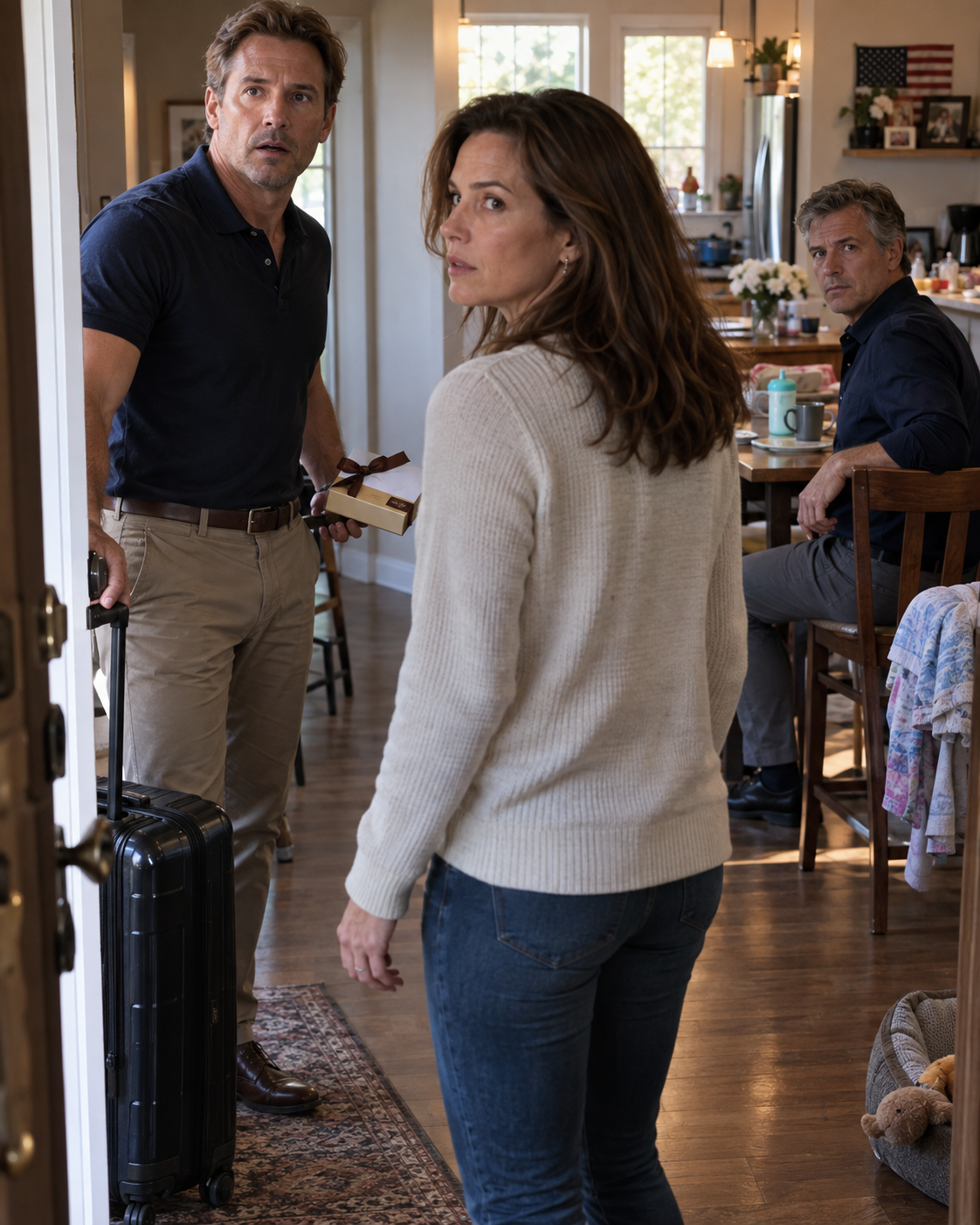
The same kitchen where Nathan had once placed his suitcase beside the island and told me our family felt suffocating.
I poured myself a glass of water.
Outside, rain tapped softly against the windows.
My phone buzzed.
A message from Nathan.
“Lucy forgot her purple sweater. I’ll bring it tomorrow.”
I smiled.
Not because of him.
Because of how ordinary the message was.
No manipulation.
No secret trip.
No hidden account.
Just a father returning a child’s sweater.
“Thanks,” I replied.
Then I placed my phone on the counter.
For years, I thought the opposite of betrayal was revenge.
Then I thought it was justice.
Eventually, I understood it was something quieter.
Peace.
Not the kind where nothing painful ever happens.
The kind where another person’s choices no longer decide what happens inside you.
Nathan once told me he needed space.
He had meant space from crying children, dirty dishes, responsibility, and a wife who needed him to participate in the life we had built.
So I gave him space.
More than he expected.
Enough space to live with his decisions.
Enough space for me to stop rescuing him from them.
Enough space for our children to love both of us without carrying the wreckage between us.
And enough space for me to discover that the home he once called suffocating had never been the thing trapping me.
The trap was believing love required me to remain exactly where someone left me.
I don’t believe that anymore.
Sometimes people leave because they think you’ll wait.
Sometimes they lie because they think you’ll protect the lie.
Sometimes they mistake your patience for weakness because you’ve spent years making forgiveness look effortless.
But there comes a moment when you finally understand that walking away isn’t always giving up.
Sometimes walking away is the first honest thing you’ve done in years.
Nathan wanted to come home after Rome.
He expected the same wife, the same kitchen, the same marriage, and the same woman who would absorb his choices until they became invisible.
He came home to the same address.
But I wasn’t there anymore.
Not that version of me.
And looking back, that was the real ending.
Not the divorce.
Not the townhouse.
Not the money.
Not Brooke.
Not the birthday dinner.
The marriage truly ended the night I stopped asking why he had chosen to leave and finally started asking why I believed I had to keep waiting.
Once I answered that question, there was nothing left to chase.
Only a life to rebuild.
And for the first time in years, every room in that life had enough air.