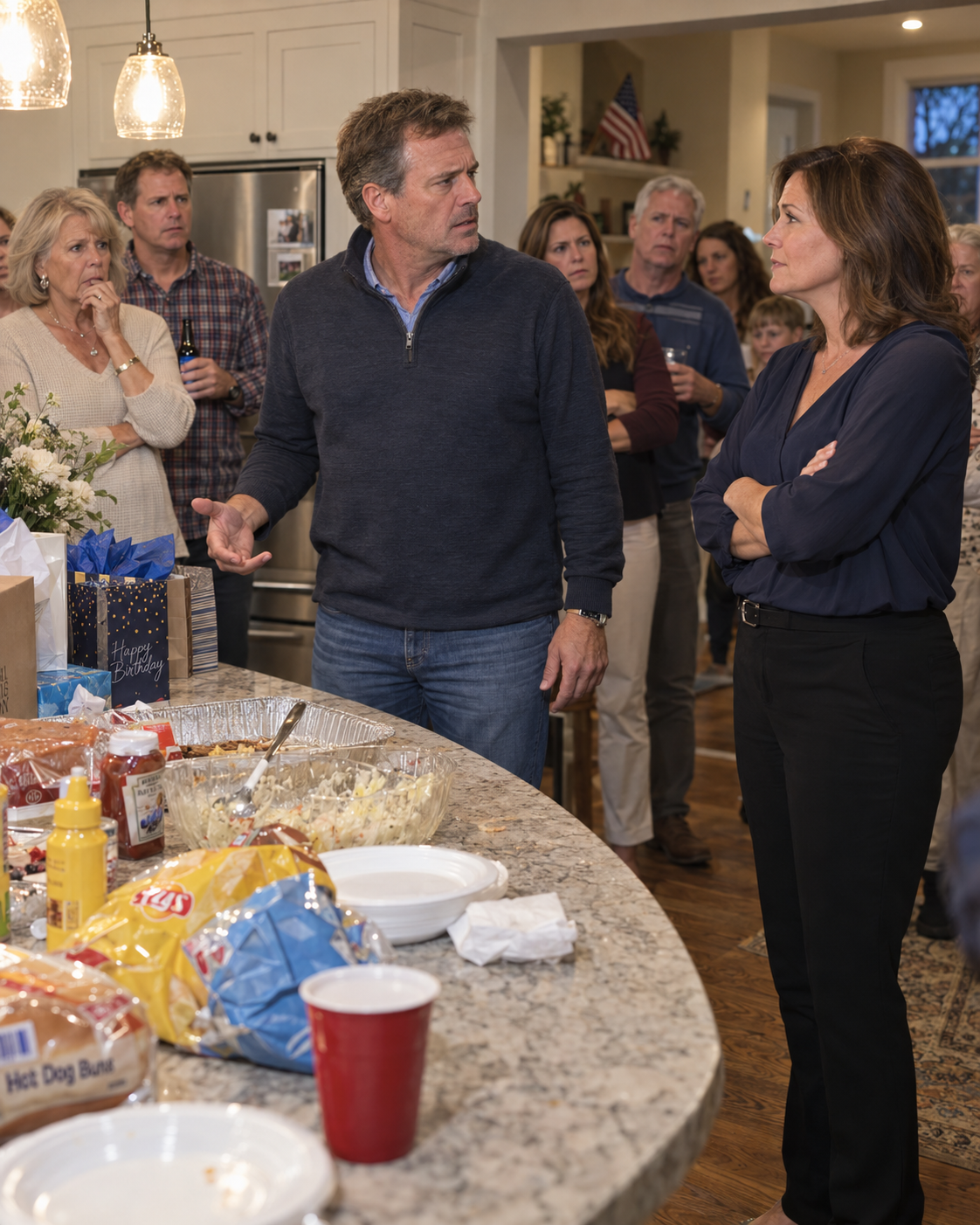
At my husband’s 55th birthday party, twenty relatives stood around our empty kitchen table
The message arrived at 10:17 on a Thursday night.
“Diane, I need to tell you something before you hear it from someone else.”
I stared at those words for a long time.
For months, I had trained myself not to react whenever Rob contacted me, because every conversation seemed to carry another accusation, another revision of history, or another attempt to pull me back into the life I had finally stepped away from.
But this message felt different.
There was no anger.
No accusation.
No demand.
Just one sentence that made my stomach tighten.
I typed, “What?”
Three dots appeared.
Then disappeared.
Then appeared again.
Finally, he wrote, “It’s about the car.”
I almost laughed.
The car.
The mysterious new car Evelyn had told me about months earlier.
The surprise Rob had supposedly been planning for me while simultaneously telling everyone I was obsessed with money.
I hadn’t thought about it in weeks.
Now my hands felt cold.
“What about it?” I asked.
He didn’t answer immediately.
Instead, he sent an address.
A dealership in Nashville.
Then another message appeared.
“Please come tomorrow morning.”
I put the phone face down.
I had promised myself I wouldn’t walk back into confusion just because Rob suddenly wanted to explain something.
But curiosity has a strange way of surviving even when love doesn’t.
The next morning, I drove to Nashville.
The dealership was larger than I expected, all glass windows and polished floors, with rows of new vehicles shining beneath bright lights.
Rob was standing near the entrance.
He looked older.
Not dramatically.
Just tired.
For a second, I remembered the man who had once picked me up from the hospital after Melissa was born, holding a tiny bundle against his chest and crying because he was terrified of dropping her.
Then I remembered the empty birthday table.
I reminded myself that memories could be true without making the marriage good.
He walked toward me.
“Thank you for coming.”
“I almost didn’t.”
“I know.”
We stood there awkwardly.
Then he pointed toward a silver SUV parked near the showroom windows.
“That was supposed to be yours.”
I looked at it.
“Supposed to be?”
He nodded.
“I put a deposit down months ago.”
I didn’t know what to say.
“Why?”
He looked at the floor.
“Because I knew you needed a new car.”
I crossed my arms.
“Then why did you tell your mother you were surprising me with it?”
“Because I wanted people to know I was taking care of you.”
The words hit harder than I expected.
Not because they were romantic.
Because they explained everything.
Rob hadn’t wanted to give me the car.
He had wanted the story of giving me the car.
I stared through the showroom glass.
“Did you actually buy it?”
“No.”
He swallowed.
“I put down a deposit, but I couldn’t finish the purchase.”
“Why not?”
He was quiet for several seconds.
“Because the money wasn’t there.”
I looked at him.
“What do you mean?”
He rubbed his forehead.
“I had debts.”
I didn’t move.
“What kind of debts?”
He looked embarrassed.
“Credit cards.”
“How much?”
He told me.
The number was larger than I expected.
For years, he had told me I was careless with money.
For years, he had complained about groceries and small household purchases.
Meanwhile, he had been carrying a balance he had hidden from me.
I felt something inside me go strangely quiet.
Not triumph.
Not anger.
Just exhaustion.
“Why didn’t you tell me?”
He looked at me.
“Because I was ashamed.”
That answer was probably the first honest thing he had said to me in months.
I sat down on a bench near the showroom.
He sat beside me.
“I thought if everyone believed I was doing well, eventually I’d actually be doing well.”
I looked at him.
“And making me feel small helped with that?”
He closed his eyes.
“I don’t know.”
“Yes, you do.”
He looked at me again.
I didn’t raise my voice.
I didn’t need to.
“Every time you told me I wasn’t contributing, you made yourself feel bigger.”
He stared at his hands.
“I know.”
“No, Rob.”
I shook my head.
“I don’t think you do.”
He didn’t answer.
For the first time, he didn’t argue.
We sat there in silence while salespeople moved around us.
Eventually, he said, “There is something else.”
I already knew I wasn’t going to like it.
“What?”
He reached into his jacket and pulled out a folded document.
He handed it to me.
I opened it.
It was a statement from one of his credit card accounts.
Several large purchases were listed.
Restaurants.
Hotels.
Clothing stores.
Then I saw a recurring charge.
A private club in Nashville.
I looked at him.
“What is this?”
He hesitated.
“Work.”
“That’s not what you told me.”
“I know.”
I looked down at the statement again.
“How long?”
“About two years.”
I felt my chest tighten.
“Two years of what?”
He didn’t answer.
That was answer enough.
But I needed to hear it.
“Rob.”
He whispered, “I was meeting someone.”
The dealership suddenly felt too bright.
I stared at him.
“Who?”
He shook his head.
“Her name doesn’t matter.”
“It matters to me.”
He looked away.
“It was someone from work.”
I felt as though the floor had moved underneath me.
There are moments when your heart doesn’t break loudly.
Sometimes it simply stops making excuses.
For years, I had wondered why he seemed increasingly distant.
Why business trips had become longer.
Why he guarded his phone.
Why certain restaurant charges had appeared in places where he claimed he was meeting clients.
I had noticed.
I had questioned.
And every time, he had told me I was imagining things.
Now I realized I hadn’t imagined anything.
I hadn’t been paranoid.
I had been married to someone who had been carefully editing the truth.
“Did you love her?”
He shook his head.
“No.”
“Did you tell her you loved her?”
He closed his eyes.
“Yes.”
I looked away.
That hurt more than I expected.
Not because I wanted him back.
But because every lie had stolen time from me.
Years I could never recover.
“You don’t get to call me difficult anymore,” I said.
“I know.”
“You don’t get to tell people I was obsessed with money.”
“I know.”
“You don’t get to say I left because I didn’t appreciate what you provided.”
“I know.”
He was crying now.
Quietly.
I watched him wipe his face.
Once, seeing Rob cry would have made me abandon everything to comfort him.
Now I simply sat there.
That was perhaps the clearest sign that something inside me had changed.
“I am sorry,” he said.
I believed that he was sorry.
But forgiveness and reconciliation are not the same thing.
“You should be,” I said.
He nodded.
“I don’t expect you to come back.”
I looked at him.
“Good.”
He almost smiled through his tears.
“I deserved that.”
“No.”
I shook my head.
“You deserved honesty.”
We left the dealership separately.
On the drive home, I cried.
Not because I wanted Rob back.
I cried for the woman I had been.
The woman who had spent years trying to make everything work.
The woman who thought a quiet marriage was a successful marriage.
The woman who had learned to swallow disappointment because keeping the peace felt easier than demanding respect.
When I reached my townhouse, I sat in my car for several minutes.
The little house looked exactly as it had when I left that morning.
White curtains.
Small porch.
One flower pot beside the door.
Nothing extraordinary.
But it was mine.
I went inside and made coffee.
Then I opened my laptop.
There was an email from one of my bookkeeping clients.
They wanted me to take over two additional accounts.
I stared at the message.
A year earlier, I would have worried about whether I had enough time.
Now I simply smiled and replied, “Yes.”
That small word felt bigger than it should have.
Over the next several months, my business grew.
I hired an assistant.
Then another client.
Then I stopped calling it my side work.
It was my business.
My name was on the invoices.
My clients called me directly.
Nobody introduced me as Rob’s wife.
Nobody asked what my husband thought.
Nobody cared.
They cared whether I did good work.
And I did.
Meanwhile, Rob began dealing with the consequences of the life he had built.
The divorce became final the following spring.
The house was sold.
The debts were divided according to the agreement.
I kept my own business.
He kept what remained of his.
There was no dramatic courtroom scene.
No screaming.
No final revenge.
Just paperwork.
Signatures.
Two people walking out of a building knowing they would never again be legally responsible for one another.
Outside the courthouse, Rob stopped me.
“Diane.”
I turned.
“I hope you’re happy.”
I looked at him.
“I am.”
He nodded.
“Good.”
Then he walked away.
I watched him disappear into the crowd.
And for the first time, I didn’t wonder whether I should have stopped him.
A few months later, Melissa invited me to dinner.
We sat at a small restaurant in Franklin.
She told me about work, her friends, and a trip she was planning.
Then she asked, “Do you ever think about Dad?”
“Sometimes.”
“Do you miss him?”
I thought about it.
“I miss who I thought he was.”
She nodded.
“That’s different.”
“Very.”
She reached across the table and squeezed my hand.
“Are you okay with everything that happened?”
I looked out the window.
“I don’t think people become okay with everything.”
She waited.
“I think you learn what you’re willing to carry.”
She smiled.
“That sounds like something you’d put on a coffee mug.”
I laughed.
Maybe it was.
But I meant it.
For years, I had carried things because I thought that was what love required.
Bills.
Schedules.
Family expectations.
Other people’s moods.
Other people’s mistakes.
Other people’s versions of me.
Eventually, I understood that love cannot survive when one person has to disappear for the other person to feel important.
A year after the birthday disaster, I hosted Thanksgiving in my townhouse.
Not twenty people.
Just eight.
Melissa came.
Evelyn came.
Linda and her husband came.
Even Rob came for part of the afternoon because Melissa wanted both her parents there.
I was nervous.
Not because I wanted him back.
Because I didn’t know what the room would feel like with the old story gone.
But something unexpected happened.
Rob arrived carrying a pie.
He looked around my little kitchen.
“Where should I put this?”
I smiled.
“Anywhere.”
He placed it on the counter.
Then he looked at me.
“Do you need help with anything?”
The question was so ordinary that it nearly broke my heart.
I shook my head.
“No.”
He nodded.
“Okay.”
And he actually accepted the answer.
Later, while everyone was eating, Evelyn raised her glass.
“To new beginnings.”
Everyone smiled.
I looked around the table.
There were no perfect marriages there.
No perfect families.
Just people who had made mistakes and, hopefully, learned something from them.
Rob caught my eye from across the table.
For a second, I remembered the empty birthday kitchen.
Then I remembered the dealership.
Then the courthouse.
Then this small room.
I realized I no longer needed the story to end with him as the villain and me as the victim.
That would still make my life revolve around him.
Instead, I wanted the story to end with me understanding myself.
After dinner, I stood alone in the kitchen washing dishes.
Some habits take a long time to disappear.
Then Melissa walked in.
“You know,” she said, “you don’t have to do those tonight.”
I looked at the sink.
Then at her.
She laughed.
“Mom.”
I turned off the water.
“You’re right.”
We left the dishes there.
The next morning, I woke before sunrise.
I made coffee and stood beside the window.
The sky was beginning to turn pale over the rooftops.
My phone buzzed on the counter.
A message from Rob.
“I finally understand what you meant.”
I read it twice.
Then another message appeared.
“I thought independence meant not needing you.”
I waited.
The final message came a few seconds later.
“Now I understand it meant learning to respect you even when you didn’t need me.”
I put the phone down.
I didn’t answer.
Not because I was angry.
Because some truths don’t require a reply.
I walked into my office, opened my laptop, and began working.
Outside, the morning light spread slowly across the street.
For years, I had thought the worst thing that could happen to a marriage was for someone to leave.
I was wrong.
Sometimes the worst thing is staying so long that you forget who you were before you started shrinking yourself.
The birthday table had been empty that night.
But it had given me something no expensive gift ever could.
It had shown me the cost of being invisible.
And it had taught me that independence isn’t about proving you can survive alone.
It’s about knowing you deserve a life in which your worth never depends on how useful you are to someone else.
I still keep the old spreadsheet.
Not because I need the numbers anymore.
I keep it because the first page reminds me of the woman who finally stopped apologizing for what she contributed.
And whenever someone tells me that peace means keeping quiet, I remember that kitchen, twenty hungry relatives, one empty table, and the sentence that changed my life.
Sometimes the moment everything falls apart is not the moment your life ends.
Sometimes it is the first moment you finally see where your life can begin.