At my front gate on a quiet Saturday morning, my parents stood beside my sister and her smug new boyfriend
Part 2
My father stood slowly.
For one unguarded second, I saw the man I remembered from childhood instead of the man sitting in front of me.
He looked tired.
Older.
Smaller somehow.
And despite everything, I felt the old grief rise inside me.
Not anger.
Grief.
The grief of wishing things had been different.
The grief of wondering what it might have felt like to have a father who understood me.
He looked at me.
“For what it’s worth,” he said, “I am proud of you.”
I stared at him.
“I know you are.”
He seemed relieved for half a second.
Then I finished.
“Now that it’s worth something to you.”
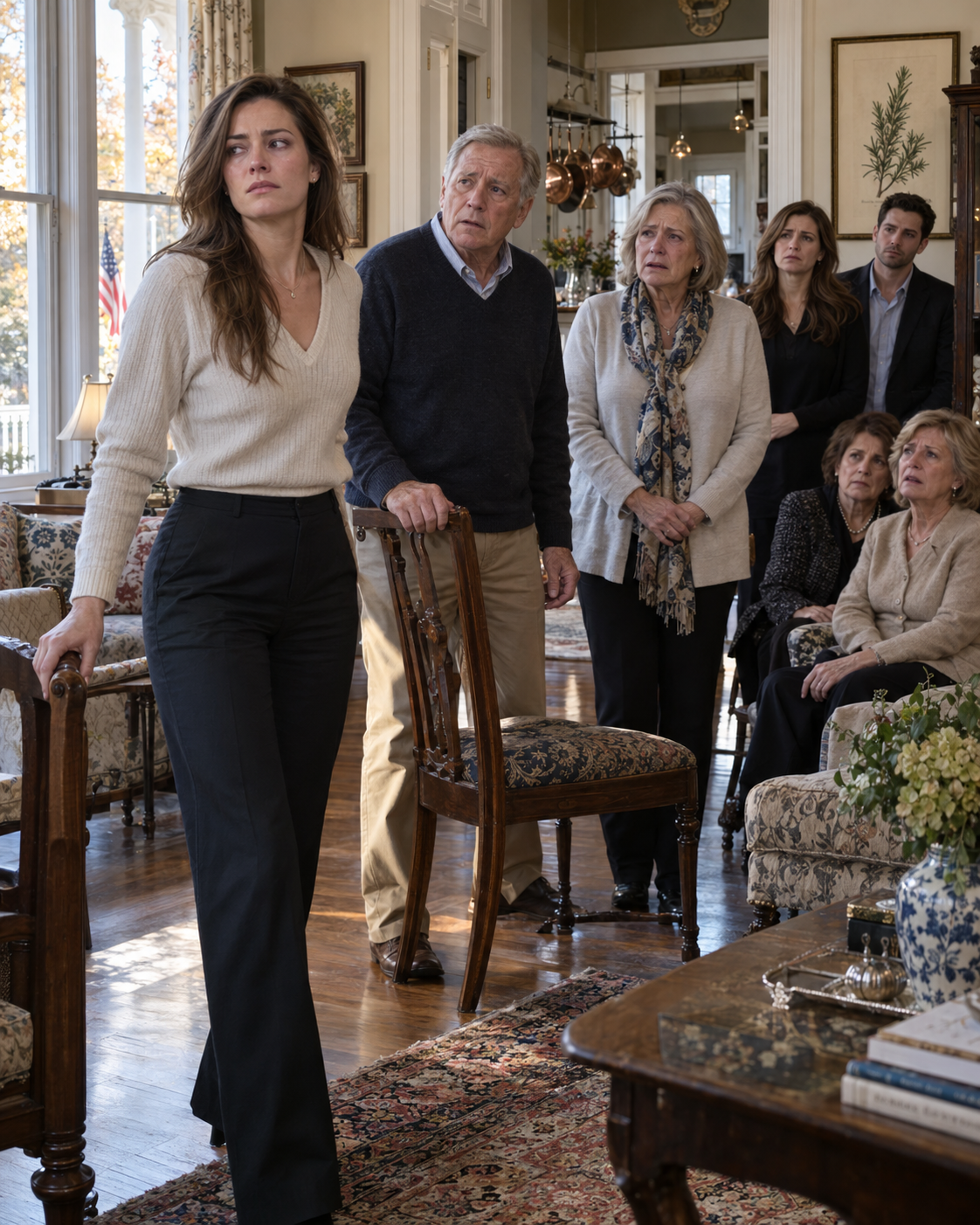
His face fell.
He didn’t argue.
There was nothing left to argue.
My mother gathered her purse.
One of my aunts stared out the window.
The other kept her hands tightly clasped in her lap.
Claudia stood near the doorway.
She looked at me differently now.
Not like the younger sister who had always been in her shadow.
Not like the daughter who had somehow chosen the wrong life.
She looked at me like someone finally beginning to understand what her place in the family had cost someone else.
She stopped beside me.
“I’m sorry,” she whispered.
I nodded.
“I believe you.”
Her eyes filled.
But I knew something she hadn’t learned yet.
Being sorry and having done differently were not the same thing.
One could change the future.
The other could never change the past.
They walked down the front path.
Victor left first, too quickly, his car disappearing through the gate as though he couldn’t get away fast enough.
My parents remained for another moment.
Their car sat at the end of the driveway.
Then it slowly pulled away.
I closed the front door.
The house became silent.
I stood there with my hand still on the lock.
The same house.
The same hardwood floors.
The same copper pots hanging above the kitchen island.
The same afternoon light spilling through the windows.
Nothing had changed.
And somehow, everything had.
I walked into the kitchen and looked at the coffee cups they had used.
For eleven years, I had imagined what it would feel like to confront my family.
I had imagined screaming.
Crying.
Demanding answers.
Instead, I felt strangely peaceful.
I picked up my phone and called Delia.
She answered on the second ring.
“What happened?”
I smiled despite myself.
“Come to Grounded tonight.”
“Why?”
“Bring whoever you want.”
There was a pause.
“What are we celebrating?”
I looked around my empty kitchen.
“Nothing.”
Then I laughed softly.
“Everything.”
By eight that evening, the private dining room at Grounded was full.
Eleven people sat around the table.
My kitchen team.
My catering manager.
Two front-of-house leads who had been with me since year one.
Delia and her husband.
People who had watched me fail.
People who had watched me rebuild.
People who knew what I looked like when I was exhausted.
People who knew when I was pretending not to be scared.
People who had stayed.
I cooked for them myself.
A lamb shoulder that had been braising since morning.
Roasted carrots with whipped feta and sumac.
Warm sourdough I had started the night before without knowing why.
There were candles in the center of the table.
Someone opened a bottle of wine.
Someone told a ridiculous story about the first month at Grounded.
Everyone laughed.
And the laughter felt different from the laughter I remembered from childhood.
It wasn’t polite.
It wasn’t performative.
Nobody was checking who was listening.
Nobody was deciding who deserved to belong.
They were simply happy to be together.
I sat there and realized something.
For years, I had thought my greatest accomplishment was proving my father wrong.
It wasn’t.
I didn’t build Grounded to spite him.
I didn’t build the second restaurant to make Claudia jealous.
I didn’t restore that house so my relatives would finally understand my value.
I had spent years believing I was building a life to prove something.
But sitting around that table, surrounded by people who had chosen to stay, I finally understood.
I had built a life because I wanted one.
And somewhere along the way, the girl who had been desperate to be accepted had become a woman who could decide who belonged.
That realization hurt.
Because it meant my family had not been the center of my story for a very long time.
They had simply been the opening chapter.
Part 3
Driving home that night, Charlotte glowed through my windshield.
Streetlights stretched across the wet pavement.
Restaurants were closing.
People were walking home.
The city looked alive in that quiet way cities sometimes do after midnight, when everything feels less like a place and more like a collection of private lives.
I thought about my father’s words.
“You’ve built something remarkable.”
He was right.
But the remarkable thing wasn’t the restaurants.
It wasn’t the house.
It wasn’t the magazine article.
It wasn’t even the sixty-three people on my payroll.
The remarkable thing was that when I was sixteen, they told me my dream was impractical.
And that impractical dream had become the most reliable thing in my life.
It had fed me.
It had challenged me.
It had introduced me to people who became family.
It had taught me that failure could be survived.
It had taught me that loneliness did not have to become permanent.
And most importantly, it had taught me that love is not measured by who shares your blood.
It’s measured by who shows up.
I pulled into my driveway and turned off the engine.
For a moment, I didn’t get out.
I looked at my house through the windshield.
The windows were glowing warmly.
The porch was exactly where I had rebuilt it.
The kitchen was waiting upstairs.
The table was empty.
But it wouldn’t stay empty for long.
And I thought about my parents asking me to be their lifeline.
There was a strange irony in that.
Because in a way, they had already been my lifeline.
Just not in the way they imagined.
Every dismissal had hardened me.
Every empty chair had taught me not to wait for an invitation.
Every holiday I spent alone had forced me to learn how to create my own traditions.
Every time someone told me I wasn’t enough had pushed me a little closer to discovering that I didn’t need their definition of enough.
I had spent eleven years thinking I was building a life in spite of them.
Maybe I had really been building it because they had taught me one painful lesson they never intended to teach.
If the door won’t open, stop standing outside it.
Build another house.
Build another table.
Build a life so full that you no longer remember why you ever begged to be invited into someone else’s.
I finally stepped out of the car.
The night air was cool.
I walked toward my front door and stopped beneath the porch light.
For years, I had imagined my family standing there.
I had imagined my father knocking.
I had imagined my mother apologizing.
I had imagined Claudia asking me to come home.
But when the moment finally came, I realized something I hadn’t expected.
I didn’t want to go home.
I was already home.
I unlocked the door.
Inside, the house was quiet.
I walked into the kitchen and turned on one small light.
The copper pots reflected the glow.
The hardwood floors carried the faint warmth of the evening.
On the counter was the recipe notebook I had kept since I was ten years old.
The pages were stained.
The corners were bent.
Some of the handwriting was almost impossible to read.
I opened it.
There was a recipe for peach cobbler.
My grandmother’s recipe.
The same dessert that had appeared at the Thanksgiving gathering I hadn’t been invited to.
I traced my finger over the faded handwriting.
And for the first time, I didn’t feel excluded when I looked at it.
I felt grateful.
Because my grandmother had taught me how to cook.
My father had taught me what rejection felt like.
My family had taught me what absence could do to a person.
And the people I met afterward had taught me what presence meant.
All of them had left something behind.
I closed the notebook.
Then I opened the refrigerator and started pulling out ingredients.
I didn’t know what I was making.
I didn’t need to.
Cooking had never been about having every answer.
It had always been about knowing how to begin.
I turned on the stove.
The flame caught.
And as the first pan warmed, I thought about the little girl who once stood on a step stool beside her grandmother, watching someone create something from almost nothing.
She had wanted to make people happy.
She had wanted to build something beautiful.
She had wanted someone to tell her she was good enough.
She never got that from the people she wanted it from.
But somehow, she got something better.
She learned to tell herself.
I smiled.
Then I started cooking.
Not for my father.
Not for Claudia.
Not for the family who had returned when my name appeared in a magazine.
Not to prove anything.
Just because I loved it.
Just because I was home.
And because tomorrow, there would be people at my table.
People who would knock.
People who would stay.
People who would never make me wonder whether there was room for me.
The door had finally closed behind the family that had spent eleven years leaving me out.
But for the first time, I understood that it wasn’t a door shutting.
It was a door opening.
The difference was that I was the one holding the key.
And I had finally learned that sometimes the greatest act of healing is not getting the people who hurt you to regret losing you.
It is building a life so honest, so full, and so completely yours that you no longer need them to.
I had spent years waiting for a seat at their table.
In the end, I built my own.
And at my table, there was always room.
There was always food.
There was always warmth.
And nobody was ever, ever left out.