At my father’s funeral in a crowded chapel in Cedar Falls, Iowa, my brother laughed at my frayed jacket
Part 2
Walter unfolded the letter carefully, as if the paper itself might break under the weight of what was written on it.
My father had always been a man who preferred facts to feelings, numbers to guesses, and contracts to promises.
Yet the handwriting on that page was unmistakably his.
Walter cleared his throat.
Then he began.
“To my family, if you are hearing this, I am no longer sitting at the head of the table.”
No one moved.
Walter continued.
“For years, people have measured my life by land, revenue, expansion, and influence.”
His voice slowed.
“Those things mattered to me once.”
Jason shifted in his chair.
“But in my final years, I learned that a man’s wealth is not measured by how many people work for him, but by how many people would stay when he has nothing left to give.”
My chest tightened.
Maya looked up at me.
Walter read the next line.
“My son Daniel stayed.”
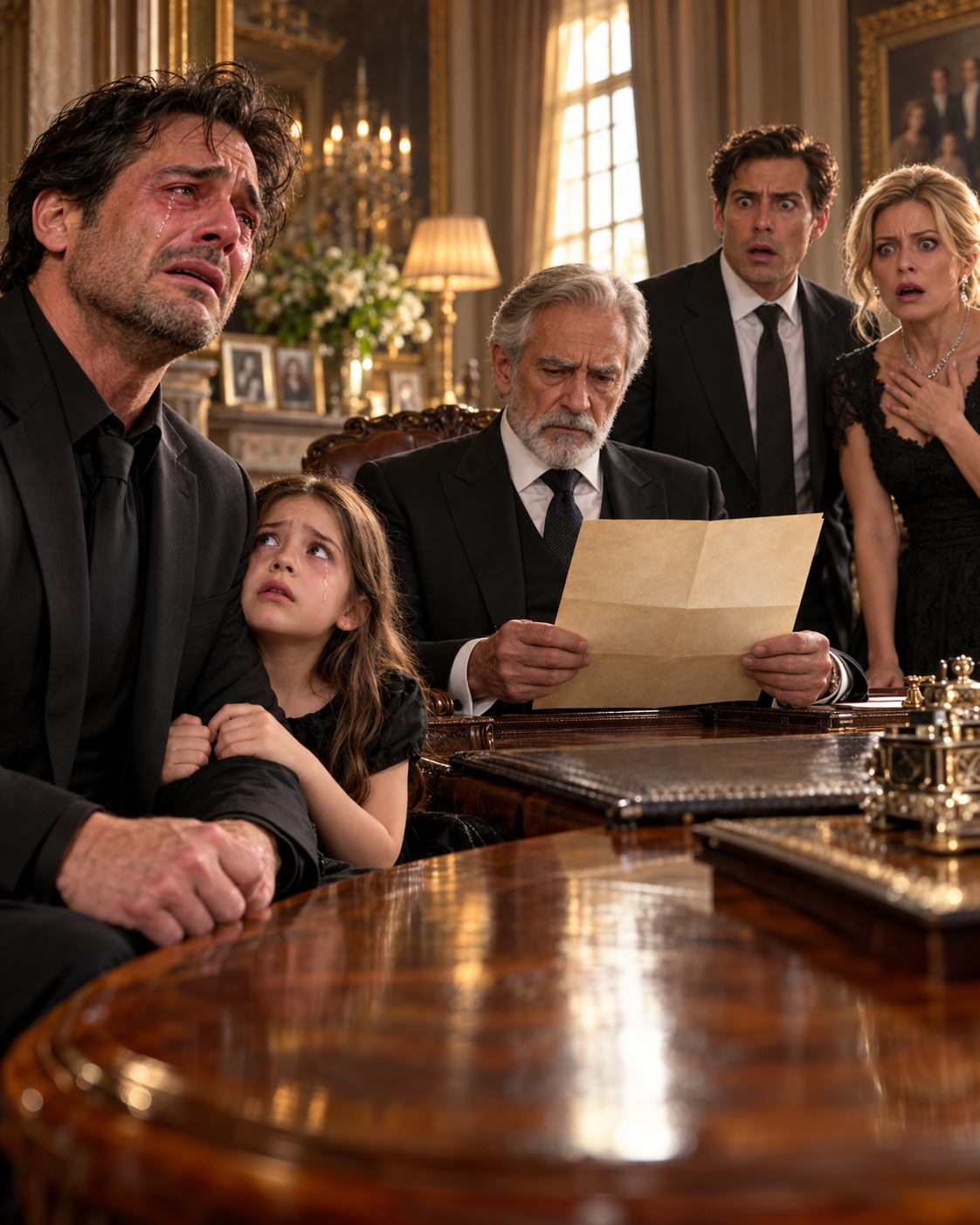
The room became so quiet I could hear the old wall clock ticking in the hallway.
Jason stared at me.
I couldn’t look at him.
I knew if I did, I would see every year I had spent wondering whether I was enough.
Walter went on.
“He stayed without asking for money.”
“He stayed without asking for shares.”
“He stayed without asking what I intended to leave him.”
“He brought me meals.”
“He fixed things around the house.”
“He listened to stories I had already told him.”
“And when I became too weak to care for myself, he gave me something no inheritance can buy.”
Walter paused.
“His dignity.”
I closed my eyes.
A memory came rushing back.
My father sitting at the kitchen table in an old gray sweater, his hands shaking as he tried to lift a spoon.
I had moved the bowl closer.
He had whispered, “Don’t tell your brother.”
I had smiled.
“There’s nothing to tell.”
He had looked at me for a long time.
“That’s why I trust you.”
I opened my eyes.
Walter was still reading.
“I watched my son raise Maya after Sarah’s death.”
“I watched him work with his hands and come home exhausted.”
“I watched him put his daughter to bed before thinking about himself.”
“And I learned something I was too proud to understand when he was young.”
“Strength does not always look like success.”
The words struck me harder than anything anyone had said at the funeral.
Walter lowered the letter slightly.
Then he looked at me.
“Arthur left the main residence and adjoining property to Daniel Bennett.”
Jason stood halfway out of his chair.
“What?”
Walter continued.
“The lake cabin on Lake Macbride, along with the investment portfolio held outside the family trust, shall also pass to Daniel.”
Jason’s face drained of color.
Andrea stared at Walter.
“That can’t be right.”
Walter looked back at the letter.
“It is.”
Then came the sentence that seemed to split the room in two.
“All controlling voting rights attached to my family trust shall pass to my son Daniel.”
Someone behind me whispered my name.
I barely heard it.
The family trust owned the controlling interest in Bennett Harvest Group.
Which meant the company that had once symbolized everything I had supposedly thrown away was now, in part, under my authority.
Jason sat down slowly.
Andrea looked furious.
Walter kept reading.
“Daniel will not be required to manage daily operations.”
A few people exhaled.
My father had anticipated the question before anyone could ask it.
“That would defeat the purpose.”
“The purpose is not to place my son in a boardroom.”
“The purpose is to give him the freedom I failed to give him when he was young.”
Walter’s voice softened.
“I spent much of my life teaching my children that winning mattered.”
“Daniel taught me that being present matters.”
“I saw him raise Maya with patience when grief could have made him bitter.”
“I saw him care for me when I had become difficult to care for.”
“And for the first time, I understood that the quiet life I once considered small was the life I was most proud to witness.”
My vision blurred.
I wiped my eyes before Maya could see.
But she saw anyway.
She reached for my hand.
Jason finally spoke.
“Why didn’t you tell us?”
His voice sounded smaller than it had in the chapel.
I looked at him.
“Tell you what?”
“That you were visiting Dad.”
I stared at him for a moment.
Then I answered honestly.
“Because he needed a son, not an audience.”
No one had anything to say after that.
The attorney read the final lines.
“I leave Daniel my trust because I trust his judgment about people.”
“Let him use it to protect what matters.”
“Let him decide what kind of family we become after I am gone.”
Then, beneath his signature, my father had written one final sentence.
“Daniel, you were never the son I was most worried about losing; you were the son I was most afraid I had already lost.”
I broke.
Not loudly.
Not dramatically.
I simply lowered my head and covered my face with one hand.
Maya slipped her arms around me.
For the first time in decades, I stopped trying to hide my tears.
Jason remained frozen in his chair.
Andrea stared at the floor.
Walter folded the letter and placed it on the table.
No one asked for numbers after that.
No one asked about land.
No one asked about stock.
My father had somehow made every dollar in that room feel embarrassingly small.
A week later, the legal paperwork began.
There were meetings I didn’t understand.
Documents I had to sign.
Financial advisors explaining accounts my father had spent years building.
There were properties I had never seen and investments I had never known existed.
And there was the lake cabin.
I took Maya there one Saturday morning.
The water was silver beneath the early sun.
She walked onto the dock and looked back at me.
“Did Grandpa really give this to us?”
I nodded.
She smiled.
“Can we keep it?”
I smiled back.
“Yes.”
She thought for a moment.
“Then I think he’d like us to use it.”
So we did.
But the money changed something else too.
It gave me a choice.
And I knew my first choice had to be made carefully.
I could have walked into Bennett Harvest Group, fired everyone who had ever underestimated me, and turned every old insult into a punishment.
For a brief moment, I imagined it.
Then I heard my father’s voice in my memory.
Let him decide what kind of family we become after I am gone.
So I decided differently.
And the decision would change hundreds of lives.
Part 3
I kept Jason as head of executive operations.
I kept Andrea overseeing corporate clients.
Neither of them expected that.
They had prepared themselves for revenge, humiliation, and a public demonstration of power.
Instead, I called them into a conference room and closed the door.
Jason looked nervous.
Andrea looked angry.
I placed the documents on the table.
“I’m not taking your jobs,” I said.
Jason frowned.
“Why?”
“Because Dad trusted you to do them.”
Andrea folded her arms.
“You don’t even know how the company works.”
“That’s true,” I said.
“Which is why I’m not pretending I do.”
Jason looked at the papers.
“Then what are you changing?”
I slid the first proposal across the table.
“Employee profit-sharing.”
Neither of them spoke.
“People who help build the harvest should share in the success,” I said.
Then came safety bonuses for crews who maintained strong safety records.
Then a workers’ emergency relief fund for employees facing medical crises, house fires, accidents, or other disasters that could destroy a family overnight.
Jason looked up.
“That was your idea?”
“Yes.”
He stared at the pages.
“Why?”
I thought about the nights my father had called me.
I thought about the people who had shown up for him when no one else saw.
“Because companies are made of people,” I said.
The changes weren’t easy.
Some executives argued that profit-sharing would reduce margins.
Some investors questioned the expense of emergency assistance.
There were meetings.
There were spreadsheets.
There were long arguments.
But the programs stayed.
A few months later, something unexpected happened.
A field worker named Tom Alvarez came into my office.
He was fifty-eight and had worked on the family farms for more than twenty years.
He stood awkwardly in the doorway, holding his cap in both hands.
“I heard about the relief fund,” he said.
I nodded.
“My wife needs surgery.”
His voice shook.
“We’re short.”
I told him to sit down.
He looked at me for several seconds before doing it.
When the assistance was approved, he cried.
Not because the money was enormous.
Because someone had noticed.
After he left, I sat alone in my office and looked at my father’s photograph.
For the first time, I understood what he had meant when he wrote about protecting what matters.
A year passed.
The company continued to grow.
The profit-sharing checks became something employees talked about at lunch.
Safety improved.
The emergency fund helped dozens of families.
And slowly, something changed inside our family too.
Jason stopped making jokes about my truck.
Andrea stopped calling my work “just electrical work.”
She once came to the lake cabin with Maya and stood on the dock beside us.
“I owe you an apology,” she said.
Maya looked at her.
“For what?”
Andrea smiled sadly.
“For thinking I knew what mattered.”
Maya shrugged.
“People make mistakes.”
Andrea laughed quietly.
“You sound like your dad.”
Maya shook her head.
“No.”
Then she pointed toward me.
“I sound like mine.”
I almost laughed.
Instead, I looked toward the water.
My father had been gone for a year.
The anniversary of his death arrived on a cold October morning.
The whole family gathered at his grave.
Jason stood beside me.
Andrea stood on the other side.
Maya held a small bouquet of wildflowers.
The headstone was simple.
Arthur Bennett.
Beloved Father.
At one time, I thought those words would never be enough to describe him.
Now I understood that no stone could hold a whole life.
Not the money.
Not the company.
Not the mistakes.
Not the love.
Jason cleared his throat.
“I didn’t understand him at the end.”
I looked at my brother.
“What do you mean?”
He stared at the headstone.
“I thought he loved the company more than anything.”
I nodded slowly.
“I thought that too.”
Jason gave a faint smile.
“Turns out we were both wrong.”
Maya placed her flowers at the base of the stone.
Then she stood there quietly.
The wind moved through the trees.
For a long moment, nobody spoke.
I thought about the chapel.
The whispers.
The old jacket.
The judgment in Jason’s eyes.
The years when I had wondered whether walking away had made me a failure.
I had spent half my life trying to prove that I was enough.
My father had answered that question only after he knew he was running out of time.
He hadn’t chosen me because I was richer.
He hadn’t chosen me because I was smarter.
He hadn’t chosen me because I was more successful.
He chose me because when there was nothing left to gain, I stayed.
That night, I returned home and placed the handwritten letter in a frame on my desk.
Maya came downstairs in her pajamas.
“What are you looking at?”
I turned toward her.
“Something Grandpa left me.”
She read the first few lines.
Then she smiled.
“That’s nice.”
I nodded.
“It is.”
She climbed onto the chair beside me.
“Are you still sad?”
I looked at the photograph of Sarah on the shelf beside the letter, then at the one of my father.
“Sometimes.”
She leaned against me.
“That’s okay.”
I put my arm around her.
Outside, my old pickup truck sat in the driveway.
It was still scratched.
Still loud.
Still the same truck my family had once used as evidence that I had failed.
I smiled when I looked at it.
Because by then I understood something I wish someone had told me when I was young.
A life does not become valuable because other people finally recognize it.
And love does not become real because someone writes it into a will.
Sometimes the greatest inheritance is simply knowing, at the very end, that the person you spent years trying to impress was quietly proud of the person you became.
I had received the house.
The cabin.
The investments.
The voting rights.
I had inherited more wealth than I ever imagined I would see.
But none of those things was the treasure I protected most carefully.
It was the letter.
That fragile sheet of paper in my father’s handwriting.
Because every time I read it, I heard the answer to a question I had carried since childhood.
Was I enough?
Yes.
Not because I had finally become successful.
Not because I had inherited my father’s fortune.
But because I had learned to stay when staying was hard.
And somewhere between a funeral chapel, a quiet kitchen, and the bedside of a dying man, my father had finally taught me that the life I thought the world had overlooked was the life that had mattered all along.