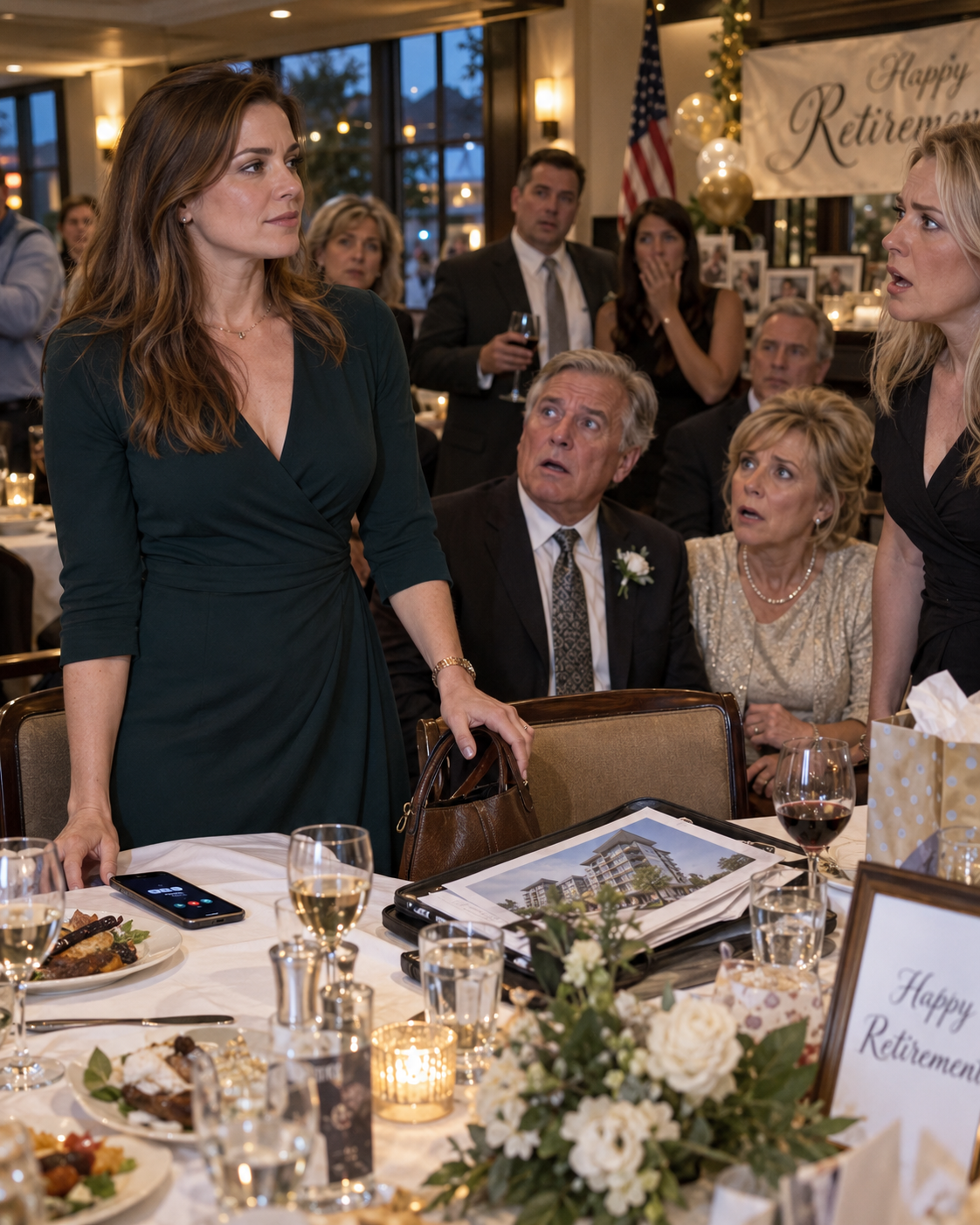
At my father Robert’s retirement party, my sister Victoria stood before our entire 53-member family
Victoria’s message contained only six words.
“Dad never told you the whole story.”
I stared at the screen while the lake moved quietly in front of me.
For years, I had believed the Crystal Lake purchase was exactly what my father had told me it was.
His company needed capital.
I had the money.
He needed help.
I bought the house.
The transaction was legal, documented, and fair.
At least, that was what I thought.
My phone buzzed again.
“Please come back tomorrow.”
I didn’t answer.
I drove home that night with the retirement party still echoing inside my head.
The next morning, Victoria arrived at my apartment carrying a thin cardboard folder.
She looked exhausted.
“Before you get angry, just read this.”
I took the folder.
Inside were copies of old financial statements, business correspondence, and one handwritten note from my father.
I recognized his handwriting immediately.
The note was dated three months before I bought the house.
It said that his company was facing a serious cash-flow crisis and that selling Crystal Lake was the only way he could raise enough money quickly.
I looked at Victoria.
“I already knew Dad needed the money.”
“No,” she said. “You knew he needed money.”
She pointed to another document.
“You didn’t know why.”
The next page showed a list of business liabilities.
Several were much larger than I had ever been told.
My father hadn’t simply needed money for expansion.
He had been trying to prevent the company from collapsing.
I sat down.
“So he used the house to save the company.”
Victoria shook her head.
“He sold the house to you because you were the only person he trusted to actually pay full value without humiliating him.”
I looked at the documents again.
That part didn’t make sense.
“If that’s true, why did everyone act like I was the one who needed help?”
Victoria’s eyes filled with tears.
“Because Dad never told anyone you were the one who saved him.”
The words landed quietly.
Somehow, that hurt more than the public humiliation at the party.
I remembered that day seven years earlier.
My father had called me into his office.
He looked tired.
He had said, “I don’t want charity.”
I had replied, “Then don’t treat this like charity.”
We signed the paperwork.
I transferred the money.
He hugged me afterward.
That was all.
I never asked what happened next.
Apparently, he had used most of the money to keep his employees paid and stabilize the company.
The business survived.
It grew.
And eventually, everyone celebrated his retirement as though he had carried the company alone.
I looked at Victoria.
“Why didn’t you tell me?”
She swallowed.
“Because I didn’t know until last week.”
“Then why did you announce the sale?”
She looked down.
“Because I believed the story everyone else believed.”
“What story?”
“That you were the sister who couldn’t quite get her life together.”
I laughed once, but there was no humor in it.
“And you believed that?”
“I wanted to.”
That answer surprised me.
Victoria sat across from me.
“I’ve spent years comparing myself to you.”
I stared at her.
“You?”
“Yes.”
She looked almost embarrassed.
“You never seemed desperate for approval.”
“I wasn’t.”
“I know that now.”
She took a breath.
“I thought you were pretending to be independent because you couldn’t compete with everyone else.”
I didn’t know what to say.
She continued.
“When you drove that old Honda, I thought you couldn’t afford anything better.”
“I could.”
“When you said you were working freelance, I thought you were between real jobs.”
“I wasn’t.”
“When you moved into this apartment, I thought you were struggling.”
“I bought it.”
She nodded slowly.
“I know.”
For a moment, we sat in silence.
Then she said something I never expected.
“I was jealous.”
The confession was almost a whisper.
I looked at her face and saw something I had never allowed myself to see before.
Not cruelty.
Not arrogance.
Fear.
Victoria had spent years trying to measure herself against me without realizing there was no competition happening on my side.
“I never wanted to beat you,” I said.
“I know.”
She wiped her eyes.
“That might be what makes me feel worst.”
Over the next few days, the family group chat became unbearable.
Everyone wanted to know what had happened at the retirement party.
Some apologized.
Others asked questions disguised as compliments.
One cousin wrote, “We had no idea you were doing so well.”
I stared at the message for a long time.
I finally replied, “I wasn’t trying to prove anything.”
That was the truth.
Money had never been my secret weapon.
Privacy had been my peace.
I had watched relatives announce promotions before their first paycheck.
I had watched people finance expensive cars to impress people they barely knew.
I had watched family members talk about investments while secretly drowning in debt.
I had decided early that if I ever built something, I wanted it to belong to me before anyone knew about it.
The Crystal Lake property became the clearest example.
I had renovated it slowly.
I replaced the roof.
Repaired the dock.
Updated the electrical system.
Turned part of it into a long-term rental.
Then I bought another property.
Then another.
I learned everything I could about commercial leases, residential demand, taxes, maintenance, financing, and risk.
My law background helped.
My patience helped more.
I wasn’t trying to become rich.
I was trying to become free.
The distinction mattered.
A week after the party, my mother called.
“Can you come to dinner?”
I almost said no.
Then she added, “Just us.”
So I went.
My parents chose a small Italian restaurant near their house.
No banquet room.
No relatives.
No audience.
Just four people around a small table.
My father looked older than he had at the retirement party.
When I sat down, he reached across the table.
“I owe you an apology.”
I didn’t interrupt.
“I let everyone believe you were struggling because I didn’t want people asking questions about the money you gave me.”
I frowned.
“You could have told me.”
“I know.”
He looked down.
“I was ashamed.”
“Of needing help?”
“Of needing my daughter.”
I felt my anger soften, but it didn’t disappear.
“You didn’t need to be ashamed.”
“I know that now.”
My mother reached for my hand.
“We should have been proud of you.”
I looked at her.
“You should have known me.”
Her eyes filled with tears.
“That too.”
Dinner arrived.
For a while, we talked about ordinary things.
The sauce.
The bread.
My father’s retirement plans.
Then he said, “The check you gave me.”
“What about it?”
“I can’t accept it.”
“You can.”
“You already gave me enough.”
I shook my head.
“That check isn’t about the house.”
He looked confused.
“It was for you.”
“Why?”
“Because you spent your life building something that helped all of us.”
He stared at me.
“You don’t owe me for that.”
“I know.”
I smiled.
“That’s why I gave it to you.”
He finally understood.
He didn’t need to prove anything anymore.
Neither did I.
The next morning, Victoria called.
“I want to learn.”
“Learn what?”
“How you invest.”
I laughed.
“You’re serious?”
“Yes.”
“What happened to knowing everything already?”
“I discovered I didn’t.”
There was something wonderfully vulnerable about hearing that from my sister.
So I agreed.
We started with one rule.
No shortcuts.
I showed her how I evaluated properties.
How I calculated cash flow.
Why I sometimes walked away from deals that looked impressive.
Why debt could be useful and dangerous at the same time.
Why an investment that made you look wealthy could leave you poorer.
She took notes.
Lots of them.
Sometimes she argued.
Sometimes I corrected her.
Sometimes she surprised me.
Our relationship changed slowly.
Not because she suddenly admired my money.
Because she finally stopped measuring my life against hers.
Then Marcus called.
He was our younger cousin, the one who had spent years talking about starting a business without ever making the first move.
“I heard Victoria is shadowing you.”
“She is.”
“Can I do the same?”
I laughed.
“Is the whole family joining?”
“Maybe.”
That was when I realized something unexpected had happened.
The retirement party had started as an attempt to reduce me to a ten-percent inheritance.
Instead, it had exposed how many people around me had been living according to assumptions they had never questioned.
Not just about me.
About themselves.
I began receiving messages from younger cousins asking about credit.
Then mortgages.
Then contracts.
Then investing.
Most of them were women.
They told me they had never been taught financial independence without being made to feel selfish for wanting it.
That stayed with me.
One night, I opened a blank document and started writing.
Not a book.
Not a business plan.
A curriculum.
Basic financial literacy.
Contracts.
Credit.
Property ownership.
Negotiation.
Emergency funds.
Investing.
The difference between looking successful and being financially secure.
I called it Quiet Wealth.
The first workshop was held in a community center with twelve young women.
I expected awkward introductions.
Instead, one woman raised her hand before I had finished speaking.
“My parents told me money wasn’t something women should worry about.”
Another said, “My boyfriend handles all our finances.”
Another whispered, “I don’t know what’s in my own bank account.”
I looked at them and remembered the banquet table.
The fifty-three faces.
Victoria’s voice.
The ten-percent offer.
The old Honda.
The apartment.
The lake.
All the years I had been quietly building something nobody bothered to understand.
“You don’t have to become wealthy to be independent,” I told them.
“You just need to understand what belongs to you, what you owe, what you are signing, and what choices you actually have.”
The room went silent.
Then someone started taking notes.
Months later, my father asked me to review a business investment.
He didn’t introduce me as his daughter.
He introduced me as his adviser.
That small distinction meant more than he realized.
Victoria eventually sold her expensive car and redirected the money into an investment account.
Marcus began working alongside me on a property analysis project.
Camilla, my cousin, started a savings plan after years of believing financial security was something other people were allowed to have.
The family changed.
Not overnight.
Not perfectly.
But enough.
Still, there was one person who never apologized.
My father had quietly kept an old file from the Crystal Lake transaction.
I didn’t know that until months later.
He brought it to me one Sunday afternoon.
“I think you should have this.”
Inside was the original purchase agreement.
Beneath it was a letter I had never seen.
It was addressed to me.
I unfolded it carefully.
My father’s handwriting covered the page.
“I know you may someday wonder why I accepted your money instead of refusing it,” it began.
He explained that he had known I was capable of building a life on my own long before anyone else did.
But he admitted something else.
He had feared that if he publicly praised my independence, the family would begin depending on me.
So he stayed quiet.
He thought silence was protecting me.
Instead, it allowed everyone to misunderstand me.
At the bottom, he had written one sentence that made my throat tighten.
“I should have protected your name as carefully as you protected my company.”
I folded the letter.
For the first time, I cried.
Not because I was hurt.
Because someone had finally named the thing I had needed for years.
Recognition without possession.
Pride without entitlement.
Love without conditions.
That evening, I drove to Crystal Lake alone.
The sun was disappearing behind the trees.
The house stood exactly where it had always stood.
The porch light came on automatically.
I walked down to the dock and sat at the edge.
For a long time, I listened to the water.
Then I heard footsteps behind me.
It was my father.
He sat beside me without speaking.
“I used to think success meant proving everyone wrong,” I said.
“What do you think now?”
I looked across the lake.
“I think success is being able to live without needing anyone to admit they were wrong.”
He nodded.
“And family?”
I smiled faintly.
“Family should make room for who you become.”
He looked at me.
“We’re learning.”
“I know.”
The wind moved through the trees.
Then my father reached into his jacket and handed me another envelope.
I recognized the handwriting immediately.
But this time, it wasn’t his.
It was Victoria’s.
I opened it.
Inside was a single page with a title at the top.
“Proposal for the Crystal Lake Foundation.”
I looked at my father.
“What is this?”
He smiled.
“Your sister has an idea.”
I read the first paragraph.
Victoria wanted to turn part of the Crystal Lake property into a place where young women could attend free financial literacy workshops.
For a second, I couldn’t breathe.
The house they had once tried to divide without me had become the place where we might teach other people never to surrender their future simply because someone else believed they knew better.
I looked across the darkening water.
Seven years earlier, I had bought that house to help my father survive.
Now it was becoming something neither of us had planned.
A beginning.
Not an inheritance.
Not a family bargaining chip.
Not proof of wealth.
A choice.
And as I folded Victoria’s proposal and slipped it into my bag, my phone buzzed again.
There was a new message from Sarah, my property manager.
“Something unusual just came up regarding the lakehouse.”
I stared at those words beneath the fading evening light.
For the first time, I didn’t feel afraid of what the next chapter might contain.
Whatever was waiting behind that message, I knew one thing now.
I would be the one deciding whether to open the door.