At my eight-year-old son’s birthday table, with thirty relatives watching, my mother snatched his rocket-shaped
“Grandma didn’t take all of it, did she?”
The question landed softly, but it carried the weight of something Wesley had been carrying alone.
I set the tripod down and sat beside him on the patio steps.
“What makes you think that?” I asked.
He looked toward the house before answering.
“When I counted it that night, there were three hundred,” he said.
“I counted it again after Grandma left.”
My stomach tightened.
“How much was missing?”
He held up both hands, then closed one finger at a time.
“Fifty dollars.”
For a second, I couldn’t breathe.
I had assumed he knew only what I had told him.
I had assumed the empty wallet was a symbol in his mind, not evidence in his memory.
“Wesley,” I whispered, “how did you know?”
He shrugged.
“Because Grandma dropped two bills when she opened it.”
I felt the back of my neck go cold.
“What bills?”
“A ten and a twenty,” he said.
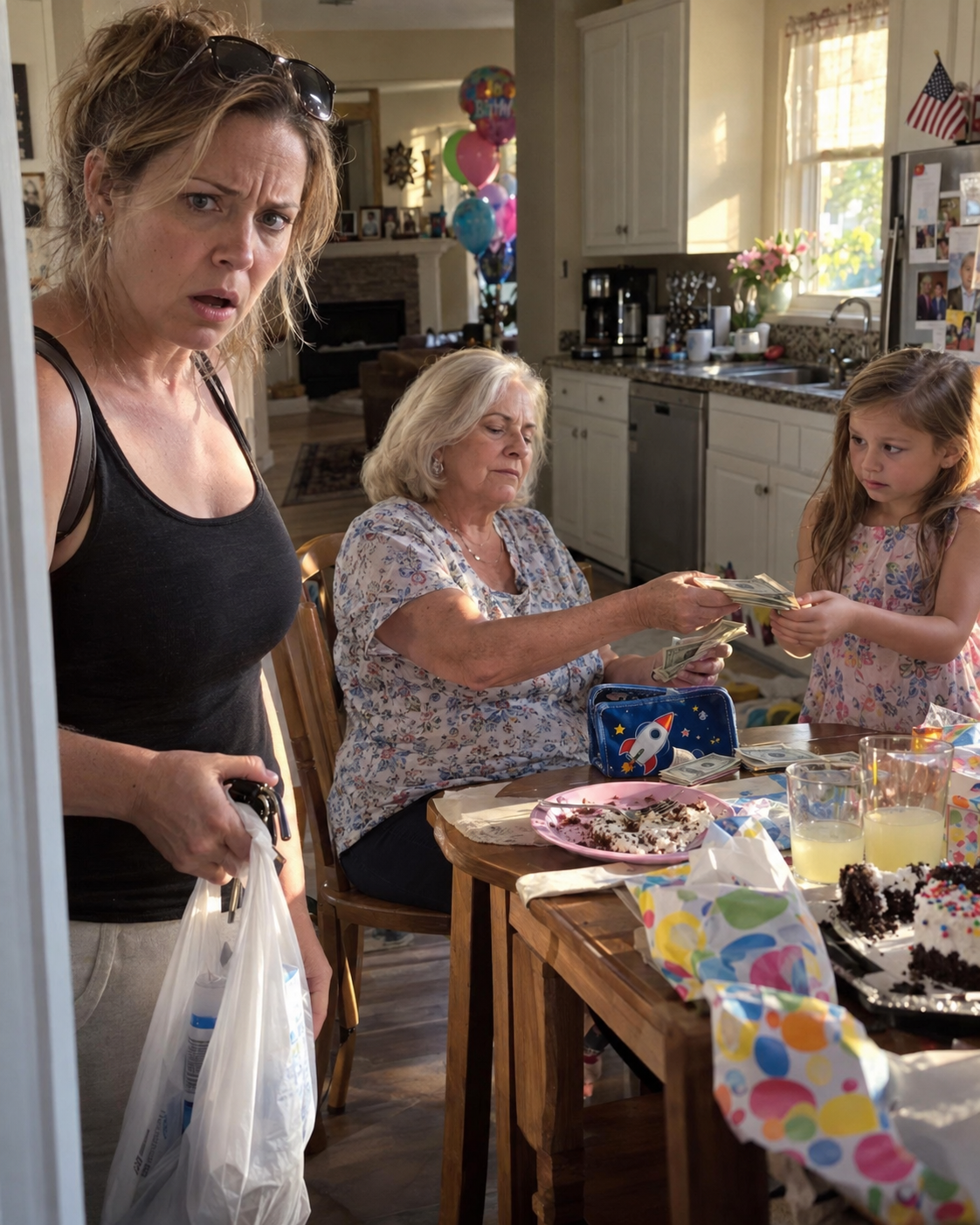
“Then she picked them up and put them with the other money.”
He paused.
“And she told Harlow, ‘Don’t tell your mom because she’ll make a big deal about it.’”
I stared at my son.
“Did you hear that?”
He nodded.
“Why didn’t you tell me?”
He looked down at the grass.
“Because Harlow looked scared.”
That answer broke something inside me.
Not because he had failed to tell me, but because an eight-year-old had been quietly protecting another child from a secret created by adults.
I pulled him against my chest.
“You should never have had to carry that,” I said.
“I know,” he murmured.
“And I should have told you sooner.”
He was quiet for a moment.
Then he asked, “Are you mad at Harlow?”
“No,” I said immediately.
“Are you mad at Grandma?”
I swallowed.
“Yes.”
His eyes dropped.
“Even though she helped Harlow?”
“Yes,” I said.
“Helping someone does not make taking from someone else okay.”
He nodded slowly.
That night, after Wesley fell asleep, I opened the drawer where I kept old bills, birthday cards, and family photographs.
I found a picture from when I was nine years old.
I was holding a brand-new bicycle with a silver bell, smiling so hard my cheeks hurt.
Carol stood behind me with her hand on my shoulder.
I remembered that bike.
What I didn’t remember was why my brother Mark had been standing several feet away, empty-handed.
The memory came back in fragments.
Mark had wanted a baseball glove.
Mom had told him there was no money.
Two weeks later, I had received a second birthday present from Grandma.
A larger one.
A helmet.
Knee pads.
A matching basket.
I had believed I was lucky.
I had never asked why Mark stopped talking to me that afternoon.
I sat on my bedroom floor until midnight, staring at that photograph.
For years, I had told myself Carol simply had a complicated personality.
Suddenly, I wondered how many family wounds had been dressed up as personality.
The next morning, I called my aunt Denise.
I didn’t mention Wesley’s new discovery at first.
I asked her whether she remembered Mark’s ninth birthday.
There was a long silence.
Then Denise said, “I wondered when somebody would finally ask.”
My hands went numb.
“What does that mean?”
“It means your mother has been doing this longer than you know.”
Denise told me about small amounts of cash disappearing from grandchildren’s envelopes.
About school fundraiser money that was supposedly misplaced.
About gifts quietly moved from one child to another because Carol had decided someone else needed them more.
“No one wanted to challenge her,” Denise said.
“Every time somebody tried, she said the family should care more about who needed help than who deserved something.”
My voice shook.
“Why didn’t anyone tell me?”
“Because you were always the one she defended.”
That sentence hurt almost as much as the truth.
I had spent my whole life believing I was the daughter who saw Carol clearly.
Apparently, I was simply the daughter who had been spared the sharpest parts.
That afternoon, Harlow came to my house alone.
She stood on the porch clutching something behind her back.
“I’m not supposed to tell you,” she said.
My heart sank.
“Tell me anyway.”
She pulled out a folded sheet of notebook paper.
It was a list.
Names.
Amounts.
Dates.
At the bottom, written in messy second-grade handwriting, were the words, “Grandma said these kids had enough.”
I looked at Harlow.
“Where did you get this?”
“She keeps a little notebook in her purse.”
I felt something inside me go still.
“Why were you writing it down?”
“So I could remember who got what.”
Her lower lip trembled.
“She told me I was lucky.”
Harlow looked toward the street.
“She said if I gave it back, Mom would be mad because we need money.”
I crouched beside her.
“You did nothing wrong.”
“But I got Wesley’s money.”
“You didn’t take it.”
“She made me hold it.”
That was the moment I stopped seeing this as a family argument.
A child had been turned into a hiding place.
Carol had not just taken money.
She had recruited children into protecting the story she wanted adults to believe.
I called my brother Mark.
Then Denise.
Then Rob.
Then the others who had received Wesley’s cards.
By that evening, eleven adults were sitting around my dining table.
Nobody knew exactly why I had asked them to come.
I placed Harlow’s notebook in the center.
For almost a minute, no one spoke.
Then Denise said, “We should have stopped this years ago.”
Mark picked up the notebook.
His face changed as he turned the pages.
There were names he recognized.
Some were his own children.
Some were cousins.
Some were people who had passed away years earlier.
Then he found one entry and stopped.
It was his own name.
Beside it was an amount and a date from when he was seventeen.
“I remember this,” he whispered.
“What?”
“Mom took fifty dollars from my graduation envelope.”
He laughed once, but there was no humor in it.
“She said she was buying groceries.”
Nobody moved.
One by one, the stories came.
A scholarship check redirected.
A Christmas envelope thinned out.
A birthday gift mysteriously exchanged for something “more practical.”
A child told to be grateful because another child was struggling.
Each story sounded different.
Every pattern was the same.
The room grew heavier with every memory.
Then my mother walked in.
She had not been invited.
She stood in the doorway with her purse on her arm and looked around the table.
“So this is what my own family is doing now?” she asked.
Nobody answered.
Her eyes landed on Harlow.
“Harlow, come here.”
The little girl froze.
I stood between them.
“No.”
Carol’s face hardened.
“She is my granddaughter.”
“And she is scared of you.”
Her eyes flashed.
“You have always been dramatic, Sonia.”
I placed the notebook on the table.
“Did you write this?”
She looked down.
For the first time, I saw the confidence leave her face.
“That doesn’t prove anything.”
“Did you take Wesley’s three hundred dollars?”
“He didn’t need it.”
“That wasn’t the question.”
She looked around the room.
“You people act like I stole from a bank.”
“You stole from a child,” Mark said.
Carol snapped toward him.
“I was helping Harlow.”
“Harlow didn’t ask you to.”
“She needed it.”
“So did Wesley.”
Silence settled over the room.
Then Carol said the words that finally exposed everything.
“Wesley had parents who would replace it.”
Nobody moved.
She had just said out loud what she had spent decades implying.
Some children, in her mind, could absorb loss because they would always be okay.
Others deserved protection because they were not.
I looked at her and realized that the deepest wound had never been the money.
It was the message underneath it.
You are safe enough to be sacrificed.
Carol sat down slowly.
For several minutes, she stared at her hands.
Then she started crying.
Not the angry tears I had expected.
Small, exhausted tears.
“I grew up with five brothers and sisters,” she said.
“We had almost nothing.”
She told us how her parents divided every dollar by need.
How the loudest child got noticed.
How the sick child got everything.
How she learned early that love in a poor house could look like redistribution.
“But there was never enough,” she whispered.
“So I decided no child in my family would go without.”
Denise asked, “Even if you had to take from another child?”
Carol closed her eyes.
“I told myself I was balancing things.”
Mark shook his head.
“You were deciding who mattered.”
She flinched.
“I want you to stop teaching children that silence is kindness.”
Her eyes filled.
“And I want every grandchild to hear the same thing.”
“What thing?”
“That what belongs to them is theirs.”
Her face crumpled.
I wanted to hate her in that moment.
Part of me did.
Another part looked at the woman I had known my whole life and saw a frightened little girl who had spent decades using the wrong solution to an old wound.
Understanding her did not erase what she had done.
But it explained why her choices had always felt less like cruelty to her and more like righteousness.
That was what frightened me most.
People can hurt others for years when they believe they are the hero of their own story.
After everyone left that night, Carol asked me to stay behind.
She sat at my kitchen table with both hands around a cup of coffee she never drank.
“There is something else,” she said.
I almost didn’t want to hear it.
She reached into her purse and took out an old photograph.
It was the same picture I had found in my drawer, the one of me with the bicycle.
“I did this to you too,” she whispered.
I stared at her.
“What do you mean?”
“The bicycle came from money Mark had saved.”
My mouth went dry.
She told me Mark had kept cash in a jar because he wanted a baseball glove.
When he was nine, my birthday came first.
Carol took his savings and used part of it to buy my bicycle.
“She said you were the one who still believed I was good,” Carol told me.
“I thought giving you something beautiful would make the difference.”
I looked at the photograph again.
All those years, I had remembered a bike.
Mark had remembered betrayal.
And Carol had remembered a lesson.
“Why didn’t you ever tell me?” I asked.
“Because then you would have known what kind of mother I was.”
I felt tears gathering in my eyes.
“You didn’t protect me from the truth.”
She looked down.
“I protected myself from it.”
That sentence stayed with me.
Because suddenly, the pattern made sense.
Whenever Carol was confronted, she didn’t deny the pain she caused.
She changed the story around it until she became the person who had sacrificed for everyone.
The problem was that every sacrifice seemed to come from someone else’s pocket.
The next morning, I called Mark.
I told him what Mom had confessed.
He was quiet for so long that I thought the call had dropped.
Finally, he said, “I always wondered why you got a better childhood than I did.”
My heart broke.
“I didn’t know.”
“I know,” he said.
And somehow that made it worse.
We spent an hour talking about memories neither of us had understood correctly.
There were years we had blamed ourselves for things that had never belonged to us.
Years we had carried old resentment without knowing where it started.
That conversation became the first real apology between my brother and me in decades.
Not because we had done anything wrong to each other, but because we finally understood why we had kept our distance.
The promises we made that night were simple, but keeping them took work.
No more secret redistribution.
No more gifts moved without permission.
No child would be asked to lie for an adult again.
A week later, Wesley came home from school carrying a folded piece of paper.
“What’s that?” I asked.
“It’s for Grandma.”
He handed it to me.
It was a drawing of the family standing beneath a huge night sky.
Everyone was holding hands.
At the top, in crooked blue letters, he had written, “You don’t have to be fair by making somebody lose.”
I looked at him.
“Did your teacher help you write that?”
He shook his head.
“I wrote it.”
I hugged him so tightly he laughed.
That evening, I drove him to Carol’s house.
Wesley held the drawing in his lap the entire way.
When Carol opened the door and saw him, her eyes filled immediately.
“I brought you something,” he said.
She knelt.
He handed her the drawing.
She stared at it for a long time.
Then she asked, “Are you still mad at me?”
Wesley thought carefully.
“I was.”
“Are you now?”
“A little.”
Carol nodded.
“That’s fair.”
Wesley studied her face.
Then he said, “You can fix it.”
She wiped her cheek.
“How?”
“By not doing it again.”
Carol laughed through her tears.
“I can try.”
Wesley pointed at the drawing.
“And by hanging that where you can see it.”
“I will.”
Carol repaid the remaining money in installments.
Harlow’s mother accepted only after Carol apologized directly to Harlow.
Wesley never asked for an apology.
He asked for something else.
He wanted the family to have dinner together when nobody was angry.
So we did.
It was awkward.
Nobody knew where to look.
Then Wesley lifted his glass of lemonade and said, “I think families should tell the truth before they have to write it down.”
Everyone laughed softly.
Even my mother.
Later that summer, I took Wesley to the science museum.
He walked through the telescope exhibit with his hands clasped behind his back, studying every model.
When we reached the one he had wanted, he looked at me.
“Can we get it now?”
I smiled.
“We can.”
He didn’t cheer.
He just touched the tripod carefully.
“Then I’ll finally know if Saturn really looks like that.”
We brought it home two days later.
That night, he carried it into the backyard by himself.
I stood beside him while he adjusted the lens.
Then he pointed toward the sky.
“Mom.”
“What?”
“Come look.”
I leaned over the eyepiece.
There it was.
A tiny ringed planet suspended in a field of darkness.
My eyes filled before I could stop them.
“What?”
Wesley looked at me.
“Why are you crying?”
“Because sometimes you find something beautiful after a really hard thing.”
He thought about that.
Then he smiled.
“That’s okay.”
We stayed outside until the air turned cold.
Before going in, I noticed the little blue rocket wallet beside his chair.
It was no longer empty.
Inside was a single folded bill.
Fifty dollars.
I looked at him.
He nodded toward it.
“Grandma gave it to me yesterday.”
My chest tightened.
“She said it was the last part.”
“What do you want to do with it?”
He looked up at the stars.
“I don’t know yet.”
Then he smiled.
“But I know one thing.”
“What?”
“I don’t want to spend it on keeping secrets.”
I laughed through my tears.
And for the first time in a long time, I understood that honesty was not always loud.
Sometimes it was a thank-you card written by a child.
Sometimes it was an adult admitting she had been wrong.
Sometimes it was a family finally choosing to stop calling unfairness generosity.
And sometimes it was simply looking through a telescope at something impossibly far away and realizing that truth, like starlight, can take a long time to reach you.
Wesley leaned against my shoulder.
“Mom?”
“Yeah?”
“Do you think Grandma will ever be okay?”
I looked toward the kitchen window, where my mother stood watching us.
“I think she’s trying.”
Wesley nodded.
“That counts.”
Maybe he was right.
Maybe redemption begins there, not with pretending the damage never happened, but with finally having the courage to stop making it.
My mother lifted one hand from the window.
I lifted mine back.
Then Wesley turned to the telescope again.
And as I watched him search the dark sky for another small light, I realized the greatest thing he had saved that summer was never the three hundred dollars.
It was his trust in his own voice.
That was the gift nobody could take from him.
And for the first time in our family, nobody was going to ask him to give it away.