At my brother’s lavish Oregon vineyard wedding, he watched in HORROR as I stepped out beside a gleaming 1947 Cadillac hearse
Part 2
The weeks leading up to Daniel’s wedding passed in a strange, quiet haze.
At work, everything continued as it always had.
Phones rang before sunrise, families came through the front doors carrying news they could barely speak aloud, and I spent my days helping strangers navigate losses that felt impossible to survive.
At home, however, the silence had changed.
I no longer found myself checking my phone to see whether Daniel had called.
I stopped buying the brand of coffee he liked whenever I went grocery shopping.
I even caught myself reaching for my phone to tell him something funny that had happened at work before remembering that I was no longer the person he wanted to share his life with.
The little habits hurt the most.
A relationship rarely disappears in one dramatic moment.
Sometimes it dies in the ordinary spaces where you used to expect another person to exist.
I told myself that I was done grieving a brother who was still alive.
Then, a week before the wedding, I attended a funeral that changed the way I understood what had happened between us.
The deceased was a retired military officer named Colonel James Walker, a man whose family had asked us to coordinate his final arrangements with a local veterans’ honor guard.
His widow, Margaret, was a small woman with silver hair and hands that trembled whenever she tried to unfold a piece of paper.
She had been married to James for fifty-two years.
When I met her, she handed me a photograph of her husband standing beside a military vehicle, younger than I was now, his uniform immaculate and his expression serious.
“He never liked people making a fuss over him,” she said. “He always said he was just doing his job.”
I studied the photograph.
“Sounds like he was a humble man.”
Margaret smiled through her tears.
“He was. But he was proud of the men he served with, and he never forgot the families who waited for them to come home.”
On the day of the service, I watched the honor guard move with measured precision.
The folded flag was presented to Margaret, who held it against her chest as though she were trying to keep her husband’s heart beating beneath the fabric.
A bugle played.
The notes drifted across the cemetery, thin and mournful against the open sky.
For a moment, nobody moved.
I had stood beside hundreds of graves, but something about that ceremony made me see my profession differently.
I realized that the hearse, the uniform, the flowers, the carefully chosen words, and the final journey were not symbols of something shameful.
They were ways of telling a person, even after death had silenced them, that their life mattered.
That their service mattered.
That their love mattered.
And that nobody should be made to feel embarrassed for honoring them.
After the service, Margaret approached me.
“I don’t know how you do this every day,” she said. “You stand beside people at the worst moment of their lives and somehow make it feel like their loved ones still deserve the very best.”
I had heard similar words before, but that day they settled somewhere deep inside me.
“Everyone deserves that,” I told her.
She looked toward the hearse waiting at the edge of the cemetery.
“Then don’t ever let anyone convince you otherwise.”
I thought about those words on the drive home.
I thought about my brother, who had spent twelve years benefiting from the quiet sacrifices of a man he now considered unsuitable for a wedding photograph.
I thought about our parents, who had never once treated my work as something to be ashamed of.
And I thought about the difference between being unwanted and being unworthy.
For the first time since Daniel’s text, I felt the weight in my chest shift.
The hurt was still there.
But beneath it, something firmer was taking shape.
I wasn’t going to beg for an invitation.
I wasn’t going to call his future in-laws and demand that they recognize my value.
And I wasn’t going to show up at the vineyard to scream, disrupt the ceremony, or humiliate my brother in front of hundreds of people.
But I also wasn’t going to spend the rest of my life acting as though my profession was a dirty secret.
Two days before the wedding, I called an older colleague named Frank Miller, a funeral director who had spent decades collecting and restoring vintage funeral vehicles.
Frank owned a pristine 1947 Cadillac hearse, black as polished obsidian, with chrome trim that caught the light like silver and a long, elegant body that looked as though it had rolled straight out of another era.
I had admired it for years.
When I explained that I wanted to borrow it for a personal reason, Frank was quiet for a moment.
“Is this about your brother?” he asked.
I didn’t answer immediately.
“How did you know?”
“Because you only call me with that careful voice when you’re trying not to sound hurt.”
I laughed once, without much humor.
“I don’t want to do anything stupid.”
“Good,” he said. “Because the car isn’t a weapon, Michael.”
“I know.”
“Then tell me what you want it to be.”
I looked through the office window at the quiet hallway beyond it.
“I want to stop being ashamed of something I never should have been ashamed of in the first place.”
Frank didn’t speak for several seconds.
Then he said, “Bring it back with a full tank, and don’t let anybody convince you that you have to apologize for earning an honest living.”
On the morning of the wedding, I stood in front of my closet for nearly twenty minutes.
I could have worn a regular suit and driven my own car to the vineyard.
I could have stood near the entrance, waited for Daniel to notice me, and told him exactly what I thought of his decision.
But that wasn’t what I wanted.
Instead, I put on my professional director’s attire, carefully buttoned my jacket, straightened my tie, and checked my reflection.
I looked like the man I had worked twelve years to become.
Not a wealthy man.
Not a powerful man.
Not a man who could impress Richard Whitmore with a property portfolio or win Patricia’s approval with the right invitation.
I looked like someone who had chosen to spend his life standing beside people when the rest of the world didn’t know what to say.
And I was proud of that man.
I drove the Cadillac out of Frank’s garage, its engine rumbling softly beneath the hood.
The morning sun glinted across the polished bodywork as I headed toward wine country.
With every mile, I felt the familiar mixture of anger and sadness settle into something steadier.
I wasn’t going to demand that Daniel love me.
Love that had to be purchased with humiliation was not the kind of love I wanted.
I wasn’t going to threaten his marriage or try to take away the future he had chosen.
I was simply going to stand in a place where he could see me and let him confront the reality of what he had asked me to become.
A man who disappeared whenever his existence became inconvenient.
By the time I reached the vineyard, the parking area was beginning to fill.
Luxury sedans and polished SUVs lined the gravel drive, while staff members in dark uniforms hurried between the entrance and the reception hall.
Beyond them, rows of grapevines stretched across the hills beneath a bright spring sky.
White flowers framed the ceremony space.
A string quartet was rehearsing near the terrace.
Everything looked beautiful, expensive, and carefully arranged to suggest that nothing unpleasant had ever happened in the world.
I eased the Cadillac into a prominent parking space near the main entrance.
The engine fell silent.
For a few seconds, I remained behind the wheel with both hands resting on it.
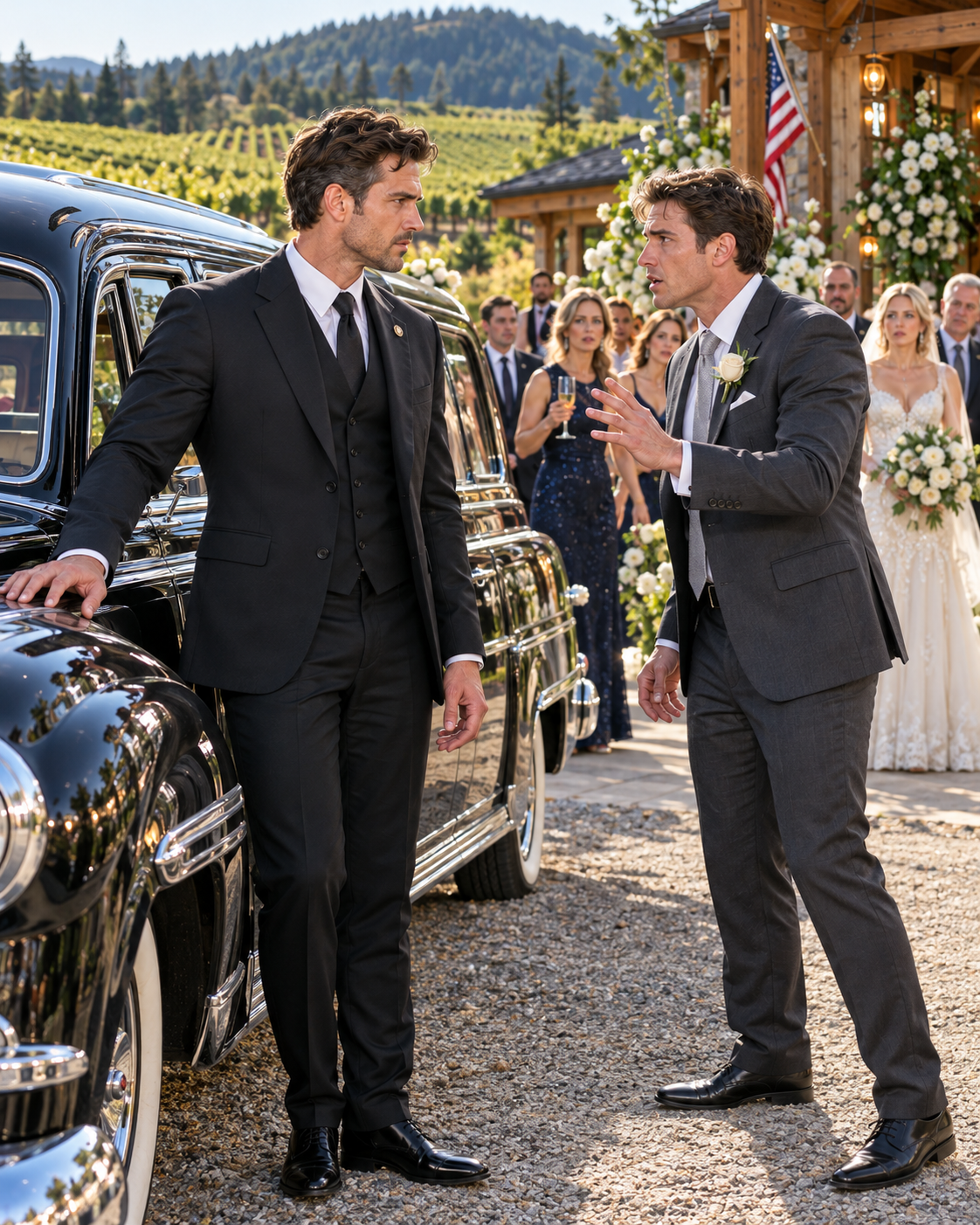
Then I stepped out, closed the door, and stood beside the gleaming hearse.
I wasn’t blocking the entrance.
I wasn’t disturbing the guests.
I wasn’t doing anything that could reasonably be called a scene.
I was simply there, dressed for the work I had devoted my life to, beside a vehicle that represented the very profession Daniel had decided was too embarrassing for me to bring near his wedding.
Guests began arriving.
A few glanced at the Cadillac with curiosity.
One older man paused to admire its chrome trim.
A woman in a pale blue dress whispered something to her companion, who turned for a second look.
I remained still.
Then I saw Daniel.
He was standing near the entrance in a perfectly tailored suit, greeting guests with a broad smile.
For one brief moment, he looked exactly like the boy I remembered, excited and a little overwhelmed by a day he had dreamed about.
Then his gaze shifted toward the parking area.
He saw the hearse.
He saw me.
And the smile vanished from his face.
Part 3
Daniel crossed the gravel so quickly that he nearly collided with a waiter carrying a tray of champagne glasses.
His eyes darted from the Cadillac to the guests gathering near the entrance, and I watched the panic spread across his face.
“What are you doing here?” he demanded in a low voice.
I kept my hands at my sides.
“Good morning to you, too.”
“Michael, are you serious right now?”
He glanced over his shoulder.
A few guests were watching us openly.
“You’re supposed to be at home.”
“You made that clear.”
“Then why are you here?”
I looked at the hearse.
“Because I had somewhere to be.”
He stared at me as though I had deliberately chosen the most offensive answer possible.
“Do you have any idea what this looks like?”
I let the question hang between us for a moment.
Then I said, “It looks like a funeral director standing beside a hearse.”
His jaw tightened.
“Stop doing that.”
“Doing what?”
“Acting like you don’t understand. Jennifer’s parents are here. Their friends are here. This is our wedding day, and you’re making everything uncomfortable.”
I looked past him toward the vineyard.
Guests in expensive clothes were gathering beneath the white floral arch, laughing and taking photographs as though the world had never given them a reason to be afraid of anything.
“Your wedding seems to be going fine,” I said.
“Not if people start asking questions about why there’s a hearse parked outside.”
I felt an unexpected sadness rise inside me.
Not because he was angry, but because even now, with the truth standing directly in front of him, he was still more concerned about what strangers might think than what his own brother felt.
“You asked me not to come because my profession might make people uncomfortable,” I said. “So I stayed away from the ceremony. I’m not inside. I’m not interrupting your vows. I’m standing here.”
He lowered his voice further.
“Just leave, Michael. Please. I don’t want this to become a thing.”
I studied his face.
“Do you remember what you said to me when Mom and Dad died?”
His expression flickered.
“Don’t do this.”
“You asked me what we were going to do now. You were sixteen, and you were scared, and I promised you we’d get through it together.”
He looked away.
“I remember.”
“Do you?”
His eyes snapped back toward mine.
“Of course I do.”
“Then tell me when I became someone you had to hide.”
For the first time since he had approached me, Daniel didn’t have an immediate answer.
His gaze shifted toward the entrance again.
Patricia Whitmore was standing near the steps, speaking to a woman in a cream-colored dress.
She had noticed us.
Richard stood beside her, his expression unreadable.
Daniel saw them watching and visibly stiffened.
“Michael, please,” he whispered. “This is important to me.”
“So was your college education.”
He flinched.
“So was having a place to live when you were sixteen. So was making sure you had a car that could get you to your first job. So was every phone call you made when you needed someone to tell you that you weren’t failing.”
I didn’t raise my voice.
I didn’t need to.
“Those things were important to me because you were important to me. I never asked you to repay me. I never asked you to live your life the way I lived mine. I only thought that when the day came for you to stand beside the person you loved, your brother would be someone you wanted there.”
His face had begun to lose its color.
“That’s not what this is about.”
“Then what is it about?”
He opened his mouth, but nothing came out.
I took a slow breath.
“Is it really that terrible for your new family to know that the man who helped raise you earns his living helping people say goodbye?”
“No,” he said quickly.
“Then why did you let them make you ashamed of me?”
He looked down at the gravel.
I could see him struggling to find a response that would make the situation manageable again, something practical and polished that would turn this into a disagreement over timing rather than a betrayal of everything we had shared.
Finally, he said, “I was trying to avoid conflict.”
I nodded.
“With them.”
He said nothing.
“Not with me.”
The words seemed to settle over him more heavily than any accusation could have.
Behind him, a guest laughed.
Somewhere near the ceremony space, the string quartet began playing again, their music drifting across the entrance like a reminder that the day was moving forward whether Daniel was ready or not.
I looked directly into my brother’s eyes.
“Do you honestly think we can ever be brothers again after this?”
His lips parted.
For a second, I thought he might finally tell me the truth.
Instead, he glanced toward the people watching us.
That small movement answered the question more clearly than words ever could.
I nodded once.
“That’s what I thought.”
I turned toward the Cadillac.
“Michael, wait.”
I stopped but didn’t turn around.
“I didn’t mean for it to happen like this,” he said.
I looked back at him.
“Like what?”
He swallowed.
“I never wanted to hurt you.”
The old version of me would have rushed to make those words easier for him.
I would have told him that I understood, that he had been under pressure, that weddings were stressful, and that we could work everything out later.
I would have taken his discomfort and carried it myself, the way I had carried so many things for him over the years.
But I was tired of making my pain invisible so other people could remain comfortable.
“You didn’t have to want to hurt me,” I said. “You just had to decide that hurting me was acceptable.”
His eyes filled, though whether with guilt, anger, or the fear of being seen differently by the people whose approval he valued, I couldn’t tell.
“Please don’t do this on my wedding day.”
I looked at him for a long moment.
“I didn’t choose the day you made your decision, Daniel. You did.”
Then I opened the driver’s door.
He stood beside the hearse, motionless, as I climbed inside.
I started the engine, and the deep rumble filled the space between us.
Before pulling away, I lowered the window.
“I hope your marriage is everything you want it to be,” I told him. “I mean that.”
He looked stunned by the sincerity in my voice.
“But I need you to understand something. You don’t get to erase me from your life when I’m inconvenient and bring me back when you need someone who remembers where you came from.”
He stepped toward the car.
“Michael—”
I raised a hand, not in anger, but to stop him from saying something he might not mean.
“I love you, little brother. I always will. But loving you doesn’t mean I have to stand still while you teach me how little I matter to you.”
Then I drove away.
In the rearview mirror, I watched Daniel become smaller against the vineyard’s white flowers and rolling green hills.
He didn’t chase me.
He didn’t call my name again.
He simply stood there, a groom surrounded by the people he had chosen, beside a beautiful wedding that suddenly seemed much less certain than it had moments earlier.
I returned the Cadillac to Frank that afternoon.
He was waiting in his garage when I pulled in, leaning against a workbench with his arms folded.
He looked at my face and didn’t ask whether everything had gone according to plan.
Instead, he took the keys from my hand.
“Are you all right?”
I looked at the polished black vehicle, at the reflection of the garage lights running along its chrome trim.
“No,” I admitted. “But I think I’ll be all right.”
Frank nodded.
“Sometimes those are two different things.”
I thanked him and drove home in my own car.
That evening, I cooked dinner for one and sat at the kitchen island where Daniel had once spread his college brochures, his bills, and his dreams.
The house was quiet.
Our parents’ photograph still sat on the shelf, the four of us smiling beneath that summer sun.
I took it down and held it for a long time.
I didn’t feel victorious.
There had been no satisfaction in watching my brother panic, and I took no pleasure in knowing that a few wedding guests had witnessed an uncomfortable moment.
I had not gone to the vineyard to destroy his happiness.
I had gone because I was finally ready to stop destroying my own dignity to protect his image.
That distinction mattered.
The days passed.
Daniel didn’t call.
I didn’t call him.
For a while, I wondered whether he had told Jennifer what happened or whether he had found a way to make me the unreasonable brother in a story that allowed everyone else to remain innocent.
Eventually, I accepted that I might never know.
I returned to work, paid my employees, cared for grieving families, and continued building the life I had made for myself.
There were still difficult mornings.
Sometimes I saw a young man who reminded me of Daniel at sixteen, and I felt the old instinct to check whether he had eaten, whether he had a place to sleep, whether someone was helping him figure out what came next.
I didn’t regret raising my brother.
I didn’t regret paying for his education or helping him become the man he was.
Those choices had been made out of love, and I refused to let the way he treated me turn that love into something shameful.
What I regretted was believing that because I had sacrificed so much for someone, he would always recognize the value of what we shared.
Love could give a person a foundation.
It could not force them to honor it.
Several months later, an envelope arrived at my house with Daniel’s handwriting on the front.
I stood by the mailbox for a long time before opening it.
Inside was a short letter.
He wrote that the wedding had been beautiful, that he and Jennifer had begun their married life, and that he had spent more time thinking about our parents than he expected.
He admitted that seeing me beside the hearse had forced him to confront something he had been trying to avoid.
He had been so afraid of disappointing Jennifer’s parents that he had convinced himself disappointing me didn’t matter as much.
He wrote that he was sorry.
Not because I had shown up at the vineyard.
Not because a few guests had stared.
But because he had treated the person who stood beside him when he had nothing as though he were an embarrassment once he finally had something.
I read the letter twice.
Then I folded it and placed it beside our parents’ photograph.
I didn’t call him that night.
Forgiveness was not a switch I could flip because someone had finally found the right words.
And an apology, however sincere, did not erase the moment when he had looked at me and chosen strangers’ approval over his own brother.
But I no longer felt the same sharp need to make him understand.
I had said what I needed to say.
The rest belonged to him.
Weeks later, I received a message asking whether we could meet for coffee.
I stared at it for several minutes.
Then I agreed.
We met at a small café halfway between our homes, a neutral place with scratched wooden tables and windows that looked out onto a busy street.
Daniel arrived early.
He stood when I entered, then seemed unsure whether he should hug me.
I saved him from having to decide by pulling out a chair.
For the first few minutes, we talked about ordinary things.
His work.
My business.
The weather.
The kind of conversation people have when the most important thing between them is also the hardest thing to say aloud.
Finally, Daniel put his coffee down.
“I’ve been thinking about what you said at the vineyard.”
I waited.
“I thought you were trying to punish me.”
“I wasn’t.”
“I know that now.”
He looked older than he had at the wedding, though only a few months had passed.
“I kept telling myself that Jennifer’s parents were paying for everything, so I had to make compromises. I convinced myself it was just one day, one guest list, one decision.”
He swallowed.
“Then I realized I hadn’t asked you to compromise. I’d asked you to disappear.”
I felt the familiar ache in my chest, but this time I didn’t rush to cover it.
“Yes,” I said. “You did.”
“I’m sorry.”
He looked directly at me.
There was no audience, no vineyard, no future in-law watching him decide what kind of man he wanted to be.
Just my brother, sitting across from me, finally willing to look at what he had done.
“I can’t undo it,” he said. “And I don’t expect you to forget it. I just want you to know that I understand why you left.”
I took a slow breath.
“I never wanted to lose you, Daniel.”
“I know.”
“But I can’t keep being the person who makes every sacrifice so you never have to feel uncomfortable.”
He nodded.
“I don’t want you to.”
We sat quietly for a moment.
Then he asked, “Do you think we can ever get back to how we were?”
I looked at him, at the face that had once been the most familiar one in my life, and chose my answer carefully.
“I don’t think we can go back. Too much has happened, and pretending otherwise wouldn’t help either of us.”
His shoulders dropped.
“But that doesn’t mean there can’t be something ahead of us,” I continued. “If we rebuild anything, it has to be honest. You have to want a brother, not just the version of me who never asks you to face what you’ve done.”
Daniel nodded slowly.
“I understand.”
For the first time in a long while, I believed he might.
We didn’t leave the café with every wound healed.
There was no dramatic embrace, no promise that everything would return to the way it had been before the accident, before the wedding, before we learned how differently two people could remember the same sacrifices.
We simply walked outside together.
At the curb, Daniel paused.
“Michael?”
I turned.
“Mom and Dad would have been proud of you.”
The words struck a place inside me I had kept guarded for months.
I looked away for a second, gathering myself.
“I hope so,” I said.
“They would have been.”
I didn’t tell him that I had spent twelve years trying to make sure he would never have to wonder whether he was loved.
I didn’t need to.
He was beginning to understand.
Our relationship grew slowly after that, with occasional calls and careful visits that sometimes felt awkward and sometimes felt almost familiar.
I learned not to measure his remorse by how often he apologized, but by whether his choices began to change.
He learned that my boundaries were not punishments, and that love did not require me to pretend I had never been hurt.
Some things remained different.
I was no longer the person who automatically solved every problem before Daniel had to face it.
He was no longer the boy who assumed I would always be waiting, no matter what he said or did.
Perhaps that was necessary.
We had lost our parents when he was sixteen, and in the years that followed, I had tried so hard to become both his brother and the safety net beneath his entire life that I had forgotten something important.
He had to grow into his own choices.
And I had to let him.
Today, I still run my funeral home in Oregon.
I still work long hours, still answer calls in the middle of the night, and still stand beside families who cannot imagine how they will survive the next morning.
I still believe that every life deserves to be treated with dignity, regardless of wealth, status, profession, or the opinions of people who think they know what matters.
Sometimes, when I see the old photograph of our family, I remember the promise I made in that hospital corridor.
“We’re going to get through this together.”
I used to believe that promise meant I had to hold on to my brother at any cost.
Now I understand that it meant something different.
It meant I would love him through his grief, support him as he grew, and give him every opportunity I could.
It did not mean I had to let him erase me to prove that my love was real.
The 1947 Cadillac hearse is still one of the most beautiful vehicles I have ever seen.
But when I remember that spring morning, I don’t think first about the guests who stared or the color draining from Daniel’s face.
I remember standing in the sunlight beside something I had once worried people might misunderstand, realizing that honest work was nothing to hide and that the people who truly loved me would never ask me to be ashamed of it.
I remember the question I asked my brother, and the silence that followed.
Most of all, I remember that I drove away without needing to make him feel small.
For twelve years, I had helped him stand tall.
At last, I had learned that I could love him without kneeling.
And if there is one thing I hope he carries with him for the rest of his life, it is this: the people who help you survive your darkest days should never have to become strangers before you understand their worth.
Because money can buy a beautiful wedding, a vineyard full of flowers, and a room filled with people who admire your success.
It cannot buy the brother who stayed awake when you were frightened, the family that loved you before you had anything to offer, or the years you cannot get back once you decide those things are no longer impressive enough to keep.
And sometimes, the greatest dignity you can give someone is not another sacrifice, another rescue, or another chance to hurt you.
Sometimes, it is the quiet courage to stand in the light, remember who you are, and finally stop apologizing for it.