At JFK, an executive snatched my faded blue passport from my hand, held it like something filthy
I stared at the screen until the letters blurred.
The name was Arthur Sterling.
Pamela’s father.
The chairman of the airline.
Daniel watched my face carefully.
“Do you know him?”
“I know who he is,” I said. “But I don’t know why his name is attached to this.”
Daniel leaned back.
“That’s what we’re going to find out.”
Outside the office, the terminal had gone strangely quiet.
The aircraft remained at the gate, passengers still seated while crew members whispered near the forward door.
Through the glass, I could see Pamela standing beside two security officers, no longer surrounded by laughing executives.
Her confidence had disappeared.
Daniel pulled another file.
“The override connected to Arthur Sterling’s name wasn’t a normal executive movement,” he said. “It was used to clear a passenger whose international documentation was incomplete.”
“So Arthur was the passenger?”
“No.”
He paused.
“Arthur was listed as the approving executive.”
The room seemed to shrink.
Daniel opened the passenger record.
The traveler had entered the country under a different corporate identity, and several required checks were still pending.
Pamela had marked the record as executive-cleared.
No legal authority allowed her to do that.
“Is he on the plane?” I asked.
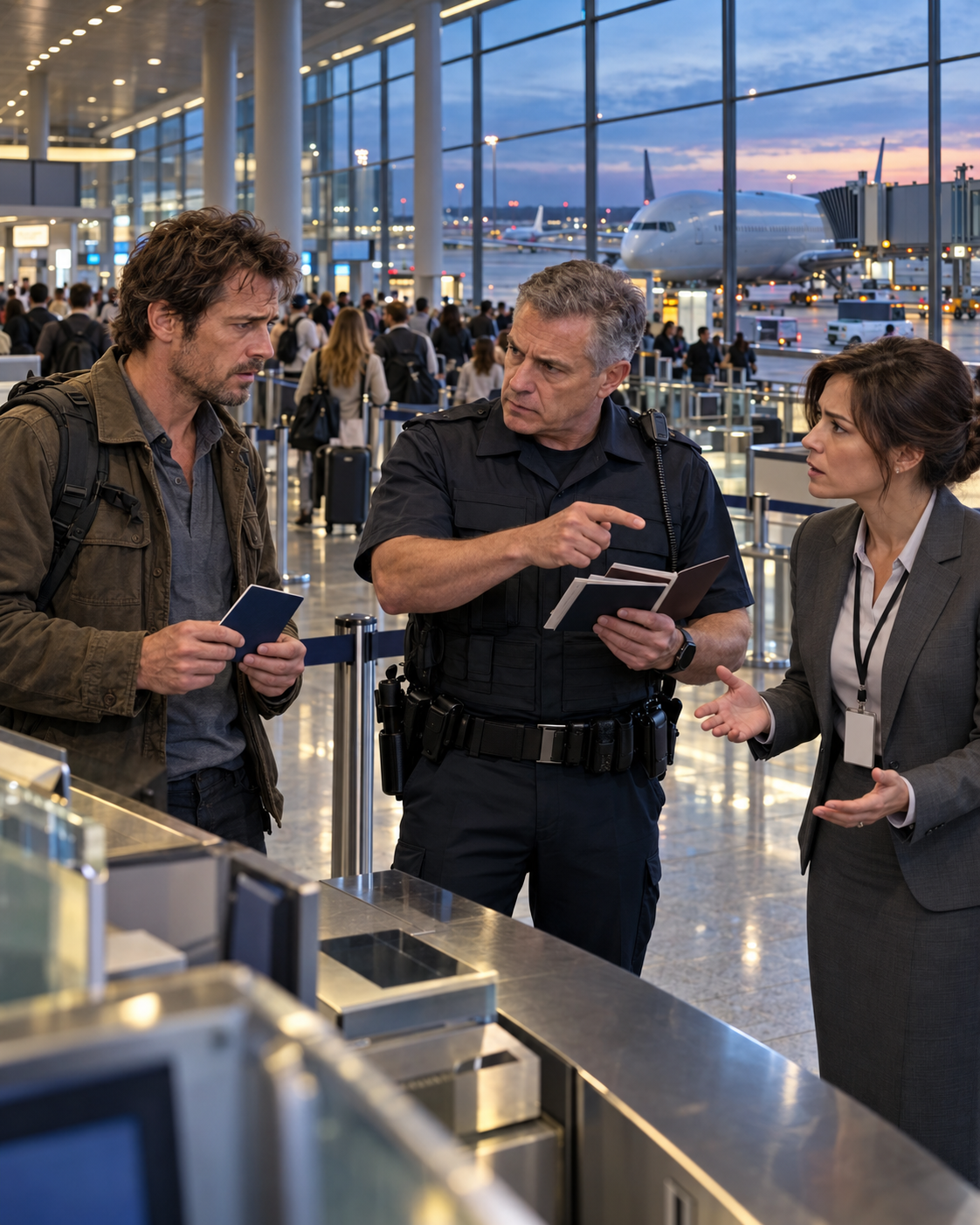
Daniel nodded.
“And there is one other person with the same problem.”
My stomach tightened.
Two passengers.
Two incomplete international clearances.
Both sitting on the same aircraft I had nearly been removed from.
Daniel called an investigator, then asked me to remain silent while he reviewed the access history.
That was when we found the pattern.
Pamela wasn’t randomly humiliating economy passengers.
She was creating obstacles for people whose documentation was clean while quietly moving selected VIP passengers through gaps in the system.
Every time an ordinary passenger questioned her authority, she used delay, intimidation, or a manual denial.
Every time a preferred passenger needed something bypassed, she used the executive code.
The system had recorded everything.
The cruelest part was how ordinary it looked.
A seat changed here.
A document request there.
A passenger sent to secondary inspection.
A boarding pass canceled.
A VIP record marked urgent.
None of those actions alone looked like a crime.
Together, they formed a map.
Daniel traced the entries with his finger.
“She has done this seventeen times tonight.”
“And how many times before tonight?”
He looked at me.
“We’re still counting.”
A knock sounded.
Toby entered.
His face was pale.
He was holding a clipboard so tightly his knuckles had turned white.
“Sir,” he said to Daniel, “I need to tell you something before they ask me.”
Daniel gestured toward the chair.
“Sit.”
Toby sat down.
“I knew some of the overrides were wrong.”
His voice cracked.
“I didn’t know how wrong.”
“What happened?”
Toby swallowed.
“Pamela told us that refusing her instructions could end our careers.”
He looked at me.
“She said the executives controlled promotions, schedules, recommendations, everything.”
I remembered the way his hand had trembled when he scanned my passport.
“You tried to tell her my document was valid.”
“Yes.”
“And then?”
“She told me to execute the denial.”
“Why did you?”
His eyes filled.
“Because I was afraid.”
No one spoke for several seconds.
I had been angry with him.
Now I wasn’t sure where to put that anger.
Fear could make decent people participate in terrible things.
It didn’t erase responsibility.
But it explained how a system could become rotten without everyone inside it becoming cruel.
Daniel asked Toby for his terminal credentials.
Toby handed them over.
Then he told us something that changed the investigation.
“There were instructions,” he said.
“Where?”
“In a private message group used by the gate supervisors.”
Daniel’s expression hardened.
“Show me.”
Toby unlocked his phone.
The messages were short.
If Pamela marked a passenger as a concern, staff were expected to create a reason to delay boarding.
If the passenger was first class, the issue was resolved quickly.
If the passenger was economy, the issue could remain open until the traveler gave up.
The words were not dramatic.
That made them worse.
They sounded like office policy.
Daniel photographed every message.
Then the door opened.
A man in a dark suit entered with two federal investigators behind him.
Arthur Sterling.
For the first time that evening, I saw the man whose name had appeared on the screen.
He looked older than his photographs.
Not weak.
Not frightened.
Just suddenly aware that money could not make the room disappear.
His eyes moved to Pamela through the glass.
Then to Toby.
Then finally to me.
“I understand there has been an incident,” he said.
Daniel stood.
“This is no longer an airline incident.”
Arthur nodded slowly.
“What do you need?”
“Everything.”
There was a long silence.
Then Arthur took out his phone.
“You’ll have it.”
One of the investigators looked surprised.
“Mr. Sterling, your daughter is involved.”
Arthur closed his eyes for a moment.
“I know.”
“You understand that this could affect the company.”
“It already has.”
He looked through the glass again.
“She has authority that I gave her.”
Then he looked at Daniel.
“If she misused it, I won’t interfere.”
Pamela heard him.
Her face changed.
“Dad?”
Arthur did not answer.
She stepped toward the glass.
“You’re really going to let them do this?”
Arthur finally turned toward her.
“I am not going to lie for you.”
Her expression collapsed.
“You don’t understand.”
“I understand enough.”
Her voice rose.
“You built this company.”
“And that is exactly why I won’t destroy it to protect you.”
The room fell silent.
Pamela stared at him as if he had struck her.
Daniel instructed the investigators to continue.
Pamela’s executive access was suspended on the spot.
Her credentials were collected.
Her security authority was revoked.
And the same people who had followed her commands all evening suddenly stopped looking at her.
That was the moment I understood something painful.
Power can look permanent when everyone around you is afraid to say no.
But fear is not loyalty.
It is only silence waiting for permission to end.
The investigation continued for hours.
The two VIP passengers were removed from the aircraft and taken through proper verification.
Neither was automatically declared guilty of anything.
Their records simply had to be completed according to the same rules applied to everyone else.
That distinction mattered to me.
Compliance was never supposed to mean punishment.
It meant applying the standard equally.
By midnight, the transaction logs had been copied, the messages secured, and every disputed override preserved.
Then Daniel found something unexpected.
My own passport scan had been flagged in the system before Pamela ever touched it.
I stared at him.
“Flagged how?”
“Not as invalid.”
He rotated the screen.
“As a test subject.”
My pulse slowed.
“So Pamela knew?”
“We don’t know.”
“Then who did?”
Daniel didn’t answer immediately.
He opened another record.
The request had come from an internal compliance account.
Not Pamela’s.
Not Arthur’s.
Someone else.
The account had no public name.
Only a code.
A code I recognized.
I had seen it eleven years earlier when I was still working as a federal document specialist.
My chair scraped backward.
“Where did you get that?”
Daniel looked at me.
“You know the account?”
“Yes.”
My mouth had gone dry.
“It belonged to a federal investigator who disappeared from the department after an internal corruption case.”
Daniel’s eyes narrowed.
“Disappeared?”
“Transferred, officially.”
“Unofficially?”
I looked at the code again.
“Never heard from again.”
For a moment, the airport noise outside sounded impossibly distant.
The story I had believed I was auditing suddenly looked larger than an airline executive.
There were people behind the system.
People who understood the weaknesses.
People who knew exactly how to make abuse look like ordinary administration.
Daniel asked me whether I wanted to stop the investigation.
I almost laughed.
“No.”
He waited.
“I want to know why my name was selected.”
He nodded.
“That answer may take us beyond this terminal.”
Before I left the terminal, Daniel stopped me near the security corridor.
“There is one thing I need you to understand,” he said.
“What?”
“This investigation doesn’t end because your flight leaves.”
“I know.”
“No,” he said quietly. “I mean it may not be safe for you to treat this as a normal compliance case.”
I looked at him.
“Are you warning me?”
“I am telling you what the records suggest.”
He handed me a card with a secure number.
“Call if anything changes.”
“What about Pamela?”
“She’ll face the process like everyone else.”
“And Toby?”
“His cooperation will be documented.”
I nodded.
Then Daniel added, “You protected him when you could have destroyed him.”
“I didn’t protect him.”
“You gave him a chance to tell the truth.”
I thought about that all the way to the aircraft.
Maybe that was the part of power people misunderstood.
Real authority wasn’t the ability to ruin someone.
It was having enough control over yourself not to do it when you could.
Three hours into the flight, another message arrived from Daniel.
The federal team had discovered forty-three additional manual interventions over the previous six weeks.
The same pattern.
Ordinary passengers delayed.
Preferred travelers accelerated.
The records were now being compared across multiple airports.
Then came the sentence that kept me awake.
“Your assessment appears to have uncovered a network, not an individual.”
I turned off my phone.
For several minutes, I listened to the engines and watched darkness move beyond the window.
I thought about Pamela’s face when Arthur refused to protect her.
She had looked less like a powerful executive and more like a daughter who had finally discovered that the rules she bent for everyone else could reach her too.
I didn’t feel triumph.
I felt tired.
People often imagine justice as a door slamming shut.
Sometimes it is simply a door opening, and everyone inside has to decide whether to walk through it honestly.
When I finally arrived in London, I carried that thought with me.
And when I saw Clara, I realized why I had stayed calm at the gate.
Not because I was fearless.
Because there are moments when anger asks you to make the story about yourself, while love asks you to survive long enough to finish it.
The flight crossed the Atlantic under a pale morning sky.
I slept for perhaps twenty minutes.
When I woke, there was a message waiting on my phone.
No sender name.
Only six words.
“You were never the real target.”
I stared at the screen.
Then another message appeared.
“Ask Arthur about the archive.”
I read it twice.
Then I deleted nothing.
When we landed at Heathrow, Daniel had already arranged for another investigator to meet me, but I refused to miss Clara’s opening.
For once, I wasn’t an auditor.
I was a father.
I took a taxi through London streets washed silver by rain.
The gallery was tucked between two old buildings, its front windows glowing against the gray afternoon.
I walked inside.
Clara was standing beside her largest painting.
She saw me before I saw her.
Her face changed instantly.
“Dad?”
I smiled.
She ran across the room and wrapped her arms around me.
I held her so tightly that for a few seconds, JFK disappeared.
The gate disappeared.
Pamela disappeared.
The screen with seventeen overrides disappeared.
There was only my daughter.
“You made it,” she whispered.
“I promised.”
She pulled back and studied my face.
“You look tired.”
“I had an interesting flight.”
She laughed.
Then she took my hand and led me toward her painting.
It showed a crowded airport terminal.
Hundreds of tiny figures moved beneath a huge departure board.
But one person stood alone near a gate.
His passport was blue.
His face was turned away.
I stopped walking.
“Clara.”
She looked at me.
“I painted that before you left.”
“Why an airport?”
She shrugged.
“I don’t know.”
I stared at the canvas.
Then I noticed something in the corner.
A small black symbol.
Three letters.
The same three letters that appeared in the federal account code Daniel had shown me.
My heart began pounding.
“Where did you get that symbol?”
Clara frowned.
“From an old sketchbook.”
“Who gave you the sketchbook?”
She hesitated.
Then she said something that made the room tilt beneath me.
“Grandpa.”
Arthur Sterling.
My daughter had never met him.
Not knowingly.
I looked at her.
“What did he tell you?”
Clara’s smile disappeared.
“He said if you ever asked about the blue passport, I should tell you the truth.”
The gallery suddenly felt too quiet.
“What truth?”
She reached into her bag and pulled out a small envelope.
My name was written across the front in Arthur’s handwriting.
I opened it with shaking hands.
Inside was a photograph.
It showed me eleven years younger, standing inside a federal office beside a sealed archive cabinet.
On the back, Arthur had written one sentence.
“You were right about the missing files.”
I read it again.
Then again.
Clara watched me.
“What does it mean?”
I folded the photograph slowly.
“I don’t know yet.”
But that was a lie.
I knew enough.
The passport had never been the problem.
Pamela had not created the trap.
She had only stepped into it.
And somewhere between an airport gate, a federal archive, and a nineteen-year-old girl’s painting, someone had been waiting eleven years for me to notice what had been erased.
I looked at Clara and forced a smile.
“Tonight, we celebrate your exhibition.”
She smiled back, but her eyes stayed worried.
“And tomorrow?”
I looked down at the photograph.
“Tomorrow, I find out who wanted me to disappear.”
Outside the gallery, rain began tapping against the glass.
Behind me, Clara’s painting seemed to watch the door.
And for the first time in eleven years, I wondered whether the people who had been hiding the truth were finally more afraid of me than I was of them.