At Chloe’s memorial, my mother stood beside the flowers, pointed at me in front of a room full of mourners
Part 2
The courthouse smelled like old paper, polished wood, and nervous people pretending not to be afraid.
Eleanor sat across the aisle from me wearing a navy suit and the expression she had perfected for every family gathering: wounded, dignified, completely innocent.
Beside her sat the attorney she had hired.
He was aggressive from the moment the hearing began.
He described my military career as unstable.
He referred to combat deployments as “dangerous choices.”
He suggested that the demands of my service could interfere with Lily’s emotional development.
He never once asked how many missions I had completed without incident.
He never asked whether I had been promoted.
He never asked whether I had a spotless disciplinary record.
He certainly never asked what Chloe had wanted.
He spoke about me as though I were a storm that had somehow wandered into a courtroom.
My attorney waited.
She had warned me not to react.
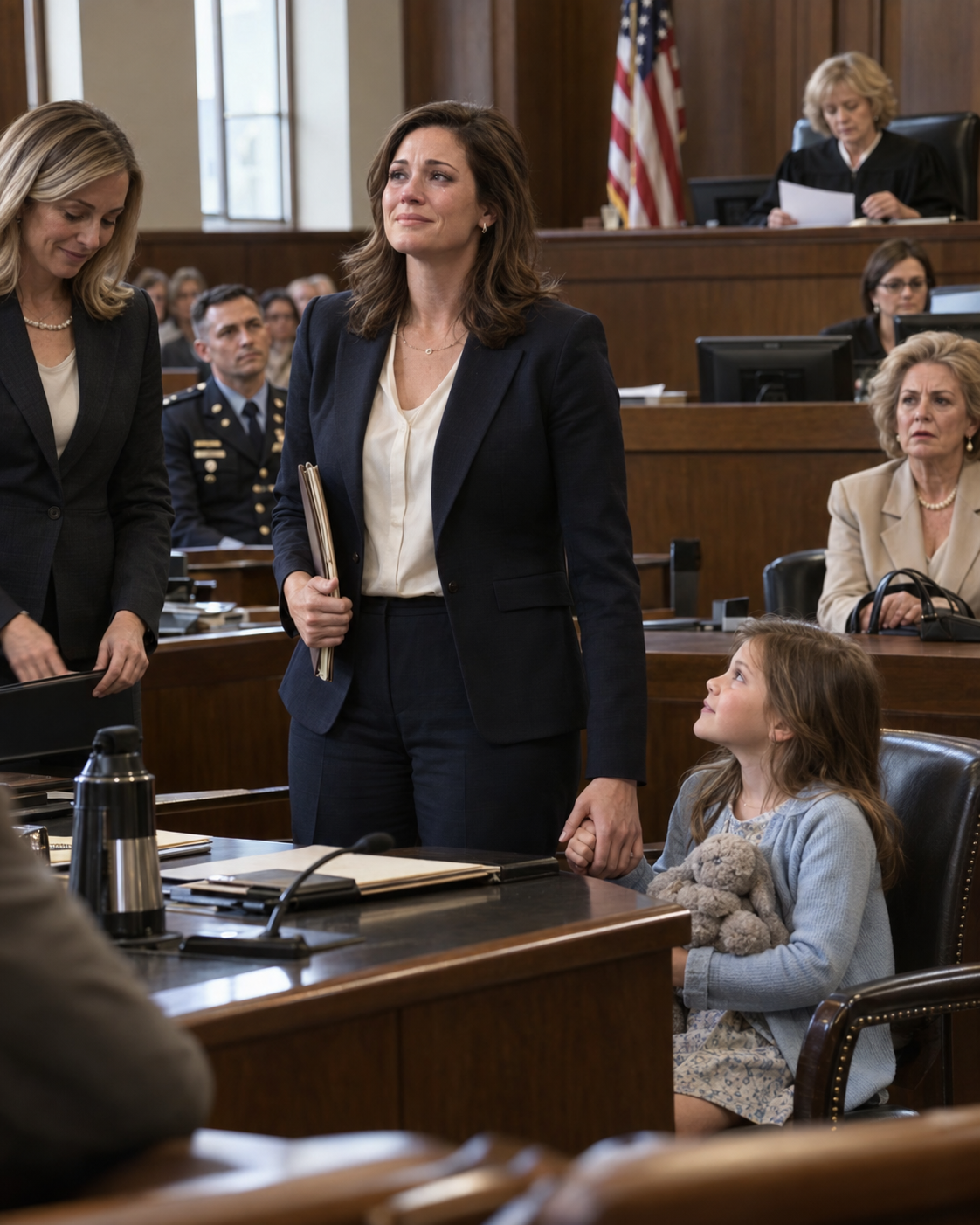
So I sat still.
Years of military training made that easier than my childhood ever had.
Then she stood.
“Your Honor, before we discuss speculation, I would like the court to review the guardianship documents signed by Chloe.”
The courtroom became silent.
She placed the papers on the table.
“These documents were executed legally and witnessed.”
Eleanor’s expression changed.
Only slightly.
But I saw it.
My attorney continued.
“Chloe explicitly named her sister as Lily’s sole guardian in the event of her death.”
The opposing attorney tried to dismiss the documents as one piece of evidence among many.
My lawyer nodded.
“Agreed.”
Then she handed the judge my service record.
Commendations.
Evaluations.
Promotion history.
Medical readiness.
Flight hours.
Incident reports.
There were no scandals.
No disciplinary actions.
No unexplained absences.
No evidence of recklessness.
Just years of consistent performance.
Still, Eleanor’s attorney leaned toward the judge and said, “Military service is inherently dangerous.”
The judge glanced down at the papers.
“So is driving on the interstate,” she said.
The attorney stopped.
But the tension in the room did not lift.
Because evidence on paper could describe what I had done.
It could not fully show who I was.
That was when my attorney called Marcus Vance.
The courtroom doors opened.
Marcus walked in wearing his service uniform.
He looked exactly the way he had after difficult missions.
Calm.
Straight-backed.
Uninterested in theater.
He took the witness stand.
My attorney asked, “How long have you known the respondent?”
“Fourteen years.”
“During that time, have you served with her directly?”
“Yes.”
“How would you describe her judgment under pressure?”
Marcus looked at me.
Then back at the judge.
“Steady.”
The opposing attorney stood.
“Isn’t it true that she has participated in dangerous missions?”
“Yes.”
“Isn’t it true that people have died during some of those missions?”
Marcus did not flinch.
“Yes.”
“And you expect this court to believe that someone who routinely places herself in danger is the safest choice for a six-year-old?”
Marcus took a breath.
“I expect the court to understand that you are confusing danger with recklessness.”
The attorney frowned.
Marcus continued.
“I’ve watched her make decisions while rounds were hitting the aircraft.”
He paused.
“I’ve watched her land when landing was the hardest option available.”
He looked at the judge.
“She doesn’t panic.”
The attorney tried to interrupt.
Marcus waited until he was done.
Then he said, “I would trust her with my own children’s lives.”
The room went completely still.
My eyes burned.
Marcus had never given a speech about me before.
He didn’t need to.
He had simply told the truth.
The judge thanked him.
Then my attorney turned toward me.
“You may make your statement.”
I stood.
My knees felt weak.
Not from fear.
From the weight of everything I had never said.
I looked at Eleanor.
She stared at me with the same expression she had worn when I was fifteen and she forgot to attend my awards ceremony.
For a second, I saw both moments layered together.
The child standing alone with a certificate.
The woman standing alone in a courtroom with a grieving niece depending on her.
I began carefully.
“My mother is right about one thing.”
Eleanor lifted her chin.
“Parenting a child is not about having a perfect life.”
I took a breath.
“It is about being there.”
I told the judge that Chloe had trusted me.
I told him she had selected me legally and deliberately.
I told him that Lily already had a bond with me.
Then I turned toward Eleanor.
“For most of my life, my mother taught me that love could be withdrawn whenever I stopped being convenient.”
Eleanor’s face tightened.
I continued.
“I learned not to ask for approval because asking never made it arrive.”
My voice shook, but I did not stop.
“She praised my sister because Chloe made her feel admired.”
I looked at Lily.
“She ignored me because I learned to stand on my own.”
The opposing attorney objected.
The judge allowed me to continue.
“My military career did not make me unreliable.”
I looked directly at my mother.
“It taught me to be accountable when everything is going wrong.”
Eleanor whispered, “This is unfair.”
I heard her.
I kept going.
“You spent my childhood telling me that I was too distant, too serious, too difficult, and too ambitious.”
My chest hurt.
“But now you want to take Chloe’s daughter because you say you know what children need.”
I swallowed.
“You don’t get to disappear from someone’s life when they stop entertaining you, then suddenly call yourself essential when there is something worth controlling.”
Eleanor’s eyes widened.
I had never spoken to her that way.
Not once.
“But this isn’t really about me anymore.”
I looked at Lily.
“It’s about whether she gets to grow up believing that love is conditional.”
My voice softened.
“I will not let that happen to her.”
The courtroom was quiet enough that I could hear the clock on the wall.
“I spent my whole childhood learning how to survive being overlooked.”
I took one final breath.
“I will spend the rest of my life making sure Lily never mistakes neglect for love.”
The judge looked down at the documents again.
Then at Eleanor.
Then at me.
He took his time before speaking.
“Full custody will be awarded to the petitioner.”
I closed my eyes.
For one second, I heard nothing.
Then the words settled.
It was over.
Eleanor sat completely still.
No tears.
No performance.
No speech.
Just silence.
For the first time in my entire life, my mother had nothing to say.
I walked out of the courthouse holding Lily’s hand.
She looked up at me.
“Are we going home?”
I crouched beside her.
“Yes.”
She nodded.
“Your home?”
I smiled.
“Our home.”
And somehow, that two-word answer carried more weight than every argument I had ever lost.
Part 3
The weeks after the hearing were quieter than I expected.
There were no newspaper headlines.
No dramatic confrontations.
Just paperwork, school enrollment, new routines, and the thousand small decisions that come with becoming responsible for a child overnight.
Lily needed a room.
So I let her choose the color.
She picked yellow because, according to her, “It looks happy even when the sky is gray.”
I bought a little desk for homework.
We put glow-in-the-dark stars above her bed.
She kept her stuffed rabbit beside the pillow every night.
The first few evenings, she asked whether I had to go away again because of work.
I told her the truth.
“Sometimes I’ll have duties.”
She stared at me.
“But you’ll come back?”
“I will always come back when I can.”
She seemed satisfied with that.
Then she asked whether I could make pancakes.
I laughed.
“Terribly.”
She smiled.
“Okay.”
It was strange how healing ordinary moments could be.
Breakfast.
Homework.
Grocery shopping.
A missing tooth.
A scraped knee.
The way Lily left crayons on the kitchen table and socks in the hallway.
Nothing dramatic happened, and that became the most beautiful part.
My mother reached out several weeks later.
Her message began with, “I think it’s time we move forward as a family.”
I read it twice.
There was no acknowledgment of the memorial service.
No mention of the courtroom.
No apology for hiring a lawyer to take Chloe’s child from me.
No recognition of the years before any of it.
Just a request to move forward.
As if history were something she could fold up and put away whenever it became inconvenient.
She called later that afternoon.
I answered.
“I don’t want to fight anymore,” Eleanor said.
“Neither do I.”
“We should focus on Lily.”
“I am.”
She hesitated.
“I want us to heal.”
I looked toward the hallway.
Lily was sitting on the floor drawing helicopters.
“You can’t heal something you refuse to name,” I said.
“Why are you always making everything so difficult?”
I almost smiled.
There it was.
The old sentence.
The sentence that had followed me for decades.
“You still don’t understand,” I said.
“What?”
“I’m not angry because you failed to praise me.”
Silence.
“I’m angry because you taught me that love had to be earned.”
She said nothing.
“And I will not let you teach Lily the same lesson.”
Her voice became cold.
“So that’s it?”
I looked at the kitchen window.
Sunlight was spilling across the floor.
“No.”
She waited.
“This is the part where it ends.”
I ended the call.
Then I blocked the number.
It was not revenge.
It was not punishment.
It was a boundary.
There was a difference.
For years, I had thought cutting ties would feel like losing something.
Instead, it felt like putting down a weight I had forgotten I was carrying.
That evening, I drove Lily home from school.
She fell asleep in the backseat before we reached our street.
Her backpack rested beside her.
One sneaker had come off.
A drawing sat on the seat.
It showed two stick figures standing beside a helicopter beneath a giant yellow sun.
At the bottom, in uneven handwriting, she had written, “MY HOME.”
I pulled into the driveway and turned off the engine.
For a moment, I simply sat there.
The neighborhood was quiet.
The porch light glowed.
Lily breathed softly in the backseat.
I looked at her reflection in the rearview mirror.
And I thought about the girl I had once been.
The girl who waited for her mother to notice the certificate.
The girl who learned not to celebrate too loudly.
The girl who believed being overlooked meant she was somehow lacking.
She had never been lacking.
She had simply been looking for love in a place that treated love like a reward.
I opened the back door carefully.
Lily stirred.
“Are we home?”
“Yes.”
She smiled without fully waking.
“Good.”
I carried her inside.
Her head rested against my shoulder.
She was getting heavier.
I was grateful for it.
Children are supposed to grow heavier in your arms before they eventually outgrow them.
They are supposed to ask too many questions.
They are supposed to leave shoes everywhere.
They are supposed to test boundaries because they trust someone will still be there afterward.
I put Lily into bed.
She reached for my hand.
“Stay until I fall asleep.”
“Okay.”
I sat beside her.
The room was dark except for the little stars above her bed.
She closed her eyes.
Within minutes, her breathing slowed.
I stayed anyway.
Because that was the thing my childhood had taught me more clearly than anything else.
Presence mattered.
Not speeches.
Not photographs.
Not public appearances.
Presence.
You could spend years telling someone you loved them, but if you disappeared whenever they needed you, the words eventually became meaningless.
I looked at Lily and made myself a promise.
She would never have to wonder whether she mattered.
She would never have to become exceptional just to earn tenderness.
She would never have to make herself smaller to keep someone else comfortable.
She would know she was loved before she ever learned what love cost.
Outside, the wind moved through the trees.
The house creaked softly around us.
I thought about Chloe.
I wondered whether she had known, when she signed those papers, just how deeply I would carry that trust.
Maybe she had.
Maybe that was why she chose me.
Not because I had the easiest life.
Not because I could guarantee safety.
But because she knew I would protect Lily without needing anyone to see me do it.
That night, after Lily fell asleep, I stood in the hallway for a long time.
There was no victory waiting for me.
No applause.
No audience.
No one to tell me I had finally proven my worth.
And strangely, I didn’t need one.
The older I got, the more I understood that some of the most important things in life happen without witnesses.
A pilot steadies the aircraft.
A mother keeps watch beside a hospital bed.
A child falls asleep believing someone will still be there in the morning.
A woman finally walks away from a relationship that taught her to doubt her own value.
None of those moments require applause.
They require courage.
I turned off the hallway light.
Then I walked to my bedroom and looked once more toward Lily’s door.
For the first time, I understood that my worth had never been something Eleanor could give me.
So she could never take it away.
She could ignore it.
She could belittle it.
She could pretend it did not exist.
But she had never owned it.
Neither had anyone else.
And somewhere between the cockpit of a helicopter and the bedroom of a sleeping six-year-old, I had finally learned the truth my mother never could.
The deepest kind of strength is not being seen.
It is knowing who you are when nobody is looking, and choosing to become the safe place you once spent your whole life searching for.