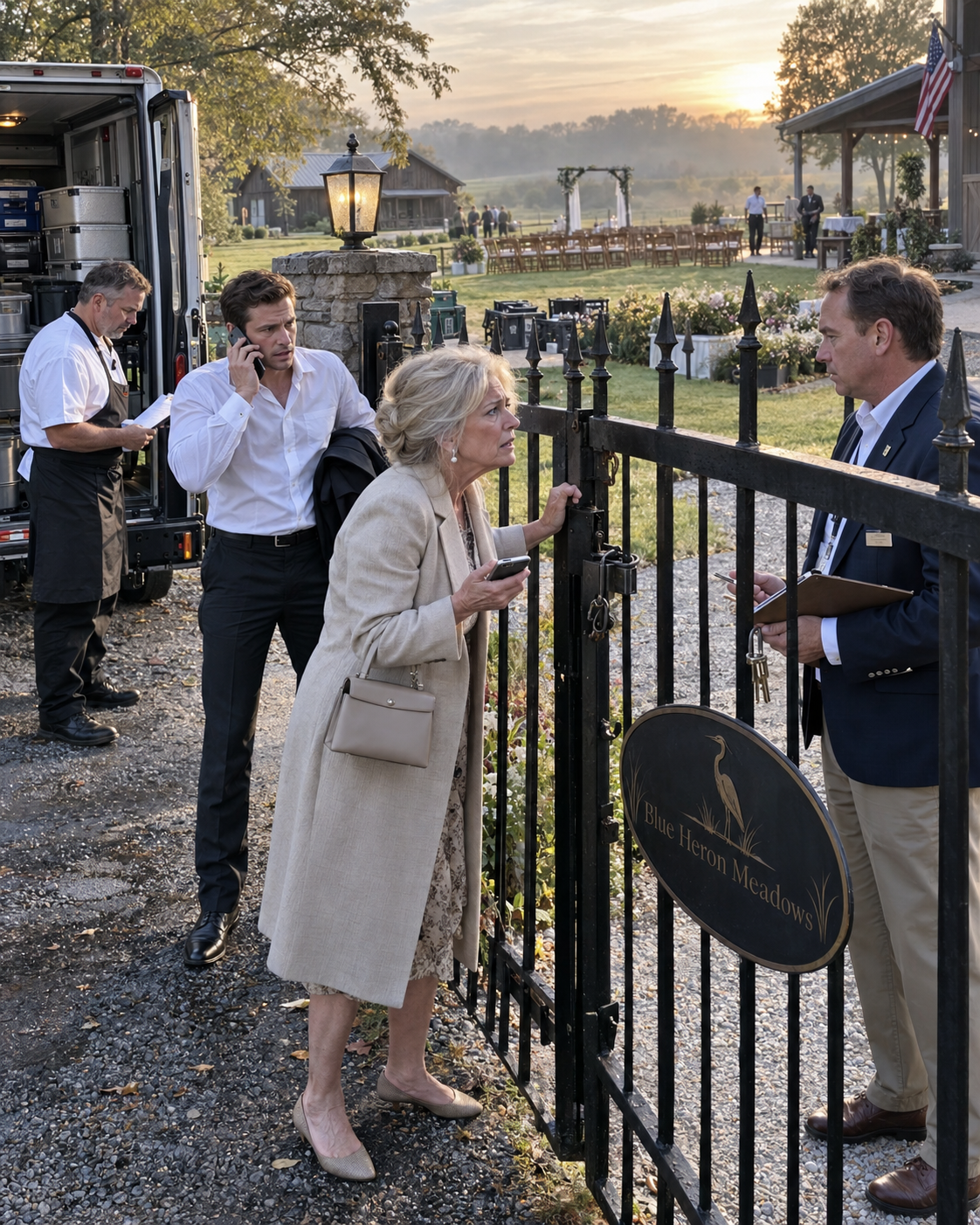
At 6:07 on my brother’s wedding morning, a furious caterer stood outside Blue Heron Meadows with his vans locked behind my gate
The envelope felt heavier than paper should have felt.
I stood in my doorway with my mother crying on one side of me and the folded document between my fingers.
For several seconds, neither of us moved.
Then I looked at her.
“What has Dad been hiding?”
Eleanor wiped her face with the heel of her hand.
“I should have told you years ago.”
That sentence frightened me more than anything else.
I opened the envelope.
Inside was a photocopy of a property agreement, several bank statements, and a handwritten note in my father’s unmistakable handwriting.
I read the first page twice.
Then a third time.
Blue Heron Meadows had never started as the business I thought I had built alone.
Years earlier, when I was twenty-three, my grandfather had placed the property into a family trust with instructions that it eventually pass to me because I was the only grandchild who had shown interest in preserving it.
My father had known.
My mother had known.
They had never told me.
Instead, Dad had encouraged me to take out a business loan to renovate the property, telling me it would be “good for the family.”
I had spent six years paying that loan.
Six years believing I was building something from nothing.
But the documents showed something else.
My grandfather had deliberately protected the property from being sold or divided without my written consent.
My name was there.
Not as an employee.
Not as a caretaker.
As the designated beneficiary.
I lowered the papers.
“Why?”
Mom stared at the floor.
“Your father thought if you knew, you would become difficult.”
I almost laughed.
“Difficult?”
“He thought you would stop helping everyone.”
The room suddenly felt very quiet.
All those years came rushing back.
The birthday parties I organized.
The holidays I hosted.
The vendors I recommended.
The relatives I helped when they needed money.
The countless times someone called me because I was “the one who could handle it.”
They hadn’t mistaken my kindness for weakness.
They had built their expectations around it.
My father had simply realized before I did that if I understood my value, I might stop giving it away.
I looked at Mom.
“Did Julian know?”
She hesitated.
That hesitation was enough.
“How long?”
“Since last year.”
My chest tightened.
“So everyone knew except me.”
“Not everyone.”
“Who?”
She looked away.
“Chloe found out.”
That was when something inside me finally cracked.
Not loudly.
Not dramatically.
It was quieter than that.
It was the sound of a story I had believed about my own family collapsing piece by piece.
Chloe hadn’t just been calling Blue Heron Meadows their dream venue.
She had known it legally belonged to me.
And still, she had treated me like hired help.
I folded the papers.
“Where is Dad?”
“He went home.”
“Of course he did.”
Mom flinched.
I stepped aside and let her come inside.
For the first time in years, she sat in my living room without asking me to fix anything.
She looked exhausted.
“I thought if I kept the peace, eventually everyone would grow up.”
I shook my head.
“Keeping the peace isn’t the same as creating peace.”
She nodded slowly.
“I know.”
“No, Mom.”
I looked directly at her.
“I don’t think you do.”
She started crying again.
This time, I let the silence stay.
The next morning, Dad called.
I almost ignored it.
Then I answered.
“Simone.”
His voice was unusually careful.
“We need to talk.”
“We do.”
“There are things you don’t understand.”
“Then explain them.”
He sighed.
“Your grandfather wanted the property protected, but I was trying to keep the family together.”
“By hiding the ownership?”
“By making sure you didn’t make impulsive decisions.”
I stared at the wall.
“You mean decisions you couldn’t control.”
He didn’t answer.
That silence told me everything.
Then he said something I never expected.
“Julian didn’t know about the trust until Chloe found the documents.”
“And when did she find them?”
“Three months ago.”
My stomach turned.
Three months.
Exactly when Chloe started planning the wedding at Blue Heron Meadows.
Suddenly, her behavior made a different kind of sense.
She hadn’t been dreaming about my property.
She had been positioning herself inside it.
I asked Dad one final question.
“Did you ever intend to tell me?”
His answer came slowly.
“Eventually.”
I closed my eyes.
“That means no.”
He hung up.
For the next week, I didn’t speak to anyone.
I worked.
I answered clients.
I walked the meadow every evening.
And slowly, the place began to feel like mine again.
Not the family’s free party venue.
Not Julian’s wedding backdrop.
Not Chloe’s social media prop.
Mine.
Then, on Thursday morning, I received an email from an attorney representing my grandfather’s estate.
The subject line read: “Trust Administration — Immediate Action Required.”
I opened it.
There was another document attached.
A clause my father had never shown me.
It stated that any attempt by another family member to represent themselves as an owner, operator, or authorized beneficiary of the property could trigger a formal review of all financial activity connected to the trust.
I read it once.
Then I read it again.
My father had not only hidden my ownership.
He had apparently been managing money connected to the property.
I called the attorney.
“What does this mean?”
“It means,” she said carefully, “we need to review the records.”
“Whose records?”
“Your father’s.”
My hands went cold.
The review took three weeks.
Those three weeks were brutal.
There were invoices I had never seen.
Payments I had never authorized.
Expenses labeled as “property maintenance” that had nothing to do with Blue Heron Meadows.
Some were family vacations.
Some were home renovations.
One payment had even covered part of Julian’s engagement party.
My father had been using the property account like a family credit card.
When I confronted him, he denied stealing anything.
“I was borrowing from it.”
“For how long?”
He didn’t answer.
The attorney did.
“Nearly seven years.”
I felt sick.
Seven years.
Seven years of me working late, paying bills, taking out loans, and believing I was carrying the property alone while my father quietly moved money through an account connected to it.
Mom finally broke down.
“I didn’t know how much.”
I looked at her.
“But you knew something.”
She nodded.
“Yes.”
That was the last piece I needed.
Not because I wanted to punish them.
Because I needed the truth more than I needed another apology.
Dad offered to repay everything.
The attorney recommended a formal repayment agreement.
I agreed.
Not because he was my father.
Because the money belonged to the trust.
For the first time in my life, I separated love from obligation.
I could love someone and still require accountability.
I could forgive someone and still lock the door.
I could be someone’s daughter without being their emergency fund.
Julian eventually came to see me alone.
He stood outside the gate for several minutes before I opened it.
He looked older than he had at his wedding.
“I owe you an apology.”
I said nothing.
He continued.
“I thought you were trying to embarrass us.”
“I wasn’t.”
“I know that now.”
He looked toward the meadow.
“I also know I never asked what you actually did for us.”
I leaned against the gate.
“You didn’t have to ask.”
“I should have.”
We stood there quietly.
Then he said, “Chloe thinks you hate her.”
“I don’t hate her.”
“She thinks you’re trying to destroy our marriage.”
I almost smiled.
“I have never cared enough about your marriage to destroy it.”
He looked down.
“That’s fair.”
There was another silence.
Then he handed me a small box.
“What is this?”
“Your wedding gift.”
I opened it.
Inside was the old silver compass our grandfather had carried for decades.
I stared at it.
“Where did you get this?”
“Dad gave it to me when I got engaged.”
I looked up.
“He said Grandpa wanted me to have it.”
Julian swallowed.
“I don’t think that’s true anymore.”
My fingers tightened around the compass.
For years, I had believed my family simply didn’t understand me.
Now I wondered whether they had understood me perfectly.
They had known I would keep showing up.
They had known I would forgive.
They had known I would choose peace over confrontation.
And they had mistaken that choice for permanent permission.
I handed the compass back.
“You should keep it.”
He shook his head.
“No.”
“It belonged to Grandpa.”
“And Grandpa wanted the truth to stay with the person who deserved it.”
I couldn’t answer.
Julian walked away.
I watched him disappear down the road.
For the first time, I didn’t chase after him.
A month later, Blue Heron Meadows reopened for business.
I changed the contracts.
I changed the pricing.
I changed the staff structure.
Most importantly, I changed the word “family” in my vocabulary.
It no longer meant automatic access.
It meant something earned through respect.
I didn’t ban my parents.
I didn’t erase Julian.
I didn’t pretend the wedding never happened.
But I stopped rescuing people from consequences they had chosen for themselves.
Then, one evening, I found Mom sitting alone on the bench beside the pond.
She had come without calling.
She was holding an old photograph.
She handed it to me.
It was Grandpa standing in the meadow when the property was still nothing but wild grass.
On the back, he had written a sentence.
“This place should belong to the person who knows how to care for it without disappearing inside it.”
I read it twice.
Then I looked across the field.
For years, I had thought I was protecting my family by making myself smaller.
I finally understood the opposite was true.
Sometimes the healthiest thing you can give the people you love is a boundary they cannot negotiate.
Mom stood.
“I’m sorry.”
This time, I believed her.
But forgiveness did not mean returning to the old arrangement.
It meant letting the past stop controlling the future.
She hugged me.
I let her.
When she pulled away, she whispered, “Your grandfather would be proud.”
I looked toward the meadow.
“I think he would have wanted me to be honest.”
That night, I walked through the empty venue alone.
The chairs were stacked.
The lights were off.
The pond reflected the moon.
There was no wedding music.
No applause.
No family pretending everything was perfect.
Just silence.
And somehow, that silence felt peaceful.
I thought about the locked gate that Saturday morning.
Everyone had seen it as an act of cruelty.
But I finally understood what it really was.
It wasn’t a door I had locked against my family.
It was the first door I had ever closed for myself.
I reached the office and found one final envelope waiting beneath the door.
There was no return address.
Inside was a copy of a letter from Grandpa dated years before his death.
The final sentence was underlined.
“If they ever make you believe that being loved requires you to disappear, remember who you were before they asked you to become useful.”
I stood there in the darkness with tears running down my face.
Then my phone buzzed.
A message from Julian.
“Simone, I found something else in Dad’s files.”
I stared at the screen.
Another message appeared.
“This time, I think you need to see it before anyone else does.”
I looked back toward the meadow.
The gate was still locked.
But for once, I wasn’t afraid of what might be waiting on the other side.
I was afraid of what the truth might finally ask me to become.
And maybe that was the real beginning.