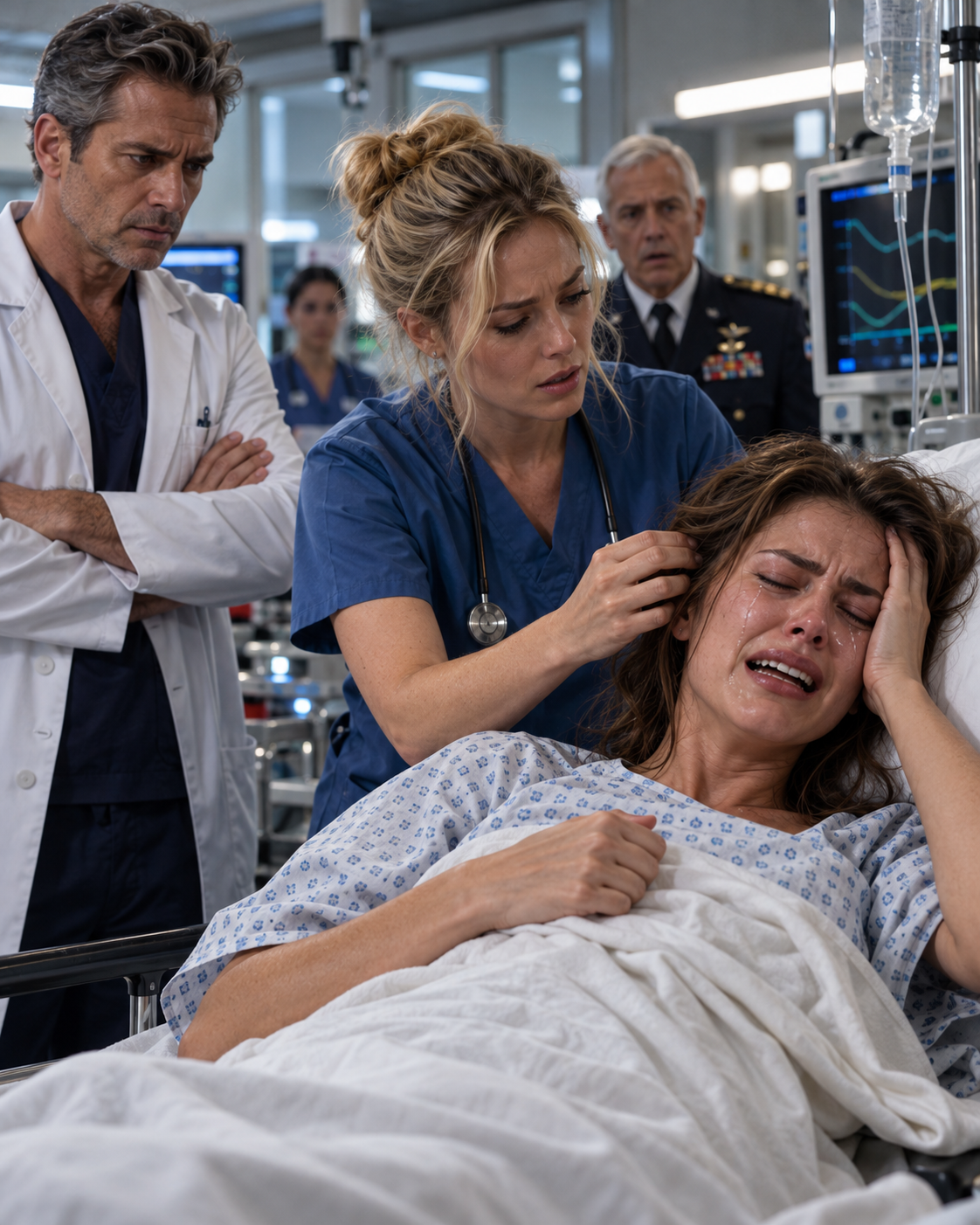
At 3:07 a.m., I shoved an attending physician away from a dying construction worker while blood sprayed across the ER floor
The name stopped me before I reached the parking lot.
I stood beneath the pale morning sky with one hand still wrapped around the paper someone had slipped into my file.
For ten years, I had trained myself not to react to certain names.
This was one of them.
Daniel Mercer.
I hadn’t heard it spoken aloud since the night everything changed in Kandahar.
Daniel had been my team leader, my closest friend, and the man who had pulled me out of a burning vehicle when I could no longer feel my legs.
He was also the man whose body I had watched disappear beneath a canvas sheet three days before my unit came home.
I read the document again.
It wasn’t a military citation.
It was a hospital transfer request.
Daniel’s name appeared beside a patient identification number.
Then came a date.
Six months ago.
I felt the same cold pressure I remembered from Afghanistan.
Someone had been hiding something from me.
I went back inside.
Marcus was still in the break room, staring at the empty coffee cup I had left behind.
He looked exhausted now, stripped of the arrogance that had filled the room a few hours earlier.
“What is that?” he asked.
I held up the paper.
“Where did you get this?”
His eyes moved to the name.
For the first time since I had met him, he looked genuinely afraid.
“You weren’t supposed to see that.”
My stomach tightened.
“What does that mean?”
He closed the door.
“Sit down.”
“I don’t want to sit.”
Marcus swallowed.
“Six months ago, St. Jude received a patient under a sealed federal transfer.”
“Who?”
He hesitated.
“Daniel Mercer.”
The room seemed to tilt.
“That’s impossible.”
“I know.”
“He died in Afghanistan.”
“That’s what the file says.”
I stared at him.
“Then why is his name here?”
Marcus looked toward the hallway before lowering his voice.
“Because somebody wanted the official story to stay official.”
I had spent ten years believing grief was something you carried until it became lighter.
That morning, I discovered grief could also be a locked door.
And someone had just handed me the key.
Marcus told me the patient had arrived unconscious, badly burned, and under federal protection.
He had been transferred between three hospitals before arriving at St. Jude.
No family.
No visitors.
No real name on the chart.
Only a government identification number.
“Why would I be in his file?” I asked.
Marcus shook his head.
“You’re not.”
“Then why was this placed inside my personnel record?”
“I don’t know.”
I believed him.
That frightened me more than if he had lied.
Because Marcus Vance was the kind of man who always seemed to know what was happening.
Now he looked like someone who had accidentally opened a door and discovered something waiting on the other side.
Before either of us could speak again, Sarah appeared at the door.
“There’s a problem in Bay 4.”
We followed her.
The construction worker from the pileup was awake.
His eyes were wide with panic, and his hands were gripping the sheets.
When he saw me, he began shaking his head.
“Don’t let them take me.”
I stepped closer.
“Nobody is taking you anywhere.”
He grabbed my wrist.
“You’re the medic.”
“Yes.”
“You were there.”
My heart stopped.
“Where?”
His lips trembled.
“Afghanistan.”
The room went silent.
Marcus looked at me.
Sarah looked at him.
I leaned closer to the patient.
“What did you see?”
He struggled to breathe around the tube.
Then he whispered something that made the blood drain from my face.
“Mercer.”
I released his hand.
“How do you know that name?”
He looked toward the hallway.
“They found us.”
The monitor suddenly began alarming.
His blood pressure dropped.
Sarah called for help while I checked the lines, but my attention had already shifted to the doorway.
A man in a dark jacket was standing at the end of the hall.
He wasn’t wearing a hospital badge.
He wasn’t carrying a medical bag.
And he was watching me.
The moment our eyes met, he turned and disappeared through the stairwell.
I ran after him.
I reached the stairwell just in time to hear the metal door slam below.
I took the stairs two at a time.
By the time I reached the parking garage, there was no one there.
Only an idling black SUV with tinted windows.
It pulled away before I could reach it.
I stood there breathing hard.
Then I noticed something on the concrete.
A small brass identification tag.
I picked it up.
There were three letters engraved into it.
D.M.
Daniel Mercer.
My hands started shaking.
I hadn’t felt that kind of fear since the war.
Not fear of dying.
Fear of discovering that everything I had survived had been built on a lie.
I went back upstairs and found Marcus waiting.
“We need to talk,” he said.
“No.”
He frowned.
“I need answers.”
“I know.”
“Then give them to me.”
Marcus rubbed his face.
“Six months ago, Daniel Mercer wasn’t transferred here as a patient.”
I waited.
“He was brought here as a witness.”
“To what?”
Marcus looked toward the ICU.
“Something that happened overseas.”
My jaw tightened.
“What happened?”
“I don’t know.”
“You’re lying.”
“I’m not.”
He stepped closer.
“But I know why they chose St. Jude.”
I said nothing.
“Because one of our administrators used to work for a federal medical unit.”
The pieces began connecting.
The sealed transfer.
The hidden patient.
The construction worker.
My personnel file.
Daniel’s name.
“Who was the administrator?”
Marcus looked at me.
“Dr. Evelyn Hart.”
I knew that name.
Everyone at St. Jude did.
She was the hospital’s chief medical officer, the woman whose signature could move patients, doctors, and money with a single stroke.
I found her office empty.
The door was unlocked.
On her desk sat a photograph.
Daniel and me stood beside an armored vehicle, both covered in dust and grinning like idiots.
I picked it up.
Someone had written on the back.
“You were never supposed to come home.”
The words hit harder than any bullet ever had.
I heard footsteps behind me.
I turned.
Evelyn Hart stood in the doorway.
She wasn’t surprised to see me.
She was almost relieved.
“You finally found it.”
“Found what?”
“The part they forgot to erase.”
She closed the door.
“Daniel didn’t die.”
I stared at her.
“Why did everyone tell me he did?”
“Because he was investigating something.”
“What?”
“An illegal medical evacuation program.”
She told me wounded soldiers and contractors had been moved through unofficial channels, their identities altered, their records rewritten.
Some survived.
Some disappeared.
Daniel had discovered the pattern.
Then he discovered something worse.
The people responsible weren’t only overseas.
Someone inside the United States had been coordinating the records.
“And you?” I asked.
“I helped him.”
“Then why did you stay silent?”
Her eyes filled with tears.
“Because they threatened my daughter.”
The anger drained from me.
For a moment, she wasn’t the powerful administrator.
She was just a mother who had been cornered.
“What happened to Daniel?”
“He’s alive.”
I stepped toward her.
“Where?”
She looked at the clock.
“Not for long if we don’t move.”
Before I could ask another question, the hospital lights flickered.
Then every monitor on the floor went black.
The emergency generators failed.
For several seconds, St. Jude became completely silent.
Then someone screamed.
Marcus ran into the hallway.
“ICU backup is down!”
I moved without thinking.
We had patients on ventilators, people on infusion pumps, unstable trauma patients depending on machines that had suddenly gone dark.
Sarah began directing nurses with battery packs.
I grabbed a manual ventilation bag.
“Bay 4 first.”
Marcus looked at me.
“Why?”
“Because someone planned this.”
A crash echoed from the ICU.
Then another.
We ran.
The construction worker’s bed was empty.
His restraints had been cut.
A nurse lay unconscious beside the doorway.
And on the wall, written in black marker, were four words.
“YOU SHOULD HAVE STAYED GONE.”
Marcus stared at them.
I didn’t.
I was already moving.
I found the patient’s IV line trailing toward the service corridor.
Someone had taken him through the hospital’s underground access route.
We followed it.
The corridor smelled like dust and old concrete.
At the far end, a door stood open.
Beyond it was the loading dock.
A van was waiting.
Evelyn appeared behind us.
“Don’t.”
I turned.
She was holding a phone.
“There’s a police unit outside.”
“Then call them.”
“I already did.”
Sirens sounded in the distance.
For the first time that morning, I thought maybe we were going to survive this.
Then Evelyn looked at me with tears in her eyes.
“The police are the ones coming for him.”
The van started moving.
I ran.
Marcus grabbed my shoulder.
“You’re not going after that vehicle.”
I pulled free.
“I’ve been running from this for ten years.”
I looked at the disappearing taillights.
“I’m done running.”
I jumped into a hospital transport SUV.
Marcus got into the passenger seat.
“You know how insane this is?”
“Yes.”
“Good.”
He fastened his seat belt.
“Because I’m coming with you.”
We chased the van onto the interstate.
Rain had started falling.
Traffic blurred around us.
For several miles, nobody spoke.
Then Marcus said something I never expected.
“I froze because I’ve never had to choose between doing the right thing and being afraid of being wrong.”
I kept my eyes on the road.
“Everyone freezes.”
“You didn’t.”
“I did.”
He looked at me.
“In that room?”
“Ten years ago.”
I told him about Daniel.
About the burning vehicle.
About the moment I had found him trapped inside.
I had tried to save him.
I had followed every protocol.
Every procedure.
Every textbook rule.
But the fire had moved faster than I could.
“I kept thinking there was one perfect decision that would have saved him,” I said.
Marcus was quiet.
“So you became obsessed with never making the wrong choice again.”
“No.”
I looked at the van ahead.
“I became obsessed with making a choice before someone else lost the chance to.”
The van suddenly swerved toward an abandoned industrial road.
We followed.
It stopped beside an old warehouse.
Three men jumped out.
One raised a weapon.
Marcus ducked.
I slammed the SUV into reverse.
The gunshot shattered the windshield.
We abandoned the vehicle and ran behind a concrete barrier.
Then I heard a familiar voice.
“Don’t shoot them.”
I froze.
Daniel.
He stepped from the warehouse doorway.
Older.
Thinner.
His face scarred.
But alive.
I couldn’t breathe.
For ten years, I had imagined his last words.
Now he was standing thirty yards away.
He looked directly at me.
“I’m sorry.”
I couldn’t move.
Then one of the men behind him raised his weapon.
Daniel turned.
The shot came before I could think.
Daniel fell.
Everything inside me broke open.
I ran toward him.
Gunfire erupted around us.
Marcus dragged me behind cover.
“Stay down!”
But I could see Daniel on the concrete.
Blood spreading beneath him.
The same image.
The same helplessness.
Ten years compressed into one terrible second.
I crawled toward him anyway.
This time, I refused to accept the ending before the fight was over.
The attackers fled when police sirens finally approached.
Marcus reached Daniel first.
“He has a pulse.”
I dropped beside them.
“Keep pressure here.”
Marcus obeyed.
Daniel opened his eyes.
“You always were terrible at following orders.”
I laughed once, though I was crying.
“You died.”
“I tried.”
“Everybody said you died.”
“I needed them to.”
“Why?”
Daniel looked toward the approaching lights.
“Because the people who killed our friends were never looking for a corpse.”
He grabbed my sleeve.
“They were looking for the person who knew the truth.”
I stared at him.
“Who?”
Daniel looked past me.
At Marcus.
At Evelyn.
At the hospital badge still hanging from Marcus’s neck.
Then he whispered one final sentence.
“The person running the program works at St. Jude.”
By the time federal agents arrived, Daniel had lost consciousness again.
They took him away in an ambulance.
Evelyn disappeared into protective custody.
The construction worker survived.
The teenage girl survived surgery and woke two days later.
Marcus never returned to the same doctor he had been that night.
He started listening.
Really listening.
Months later, he asked me to speak to the hospital’s new residents.
I stood in front of a room full of young doctors and watched them wait for some heroic story.
I gave them something else.
“You’re going to be afraid,” I told them.
“You’re going to make mistakes.”
“And sometimes, you’re going to stand in a room where someone needs you to act before you feel ready.”
I looked around the room.
“Don’t confuse confidence with courage.”
Nobody moved.
“Courage is being afraid and choosing responsibility anyway.”
After the lecture, Marcus found me outside.
He handed me a sealed envelope.
“Daniel sent this.”
I stared at it.
“When?”
“This morning.”
My hands felt cold.
I opened it.
Inside was a single photograph.
Daniel stood beside another soldier.
A soldier I recognized.
A soldier whose name had been listed among the dead ten years ago.
On the back, Daniel had written six words.
“He’s alive, too, and he remembers everything.”
I looked toward the hospital windows.
For the first time in a decade, I understood that surviving the war had never been the end of my story.
It had only been the part they wanted me to believe.
I folded the photograph and put it in my pocket.
Then I walked back into the ER.
The coffee still tasted terrible.
The bleach still smelled the same.
People were still bleeding.
And somewhere beyond those walls, another secret was waiting for someone brave enough to stop pretending they couldn’t see it.
Because sometimes the hardest battle isn’t surviving what happened to you.
It’s finding the courage to uncover who made sure it happened.