At 2:17 a.m., I was on my knees scrubbing blood from Oak Creek Memorial’s ER floor while Head Nurse Brenda Holloway
Part 2
The helicopter vanished into the storm above Seattle.
Rain hammered the windshield.
Below us, the city glowed beneath sheets of gray cloud.
Alistair sat across from me, checking his weapon.
Neither of us spoke for several minutes.
Finally, he said, “You know what you’re walking into.”
“Yes.”
“No, Claire.”
He looked at me.
“You know what he wants you to remember.”
I stared through the window.
Julian had always understood people better than machines.
He knew exactly which memory to place in front of you.
Exactly which wound to touch.
Exactly how long to wait before twisting the knife.
“I put him away once,” I said.
“You did.”
“I should have killed him.”
Alistair didn’t answer.
That silence was answer enough.
Solstice Tower appeared through the clouds.
Fifty floors of black glass.
Beautiful.
Silent.
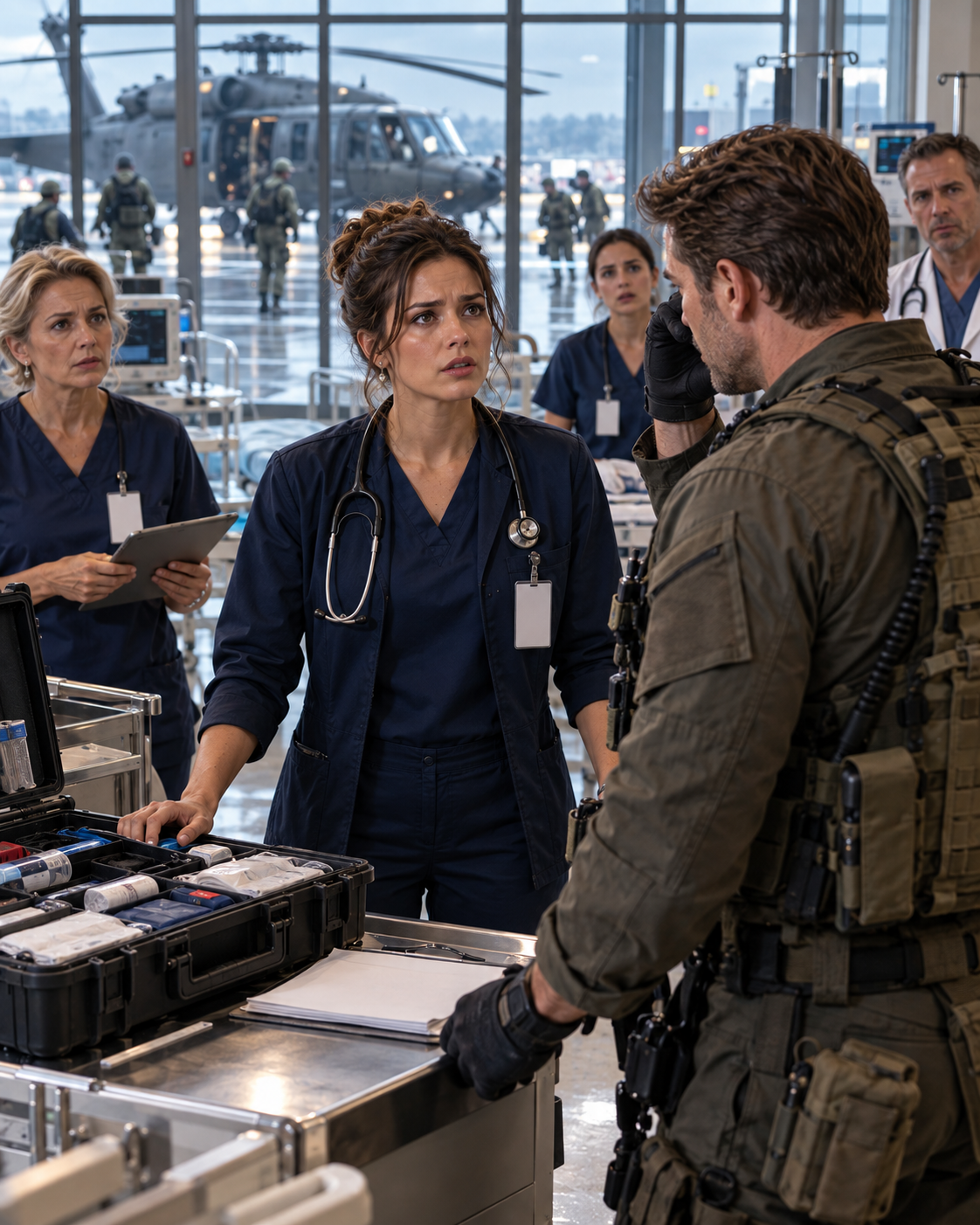
Deadly.
The roof was surrounded by emergency lights.
We couldn’t land.
The airspace was compromised.
So we jumped.
The rain struck my face as I descended.
My boots hit the roof hard.
Alistair landed beside me.
“Forty-one minutes,” he said.
We moved.
The main entrance was useless.
Julian had expected military intervention.
Every obvious route was probably trapped.
I found the maintenance access on the eastern side.
A narrow service hatch.
Exactly where Julian would have hidden it.
He had once told me that buildings were like human bodies.
“Every fortress has a throat,” he had said.
“You just have to find it.”
I opened the hatch.
Darkness waited below.
The ductwork was barely wide enough for my shoulders.
I crawled forward.
The metal was cold beneath my hands.
Every few feet, I found signs of Julian’s work.
A wire where there shouldn’t have been one.
A vent facing the wrong direction.
A panel replaced with newer screws.
He had rearranged the building’s internal pathways.
Dead ends.
False passages.
Traps.
He wanted intruders to feel clever right before they died.
I reached the first junction.
Three tunnels.
Only one was real.
I remembered Julian’s voice.
“People always choose the cleanest path.”
I smiled.
“Not anymore.”
I chose the dirtiest.
A click sounded beneath my palm.
I froze.
A tripwire.
I didn’t breathe.
Somewhere ahead, machinery woke.
Turrets.
I pulled my pistol.
The first muzzle emerged from the wall.
I fired.
The optical sensor shattered.
The second turret rotated.
I fired again.
Metal screamed.
The third turret opened.
I rolled backward and fired twice.
Silence returned.
My hands shook for half a second.
Not from fear.
From memory.
Julian had trained me to shoot that way.
Then he had used those same lessons against the people I loved.
I crawled deeper.
Thirty-one minutes.
I reached the forty-eighth-floor filtration hub.
The door was sealed.
I entered the access code.
Denied.
Another code.
Denied.
Then I saw the biometric reader.
Julian had designed it himself.
Which meant there was only one person who could open it.
Him.
I kicked the door.
Nothing.
Again.
Nothing.
Then a voice came through the speaker.
“Hello, Claire.”
I froze.
His voice hadn’t changed.
Older.
Calmer.
Still unmistakably him.
“Julian.”
“You took your time.”
“You killed a tactical team.”
“They were very determined.”
“You infected innocent people.”
“I gave the city a choice.”
“What choice?”
“Whether to sacrifice four million people to preserve its illusion of safety.”
I looked at the countdown.
Twenty-four minutes.
“You’re sick.”
“No.”
His voice softened.
“I’m disappointed.”
The door opened.
Julian stood beyond it.
Gray hair.
Thin face.
Same eyes.
For a moment, I saw the man who had taught me how to survive.
Then I saw the man who had betrayed us all.
He smiled.
“You still look at me like I’m the monster.”
“You are.”
“I became what you needed me to become.”
He raised his hands.
“No weapon.”
I didn’t lower mine.
“Step away from the terminal.”
He smiled again.
“You always were my best student.”
Then he moved.
Fast.
I fired.
The bullet struck his right hand.
He screamed and dropped beside the terminal.
Blood splashed across the floor.
“Claire!”
“Your right hand was never your important one.”
He looked up at me.
For the first time, fear appeared in his eyes.
I dragged him toward the biometric scanner.
“You taught me never to destroy something I might need.”
I pressed his injured hand against the reader.
Denied.
He laughed through the pain.
“Wrong hand.”
I grabbed his left.
“Of course.”
The scanner flashed green.
The terminal unlocked.
The dispersal countdown appeared.
Nineteen minutes.
The system showed hundreds of ventilation routes.
Most were false.
I remembered the architecture.
I remembered Julian.
And I remembered something else.
Five years earlier, before I arrested him, he had looked at me and whispered, “If you ever come for me, Claire, don’t trust the map.”
I stared at the screen.
Then I understood.
He hadn’t built the system around the building.
He had built it around the way people expected air to move.
I changed the sequence.
The system screamed.
Julian watched me.
“You can’t stop it.”
“Watch me.”
I entered the inhibitor command.
Error.
Again.
Error.
The central intake port was physically locked.
I looked through the reinforced glass.
The synthesized inhibitor had to enter the ventilation system directly.
There was no time to find another route.
I raised my pistol.
Julian smiled.
“You won’t.”
I smashed the glass.
Once.
Twice.
The third strike shattered it.
Wind exploded through the room.
I opened the vial.
My hands were bleeding.
The countdown hit six minutes.
I poured the compound into the central duct.
For three seconds, nothing happened.
Then the sensors changed.
Red.
Orange.
Yellow.
Green.
The lethal cloud began disappearing from every floor.
Julian stared at the monitors.
“No.”
I watched the numbers fall.
“Yes.”
The final sensor turned green.
Outside, military aircraft circled the skyline.
Then Alistair’s voice came through my earpiece.
“Claire.”
“Go ahead.”
“The strike has been canceled.”
I closed my eyes.
For the first time all night, I breathed.
Behind me, Julian laughed softly.
“You saved them.”
I turned.
“Yes.”
“And you think that makes you different from me?”
I looked at him.
“No.”
I holstered my weapon.
“It makes me nothing like you.”
Part 3
We left Solstice Tower before sunrise.
The rain had stopped.
Seattle was still there.
Four million people were still alive.
That was enough.
Julian was taken into federal custody.
The world would eventually hear a sanitized version of what happened.
A terrorist.
A bioweapon.
A military operation.
A successful containment.
They would never hear about the woman in oversized scrubs who had spent three weeks cleaning hospital floors because she wanted to remember what ordinary life felt like.
They would never know that I had once believed my worth depended on how many dangerous people I could stop.
Alistair knew.
He waited beside the helicopter.
“You’ve earned a place at the Pentagon.”
I shook my head.
“Director-level.”
“No.”
“Presidential commendation.”
“No.”
“Your own command.”
I smiled.
“Still no.”
He stared at me.
“Why?”
I looked toward the horizon.
Because somewhere beneath the mountains was a hospital where people did not care who I had been.
They only cared whether I showed up.
“I already have a job.”
Alistair laughed.
“You mop floors.”
“Sometimes.”
“You save lives.”
“Sometimes.”
He studied me.
Then he nodded.
“You’re serious.”
“Very.”
Three days later, I walked back into Oak Creek Memorial.
The same cracked windows.
The same flickering lights.
The same smell of disinfectant and burnt coffee.
Brenda saw me first.
She folded her arms.
“You disappeared without authorization.”
“I know.”
“You left me with two shifts uncovered.”
“I know.”
“You also walked out wearing hospital scrubs.”
I looked down.
“Technically, I returned them.”
She stared at me.
Then sighed.
“I have a pile of linens waiting.”
I smiled.
“Where?”
She pointed toward the laundry room.
I picked up the bag.
“Welcome back, Brenda.”
She looked away.
“I didn’t say you were welcome.”
But her voice had softened.
Nathan approached me near the nurses’ station.
For once, he didn’t look arrogant.
He looked embarrassed.
“I owe you an apology.”
I waited.
“That patient from the freeway.”
“He lived.”
“I know.”
He rubbed the back of his neck.
“I’ve replayed it about a hundred times.”
I nodded.
“You’ll replay it another hundred.”
“Probably.”
He looked at me.
“How did you know?”
I smiled.
“Experience.”
He laughed quietly.
“I figured.”
Chloe was standing near the medication cabinet.
She waited until Nathan walked away.
Then she approached.
“You came back.”
“I said I’d try.”
She looked at the laundry bag in my hands.
“After all that?”
I shrugged.
“This place needs nurses.”
“It needs you?”
I looked through the glass doors toward the emergency department.
A mother was holding her feverish child.
An old man was sleeping beneath a thin blanket.
A paramedic was bringing in another patient.
Nothing about the scene was glamorous.
Nothing would ever make the news.
And yet, I understood something I hadn’t understood when I first joined the military.
Saving a city was unforgettable.
Saving one frightened person at three in the morning was invisible.
But invisible didn’t mean meaningless.
“Yes,” I said.
“It needs me.”
Chloe smiled.
She didn’t ask for the details.
She didn’t ask what the Pentagon wanted.
She didn’t ask why a woman who could have commanded soldiers preferred carrying dirty sheets.
She simply reached into the laundry cart and took half the load.
We walked down the hallway together.
For the first time in years, I didn’t feel like I was hiding.
I felt like I was home.
That night, another trauma patient came through the doors.
A frightened teenager.
A broken arm.
A terrified father.
I stood beside the bed while Chloe checked the monitor.
She glanced at me.
“You good?”
I looked at the patient.
Then at the rain sliding down the windows.
Then at my reflection in the glass.
For years, I had believed identity was something you defended with weapons, credentials, and secrets.
Now I knew better.
Your identity is what you do when nobody is watching.
I adjusted the patient’s blanket.
“I’m good.”
Outside, the mountains disappeared beneath the darkness.
Inside, the hospital lights hummed softly.
No helicopters.
No soldiers.
No classified files.
Just people.
And that was enough.
Because the world might remember the night Colonel Claire Vane saved four million lives.
But I would remember the quiet morning afterward, when nobody applauded, nobody saluted, and nobody knew what I had done.
Brenda handed me another stack of soiled linens.
Chloe gave me that knowing little smile.
And I took the load without complaint.
Some heroes need medals.
Some need monuments.
I only needed one ordinary hallway, one tired hospital, and the knowledge that somewhere, because I had chosen to stay, another human being would get to see tomorrow.
That was the first time I understood what Julian never could.
You don’t become a monster to save the world.
You become human enough to care whether one person makes it home.