At 11:48 p.m., my husband pressed his mouth to another woman’s beneath the rooftop heat lamps
I stared at the envelope for so long that Martha finally sat beside me.
“You knew about this?”
“Not what was inside.”
“Then why did you keep it?”
“Because your grandmother told me to.”
That answer sounded exactly like Martha. She had spent thirty years refusing to elaborate when a simple sentence would do.
I turned the envelope over.
The flap had been sealed with dark green wax, stamped with the little spiral my grandmother used on every private letter.
My hands were shaking when I opened it.
Inside was a single sheet of paper and a photocopy of an old deed.
The letter began without a greeting.
Lena, if you are reading this because someone has begun speaking to you about marriage, partnership, preservation, or the future of Havencrest, slow down.
I read that sentence twice.
Then I continued.
People will tell you that houses are buildings. They aren’t. A house is a record of who was allowed to remain themselves inside it.
At the bottom she had written a name.
Arthur Vance.
Julian’s grandfather.
My stomach tightened.
Martha watched me read.
“How long did she know them?”
“Long enough.”
“That’s not an answer.”
“No,” Martha said. “It isn’t.”
She pointed to the photocopied deed.
The document was dated 1978. Arthur Vance had made an offer to purchase the Havencrest property from my grandmother. She had refused.
But beneath the offer was a handwritten notation from an attorney:
Alternative structure discussed: marriage alliance between families. Acquisition to occur through marital transfer if voluntary sale fails.
I stopped breathing for a second.
“Voluntary sale?”
Martha looked at me.
“Your grandmother wasn’t interested in selling.”
“Then why did Julian marry me?”
“I don’t know.”
That was the first answer Martha had ever given me that frightened me.
For the next week, I did almost nothing except read.
Martha brought coffee to my workroom. I went through old ledgers, exhibition catalogs, letters, invoices, estate records, and boxes I’d avoided since my grandmother died. I called an attorney in Portland and gave her everything.
Julian kept contacting me.
At first his messages were emotional.
Then practical.
Then irritated.
Eventually they became corporate.
He wanted the portfolio.
He wanted access to the digital archive.
He wanted the rights to the barnacle spiral collection because, according to him, “those assets were already integrated into Vance Textile Group’s strategic planning.”
Assets.
My grandmother had never called them assets.
She called them hands.
Every pattern had a hand behind it.
Every knot carried a memory.
Every imperfect edge meant someone had sat beside a window and decided to make one more row before supper.
I changed every password.
I locked the archive server.
I revoked Julian’s firm’s access to the digital catalog.
Then I called the women whose work was stored there.
There were twenty-seven artisans in all.
Some lived along the Oregon coast. Others were in Washington, northern California, and the inland farming communities where my grandmother had spent forty years teaching weaving.
I expected anger.
Instead, most of them sounded tired.
One of them, Rosa Alvarez, said, “We knew something wasn’t right.”
“What do you mean?”
“He kept asking which patterns were exclusive.”
“He?”
“Julian.”
My fingers tightened around the phone.
“He asked whether the artists had signed permanent licensing agreements.”
“They hadn’t.”
“I know.”
There was silence.
Then Rosa said, “That’s why we’re taking our work back.”
Within three days, nearly everyone had withdrawn their pieces from Vance’s upcoming exhibition.
Julian called me after the last withdrawal.
His voice was strangely composed.
“You’ve made a serious mistake.”
“No. I corrected one.”
“You don’t understand what you’re damaging.”
“I understand exactly what I’m protecting.”
“You think this is personal.”
“It is personal.”
“You’ve made it impossible for me to help you.”
I almost laughed.
“I never asked you to.”
He hung up.
Two weeks later, an envelope arrived from Portland.
Inside was a proposal from the Starlight Theater Trust.
The historic Starlight, closed for almost eleven years, was being restored as a performing arts venue. They wanted textile installations for the entry hall, curtains for the main stage, and a permanent woven threshold honoring the building’s history.
I had submitted the proposal months before my wedding.
I had forgotten about it.
The acceptance letter was signed by the trust director.
Callum Ward.
I met him on a wet Tuesday morning at the theater.
He was taller than I expected, wearing an old navy coat and carrying a folder with no logo on it. He didn’t bring an entourage.
He didn’t begin with congratulations.
He walked me through the building.
Dust floated through broken shafts of light. The seats were covered in canvas. Old plaster peeled from the walls in curls.
“This place doesn’t need to look new,” he said.
I glanced at him.
“No?”
“No. It needs to look alive.”
That was the first thing he said that made me trust him.
Not because it was brilliant.
Because it sounded like something my grandmother might have said.
Our work began slowly.
I chose patterns inspired by the Starlight’s original ironwork and my grandmother’s coastal motifs. Callum handled permits, contractors, preservation committees, and the endless arguments over what could be repaired and what had to remain untouched.
He never changed one of my designs without asking.
When I said no, he said, “Okay.”
When I changed my mind, he adjusted.
When I needed three days alone, he didn’t text.
That last part mattered more than he knew.
One evening, while we were standing beneath the half-restored proscenium, he asked, “Do you want me to tell you what I think?”
“About the design?”
“About Julian.”
I looked at him.
“No.”
“Okay.”
And he dropped it.
I loved him a little for that.
I didn’t admit it.
Not even to myself.
Then, three months into the restoration, I found the second letter.
It was hidden in a box labeled “Foundation correspondence.”
It wasn’t from my grandmother.
It was from Arthur Vance to his son.
Julian’s father.
The letter described Havencrest as “the last strategic obstacle” and referred to my grandmother’s granddaughter—me—as “the cleanest route to future control.”
I read the sentence until the paper blurred.
There was one other name in the letter.
Callum Ward.
I called him that night.
He arrived at Havencrest within an hour.
“You knew.”
He didn’t pretend not to understand.
“Yes.”
The word landed harder than any denial could have.
“How long?”
“Since before I met you.”
I stepped away from him.
“Why?”
“Because I was asked to review the old trust records.”
“That’s not why you kept it from me.”
“No.”
His honesty made me angrier.
“You decided I couldn’t handle it.”
“I decided you deserved one part of your life that wasn’t controlled by men telling you what they thought you needed to know.”
“That’s still a decision you made for me.”
“Yes.”
There was no defense in his voice.
No excuse.
Just the ugly truth.
I asked him to leave.
He did.
For seven days he didn’t contact me.
On the eighth, he sent one email.
I was wrong to withhold the information. I won’t ask you to forgive me. The theater can proceed without me if that’s what you decide. If you want me gone, say so and I’ll make it happen.
I read it three times.
Then I called him.
He answered on the first ring.
“I’m not forgiving you yet,” I said.
“I know.”
“You work under my terms.”
“Yes.”
“If I ask a question, I get the whole answer.”
“Yes.”
“And you don’t protect me by making decisions for me.”
A pause.
“Understood.”
I closed my eyes.
“Come back tomorrow.”
He did.
Nothing became magically easy after that.
In some ways, it became more difficult because now I cared.
The theater progressed.
The curtains were woven.
The entryway was rebuilt.
The barnacle spiral became the central motif—not copied from my grandmother’s original, but developed from the spaces between her stitches.
Then, one Thursday morning, Rosa called.
“Lena, turn on the news.”
I did.
A gala was being held in San Francisco that night by Vance Textile Group.
The headline read:
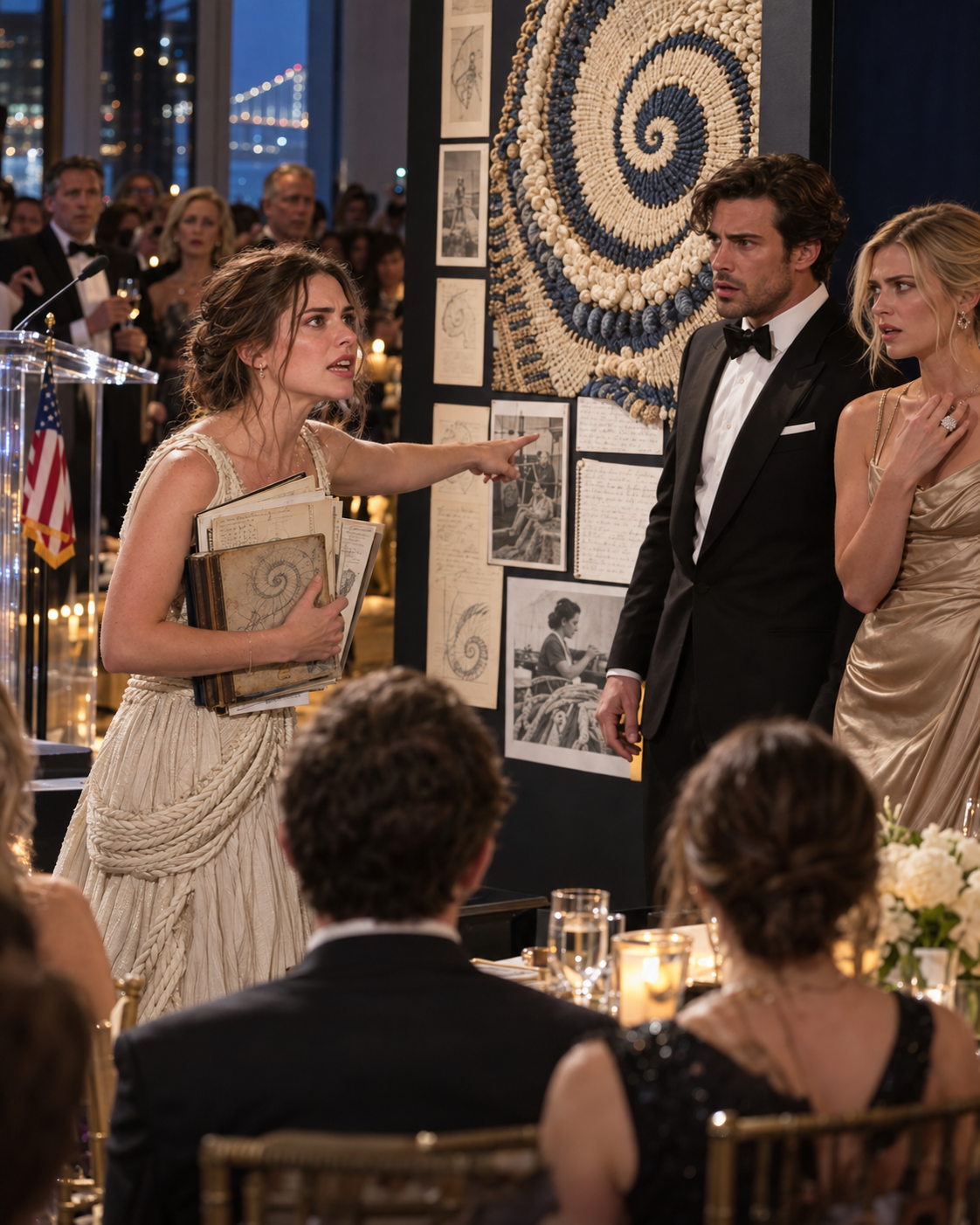
THE FUTURE OF AMERICAN TEXTILE: TAMSIN COLE UNVEILS THE BARNACLE SPIRAL.
My hands went cold.
On screen was a photograph of the pattern.
My grandmother’s signature spiral.
Underneath it was Tamsin’s name.
And on her right hand, catching the camera flash, was my grandmother’s ring.
My ring.
The ring I’d left on the pillow.
I drove to San Francisco.
Callum came with me, but he sat in the passenger seat and didn’t ask what I intended to do.
That mattered.
At the gala, Julian stood beneath a wall of gold fabric.
Tamsin was beside him.
She wore the ring.
When she saw me, her smile vanished.
Julian walked toward me.
“Lena.”
“Where did you get the pattern?”
“From the archive.”
“You didn’t have permission.”
“It’s a family asset.”
“No.”
He lowered his voice.
“You should leave.”
“Why?”
“Because you’re angry.”
“I’m not angry.”
That was the strange part.
I wasn’t.
I was clear.
I had brought copies of my grandmother’s original journals.
Early exhibition catalogs.
Signed contracts from the artisans.
Server logs showing unauthorized downloads.
And three production orders signed by Julian’s operations director.
The orders were for fabric manufactured under Tamsin’s name before my wedding.
Sixteen months before.
Exactly the length of the affair.
But there was something else.
I handed Julian the final document.
His face changed.
It was a transfer record showing money moved from the Vance Foundation into shell vendors connected to Tamsin’s projects.
“You stole from your own company,” I said.
“No.”
“Then explain the invoices.”
He couldn’t.
Tamsin stepped backward.
His mother, Eleanor Vance, appeared behind him.
She read the papers.
Then she looked at her son.
“How much?”
Julian said nothing.
“How much, Julian?”
He finally answered.
“Not what you think.”
Eleanor’s face hardened.
“That’s what people say when the number is worse.”
The gala ended without the speech they’d planned.
The board met before midnight.
By morning, Julian was stripped of his leadership position.
The Vance family trust froze his discretionary accounts.
Tamsin was dismissed.
The ring was returned to me by an attorney two days later in a padded envelope.
I didn’t put it on.
I took it to a jeweler in Portland.
“Can you melt this down?”
He examined it.
“Sentimental?”
“Very.”
“Want to preserve the stone?”
“No.”
He nodded.
“What do you want made?”
I thought of my grandmother.
I thought of the rooftop.
I thought of the little girl I had been before I understood how often women were praised for being chosen.
“A spiral,” I said.
He smiled.
“Of course.”
The Starlight opened six months later.
The new curtains moved whenever the doors opened, catching the air in long, quiet folds. My grandmother’s patterns appeared in them without becoming hers alone.
The brass spiral sat in the entryway threshold.
People stepped over it without knowing what it had cost.
I liked that.
Some things didn’t need an explanation.
Callum found me backstage before opening night.
He was holding two tickets.
“I have a question.”
“That’s dangerous.”
He smiled.
“Would you consider moving to Portland?”
I stared at him.
“With you?”
“Yes.”
“And Havencrest?”
“Yours.”
“My workrooms?”
“Yours.”
“My name?”
He looked genuinely puzzled.
“Lena, I wouldn’t know what to do with it.”
I laughed then.
A real laugh.
The kind I hadn’t heard from myself in months.
“I’ll move,” I said.
He didn’t kiss me.
He waited.
That was when I closed the distance.
His hands settled lightly at my waist, not claiming, not steering.
Just there.
The kiss was quiet.
No rooftop.
No audience.
No borrowed robe.
No ring.
Only two people standing in the doorway of a theater we’d rebuilt without pretending the broken parts had never existed.
Later that night, I stood beneath the curtains and watched the first audience enter.
For the first time in months, I wasn’t wondering who might take something from me.
I was thinking about what I wanted to make next.
Havencrest would remain mine.
The workrooms would stay locked.
The archive would stay under the artisans’ control.
And my name would stay exactly where it belonged.
With me.
Julian never got the closure he wanted.
He sent letters for almost a year, some angry, some apologetic, one heartbreakingly sincere. I read the last one once and put it away.
Not because I hated him.
Because forgiveness, I learned, didn’t require reopening a door.
Some doors could simply remain closed.
On opening night, as the house lights dimmed and the brass spiral gleamed beneath hundreds of passing shoes, Callum took my hand.
Not to lead me.
Just to hold it.
And for the first time, I understood why my grandmother had never finished that sentence about being chosen.
She hadn’t needed to.
The rest was something I had to learn myself.