At 11:14 on a Tuesday morning, a decorated admiral stormed into St. Jude General, ignored the chief of staff
Part 2
The patient was a seventeen-year-old boy who had collapsed during practice after complaining of sudden chest pain.
By the time they brought him in, his blood pressure was falling.
The room erupted into motion.
“Two large-bore IVs.”
“Get cardiology.”
“Where’s the ultrasound?”
I moved without thinking.
My hands remembered what my mind had tried to forget.
For ten minutes, the world narrowed to numbers, voices, blood, and breath.
Then the boy stabilized.
His mother burst into tears when the doctor told her he was going to live.
I stood against the wall for a moment and closed my eyes.
When I opened them, Admiral Hayes was still standing outside the glass.
He had watched everything.
Not the nurse.
Not Elena.
He had watched Ghost.
And I suddenly understood why he had looked so stunned when he found me.
For six years, he had been searching for a legend.
Instead, he had found a tired woman with coffee stains on her scrubs.
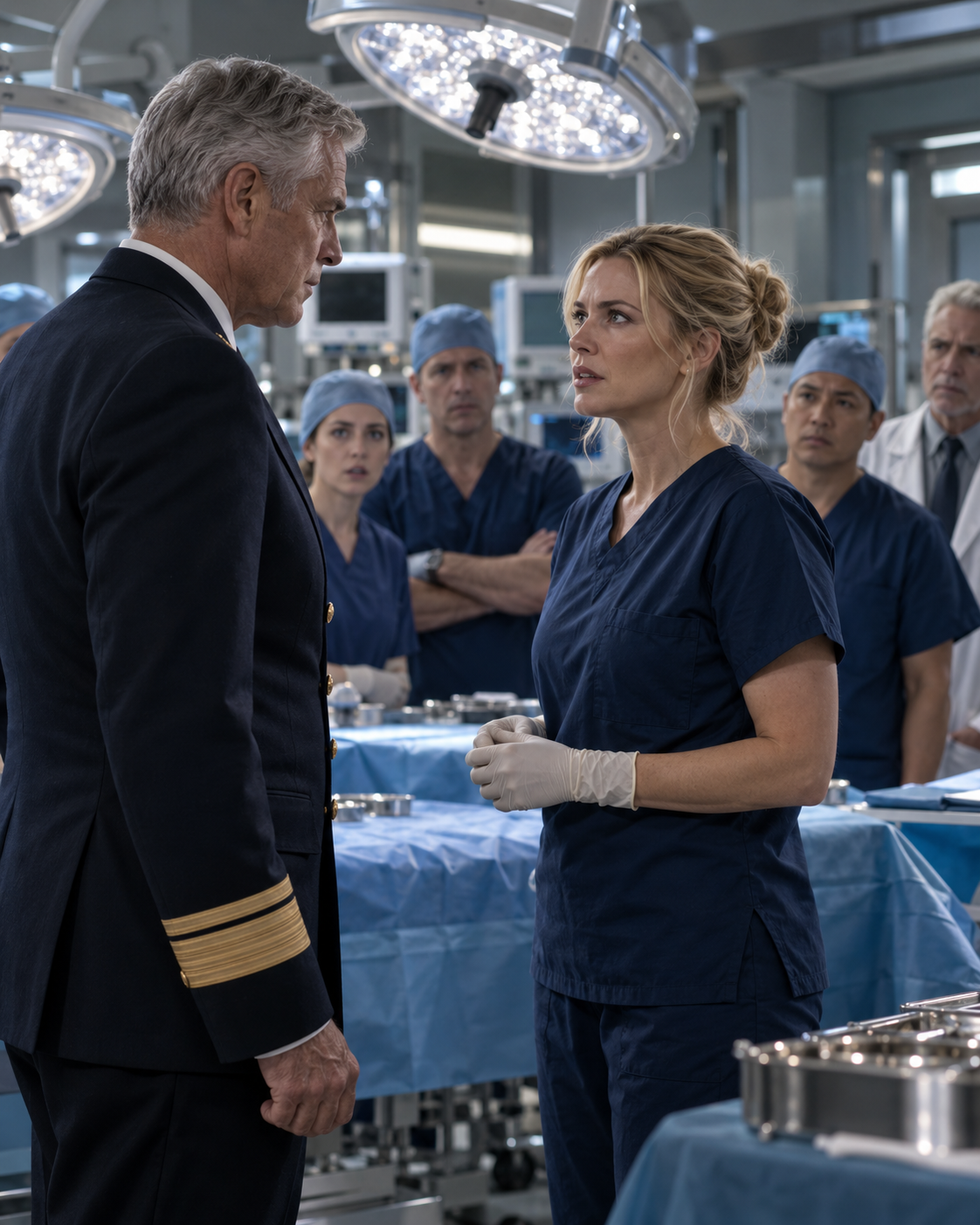
After the emergency was over, he waited for me near the staff lounge.
“That was impressive,” he said.
“It’s my job.”
“You always say that.”
“Because it’s true.”
He smiled faintly.
“Daniel used to say the same thing about you.”
I froze.
“You knew him well?”
“He talked about you.”
I looked at him.
“After the mission?”
“Before.”
Something tightened inside my chest.
“What did he say?”
Admiral Hayes looked down at his hands.
“He said you never told anyone when you were afraid.”
I laughed softly.
“That sounds like him.”
“He also said you sang when you were nervous.”
I stared at him.
“I did not.”
“He swore you did.”
I remembered the ridge.
The rain.
The darkness.
My hands covered in blood.
And the quiet humming I had used to keep myself from shaking.
I hadn’t remembered doing it.
Until then.
The admiral reached into his jacket and pulled out a small envelope.
“I’ve carried this for six years.”
I didn’t take it.
“What’s inside?”
“A photograph.”
He held it toward me.
“Daniel’s mother gave it to me.”
I finally accepted the envelope.
Inside was a photograph of three young soldiers standing shoulder to shoulder.
Daniel was in the middle.
He was smiling.
On the back, someone had written four words.
“We came home because of her.”
My vision blurred.
I quickly looked away.
“I didn’t do it alone.”
“I know.”
He paused.
“But they believe you saved them.”
I held the photograph carefully.
“Maybe I did.”
It was the first time I had allowed myself to say it.
Not because I wanted praise.
Not because I wanted to reopen the past.
Because sometimes surviving something meant eventually admitting that it happened.
Admiral Hayes took a breath.
“The mothers want to meet you.”
My fingers tightened around the photograph.
“No.”
He didn’t argue.
He simply nodded.
“Okay.”
That surprised me.
I looked at him.
“I thought you’d insist.”
“I spent six years searching for you.”
He smiled sadly.
“I learned patience.”
I returned the photograph.
He pushed it back toward me.
“Keep it.”
I hesitated.
Then I slipped it into my pocket.
“Thank you.”
He put his hand out.
I shook it.
His grip was firm.
Mine was steady.
There was no salute.
No ceremony.
No medal.
Just two people acknowledging a past neither of us could change.
Then he said, “If you ever decide you want to meet them, I’ll arrange it.”
I nodded.
“I’ll consider it.”
He turned to leave.
At the end of the corridor, he stopped.
Without looking back, he said, “For what it’s worth, Elena, I don’t think Ghost ever disappeared.”
I watched him walk away.
Maybe he was right.
But I also knew something he didn’t.
Ghost wasn’t a person I had abandoned.
She was a part of me I had finally learned how to live with.
Part 3
Three weeks later, I received a letter.
There was no military seal.
No official letterhead.
Just my name written in careful handwriting.
I knew who it was from before I opened it.
Daniel’s mother.
I sat alone in the hospital cafeteria after my shift and read it slowly.
She didn’t ask for details.
She didn’t ask me to explain the mission.
She didn’t call me a hero.
She simply wrote that for six years, she had wondered who had held her son’s hand when he thought he was dying.
At the bottom, she wrote, “You don’t owe me anything, but if you ever want to sit with us, there will always be a chair for you.”
I read that sentence three times.
Then I cried.
Not loudly.
Not dramatically.
Just enough that the tears fell onto the paper before I could stop them.
A month later, I stood outside a small house in Ohio.
Admiral Hayes was beside me.
My hands were shaking.
“You don’t have to go in,” he said.
“I know.”
I looked at the front door.
“That’s why I am.”
He smiled.
We knocked.
Daniel’s mother opened the door.
She was smaller than I expected.
Older than the photograph.
For one second, neither of us spoke.
Then she looked at the scar near my hairline.
She knew.
She stepped forward.
“You held his hand.”
It wasn’t a question.
I nodded.
Her face crumpled.
“So he wasn’t alone.”
I shook my head.
“No.”
She pulled me into her arms.
And something inside me finally broke.
For six years, I had believed that remembering the dead meant carrying their pain.
That afternoon, I learned it could also mean carrying the love they left behind.
We sat in her kitchen for hours.
She told me Daniel hated tomatoes.
He called his little sister every Sunday.
He wanted to become a firefighter after leaving the military.
He had once tried to cook Thanksgiving dinner and nearly burned the house down.
I laughed.
Then I cried.
Then I laughed again.
For the first time, Daniel was no longer a name attached to a battlefield.
He was a son.
A brother.
A terrible cook.
A young man who had wanted to come home.
And I realized that was what I had been missing all these years.
Not the mission.
Not the medals.
Not the title.
The people.
The three soldiers were eventually reunited with me at a quiet gathering arranged by Admiral Hayes.
All three had survived.
One walked with a cane.
One had a scar across his jaw.
The third had become a high school football coach.
They didn’t call me Ghost.
They called me Elena.
That meant more than any medal ever could.
The coach hugged me and whispered, “I remember your voice.”
I smiled.
“I was probably yelling.”
“You were singing.”
I laughed.
“Daniel told you?”
“He told everybody.”
We stood together in silence for a moment.
Then one of them said, “You saved us.”
I shook my head.
“I kept you alive until help arrived.”
He smiled.
“Sometimes that’s the same thing.”
Years later, I would still think about that sentence.
Because it wasn’t only true on battlefields.
It was true in hospitals.
In homes.
In friendships.
In every moment when someone was hurting and another person chose not to walk away.
I never returned to the military.
I never accepted a medal.
I never gave interviews.
I remained a nurse.
I still arrived early.
I still drank terrible hospital coffee.
I still kept an extra pen in my pocket because someone always needed one.
And sometimes, when an emergency came through the doors, I felt that old part of myself wake up.
Not Ghost.
Not the legend.
Just Elena.
The woman who knew how to stay when everything became frightening.
One winter morning, six years after Admiral Hayes walked into St. Jude, I was preparing for another shift when I noticed the photograph on my apartment shelf.
Three young soldiers.
Three smiles.
One sentence written on the back.
I turned it over and touched the words with my thumb.
Then I put the photograph back.
Outside my window, the city was waking.
Sirens moved somewhere in the distance.
People were heading to work.
Life was beginning again, as it always did.
I put on my hospital badge.
It said only one thing.
Elena Vance.
I smiled.
For years, I had believed that healing meant forgetting the person you had been before the pain.
Now I knew better.
Sometimes healing means remembering her without being trapped by her.
The soldier.
The medic.
The nurse.
The woman who ran from a name.
They had never been different people.
They were all me.
And when I walked through the hospital doors that morning, I understood why I had never truly been able to leave Ghost behind.
She had never been the woman who saved three soldiers.
She was the part of me that, whenever someone was afraid, still chose to reach for their hand.