At 04:17 over the frozen Atlantic, Lieutenant Julian Vance screamed that I was going to get us killed
For several seconds, nobody moved.
The wind pushed cold rain across the runway, and somewhere behind us, an aircraft engine ticked as it cooled.
I looked at Major Sterling.
“Say that again.”
His expression didn’t change.
“Someone inside this base gave the attackers an access code.”
Julian stood a few feet away, still wearing his flight gear.
His face had lost every trace of the arrogance I’d seen at my desk.
He looked from Sterling to me.
“The server farm?”
Sterling nodded.
Julian swallowed.
“What the hell is under this airfield?”
I looked at him.
“Something that was never supposed to be under an airfield.”
General Marcus Vance finally stepped forward.
He was Julian’s father.
I had known that for months.
Julian had never known I knew.
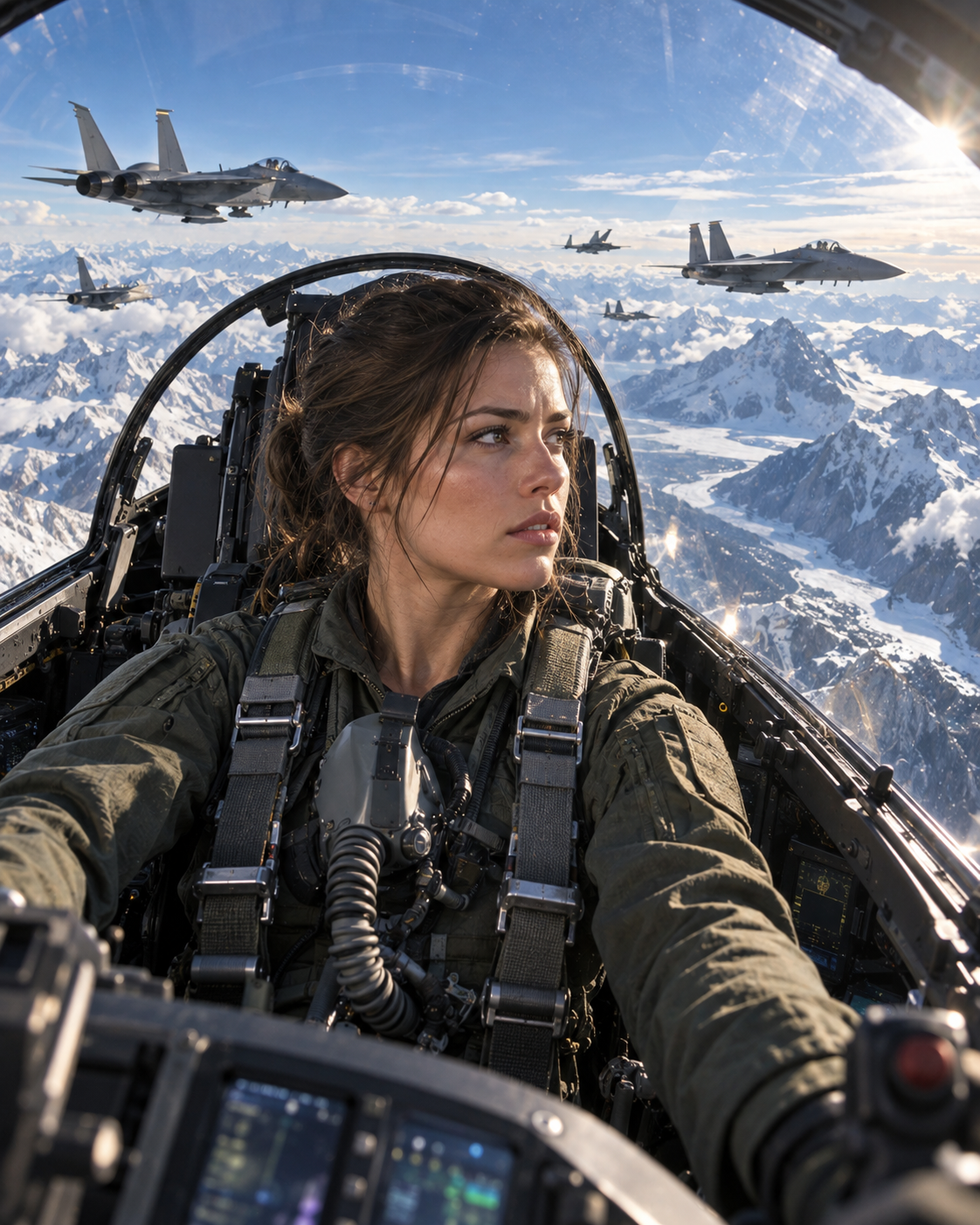
“Captain Drake,” the general said, “you are going to come with us.”
I almost laughed.
“That’s what you said before Syria.”
His eyes hardened.
“Not this time.”
That sentence followed me underground.
We entered through a maintenance corridor hidden behind a locked equipment room.
The elevator descended far deeper than any ordinary military facility should have needed.
Level one.
Level two.
Level three.
Then the numbers disappeared.
The elevator kept falling.
Julian stood beside me in silence.
Finally he whispered, “You really were Ghost of Damascus.”
I didn’t answer.
“You killed three hostile aircraft tonight.”
“Four.”
He stared at me.
“The first one?”
“Not dead.”
I watched the elevator numbers continue dropping.
“Not everything that falls from the sky is destroyed.”
He looked down.
For the first time since I’d met him, Julian seemed to understand that there were things about war he had never been taught.
The doors opened.
Cold white light spilled across a cavernous room filled with servers.
Thousands of them.
Rows upon rows disappeared into darkness.
Technicians moved between glass partitions while enormous displays showed shipping lanes, fuel reserves, weather patterns, rail traffic, power demand, agricultural forecasts, port congestion, and military logistics.
At the center was a circular command station.
My station.
Julian stared.
“This is what you do?”
“Part of it.”
“You run this?”
“I built the original predictive architecture.”
He turned toward me.
“You’re a pilot.”
“I was.”
The truth was more complicated.
Seven years earlier, I had been attached to a classified SOCOM unit operating in Syrian airspace.
Our mission had been simple on paper.
Protect people.
Find threats.
Get home.
But war never stayed on paper.
One night, an extraction convoy disappeared from every known tracking system.
Enemy jamming had blinded the region.
Three aircraft were already down.
I was ordered to withdraw.
I refused.
I stayed.
I found the convoy.
I found the ambush.
And I found something else.
A supply network moving weapons through routes our intelligence systems considered impossible.
I spent thirty-six hours reconstructing their logistics chain from fragments.
Afterward, intelligence officers realized I could see patterns most machines missed.
That was how the algorithm began.
Not as a weapon.
As a way to prevent people from disappearing.
The brass called it strategically valuable.
I called it a promise.
Nobody else knew the promise.
Until tonight.
A technician hurried toward Sterling.
“Sir, we’ve got a problem.”
“What kind?”
“The intrusion wasn’t external.”
My skin went cold.
The technician looked at me.
“It originated inside the facility.”
Julian immediately reached for his sidearm.
Sterling raised a hand.
“Don’t.”
The technician continued.
“Someone opened a maintenance channel forty-three minutes before the aircraft appeared.”
“Can you trace it?”
“We did.”
He hesitated.
“Whose credentials?”
Nobody spoke.
Then he turned the monitor toward us.
My credentials were displayed across the screen.
Julian looked at me.
I felt the room tilt.
“That’s impossible.”
Sterling didn’t look surprised.
“Someone cloned her authorization.”
Julian stepped closer.
“Then why does the system think she did it?”
“Because whoever did this knew her encryption signature.”
My hands went numb.
There were only three people in the world who knew the full structure of my authorization.
Sterling.
General Vance.
And me.
I looked at the general.
He didn’t blink.
“Someone stole the key from inside your command chain,” he said.
“Then find them.”
“We are trying.”
“No.”
I stepped toward the central terminal.
“You’re looking in the wrong direction.”
Sterling frowned.
“What do you mean?”
I pointed to the map.
“The attack pattern.”
Six aircraft had crossed the border.
They hadn’t tried to destroy the base.
They hadn’t targeted the runway.
They hadn’t attacked the fuel depot.
They had gone directly for the data network.
“They weren’t trying to get inside,” I said.
“They were trying to make us believe they were.”
Julian stared at the display.
“Then what’s the real target?”
I zoomed into the logistics map.
A thin line appeared across the country.
Then another.
Then another.
Hundreds of routes began connecting.
Ports.
Rail yards.
Fuel terminals.
Military depots.
Agricultural storage.
Power substations.
The pattern formed a shape.
A trap.
I whispered, “They wanted us to activate the emergency network.”
Sterling’s expression changed.
“Why?”
“Because the emergency network bypasses the predictive firewall.”
The room became silent.
I looked at the clock.
“They didn’t need to steal the algorithm.”
I swallowed.
“They needed the algorithm to open the door for them.”
Every screen went black.
Then one came back.
A single message appeared.
HELLO, VESPER.
Julian stepped backward.
“You know them?”
“No.”
The message changed.
YOU SHOULD HAVE STAYED IN SYRIA.
My heartbeat stopped.
Sterling grabbed my shoulder.
“Valerie.”
I pulled away.
“They know me.”
Another line appeared.
WE KNOW WHAT YOU FOUND.
Then:
WE KNOW WHAT THEY HID.
I stared at the words until my eyes burned.
Seven years earlier, in Syria, I had discovered the weapons network.
But I had never discovered who controlled it.
The mission had been buried.
The records had been sealed.
My unit had been reassigned.
One teammate had disappeared.
Another had died in what the official report called an accident.
And I had been quietly removed from operational flying.
I had always believed the brass feared what I could do.
Maybe that had never been the reason.
“Sterling,” I whispered.
“What?”
“Pull the old Damascus file.”
He looked at me.
“Why?”
“Because whoever is inside this system knows something that file contains.”
He hesitated.
Then General Vance said, “Do it.”
A secure archive opened.
Most of the documents were blacked out.
Names.
Locations.
Operations.
But one line remained visible.
PROJECT ORPHEUS.
Julian looked at his father.
“What is that?”
General Vance didn’t answer.
I did.
“The reason I was grounded.”
Julian stared at me.
“You were grounded because of this?”
“No.”
I looked at the file.
“I was grounded because I found out who was funding it.”
Sterling closed his eyes.
“Valerie…”
“You knew.”
“I suspected.”
“You knew.”
His silence was answer enough.
Something inside me broke.
Not loudly.
Not dramatically.
It simply went quiet.
All those years I had believed I was punished for being too aggressive.
For refusing orders.
For frightening senior officers.
But the truth was uglier.
I had gotten too close.
The system flashed again.
A new message appeared.
ORPHEUS WAS NEVER DESTROYED.
Then the lights returned.
The server farm erupted into alarms.
“Intrusion detected.”
“Containment failing.”
“External authorization received.”
The technicians began shouting.
I moved toward the console.
“Shut down the external links.”
“We can’t.”
“Why?”
“They’re already inside.”
The screen filled with cascading commands.
Someone was attempting to redirect the predictive model.
If they succeeded, the system could create artificial shortages, redirect shipments, overwhelm emergency reserves, and trigger military responses across the country.
A war could begin without a single missile being fired.
Julian stepped beside me.
“What do you need?”
I looked at him.
For the first time, I didn’t see the arrogant pilot from my desk.
I saw the terrified young man who had trusted me in the sky.
“I need you to trust me.”
He nodded.
“Done.”
I began typing.
The algorithm responded.
I built a false logistics picture around the intruder.
Instead of blocking him, I gave him what he wanted.
Fake access.
Fake data.
Fake routes.
“You’re letting him in,” Sterling said.
“Yes.”
“Why?”
“Because I want to know where he goes.”
The trap closed slowly.
One route lit up.
Then another.
The intrusion originated from inside the base.
But the final signal bounced through three remote systems.
A contractor.
A private satellite.
Then a secure military communications node.
General Vance stared at the screen.
“That’s impossible.”
I looked at him.
“Nothing is impossible when someone has been hiding the truth long enough.”
The signal terminated at a location only eighty miles away.
Sterling ordered a tactical team.
I stood.
“I’m going.”
“No.”
“I built the system.”
“You’re not going.”
I looked at him.
“Then you’re sending people into a building designed by someone who knows my entire mind.”
He said nothing.
Julian stepped forward.
“I’m going with her.”
His father turned.
“Absolutely not.”
Julian didn’t move.
“She saved my life tonight.”
He looked at me.
“I owe her more than a salute.”
General Vance studied his son.
Then he looked at me.
“Bring him back.”
I nodded.
“We both come back.”
The facility was an abandoned communications station surrounded by snow.
We entered just before dawn.
No guards.
No vehicles.
No lights.
That frightened me more than gunfire.
Inside, we found servers still running.
The walls were covered with photographs.
Supply routes.
Aircraft.
Military officers.
Contractors.
And one photograph made my blood turn cold.
It showed me seven years earlier in Syria.
Standing beside my missing teammate.
Someone had circled my face in red.
Underneath were three words.
SHE REMEMBERED.
Julian whispered, “What did you remember?”
I couldn’t answer.
Then I saw the final photograph.
Major Sterling.
General Vance.
And a third man I hadn’t seen in seven years.
Colonel Adrian Cross.
My former commander.
The man who had signed the report declaring my teammate’s death accidental.
Behind us, a door clicked.
A voice spoke from the darkness.
“You always were difficult to kill, Vesper.”
I raised my weapon.
Julian raised his.
Colonel Cross stepped into the light.
Older.
Thinner.
But alive.
“You.”
He smiled sadly.
“I was hoping you’d recognize me.”
Julian stared.
“You’re behind this?”
Cross shook his head.
“I’m behind part of it.”
“Then who is?”
Cross looked directly at me.
“You.”
My breath caught.
He continued.
“Not intentionally.”
Seven years ago, I had designed the first version of the predictive model.
I had believed it would prevent crises.
But Cross had secretly copied its architecture.
He had spent years building a shadow version.
A system capable of predicting not just supply shortages, but human reactions.
“Elections, markets, wars, panic,” he said.
“It can model all of them.”
I felt sick.
“You turned my work into a weapon.”
“No,” Cross whispered.
“I turned your work into a mirror.”
He pressed a button.
A screen illuminated.
It showed thousands of simulated futures.
In most of them, the country fractured under cascading crises.
But one path remained stable.
A path requiring the algorithm to control information.
To manipulate supply.
To manufacture fear.
“You wanted control.”
“I wanted survival.”
“No,” I said.
“You wanted obedience.”
Cross smiled.
“Maybe.”
Then alarms began outside.
Our extraction team had arrived.
Cross looked at me one last time.
“You think this ends because you found me?”
He shook his head.
“The people who funded Orpheus are still alive.”
Then he looked at Julian.
“Ask your father why your family name is in the original file.”
Julian froze.
Cross dropped his weapon.
He didn’t fight.
He didn’t run.
He simply surrendered.
And somehow, that terrified me more than anything else.
Hours later, beneath the airfield, I stood before the server farm again.
Cross was in custody.
The intrusion had been stopped.
The predictive system was secure.
For the first time in years, I thought I could breathe.
Julian approached quietly.
“I owe you an apology.”
I looked at him.
“For what?”
“For every time I laughed.”
I smiled faintly.
“You were twenty-four.”
“That’s not an excuse.”
“No.”
I looked at the endless servers.
“But it’s a reason to become different.”
He nodded.
Then he handed me a folder.
“What is this?”
“Something my father gave me.”
I opened it.
Inside was the original Damascus report.
My hands began shaking.
There was one page I had never seen.
A list of personnel connected to Project Orpheus.
At the bottom was a final name.
Marcus Vance.
I stopped breathing.
General Vance had been there.
Not as an observer.
Not as a commander.
As one of the original architects.
I closed the folder.
Across the room, Sterling watched me.
He already knew.
“How long?” I whispered.
He didn’t answer.
I looked through the glass at the servers that held the nation’s most important predictions.
Then I looked at the sunrise appearing beyond the underground access tunnel.
For years, I had believed the Ghost of Damascus was the part of me I had buried.
I finally understood the truth.
The ghost wasn’t the woman who killed enemies in the sky.
The ghost was the woman who survived being lied to.
And somewhere above us, General Vance was waiting.
The man who had just saved the country might also have been one of the people who nearly destroyed it.
I picked up the folder and walked toward the elevator.
Julian followed.
“Where are we going?”
I looked at him.
“To ask your father the question he’s been afraid of for seven years.”
The elevator doors opened.
And just before they closed, my secure phone vibrated.
One message appeared from an unknown number.
YOU FOUND THE FIRST LAYER.
Then another message arrived.
THERE ARE SIX MORE.
I stared at the screen.
For the first time since Syria, I felt that familiar coldness settle inside my chest.
Not fear.
Not anger.
Purpose.
Because sometimes the hardest battle isn’t against the person firing the missile.
It’s against the person who taught you to trust the hand holding the launch button.
And as the elevator carried us toward the surface, I finally understood that the dogfight over the Atlantic had never been the beginning of the story.
It had been the warning.
The real war had already started.
And this time, the enemy wasn’t coming from the sky.