As forty-two bloodied veterans watched me stagger through Oak Creek Memorial Hospital’s emergency doors
Part 2
Colonel Harding did not interrupt me.
I had expected disbelief, anger, perhaps even disgust, but he simply pulled a chair away from the wall and sat down, leaving enough space between us that I would not feel trapped.
“All right, Meline,” he said quietly. “Tell me what happened.”
I pressed both palms against the stainless-steel counter.
For years, I had rehearsed explanations in my head, but never the truth itself, because the truth was not a story I could tell without returning to the place where it began.
My father, Daniel Rossi, had been a physician who believed that medicine mattered most in places where help rarely arrived.
When I was younger, I had accompanied him to remote clinics, where families sometimes traveled for days to receive treatment and where a handful of volunteers did the work of entire hospitals.
He taught me that a person’s suffering did not become less important because their choices had been terrible, and that a frightened patient was still a human being, even when the rest of the world had decided otherwise.
I believed him.
I believed him so completely that when I was twenty, I volunteered with him at a small missionary clinic in the Colombian jungle, convinced that the world was difficult but never beyond repair.
The clinic consisted of several simple rooms, a narrow corridor, and a roof that rattled whenever the rain grew heavy.
We treated children with infections, farmers injured in the fields, and women who had traveled from distant villages because there was nowhere else to go.
My father worked until exhaustion blurred the lines beneath his eyes, then slept for a few hours before beginning again.
He was gentler with patients than he was with himself.
Whenever I complained that we could not possibly help everyone, he would smile and tell me that we were not required to save the whole world in one day.
“We only have to do the next right thing,” he once said, tying a clean bandage around a child’s arm. “And then we do the next one.”
I remembered those words when the armed men arrived.
It was late afternoon, and the air outside was thick enough to drink.
Several men carried a wounded lieutenant into the clinic, followed by others whose weapons made it clear that they were accustomed to taking whatever they wanted.
Their commander introduced himself as Leon Graves.
He was not the loudest man in the room, nor the most visibly frightening, which made him more dangerous than either.
He wore his authority like an expensive watch, something that did not need to be displayed because everyone around him already understood its value.
His lieutenant was critically ill.
My father and I worked for hours, using what little equipment and medication we had, trying to stabilize him, but the man’s condition deteriorated beyond what our small clinic could manage.
My father finally stepped away and told Graves that the lieutenant needed care we could not provide.
Graves stared at him as though he had just been told that the laws of nature were negotiable.
“You’re a doctor,” he said.
“I’m a doctor, not a miracle worker,” my father answered. “I have done everything available to me.”
The lieutenant died shortly afterward.
I still hear the sound Graves made when he realized the man was gone.
He did not shout or strike anything.
He simply looked at my father, then at me, and decided that someone needed to pay for a death he could not control.
My father stepped in front of me.
“She has nothing to do with this,” he said.
Graves ordered his men to take us both.
My father resisted, not because he believed he could defeat armed men, but because he understood that once we left the clinic, there might be no chance to return.
The first shot struck him before I understood what was happening.
I dropped to my knees beside him, pressing my hands against the wound, calling his name, begging him to look at me.
He tried.
For one terrible moment, his eyes found mine, and I saw in them something that frightened me more than death itself.
He was worried about what would happen to me.
Then his hand went slack.
I remember the dirt beneath my knees.
I remember the smell of rain hitting hot ground.
I remember Graves looking down at my father and telling me that I would be useful to him.
That was how my captivity began.
For three years, I was forced to provide medical care for cartel members inside a remote compound hidden among the trees, where the men guarding the doors carried rifles and the people who came to me with injuries rarely arrived without having caused injuries of their own.
I was not permitted to leave.
My documents were taken.
My name became something I could not safely speak.
If I refused treatment, I was threatened.
If a patient died, I was blamed.
If a patient survived, the men who had brought him there returned to their violence with renewed confidence, and sometimes more people came through the doors because I had kept the wrong man alive.
There is a particular kind of horror in being forced to save someone who will hurt another person the moment he can stand again.
The first time I treated a man who had beaten a prisoner nearly to death, I cried afterward in a locked room until I had no tears left.
The next time, I cried silently while I worked.
Eventually, I stopped crying in front of the men who were watching me.
I learned to move when I was ordered, to speak only when necessary, and to keep my face still when something inside me was breaking.
I saved men who had murdered strangers.
I saved men who had carried out orders without asking what those orders meant.
I saved men who laughed about the pain they had caused while holding out their hands for treatment.
Every time I helped one of them survive, I wondered whether I had betrayed my father by keeping his killers alive.
Every time I failed to save someone, I wondered whether another person would pay for it.
Graves understood that uncertainty was a more effective prison than a locked door.
“You are a doctor when I need one,” he told me once, “and you are a prisoner when I don’t.”
I began to lose the ability to tell the difference between the person I had been and the person I had become to survive.
I stopped imagining a future.
I stopped thinking about the outside world.
I counted the days by the injuries I treated and the faces I tried not to remember.
Then, during a violent storm, the Colombian military raided the compound.
The first explosion shook the walls hard enough to scatter instruments across the floor, and the men outside began shouting orders I could barely understand.
Gunfire followed.
I dropped beside a frightened young captive and covered his head as glass fell from a window.
When the door finally burst open, soldiers flooded the room, ordering everyone to the ground.
Graves appeared in the mud outside the compound, wounded and furious, still trying to command men who had begun running in every direction.
For the first time in three years, I stood within reach of a world in which he no longer controlled my every breath.
He saw me through the rain.
“You,” he snarled.
He reached toward me, and instinct carried me backward.
I could have tried to help him.
There were supplies nearby, and I knew enough about his condition to understand that he needed immediate medical attention.
But for the first time since my father’s death, I was no longer being ordered to save him.
I stood there while Graves bled into the mud.
I did not harm him.
I did not call out for someone to finish him.
I simply did not rush to his side.
Soldiers moved between us, and another medic eventually reached him, but I could not force myself to take one step toward the man who had stolen three years of my life and turned my hands into tools for his cruelty.
When I finally fled, I carried almost nothing with me.
I eventually reached the United States through a network of people helping survivors escape the region, and I entered a long, complicated process of rebuilding my life under a new identity.
There were interviews, medical assessments, security concerns, and documents that could not easily be reconciled with the person I had been before my captivity.
I learned to be Claire Morgan.
I found work at Oak Creek Memorial and chose pediatrics because children had no reason to fear that I was secretly counting how many people I could keep alive before someone punished me for failing.
I liked the quiet rituals of the ward.
The colorful bandages.
The little paper crowns.
The parents who cried with relief when a fever finally broke.
Children did not ask me to make monsters survive so that they could return to making other people afraid.
For years, I believed I had found a way to live without becoming my past.
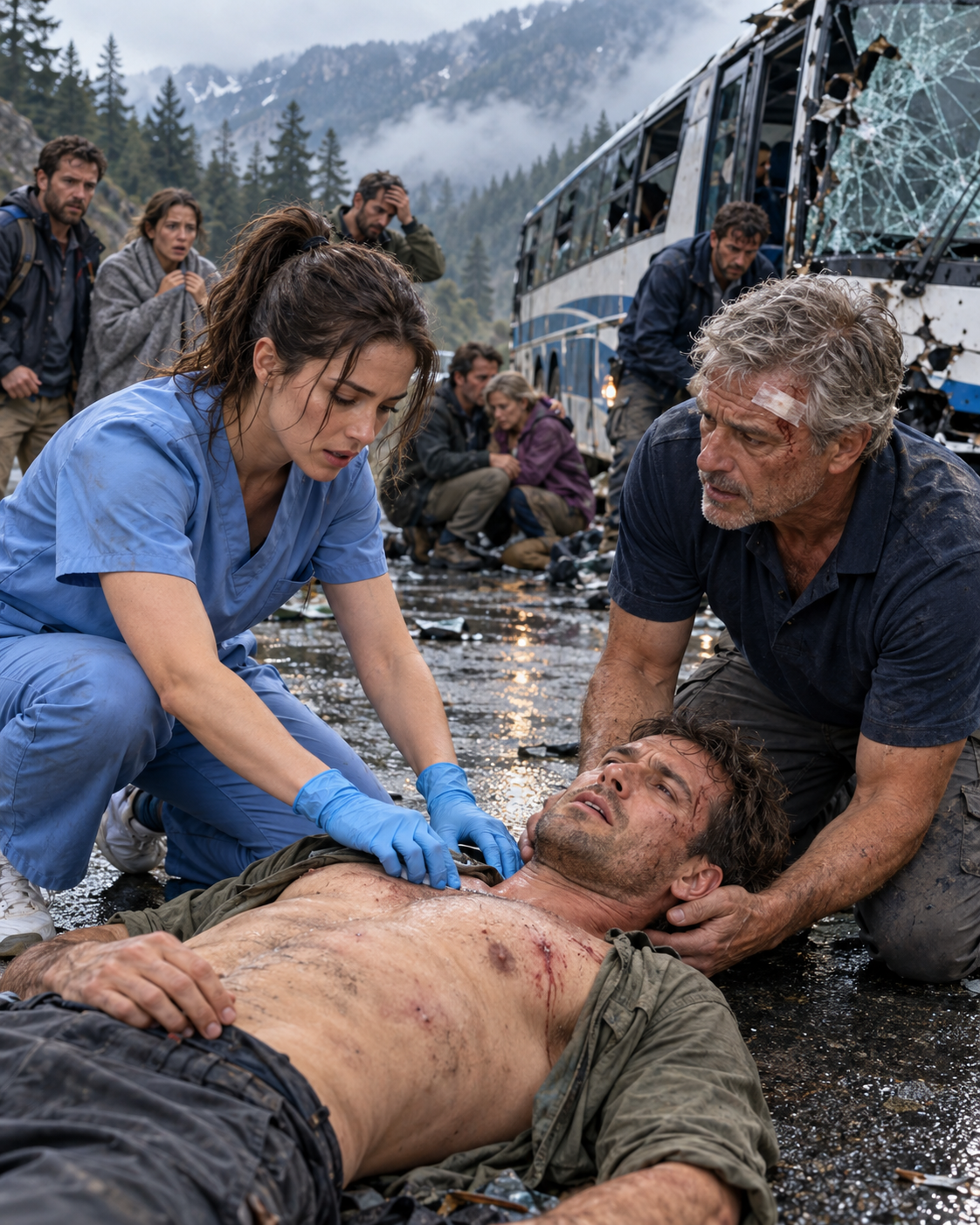
Then forty-two veterans crashed on a rainy highway, and every skill I had buried came rushing back as though the years between then and now had never existed.
By the time I finished speaking, I was crying so hard that I could barely breathe.
“I saved them,” I whispered, looking down at my hands. “But I saved those men, too. I kept Graves’s people alive. I watched terrible things happen, and sometimes I had to help the people making them happen. What does that make me?”
Colonel Harding remained silent for several seconds.
I expected him to tell me that I had chosen the wrong profession, that a decent person would have found a way to resist, or that the things I had done made me unfit to stand beside the people I had just helped.
Instead, he leaned forward and placed his hands on his knees.
“It makes you someone who survived an impossible situation,” he said.
I shook my head.
“You don’t understand. I had the ability to keep them alive. Every time I did, they went back out there.”
“And you were a prisoner,” he replied. “You weren’t the person giving the orders. You weren’t free to decide the conditions under which you provided care. You were trying to survive.”
“But I knew what they were.”
“So did you know what the veterans on that bus were?” he asked gently. “Did you know what they’d done, what they believed, or what kind of people they’d be when they got home?”
I stared at him.
“No.”
“Because it wasn’t your job to decide which of them deserved to live.”
His words landed more painfully than condemnation would have, because some part of me had spent three years trying to prove I had been a bad person who deserved the life I had endured.
I had treated my survival like a crime for which I owed the world an apology.
Harding shook his head.
“What happened to you was not cowardice, Meline. And refusing to die for the sake of proving you were brave would not have made you a better person.”
I pressed both hands over my mouth.
He continued, his voice steady.
“You didn’t choose that captivity. You didn’t choose what those men did. And last night, when forty-two people needed help, you didn’t turn away because of what the past had done to you.”
He paused.
“You went toward them.”
I broke then, not the quiet tears I had learned to hide, but a grief that seemed to come from somewhere deeper than my body, from the part of me that had waited years for someone to say that surviving did not make me guilty.
For the first time since I escaped the compound, I allowed myself to cry without trying to justify why I was crying.
Harding stayed beside me.
He did not tell me to stop, did not rush me toward a lesson, and did not ask me to make my pain useful to anyone else.
He simply stayed.
Then footsteps sounded in the corridor outside.
The supply-room door, which I had failed to latch properly, began to open.
I lifted my head, wiping my face with the heel of my hand, and saw Corporal Danny Ruiz standing in the doorway.
Behind him stood Mitchell Hayes, supported by two nurses, his leg already dressed and stabilized, his face pale but alive.
Kevin was there, too, breathing with assistance and looking exhausted, but conscious.
And behind them, filling the corridor, stood more veterans than I could count.
I felt the blood drain from my face.
They had heard everything.
Part 3
For one awful second, nobody moved.
I saw the questions in their faces, the confusion, the new knowledge that the quiet pediatric nurse they had watched working in the rain carried a history none of them had imagined.
I had spent years fearing that if the truth ever escaped me, people would look at my hands and see only the men I had been forced to save.
Now I stood in front of a corridor full of men who had witnessed what those same hands had done for them.
Danny Ruiz stepped forward first.
He looked as though he had not slept, his uniform replaced by hospital clothes and his eyes still reddened from the night before.
“I heard what you said,” he told me.
My stomach tightened.
“I’m sorry,” I whispered. “I didn’t mean for anyone to hear that.”
He glanced back at Kevin, who was sitting in a wheelchair beside a nurse, then returned his attention to me.
“You saved my friend.”
I tried to answer, but my throat had closed.
Danny continued, his voice shaking.
“You don’t know what he means to me. We’ve been through things together that I can’t explain to people who weren’t there. When he stopped responding last night, I thought I was watching him die, and I couldn’t do anything about it.”
He swallowed hard.
“Then you came.”
“I only did what I could.”
“No,” Danny said. “You did what you could when you had no reason to believe anyone would ever thank you for it.”
Mitchell Hayes moved forward with the help of a nurse, refusing to sit until he was close enough to look me in the eye.
“I heard about the tourniquet,” he said. “The team told me what you did and how you made sure they knew when you’d put it on.”
He glanced down at his leg, then back at me.
“I’ve been in combat. I’ve watched good people work under terrible conditions. Last night, you were one of those people.”
His voice broke slightly.
“I have a daughter. Seven years old. You told me to keep talking so I could see her again.”
He reached into his pocket and pulled out a folded photograph.
It showed a little girl with dark curls, missing one front tooth, and grinning in front of a birthday cake.
“This is Emma,” he said.
I nodded, unable to trust my voice.
“I’m going to tell her about the nurse who helped me get home. And when she asks why you did it, I’m going to tell her that some people keep helping even after the world gives them every reason to stop.”
I looked at the photograph, and suddenly I could see my father’s hands again, tying that bandage around a child’s arm at the missionary clinic.
For years, I had remembered his death more clearly than his life.
Now I remembered his smile.
Kevin lifted his head from his wheelchair.
“I don’t know if I understand everything I just heard,” he said slowly. “I don’t think I can pretend I understand what you went through.”
He paused to catch his breath.
“But I know I was dying, and you didn’t leave me.”
I felt tears gathering again.
He gave me a tired, crooked smile.
“That’s enough for me.”
Something shifted in the corridor.
Not a dramatic cheer or a sudden burst of applause, but a series of small, deliberate gestures that carried more weight than noise ever could.
One veteran stepped forward and thanked me.
Another nodded, his eyes shining.
A man whose arm was wrapped in a thick dressing reached out to shake my hand, then seemed to remember how badly it was trembling and held it gently instead.
Nobody demanded that I explain every choice I had made in captivity.
Nobody asked whether I thought Graves had deserved to live.
Nobody told me I had to forgive the people who had hurt me.
They offered something I had not known how to ask for.
They allowed me to be the person standing in front of them now, rather than the prisoner I had been.
Colonel Harding stepped aside to let the veterans approach, and for the first time since I had entered the supply room, I did not feel trapped.
I felt seen.
Later that morning, after the corridor had emptied and the hospital settled into the exhausted quiet that follows a mass-casualty emergency, Harding found me sitting beside a window overlooking the ambulance bay.
The rain had stopped, but the sky remained dark and heavy.
He sat in the chair beside mine.
“You know,” he said, “people sometimes think the bravest person is the one who never feels afraid.”
I looked at him.
“I used to think that.”
“So did I,” he answered. “It took me a long time to learn that fear doesn’t make a person weak, and surviving something doesn’t mean you owe the world a performance of strength.”
He rested his hands together.
“You don’t have to tell your story to everyone who asks. You don’t have to make your pain into a lesson, and you don’t have to prove that you’re a good person every time somebody discovers what happened to you.”
I stared at the morning light filtering through the window.
“What if I still don’t know how to forgive myself?”
“Then don’t force it today,” he said. “Just stop sentencing yourself for surviving.”
I had no answer.
For years, I had treated healing like a courtroom in which I was both the accused and the judge, returning to the same terrible evidence until the verdict never changed.
But Harding was right about one thing.
I could not change the fact that I had been held prisoner, and I could not rewrite the things the men around me had done.
What I could change was whether I continued to punish the person I had been when I had almost no freedom at all.
Over the following weeks, the veterans recovered at different speeds.
Mitchell underwent further treatment and began physical rehabilitation, his determination to return home to Emma stronger than his frustration with the uncertainty ahead.
Kevin remained under close medical care, and although he faced a difficult recovery, he eventually left intensive treatment and began the slow process of rebuilding his strength.
Danny visited him whenever he could, carrying terrible hospital coffee and making jokes that were only occasionally funny.
The first time they both came back to Oak Creek for a follow-up visit, they brought a card signed by members of their unit.
There were forty-two names inside, some written in careful block letters, others shaky from injured hands.
At the top, Danny had written, “To the nurse who ran toward the wreckage when the rest of us were afraid of what we would find.”
I read the card in the hospital break room and had to sit down before I reached the last signature.
I kept it in the drawer beside my bed, not as proof that I had become a hero, but as a reminder that the worst chapter of my life had not taken away my ability to do something good.
The hospital administration eventually learned more about the circumstances of the crash, and I cooperated fully with the review of the emergency care provided before the professional rescue teams arrived.
I made no attempt to portray the improvised intervention as a substitute for proper equipment or trained trauma care, because I knew how dangerous those circumstances had been.
I knew, too, that the right answer to an emergency was always access to qualified help as quickly as possible.
The lesson was not that one person could replace a trauma team.
It was that every life mattered while help was on its way, and that desperation should never be confused with glory.
When the review ended, the hospital recognized the efforts of the staff and bystanders who had helped at the crash.
I accepted no special title and made no public speech about my past.
I only asked that the hospital continue improving its emergency preparedness training and support services for staff members who had experienced trauma themselves.
The request surprised no one who knew me.
I had seen what happened when people were left alone with the things they could not bear, and I did not want another person to spend years believing silence was the only way to survive.
Eventually, I began speaking privately with a trauma counselor, first about sleep and the way rain still made my heart race, then about my father, and finally about the years I had spent believing that the choices forced on me defined the kind of woman I was.
Some sessions ended with anger.
Others ended with silence.
A few ended with me remembering something about my father that had nothing to do with his death, like the way he sang badly while washing instruments or how he always saved the last piece of fruit for me despite pretending he wanted it himself.
Those memories became a kind of shelter.
I began to understand that Graves had taken three years from me, but I had given him more years afterward by allowing his cruelty to define how I understood myself.
I could not undo the captivity.
I could not bring my father back.
But I could stop treating my survival as evidence that I had failed him.
One evening, several months after the crash, I sat on the small balcony outside my apartment, listening to rain tap gently against the railing.
For the first time in years, I did not rush inside.
I let the sound wash over me, remembering the clinic and the jungle without forcing the memories to disappear.
I imagined my father sitting beside me, his tired smile returning, asking me the same question he had asked whenever I thought the world had become too large for my hands to hold.
“What is the next right thing?”
I breathed in slowly.
Then I answered him, though he was no longer there to hear it.
“Keep going.”
The following morning, I returned to the pediatric ward.
A little boy was waiting for me with a bandaged hand and a stuffed dinosaur tucked beneath his arm, and when he saw me, he immediately began explaining that his dinosaur was braver than all the other dinosaurs because it had survived a terrible fall.
I listened with the seriousness his story deserved.
Then I helped him settle into bed, adjusted his blanket, and assured him that he did not have to be brave every minute of the day.
He looked up at me.
“Can I be scared and still be brave?”
I felt something warm and aching move through my chest.
“Absolutely,” I told him. “Sometimes that’s exactly what brave means.”
After my shift, I took the veterans’ card from my drawer and read the names one more time.
Forty-two men had climbed onto that bus expecting to reach their destination, and forty-two lives had collided with mine on a dark, rain-soaked highway.
They had not known my history, and I had not known theirs, but for a few terrible hours, we had been bound together by something more powerful than the secrets each of us carried.
They had trusted me with their lives.
And when they learned the truth about mine, they did not ask me to prove I deserved that trust.
I had spent years believing the blood on my hands could never be washed away, that whatever good I did afterward would always be smaller than the terrible circumstances in which I had once been forced to work.
But the truth was more complicated, and far more merciful.
I had been a daughter who lost her father.
I had been a prisoner who endured the unendurable.
I had been a nurse who walked into a wrecked bus because people were dying and someone needed to help.
None of those truths erased the others, but neither did any single one of them tell the whole story of who I was.
I no longer needed to pretend that my past had never happened.
I only needed to remember that it was my past, not my sentence.
And somewhere in the quiet spaces between the memories that still hurt and the lives that continued because I had reached for them, I finally began to believe that my father’s greatest lesson had survived everything that had happened to us.
A human life was never measured by the worst thing someone had done to you, the terrible choices you had been forced to make, or the years you had lost trying to escape them.
It was measured, in part, by what you chose to do when the next person needed help.
That night on Route 114, I had run toward the wreckage without knowing whether I could save anyone.
I had simply known that I could not stand by and watch.
For years, I had thought that was the one part of myself I had never managed to bury.
Now I understood that it was the one part I had never truly lost.
My name was Meline Rossi.
I was a survivor, a daughter, and a nurse.
And at last, I was learning that I could carry all three truths without being ashamed of any of them.