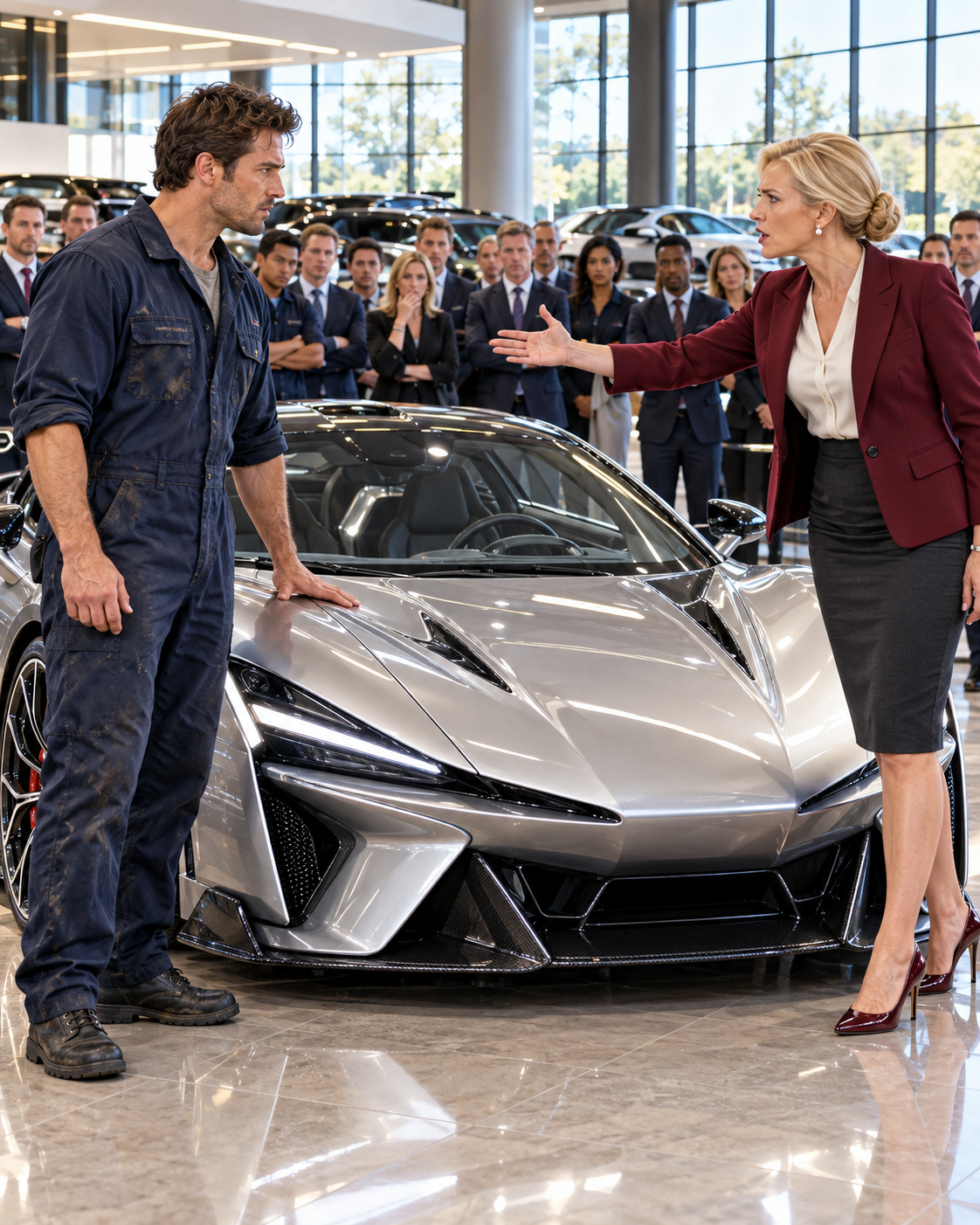
Allison Vance tore my badge from my neck on the showroom floor and called me a reckless nobody beside a nearly $200 million
Part 2
The engineer carefully isolated the failing component while the rest of the team secured the vehicle.
No one was allowed within the marked perimeter.
I remained outside it, arms folded, listening as the engineers compared readings and traced the pressure path.
After twenty minutes, they found the problem.
A control component had begun to fail internally.
It was not dramatic from the outside.
There was no smoke, no shattered metal, no cinematic explosion.
Just a tiny internal failure that had been building toward something much worse.
One engineer straightened.
“He was right.”
Nobody corrected him.
Allison stepped toward me.
For a moment, she looked less like the most powerful person in the showroom and more like someone who had just realized how close she had come to losing something she could never replace.
“Daniel.”
I looked at her.
“I’m sorry.”
I said nothing.
She held out my badge.
“I should have listened.”
I stared at the plastic rectangle in her palm.
She continued quietly.
“I panicked.”
“You were protecting the showroom.”
“I was protecting the car,” she said.
Then she paused.
“I forgot there was a person standing beside it.”
That sentence hurt more than the firing.
Because I realized she was not entirely cruel.
She was scared.
Scared of the client.
Scared of the car.
Scared of what a failure on her watch could mean for her career.
Fear had made her choose certainty over judgment.
And I had been the easiest person to sacrifice.
She looked at the engineers.
“They need him back.”
I almost laughed.
“That’s not the same as an apology.”
“I know.”
She extended the badge again.
“I’m asking you to come back.”
I took it.
Not because I had forgiven her.
Not yet.
I clipped it back onto my shirt.
Then I looked directly at her.
“Rare cars need careful hands.”
She nodded.
“People do, too.”
Her eyes dropped.
“You’re right.”
I returned to the technical floor beside the engineers.
There was another defect hidden in the same system, smaller but still serious enough to compromise performance during the afternoon demonstration.
We found it just before noon.
One of the engineers whistled under his breath.
“If that had gone unnoticed…”
He didn’t finish the sentence.
He didn’t need to.
We repaired the assembly, ran the diagnostics, and tested the system repeatedly.
By early afternoon, the hypercar sat beneath the showroom lights again, silent and perfect.
Like nothing had ever happened.
But I knew better.
Machines never forgot what they had been through.
Neither did people.
A few hours later, the collector returned with his advisors.
He was an older man named Richard Hale, the kind of person whose name appeared in auction catalogs and private collections.
He walked slowly toward the car.
Then he stopped.
One of the engineers spoke first.
“There was a mechanical issue.”
Richard looked at him.
“What kind?”
The engineer glanced toward me.
“A pressure-control failure that could have caused catastrophic damage under load.”
Richard turned.
His eyes found mine.
“You heard it?”
I nodded.
“Before the system alarmed.”
He studied me for several seconds.
“What did you hear?”
“A clicking pattern that changed frequency under vibration.”
He smiled faintly.
“Most people would never notice.”
“That’s why I’m here.”
He looked toward Allison.
“Is this the mechanic you fired?”
The room went still.
Allison did not hesitate.
“Yes.”
Richard looked back at me.
“And then brought back?”
“Yes.”
“Why?”
Allison answered before I could.
“Because he was right.”
Richard nodded once.
Then he asked me to step into a private office.
I expected a complaint.
Maybe a legal question.
Instead, he poured two glasses of water and sat down.
“Tell me about yourself.”
I hesitated.
There was nothing impressive about my apartment.
Nothing glamorous about working overtime.
Nothing that sounded important next to a collection of historic machinery.
“I’m a mechanic.”
Richard waited.
I continued.
“I’ve been doing high-performance work for fifteen years.”
“And when you’re not working?”
I smiled despite myself.
“I have a daughter.”
“How old?”
“Seven.”
“What’s her name?”
“Mia.”
For the first time, Richard smiled.
“What does Mia know about cars?”
“More than she should.”
He laughed.
“How?”
“Because I talk about them too much.”
I told him about our apartment.
Our tiny kitchen.
The cartoons Mia watched while I cooked dinner.
The way she liked to draw cars with absurdly large wheels.
I told him she always asked whether I had finished work early so we could eat together.
I didn’t tell him every detail.
I didn’t need to.
Richard leaned back.
“I have a private restoration collection.”
I thought I knew where the conversation was going.
He continued.
“It contains some of the rarest cars in the world.”
I nodded.
“I’m looking for someone to oversee the mechanical restoration side.”
I stared at him.
“Me?”
“Yes.”
“I work here.”
“You worked here.”
I glanced at the showroom floor.
Richard smiled.
“I’m offering you the position.”
My first instinct was disbelief.
My second was suspicion.
“Why me?”
“Because your ears caught what millions of dollars in diagnostic equipment had not yet confirmed.”
He paused.
“And because when you were humiliated, you still turned around to save a machine owned by a man who had nothing to do with you.”
I looked down.
Richard’s offer came with a salary I had never earned before.
Health coverage.
A leadership title.
And something that mattered even more to me.
Flexible hours.
He had heard me when I spoke about Mia.
“Your daughter comes first,” he said.
I looked up.
“There are engineers who can work at midnight. There are mechanics who can stay until dawn. I need a person I can trust during the hours when judgment matters.”
My throat tightened.
“I don’t know what to say.”
“You say yes or no.”
I thought about the badge.
The floor.
Allison’s hand.
Mia’s voice that morning.
Come home early.
I smiled.
“Yes.”
Richard stood and shook my hand.
“Then we have a deal.”
When I stepped back onto the showroom floor, Allison was waiting.
She gave me a small smile.
“Congratulations.”
“Thank you.”
She nodded toward the hypercar.
“You saved us today.”
I looked at the car.
“No.”
She frowned.
“What?”
“The car warned us.”
I touched my badge.
“I just listened.”
That evening, I drove home with a bag of groceries in the passenger seat and a small birthday cake on the floorboard.
The sky over Miami was streaked orange and pink as the sun dropped behind the buildings.
Traffic crawled.
My mind was still trying to understand everything that had happened.
That morning, I had been an employee afraid of losing his paycheck.
By evening, I had been offered a future I had never imagined.
But none of that mattered when I opened the apartment door.
Mia ran toward me.
“Dad!”
I dropped the groceries just in time to catch her.
She wrapped her arms around my neck.
“You came home early.”
“I did.”
She pulled back.
“What happened?”
I looked at her little face.
I thought about telling her everything.
The firing.
The alarm.
The hypercar.
The offer.
Instead, I said, “I heard something important today.”
She tilted her head.
“What?”
“A warning.”
She thought about that.
Then she smiled.
“Good thing you listened.”
I kissed her forehead.
“Yeah.”
We ate dinner together.
We opened the cake.
She blew out the candles.
And while she laughed with frosting on her cheek, I realized how close I had come to missing this moment because of pride.
Not mine.
Someone else’s.
That night, after Mia fell asleep, I sat alone at the kitchen table.
My badge rested beside a stack of bills.
The same badge that had felt like a symbol of humiliation that morning now looked different.
It was only plastic.
It had never been my worth.
My work was not valuable because somebody important allowed me to do it.
It was valuable because I had learned how to do it well.
And no title could give that to me.
No firing could take it away.
Part 3
The next morning, I stood outside Richard Hale’s private collection for the first time.
There were cars inside that I had spent years reading about in magazines.
Machines with histories older than me.
Machines whose engines carried the fingerprints of dead craftsmen.
I walked through the doors wearing a new uniform.
But I did not feel like a different man.
I still had grease beneath my fingernails.
I still carried a small photo of Mia in my wallet.
I still checked the time because I wanted to be home for dinner.
Richard met me at the entrance.
“Ready?”
I smiled.
“Yes.”
He pointed toward the first restoration bay.
“That one has been waiting for someone like you.”
I walked over.
I opened the hood.
I listened.
The engine was quiet.
Too quiet.
I smiled.
Some things never changed.
A week later, Allison called me.
She asked how the new job was going.
I told her it was good.
There was a long pause.
Then she said, “I’ve been thinking about that morning.”
“So have I.”
“I was wrong.”
I appreciated that she said it plainly.
No excuses.
No polished speech.
Just the truth.
“I know.”
She took a breath.
“I thought protecting the showroom meant controlling everything.”
“And now?”
“Now I think sometimes it means trusting the people who know what they’re hearing.”
I smiled.
“That’s a lesson worth keeping.”
She laughed softly.
“Take care of Mia.”
“I will.”
Then we hung up.
I never returned to the old showroom as an employee.
I visited once as a guest.
The hypercar was still there, still flawless, still surrounded by velvet ropes and security glass.
People stood around it whispering about its price.
Two hundred million dollars.
That number meant something to them.
To me, it meant something else.
I remembered the clicking.
The pressure.
The warning.
The moment everyone thought I had crossed a line by touching the car.
And I remembered the silence after Allison handed me back my badge.
Sometimes the most important thing in a room is the thing nobody wants to hear.
A warning.
A correction.
A quiet truth.
A person saying, “Something is wrong.”
And sometimes the cost of listening to that truth is humiliation.
Sometimes it is losing a job.
Sometimes it is standing alone while everyone else tells you that you are overreacting.
But the right choice does not become wrong because it is inconvenient.
And expertise does not become arrogance simply because someone with more authority refuses to hear it.
A few months after I started with Richard, Mia came to the collection for the first time.
She walked between the cars with her mouth open.
“Dad, are these all yours?”
I laughed.
“No.”
“Then whose are they?”
“Somebody else’s.”
She thought about that.
Then she looked around at all the beautiful machines.
“Do they trust you with them?”
I knelt beside her.
“Yes.”
“Why?”
I looked at the cars.
Then at her.
“Because I take care of them.”
She smiled.
“That’s important.”
“It is.”
She grabbed my hand.
“Are we going home soon?”
I looked at the clock.
“Pretty soon.”
She smiled wider.
“Good.”
We walked toward the exit together.
Behind us, millions of dollars sat beneath museum lights.
Rare metal.
Rare engines.
Rare histories.
But none of it could follow me home.
What followed me was Mia’s hand in mine.
Her voice.
Her trust.
The quiet knowledge that I had finally found a place where my work and my responsibilities did not have to compete with each other.
That night, I tucked her into bed.
She was almost asleep when she whispered, “Dad?”
“Yeah?”
“Did you do the right thing that day?”
I looked at her in the dark.
“Yes.”
She smiled without opening her eyes.
“Good.”
Then she was gone into sleep.
I stood there for a moment longer.
I thought about the hypercar.
The badge.
The alarm.
The humiliation.
The offer.
The cake.
The lesson.
A machine worth nearly two hundred million dollars had been saved because someone listened to a sound most people ignored.
But the greatest thing I carried from that day was not money, a promotion, or a beautiful collection of cars.
It was the reminder that true value has never lived inside a price tag.
It lives in the person who notices the crack before the wall falls.
In the worker who still does the right thing after being treated unfairly.
In the parent who keeps going because a child is waiting at home.
And sometimes, in the quietest moment of all, it lives in simply listening.
The next morning, I put on my uniform, kissed Mia goodbye, and walked out the door.
I was no longer measuring my worth by the people standing above me.
I was measuring it by the people I could protect, the work I could do, and the promises I could keep.
And somewhere deep in the memory of that impossible morning in Miami, I could still hear that tiny metallic clicking.
A warning.
A chance.
A choice.
I had listened.
And that changed everything.