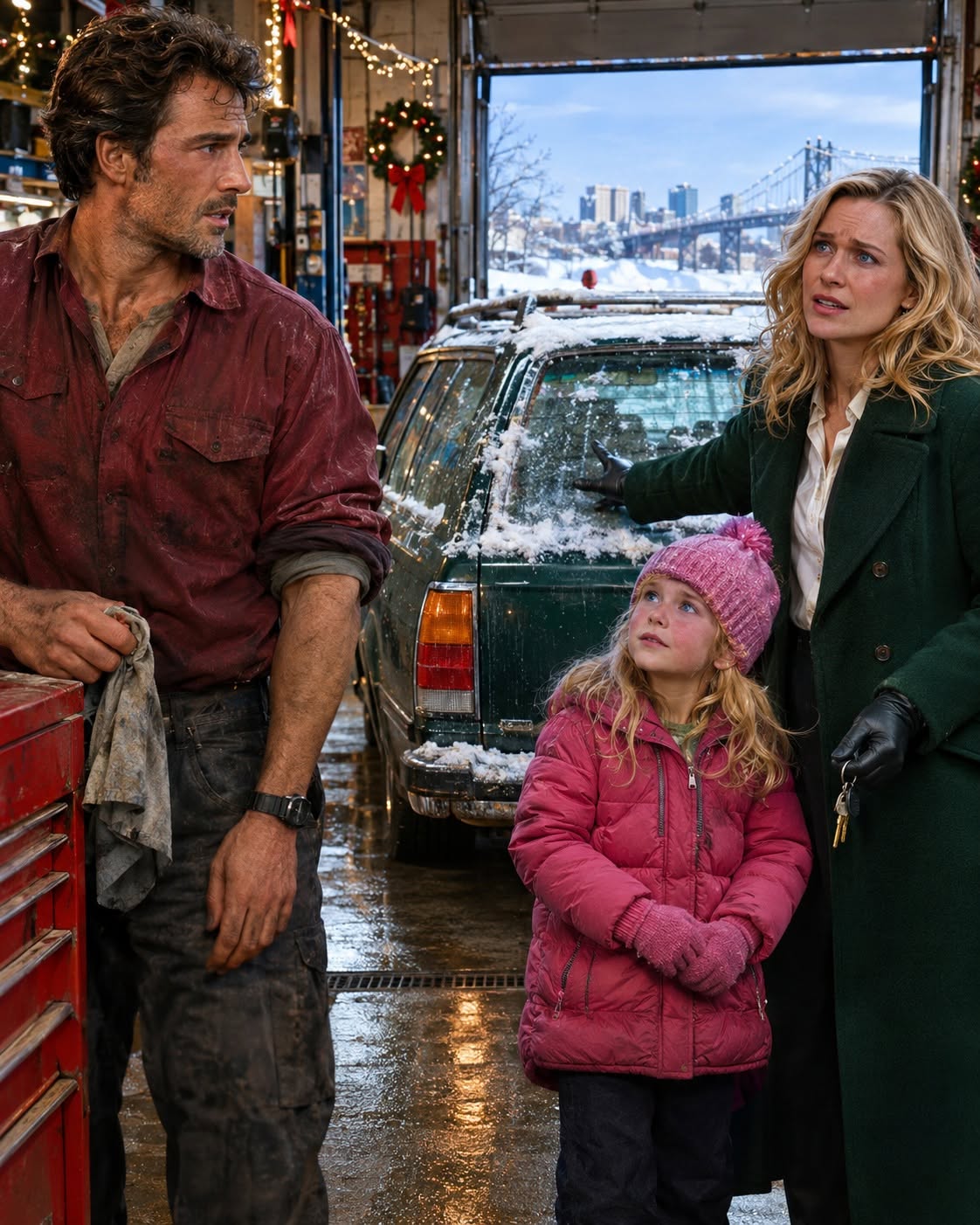
A little girl walked into my auto shop carrying a glass jar full of coins and asked if she had enough money to save Christmas.
“You were the young man on Route 17,” Clara whispered.
I nodded.
For a moment, neither of us spoke. The sounds of the garage seemed to fade into the background. The rattling tools, the humming heaters, the distant radio playing Christmas music—all of it disappeared beneath the weight of a memory I had carried for nearly ten years.
“That was you?” she finally asked.
“Yes. It was me.”
Clara covered her mouth with one hand.
“Oh my goodness. I never knew what happened to you.”
I leaned against the workbench, and suddenly I wasn’t standing in my garage anymore. I was twenty-six years old again, sitting beside a broken-down sedan on a snow-covered highway, wondering how I was going to get home.
It had been December then, too.
My father had died three months earlier, leaving behind more debt than money. My girlfriend had walked out, and the little repair shop I’d been working at had laid me off.
I was driving an old car that barely ran, heading to a friend’s house because I had nowhere else to go.
Then the engine died.
I remember standing beside the road, trying to flag down passing cars. Most people slowed down just enough to look at me before driving away.
My phone was nearly dead. My wallet contained eleven dollars.
And I had no idea what to do.
That’s when a dark SUV pulled over.
A woman stepped out wearing an emerald green coat.
It was Clara.
She asked if I was okay, then helped me push my car into a safer spot. She called a roadside service, but when the mechanic quoted me a repair bill, I just stared at the ground.
“I can’t afford that,” I’d admitted.
Clara didn’t ask why. She didn’t lecture me about responsibility or tell me I should have planned better.
She simply opened her purse, counted out several hundred dollars, and placed the money in my hand.
“I can’t take this,” I’d protested.
“Then don’t think of it as something you’re taking,” she replied. “Think of it as something someone is giving you because they remember what it’s like to need help.”
I tried to get her name and address so I could repay her.
She only smiled.
“One day, when you’re able, do the same for someone else.”
Then she drove away.
I never saw her again.
I used that money to repair my car, buy groceries, and get to a job interview. That interview eventually led me to a small mechanic’s shop where an older owner taught me everything he knew.
A few years later, I bought the place.
It wasn’t easy. There were nights when I slept in the office because I couldn’t afford to rent an apartment and keep the business running. But I survived.
Eventually, I married, had a daughter named Maya, and built a life I once thought was impossible.
And now the woman who had helped me when I had absolutely nothing was standing in front of me.
With her little girl beside her.
“Clara,” I said softly, “you have no idea what that night meant to me.”
She shook her head.
“I was just doing what anyone should do.”
“No. You were doing what most people didn’t.”
Her eyes filled with tears.
Nora looked between us, clearly confused.
“Mommy, do you know him?”
Clara knelt and brushed a strand of hair away from her daughter’s face.
“Yes, sweetheart. A long time ago, I helped this man when he was having a very difficult time.”
Nora looked at me.
“Then why are you helping us?”
I smiled.
“Because your mommy taught me something a long time ago.”
“What?”
I glanced at Clara.
“That sometimes, when someone helps you, you don’t pay them back. You pass the kindness along.”
Nora considered that for a moment.
Then she hugged her jar against her chest.
“So does that mean I can keep my money?”
I laughed for the first time that afternoon.
“Absolutely. That’s your money. You worked hard to save it.”
She smiled, but Clara still looked uncomfortable.
“I appreciate what you’re doing,” she said. “But I don’t want you losing money because of us. You said this was a complicated repair.”
I looked toward the SUV.
“Your car needs a new battery, some electrical work, and a replacement alternator. I can handle it.”
“But the cost…”
“Consider it a Christmas present.”
Clara started to protest again.
I raised a hand.
“Please. Let me do this.”
She looked down, wiping her eyes.
“Thank you.”
I nodded and returned to work.
But as I walked toward the SUV, I noticed something I hadn’t paid much attention to before.
Clara’s coat was expensive, but worn at the cuffs. Her shoes were scuffed. Her hands trembled slightly as she tried to zip up Nora’s jacket.
There was an envelope sticking out of her purse.
The same care facility logo I’d seen in the glove compartment.
And beneath it, a stack of overdue bills.
Something told me that this woman was carrying more than a broken-down car.
For the next two hours, I worked while Clara and Nora waited in the customer area.
Nora kept herself busy drawing Christmas trees on scrap paper. Every few minutes, she’d come over to ask how much longer the repair would take.
“Almost there,” I told her.
“Is that what mechanics always say?”
My assistant, Ben, overheard and burst out laughing.
“Only when they’re trying to keep customers happy.”
Nora giggled.
For a little while, the garage felt warmer than it had all day.
Then my phone rang.
It was Maya.
“Dad, are you coming home?”
I looked at the clock.
I’d promised her we’d decorate the Christmas tree together at six.
It was already six fifteen.
“I’m sorry, sweetheart. I have one more car to finish.”
There was silence.
“But you promised.”
The words hit harder than I expected.
“I know. I’ll try to be home soon.”
“Okay.”
She hung up.
I stood there staring at the phone.
Ben approached me.
“Everything all right?”
I nodded, although it wasn’t.
He glanced toward Nora, who was carefully arranging colored pencils on the table.
“Go home, boss. I’ll finish checking the electrical connections.”
“I can’t leave you with this.”
“You taught me how to do the job. Besides, I think this little girl has waited long enough.”
I looked at him.
Then I smiled.
“Thank you.”
I spent another twenty minutes checking everything before handing the keys to Ben.
By seven thirty, the SUV was ready.
The engine started smoothly, and Nora clapped as if she’d just watched a magic trick.
“IT WORKS!”
She ran straight to her mother.
“Mommy! We can see Grandma!”
Clara laughed, but tears were already running down her cheeks.
She approached me with her wallet again.
I gently shook my head.
“Remember Route 17.”
She lowered her hand.
“I remember.”
“Then let me remember it, too.”
She hugged me.
It was an awkward hug between two people who had once been strangers, but somehow it felt like the most natural thing in the world.
Before leaving, Nora walked back to my counter.
She placed something beside my clipboard.
It was one of her drawings.
A Christmas tree with three people standing beneath it. One woman, one little girl, and one man wearing a blue shirt.
Above them, she’d written in crooked letters:
“PEOPLE WHO HELP EACH OTHER.”
I smiled.
“Thank you, Nora. I’m going to keep this.”
She waved and climbed into the SUV.
I watched the taillights disappear into the snowy evening.
Then I locked up and drove home.
When I walked through my front door, Maya was sitting on the living room floor beside an undecorated Christmas tree.
The ornaments were scattered around her.
She looked up at me.
“You’re late.”
I knelt beside her.
“I know. I’m sorry.”
She crossed her arms.
“Did you fix the car?”
“Yes.”
“Did the little girl get to see her grandma?”
“She’s on her way.”
Maya looked at the ornaments for a moment.
Then she handed me a silver star.
“Okay. You can put this one on top.”
I pulled her into a hug.
And that evening, as we decorated the tree, I realized something important.
I’d spent years believing that building a successful business meant working harder, earning more, and never turning away a paying customer.
But sometimes the most valuable thing you could do with what you’d built was give someone else a chance to keep going.
I thought that was the end of the story.
I was wrong.
Three days later, on Christmas Eve, someone knocked on the garage door.
I was preparing to close early when I saw Clara standing outside.
This time, she wasn’t wearing her emerald coat.
She had a red scarf wrapped around her neck and a small gift bag in her hand.
Nora was beside her.
“Well, look who it is,” I said, opening the door.
Nora rushed inside.
“WE SAW GRANDMA!”
I smiled.
“How is she?”
“She’s better! Well, she’s still sick, but she smiled when she saw me.”
Clara nodded.
“We made it just in time. She’d been asking about Nora all morning.”
I felt a wave of relief.
“That’s wonderful.”
Clara handed me the gift bag.
“This is for you.”
I opened it carefully.
Inside was a framed photograph of a snowy highway.
At the bottom was a handwritten note:
“To the man who finally got his Christmas miracle. Thank you for remembering.”
I looked up, confused.
Clara smiled.
“There’s something I never told you about that night on Route 17.”
I waited.
“After I helped you, I drove home and found out my mother had been admitted to the hospital. She’d suffered a stroke. I was on my way to see her when I stopped for you.”
I frowned.
“Clara, I had no idea.”
“I didn’t tell you because it wasn’t important. But when I saw you today, I remembered something else.”
She paused.
“That night, after helping you, I went to the hospital. My mother was conscious, but she couldn’t speak very clearly. I told her about the young man stranded in the snow. I told her I’d given him money even though I wasn’t sure I could afford it.”
Clara laughed softly.
“She squeezed my hand and said, ‘Good. The world needs more people who stop.'”
My throat tightened.
“She was right.”
“She also made me promise something. She said that if I ever needed help, I shouldn’t be too proud to accept it.”
Clara looked toward the garage floor.
“I haven’t always been good at keeping that promise.”
I understood then.
She wasn’t simply embarrassed about accepting a free repair.
She had spent years being the person everyone depended on.
And now, when life had become difficult, she didn’t know how to let someone else carry even a small part of the burden.
“Clara,” I said, “there’s nothing wrong with needing help.”
She nodded.
“I know that now.”
Then she reached into her bag and pulled out a folded piece of paper.
It was a photograph of Nora sitting beside an elderly woman in a hospital bed.
They were holding hands and smiling.
“Grandma asked me to give you this.”
I studied the picture.
On the back, someone had written in shaky handwriting:
“To the young man who was helped by a stranger. May you never forget that kindness is never wasted.”
I had to look away for a moment.
I wasn’t sure why, but those words made me think of my father.
He’d spent his entire life helping people without expecting anything in return. When he died, I’d been so consumed by grief and debt that I’d forgotten the lessons he’d tried to teach me.
I looked at Clara.
“How is your mother doing financially?”
Her smile faded.
“That’s complicated.”
“Tell me.”
She hesitated.
Then she explained.
Her mother had been living in a care facility for several months. The costs had become overwhelming, especially after Clara lost her job at a small accounting firm.
She’d taken temporary work whenever she could, but the medical expenses kept piling up.
The SUV had been her only reliable way to get to the facility.
When it stopped working, she’d spent nearly all the money she had trying to arrange transportation.
She hadn’t told Nora how serious things were.
But children often understand more than adults think.
That’s why Nora had started saving.
She’d been putting away every coin she could find since summer.
Birthday money. Loose change. Coins from the couch.
She even stopped buying candy after school.
All because she wanted to make sure her mother could visit Grandma.
I looked at Nora.
“That’s a lot of saving.”
She nodded proudly.
“I wanted to help.”
I crouched down.
“You already did something very important.”
“What?”
“You reminded everyone around you that people matter more than money.”
She smiled shyly.
Clara wiped her eyes.
I thought for a moment.
Then I made a decision.
“Clara, we’re hiring.”
She blinked.
“What?”
“I need someone to handle invoices, customer records, scheduling, and the office. I’ve been doing all of it myself, and I’m terrible at it.”
Ben, who had been listening from the workbench, turned around.
“He’s not kidding. Last week he scheduled the same customer three times.”
“That was one time,” I protested.
“Three times,” Ben corrected.
Clara laughed.
For the first time since I’d seen her, she looked genuinely relaxed.
“You’re offering me a job?”
“If you’re interested. We can work around your mother’s care schedule. The position pays fairly, and I need someone I can trust.”
She stared at me.
“But you don’t even know if I’m qualified.”
I raised an eyebrow.
“You just spent five minutes explaining a complicated financial situation more clearly than I could explain my own business accounts.”
Ben nodded.
“She’s hired.”
Clara laughed through her tears.
“I don’t know what to say.”
“Say you’ll come in Monday morning.”
She looked at Nora.
Nora was already jumping up and down.
“Mommy! You got a job!”
Clara hugged her daughter tightly.
And just like that, another chapter began.
Over the next few months, Clara became an important part of the shop.
She reorganized our records, created a proper scheduling system, and helped us recover thousands of dollars in unpaid invoices.
She also discovered that we were charging too little for several services.
Within six months, the business was doing better than it had in years.
But the biggest change wasn’t financial.
It was the atmosphere.
Clara had a way of remembering every customer’s name. She knew which people were struggling, which families had children, and which older customers needed a little extra time.
She never embarrassed anyone.
If someone couldn’t afford a repair, she’d quietly talk to me before they left.
Sometimes we’d arrange a payment plan.
Sometimes we’d find used parts.
And occasionally, we’d cover a repair entirely.
We never advertised it.
We never posted pictures or told customers they should be grateful.
We simply helped when we could.
Nora became a familiar face at the garage after school.
She’d sit at the counter doing homework, occasionally asking Ben questions about engines.
One afternoon, she announced that she wanted to become a mechanic.
Ben looked delighted.
“Finally! Someone around here who appreciates real work.”
I laughed.
“Don’t encourage her. She’ll be taking your job in a few years.”
Clara’s mother also improved.
Not dramatically, and not overnight.
There were difficult days when she struggled to recognize people. But she began speaking more clearly, and the doctors were cautiously optimistic.
Every Sunday, Clara took Nora to visit her.
And every time, Nora brought her grandmother a drawing.
A Christmas tree.
A flower.
A picture of the three of them holding hands.
One afternoon, nearly a year after the day Nora walked into my garage with her jar of coins, I received a phone call.
It was Clara.
Her voice sounded different.
“Can you come to the care facility?”
I immediately felt worried.
“Is your mother okay?”
“She’s asking for you.”
I drove there after closing.
When I entered her room, Clara’s mother was sitting by the window in a wheelchair.
She looked frail, but her eyes were bright.
Clara introduced me.
“Mom, this is the man I told you about.”
The elderly woman studied my face.
Then she smiled.
“Route 17?”
I nodded.
“Yes, ma’am.”
She reached for my hand.
“Good.”
Her voice was weak, but her grip was surprisingly firm.
“Good people should find each other.”
I swallowed.
“Your daughter changed my life.”
She shook her head.
“She didn’t do it alone.”
Then she looked at Clara.
“Sometimes we spend so much time helping others that we forget to let them help us.”
Clara smiled through her tears.
“I know, Mom.”
The woman turned back to me.
“Promise me something.”
“Anything.”
“Keep the door open.”
I frowned slightly.
“For the garage?”
She nodded.
“For people who need somewhere to go.”
I looked at Clara.
Then at Nora, who was sitting beside her grandmother with a coloring book.
“I promise.”
A few weeks later, Clara’s mother passed away peacefully in her sleep.
It was a difficult loss.
Clara took several days off, and I made sure she didn’t have to worry about her job.
At the funeral, Nora placed a small glass jar beside her grandmother’s photograph.
It was the same jar she’d carried into my garage.
Only this time, it was full of handwritten notes.
Each note contained a memory, a thank-you, or a promise.
Nora explained that she’d asked everyone in the family to write something they wanted Grandma to know.
Before the service ended, she stood beside the jar and read one of the notes aloud.
“Dear Grandma, thank you for teaching Mommy to stop when someone needs help. I hope I can be like you when I grow up.”
There wasn’t a dry eye in the room.
I stood at the back, thinking about how one small act on a snowy highway had traveled through years, through different lives, and eventually reached a little girl who had never even been born when it happened.
And I understood something I’d never fully understood before.
Kindness doesn’t always come back to us in the form we expect.
Sometimes it comes back as a job.
Sometimes as a friendship.
Sometimes as a little girl carrying a jar of coins.
And sometimes it comes back as the chance to become the person who once saved you.
Two years passed.
Our garage grew.
We hired two more mechanics, expanded the waiting area, and started a small program for families who couldn’t afford essential vehicle repairs.
We called it the Open Door Fund.
The name came from a promise made by a woman who had once been kind enough to stop on a snowy highway.
Clara managed the program.
Ben handled the repairs.
And I made sure we never forgot why we’d started.
Then, one December afternoon, something happened that brought the entire story full circle.
A boy, probably ten years old, walked into the garage.
His jacket was too thin for the weather, and he was carrying a small envelope.
He approached the counter nervously.
“Sir?”
I put down my paperwork.
“How can I help you?”
“Is this where you fix cars for people who don’t have enough money?”
I glanced at Clara.
She smiled.
“Sometimes. What’s going on?”
The boy opened his envelope.
Inside were twenty-three dollars and some change.
“My dad’s truck broke down. He uses it for work. If he can’t fix it, he might lose his job.”
He looked embarrassed.
“I know this isn’t enough, but I wanted to try.”
For a moment, I couldn’t speak.
I looked at the money in his hands.
Then I looked at Clara.
She had tears in her eyes.
Nora, who was now helping at the counter after school, slowly stood up.
She approached the boy and smiled.
“What’s your name?”
“Tyler.”
“I’m Nora.”
She glanced at his envelope.
“Do you know what my mom taught me?”
Tyler shook his head.
“That you don’t have to pay for kindness with money.”
Nora turned toward me.
“Right?”
I smiled.
“That’s right.”
I invited Tyler to sit down and asked him where his father was.
His dad was waiting outside in an old pickup truck.
When I went to inspect it, I found a failing fuel pump and several smaller issues.
The repairs weren’t cheap.
But they were manageable.
We fixed the truck.
We didn’t charge them a dollar.
Tyler’s father tried to protest, but Clara gently explained the Open Door Fund.
Before leaving, he shook my hand.
“I don’t know how to thank you.”
I looked at Tyler.
“Just remember this day. That’s all.”
He nodded.
A week later, a handwritten letter arrived at the garage.
It was from Tyler.
He wrote that his father had returned to work, that they had enough money to buy Christmas presents, and that his little sister had finally stopped worrying about whether they would have a Christmas tree.
At the bottom, he had written:
“When I grow up, I want to help people the way you helped us.”
I pinned the letter beside Nora’s original drawing.
The one with the three people beneath the Christmas tree.
And underneath both, I placed a photograph of Clara in her emerald coat on Route 17.
Three pieces of paper.
Three different moments.
One lesson.
On Christmas Eve that year, we closed the garage early.
Maya came with me, carrying a box of ornaments.
Nora was already there with Clara, and Ben had brought enough food to feed an entire football team.
We decorated the tree in the waiting room.
Every ornament had a story.
One had belonged to my father.
Another was a little red truck that Tyler had made for us.
Nora hung a tiny glass jar near the bottom branches.
Inside it were a few coins.
I recognized them immediately.
“Are those from your old jar?” I asked.
She nodded.
“I kept some.”
“Why?”
She looked at me with a smile.
“Because that’s where everything started.”
Then she reached into her pocket and pulled out a folded piece of paper.
It was a new drawing.
This time, there were five people standing beneath the Christmas tree.
A little girl, her mother, an old woman, a man, and another little boy.
Above them, Nora had written:
“CHRISTMAS IS BIGGER WHEN EVERYONE HAS SOMEONE.”
I read it twice.
Then I looked around the room.
Clara was laughing with Maya.
Ben was pretending he knew how to hang decorations properly.
The heater was humming.
Outside, snow was beginning to fall.
And for the first time in a long time, I wasn’t thinking about overdue bills, unfinished repairs, or how much money we might make next month.
I was thinking about a woman who had once stopped her car on a freezing highway.
A woman who had given a stranger a few hundred dollars without asking for his name.
A woman who had taught me that kindness was not something you gave only when life was easy.
It was something you chose, especially when life was hard.
Later that evening, after everyone had gone home, I stood alone beside the Christmas tree.
I took Nora’s original drawing from the wall and looked at the words she’d written.
“PEOPLE WHO HELP EACH OTHER.”
I thought about the young man I’d once been.
The man who believed his life was over because he had lost his father, his job, and nearly everything he owned.
If Clara hadn’t stopped that night, perhaps my life would have turned out very differently.
But she had stopped.
And because she had, I was standing here.
I was a father.
I owned a business.
I had people around me who trusted me.
And I had the opportunity to help someone else.
I finally understood what she meant when she’d handed me that money all those years ago.
Kindness was never a debt.
It was a seed.
You planted it without knowing where it would grow, how long it would take, or whose life it might eventually touch.
Sometimes you never even got to see the flowers.
But that didn’t mean the seed had been wasted.
The next morning, I arrived at the garage early.
A small envelope was sitting beneath the Christmas tree.
My name was written across the front in Nora’s handwriting.
Inside was a single quarter and a note.
“Dear Mr. Jack, this is the first coin I ever saved for Grandma. I want you to keep it so you remember that even little things can make a big difference. Merry Christmas. Love, Nora.”
I held that quarter in my palm for a long time.
Then I placed it in a small glass frame beside the photograph of Clara on Route 17.
Beneath it, I wrote four words:
“NEVER STOP FOR SOMEONE.”
And every year since, when December comes around and the garage fills with cold, tired people trying to get somewhere for Christmas, I remember that little girl.
I remember the woman in the emerald coat.
And I remember that snowy night when a stranger stopped for a man who had nothing.
Because sometimes saving Christmas doesn’t require a miracle.
Sometimes it only takes one person deciding that someone else’s struggle matters.
And sometimes the smallest jar of coins holds more than money.
It holds hope.
It holds love.
And it holds the beginning of a story that can keep going long after the people who started it are gone.
**THE END.**